Show Choir in VA over April Break

Clara Strong || STAFF WRITER

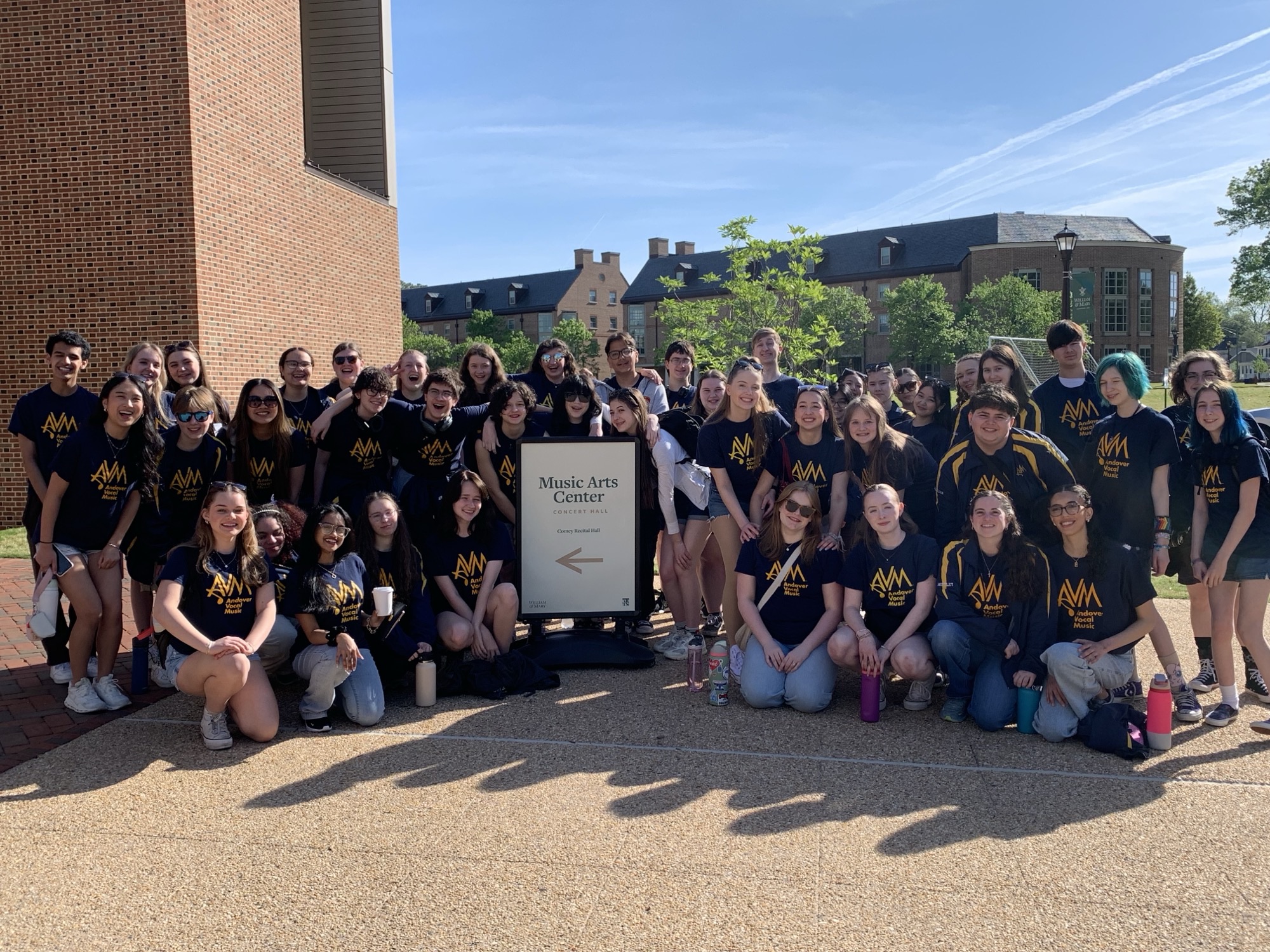
Andover High School’s three show choirs traveled to Williamsburg, Virginia for three days during April Break, to perform and compete, winning first, second, and third place in the show choir category.

On April 24, 44 students and 6 chaperones involved in the AHS show choir program flew to Virginia. They competed on the 25th and attended a workshop with a choral professor before going to Busch Gardens Amusement Park and touring a reenactment of Colonial Williamsburg.

“The competition was not only for choirs, but also for bands, orchestras, jazz bands, jazz choirs,” said Dr. Lauren Peithmann, the show choir director. “In the category of show choir, we won first, second, and third place, which is pretty awesome. We’re happy with that.”

The show choir group Back to Bassics performs their show Weird Science in Williamsburg, Virginia.

“It was cool seeing all of the other choirs, and we got rated really highly.” said Rielyn Leahy, a freshman in Nothing But Treble (NBT), the show choir for high (treble) voices. The other two show choirs are Back to Bassics (BTB) for low (bass) voices, and From Start to Finish (FSTF), a mixed choir for all voices.

Of all show choirs, FSTF placed first, NBT placed second, and BTB placed third. They also placed second, fourth, and sixth, respectively, out of all 27 choirs at the festival. “Also, Grace Lilley (a senior in FSTF) got Best Vocalist of the entire competition, which is a huge accomplishment,” explained Anna Bacchi, a senior in NBT and FSTF.

“We also… did a clinic with a professor at the College of William and Mary. The choral professor there, Dr. Jamie Bartlett, worked with all three of our choirs, which was awesome.” Peithmann said. “It was really lovely to see another person work with the choir directly, give them feedback, and help them to sound even better and do even better in performing.”

While this was their last competition, the show choirs still have two more performances this year. “We have our home show on May 19, which is the last time that we’ll perform our competition sets,” Bacchi explained. “We also have the Alumni Cabaret on June 4, where all the alumni (including the seniors who will have just graduated) are welcomed back to do solos, duos, and small group numbers.”

Show choir auditions for next year will happen on the week of May 19. Email Dr. Peithmann at lauren.peithmann@andoverma.us for more information.

Related Posts

Bubble, Bubble, Toil, Trouble: Failures of Scantron tests
  • May 7, 2026

ADVIKA SINGH ll STAFF WRITER

Are Scantrons a lifesaver or mistake? At Andover High School, the jury is still out. Many favor the quick results, while others say a few filled-in circles doesn’t show what a student really knows. As we keep bubbling in answers, one big question remains: Are we choosing easy grading over critical thinking?

Let’s be realistic: teachers are human. They need sleep and aren’t trying to decipher every student’s chicken-scratch handwriting. For those managing classes the size of a small village, Scantrons aren’t just a tool but a life raft.

“When you have large classes taking large, multiple choice tests, Scantrons can help speed up the grading,” forensics teacher Cole Hauser noted. He suggested the efficiency of the exam benefited both students and teachers: “There’s a quick turnaround on feedback for the assessment. Students are able to see how they did almost right away which can be helpful, especially for students who feel a lot of post-test anxiety.”

In contrast, English teacher Jennifer Percival chooses to skip the bubbles entirely, believing English should focus more on skill development. “I suppose if I gave Scantron tests, feedback would be faster, but I also think … it would be difficult for me to ‘see’ a student’s thinking,” said Percival. “Unless part of the assessment required students to defend their answers, I wouldn’t be able to see the thought process.” 

Furthermore, I believe using Scantrons for subjects such as English and math is unreasonable. English relies on subjectivity and the ability to defend an opinion, none of which is captured by filling in a bubble. Similarly, in math, the process of solving problems is often more important than the answer. When we use Scantrons, we shift focus from critical thinking to luck and accuracy. Education should be focused on our ability to demonstrate intellectual growth and the ‘why’ behind answers, and not centered on a score spit out from a machine.

The subject a teacher instructs often determines the practicality of Scantrons. While many educators appreciate the efficiency they bring to subjects requiring memorization, like science or social studies, freshman Maria Barsegov believes some classes are a better fit for the technology than others. “It’s okay to use Scantrons for social studies because there isn’t solving or thinking, but that it’s unfair to use for math or English,” she observed. In her view, subjects that involve showing work should allow students to demonstrate their abilities.

The student body at AHS is just as split as teachers. While teachers focus on “feedback” and “efficiency” students are more concerned about how the format affects their actual grades. The biggest complaint among students is the lack of partial credit. On a Scantron, you are either 100 percent right or 100 percent wrong.

As a student, I’m familiar with Scantron exams, and to put it bluntly, I detest them. While I empathize with teachers who are tempted by prospects of a lighter workload, these benefits are outweighed by academic costs for students. For struggling students, partial credit is often the line between a C and a D+ or a C+ and a B, and losing that opportunity greatly alters your overall grade.

Junior Adelelaide Buzay found Scantrons stressful. “Scantron tests are efficient but don’t allow room for mistakes. I find them confusing,” she stated. This sentiment is common among students who believe Scantrons to be unfair. An anonymous freshman shared a story about a teacher reliant on Scantron exams: “I have a teacher who gives no partial credit and only does multiple choice and … her tests only have a few questions which makes it harder.” When a test only has ten to twenty questions, each bubble carries a massive weight. Without room for partial credit, students are left distressed.

Despite concerns of fairness and partial credit, the siren song of Scantrons still calls to many. For some, the stress of waiting weeks for a teacher to grade something is more dreadful than the grade itself. Freshman Bhavika Sharma stated, “ I like Scantron exams because the results return quickly.” In a high-pressure environment, this nearly-instant feedback allows students to see their mistakes without the anxiety of a long wait.

It’s ironic for students to be told to think outside the box, when only being rewarded for filling it in. It’s better if a teacher is reading your work because the machine can only see lead marks on a paper, and not the person holding the pencil. A Scantron can’t see the logic, effort, or the ‘almosts’ defining how people actually learn. We’ve built a culture that values convenience over students’ abilities. By handing grades over to a machine, we aren’t just losing partial credit but the most important part of education: growth.

Continue reading
Capstone Pass System Carries On
  • May 7, 2026

JANAESA MACASAET || ARTS EDITOR

Principal Jimmy D’Andrea has confirmed that passes that allow Capstone students to leave campus for research purposes will remain for the next year, denying rumors that they would be completely eliminated. 

Seniors in the Capstone Research class spend the year answering a question through both qualitative and quantitative methods. These passes allow students to leave campus for primary research. They may interview professionals, complete case studies, run experiments, or utilize outside resources such as Memorial Hall Library using these passes. 

Entering the school year, the status of the passes were initially unclear, concerning a number of students. 

“Multiple students have met with me because there were rumors circulating that I wanted to get rid of the CAPS passes, which was not accurate,” said D’Andrea. “I just want to make sure that we knew if a student was leaving, and then making sure that they were getting back.”

According to Capstone teacher Rebecca D’Alise, the passes were under review at the start of the year as school administration and staff worked through logistics. 

“The status at the beginning of the year was ‘To Be Determined,’” said D’Alise. “As a CAPS team, we were asked to work with administrators to make sure that there were strong protocols put into place to make sure that students [were] able to utilize this unique experience while also adhering to school expectations and safety requirements.”

Senior Kari Belson explained that at the start of the year, many students believed they would not have access to the Capstone passes at all. Belson’s project is focused on menstrual health education in elementary schools, which is greatly eased by the passes. 

“For some people, it was an issue to not have those Capstone passes,” Belson said. “A lot of research, especially observational studies, can only happen during the school day.”

After deliberation, passes were later made available, but the delay made it challenging for students such as herself, whose topic is focused on elementary schools, to start their primary research. “It was really important for me to have that opportunity,” she said. 

Other students echoed the idea that Capstone passes are essential. Senior Claire Woodring emphasized that these projects benefit from real-world interaction that cannot be done inside the classroom.  

“If a student can’t continue their research until they do an interview, or something similar that can’t happen in the school building, arguably more time is wasted by Caps students not doing anything in class because they can’t make any progress on their work in the classroom,” Woodring said. 

Woodring added that while misuse may occur, the removal of passes would limit opportunities for meaningful research. “I think it’s important to keep in mind that this is a senior-only class,” Woodring said. “The people taking it are, or are about to be, adults, who are going to have to be responsible for themselves, and a special privilege like the Caps Pass is an opportunity to work on that.”

The passes remain available, with a few changes made to the system. The process to request a pass has not changed—students and teachers have their own personal conversations if there is a need for a pass, often requiring the student to be in good academic standing in the class. 

Otherwise, passes can now only be used during long blocks or last blocks to ensure that students come back to school on time; students must ensure that their interviews are held within safe locations; students must retrieve all of their items before signing out to leave. 

“We just want to make sure that we know where students are and that they’re getting back to school,” D’Andrea said.

D’Alise mentioned that another significant change involves the use of Memorial Hall Library during the secondary research phase. Previously, students were able to use the library for both primary and secondary research—now, passes can only be used for primary research, such as observations and interviews. 

D’Andrea emphasized that the review process was for the system to be improved and for students’ safety to be maintained. 

“I think the program has always been great. I had some questions about the process for the passes, and I think the collaboration with the teachers has been really positive,” said D’Andrea. “I’m a big supporter of the program because I think it’s great to give students an opportunity to do deep research in something that they’re interested in.” 

D’Alise emphasized that the pass system enriches the Capstone course and has lifelong benefits. 

“I would be extremely disappointed to see the [Capstone] pass eliminated from this class as it presents students with the opportunity to develop a number of skill sets beyond primary research, such as maturity, accountability, and responsibility,” D’Alise said. “These are skills that students will need as they leave AHS.”

Continue reading

Leave a Reply

You Might Also Like

Spanish Department to Host Day of the Dead Fair

  • November 12, 2025

Funding the Future of Science: Proposed NIH Funding Cuts Throw US Biomedical Research Into Uncertainty

  • November 4, 2025
Funding the Future of Science: Proposed NIH Funding Cuts Throw US Biomedical Research Into Uncertainty

Student-Hosted Video Game Hackathon Scheduled for Late September

  • September 22, 2025
Student-Hosted Video Game Hackathon Scheduled for Late September

World Languages Coordinator Reflects On Career, Retirement

  • June 9, 2025
World Languages Coordinator Reflects On Career, Retirement

CollegeBoard Scores 1/5 on AP Testing Administration

  • June 9, 2025

AHS Student Directs Coming-of-Age Film, ‘Horizon’

  • June 9, 2025

Discover more from AHS NEWSPAPER

Subscribe now to keep reading and get access to the full archive.

Continue reading