Spanish Department to Host Day of the Dead Fair
  • November 12, 2025

Areeta Faiz || Social Media Editor

A cultural fair celebrating the Day of the Dead will take place during H Block this Thursday in the cafeteria.

The fair will include a variety of hands-on activities, music, and food, allowing students to explore several popular Mexican traditions. The event has been organized by students from the Spanish Conversation Club led by teacher Sylvia Danos and AP Language and Culture classes taught by Indira Garcia. This will be Andover High School’s first year hosting this celebration.

“Students from all world language classes will have the chance to experience one of Mexico’s most meaningful and beautiful traditions,” said Danos.

Stations will include the traditional ofrenda (altar), calaverita (mini skull) painting, papel picado (colorful, decoratively cut paper), the classic Mexican game Lotería, and a chance to try traditional Mexican sweet treats.

Students can participate by signing up for the H3 block with their world language teacher, who will then bring them to the cafeteria where the fair will take place.

“This celebration reflects the values of love, memory, and cultural identity that are central to many Latin American traditions,” said Danos. She added that experiences like this help students appreciate the richness and diversity of the Spanish-speaking world while fostering empathy and global awareness.

Traditionally celebrated in Mexico and other Latin American countries on November first and second, Día de los Muertos honors deceased loved ones through family, music, food, and art. A key tradition is the creation of an ofrenda, or altar, decorated with photos, candles, and offerings to remember loved ones who have passed.

AHS has showcased the student-made ofrendas for the last seven years as a part of the World Language Department curriculum. This year, Danos and Garcia decided to go all out, believing that it is essential for students from other language programs to learn about this celebration.

Danos is excited to see students from diverse language backgrounds come together to celebrate culture, creativity, and diversity: “Enjoy music, crafts, food, and culture, all in one H Block!”

Continue reading
Funding the Future of Science: Proposed NIH Funding Cuts Throw US Biomedical Research Into Uncertainty
  • November 4, 2025

Anushka Dole || Online Editor 

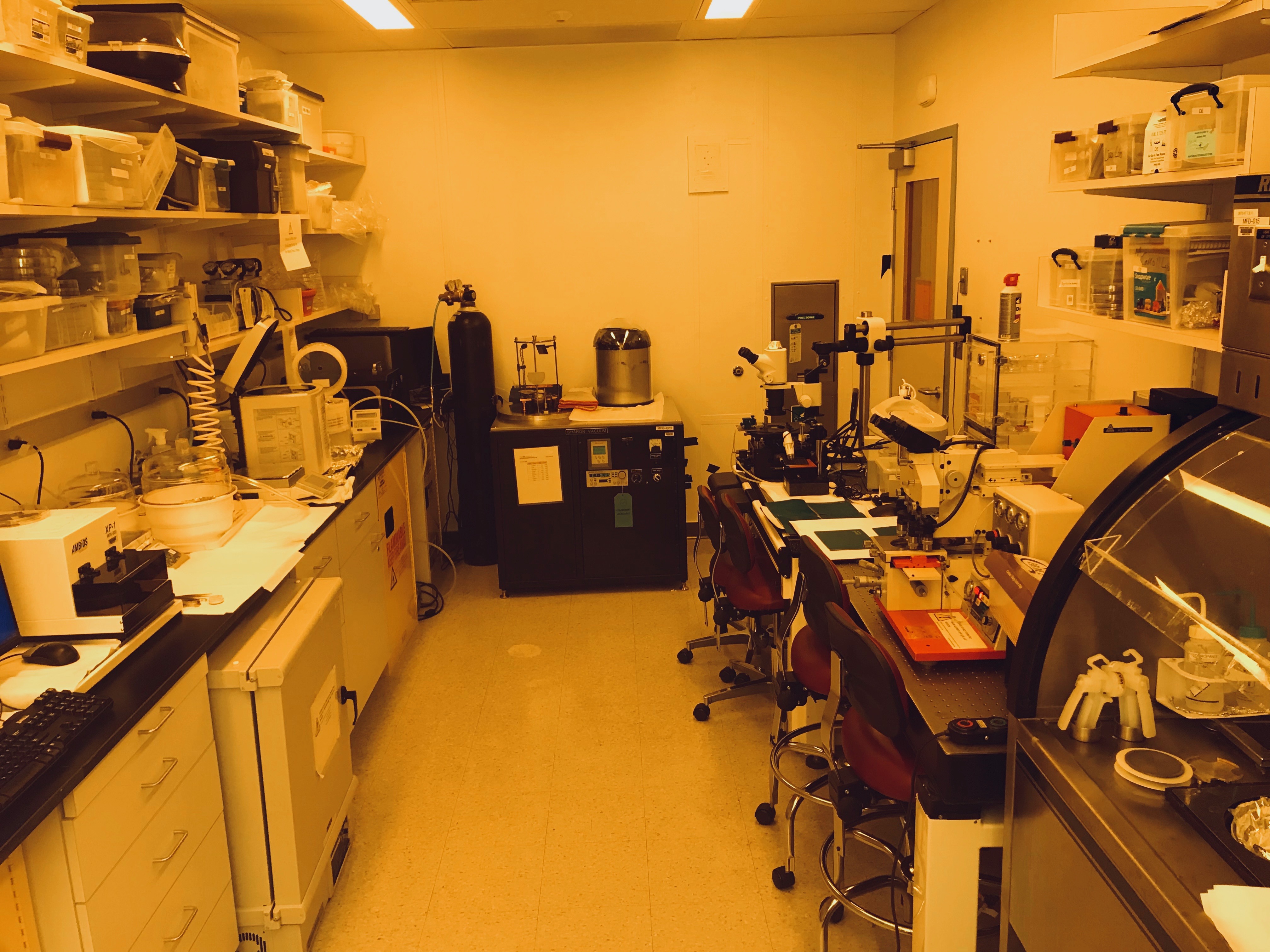
In the sunlit Orkin Lab at Harvard Medical School, lab technicians diligently carry out their experiments, pipetting meticulously into Eppendorf tubes. Next door, in a darkened room, a team of researchers are  huddled around a fluorescence microscope, tracking how gene‑editing tools can restore crescent-shaped red blood cells into their healthy state—a pathway the Orkin team helped pioneer.

Like the Orkin Lab, countless biomedical research labs across the United States engage in lifesaving research every single day. Their research is now in jeopardy. Funding inconsistencies in the National Institutes of Health (NIH), including proposed cuts to indirect costs and the halt in federal funding due to the current government shutdown, threaten to stall progress and could have lasting detrimental effects on both the ongoing research and the communities that rely on it, including Andover.

In April, the NIH cancelled $800 million in grants that it had already approved because the projects didn’t align with the Trump administration’s policies. In July, a federal judge then ruled that the cuts were unlawful, which restored research funding. According to the Boston NPR station WBUR, the US Supreme Court ruled that the NIH can withhold the grants in August.

In addition to withholding the grants, the Trump administration is proposing to significantly reduce funding for “indirect” costs of research, supported by the narrative that the funds “were largely administrative bloat, unrelated to the costs of research.” According to the Harvard Crimson, these indirect funds include costs such as lab construction, research equipment, hazardous waste removal and “countless other very real and necessary costs of research.” For institutions in our own backyard, the impact is tangible: Harvard University stands to lose hundreds of millions of dollars, a blow that could ripple across its affiliated hospitals—including Boston Children’s Hospital, Brigham and Women’s hospital, Dana-Farber Cancer Institute, Massachusetts General Hospital, and many more. Across the country, other US institutions stand to lose billions more.

To fully understand the effects of the funding cuts, it’s important to start at the source: with the research itself. Research is a long, iterative process, full of ideas that start small and experiments that may or may not work. Unlike labs and experiments in school, where the outcome is clearly defined and predetermined, research can be filled with dead ends and uncertainties.

It often begins with something as simple as an idea. Dr. Nathan Crook, an associate professor in the Department of Chemical and Biomolecular Engineering at North Carolina State University, described a project’s start as the moment you first think of a concept, and the end as the moment you stop actively working or thinking about it

“Normally, you or someone in your lab has a flash of insight… at these early stages, you usually don’t have dedicated funding for it,” he said. Early experiments are often small-scale pilot tests that can be supported by seed-funding (typically around $10,000) from the university, or a research foundation. More senior researchers may have access to discretionary funds – “rainy day” funds to use on early projects that aren’t bound by any specific research question.

Dr. Sara Smaga, an AAAS Congressional Science and Engineering Fellow and former Executive Director at the NSF Center for Genetically Encoded Materials, added that this initial stage is the beginning of a longer iterative process.

“In academia, faculty choose what topics they want to study…often a student will collaborate to design their project within their advisor’s topic area,” she explained. “The results of each experiment generate new questions, leading to further hypotheses, even if the initial result is ‘nothing happens!’”

Each experiment can quickly expand into multiple interconnected projects. Each project requires more resources, which are obtained by funding, typically in the form of research grants.

“Let’s say the pilot test goes well, and you get some interesting data,” Crook said. “You will then likely apply for a ‘normal’ research grant using those results as preliminary data. Usually the cool projects are kind of crazy, and the grant reviewers won’t believe that you will be able to do what you are proposing unless you have some sort of proof-of-concept that it is working.”

These grants can come from a variety of sources, including private foundations (such as the Gates foundation or the Chan Zuckerberg Institute), federal funding, internal university funding, state grants, or industry funding. 

“Generally, a Principal Investigator (usually the senior faculty member overseeing the lab), will craft a proposal describing what they’d like to study and why, and submit to a funder,” Smaga said. “After submission, proposals are reviewed by a panel of experts in the field, who evaluate each proposal for feasibility and impact. Not every proposal is funded, and sometimes it takes multiple tries to write a proposal that gets chosen for funding.”

If a proposal isn’t funded right away, researchers often continue the project on the side, refining their ideas and re-applying for grants until they can secure official funding. Once secured, labs can expand, hire more researchers, and pursue the project in earnest. Ultimately, the most significant source of funding for research projects—especially in academia—comes from federal funding, typically the NIH.

“Most of the funding in every lab I’ve ever been a part of has come from federal funding,” Smaga said. Crook agreed, stating that “the most important [source of funding] by dollar amount, are federal grants,” and that “federal grants have funded 77 percent of the research in [his] lab.”

This reliance on federal support means that any disruptions in the grant cycle—whether from delays, government shutdowns, or the proposed cuts to indirect costs at agencies like the NIH—can ripple far beyond the walls of a single lab, outpouring from academia to industry, and eventually, impacting the lives of citizens. The money from NIH funding is a key part of funding early-stage projects, like projects being worked on by Smaga and Crook, laying the foundations for industry to develop novel therapeutics. 

“Just one example: NIH-funded research on bacterial immune systems gave us gene editing, which is now being used to cure sickle cell and rare genetic diseases,” Smaga said.

Jackie Thompson, who works on targeted cancer treatments at Takeda Pharmaceuticals in Cambridge, agreed. “My current work involves developing cell and gene therapies for cancer,” Thompson said. “These treatments rely on decades of foundational research…that was often NIH-funded.”

For communities like Andover, where students and educators are deeply connected to Massachusetts’ vibrant research ecosystem, those losses hit especially close to home. Sarepta Therapeutics, a biotechnology company with an office in Andover, develops gene therapies that depend on the same fundamental research NIH grants have long supported. 

At AHS, the BioBuilder club gives students hands-on experience with synthetic biology research, and the opportunity to work on projects that can be published in a student research journal. While BioBuilder opens doors for aspiring scientists, those doors exist within a larger research ecosystem that relies on consistent federal funding.

“It’s not something that you can just reinstate the funding and think that things are going to pick up as normal,” said Dr. Lindsey L’Ecuyer, the advisor of Andover High School’s BioBuilder club. “When people set up a lab somewhere else, they’re not coming back… it’s going to make it really hard for us to come back from that.”

L’Ecuyer sees the loss trickling down to high school classrooms, mentorship programs, and the students who might have been inspired to pursue science in the first place. “It feels like we’re losing a whole generation of people that would be coming to do research in the U.S.,” she said. “America has been a leading country in scientific research, and it’s going to make it really hard for us to come back from that.”

Crook agreed. “Other countries certainly aren’t reducing research funding, and guess where top scientists—even US citizens—will go? It really hurts our country’s economic…and actual…security to reduce research funding.”

Smaga also worries that America could lose a generation of scientists, and she’s already seen the early signs. “This past cycle, we saw graduate programs responding to funding freezes and future funding uncertainty by admitting fewer students,” Smaga said. 

Biomedical research supports far more than scientific discoveries and the university labs that make them: according to the nonprofit United for Medical Research, every dollar of NIH funding generates about $2.56 in economic activity. The stakes of losing consistent funding are clear in places like the federally funded Orkin Lab at Harvard, where gene-editing research is already transforming lives. The lab is a clear example of how federal support fuels the discoveries that save lives, and it continues to inspire students and scientists to pursue the next breakthroughs. 

“It’s a challenging time to be in biomedical research, but I’m still optimistic about the field,” Thompson said.

“For students who want to get into science, the advice is simple: start early, get involved, and follow the questions that excite you,” she said. “Even sending an email to a professor whose work interests you can open doors. Despite the obstacles, the next generation of scientists has a real shot at making a difference—and it could be your curiosity that drives the next big breakthrough.”

Continue reading
Student-Hosted Video Game Hackathon Scheduled for Late September
  • September 22, 2025

Anushka Dole || Online Editor

Daydream Andover is a two-day hackathon for high school students that will be held at Merrimack College on September 27 and 28, with prizes available for the winning teams. 

At a hackathon, students come together to code a project over a short period of time. Daydream is a game-jam, which is a subcategory of a hackathon, where students will collaborate to create a video game during the event.

The hackathon is being organized by a team of three students, AHS seniors David Shi and Jessie Wang, as well as Emily Fang, a senior from Phillips Academy. Designed to be beginner friendly, Wang, Shi, and Fang are hosting workshops for beginners during the event to give them the tools they need to build their projects.

“We’ll teach them how to make a project on Godot, one of the simplest languages to make a game… we run workshops, and then we let them code,” Wang said. She added that artists and musicians are also encouraged to come to Daydream, as their contributions are essential to designing a game.

The first day of Daydream runs from 10am to 8pm, and students are encouraged to start their games the moment they arrive. Teams of up to four people are allowed, and team selection can happen at any time during the event. Each game will follow a set theme which will be announced on the day of the event.

“We get to pick one out of the ten themes that are sent to the organizers, but those haven’t been released [to the public] yet…basically, it’s a mystery,” Wang said.

Amenities will also be provided for coders during the events, including lunch and dinner on both days. There will also be prizes for the top three teams after being judged by the organizers. 

Wang, Fang, and Shi all came together to host the event out of a shared passion for hackathons, bringing Daydream to Andover by working through the California-based nonprofit Hack Club. 

“We had the best time ever [at Shipwrecked, a hackathon held at Cathleen Stone Island]. I met friends that I never thought I would meet… [hackathons] opened my mind to new ideas, it’s a very valuable experience,” Wang said. 

Shi agreed, adding that “you get to learn how to build a lot of cool things, and make lasting connections.”

When asked what they hope students will gain from the event, Fang stated that she simply hoped that they would “gain a new friend,” as well as get their foot into the “doorway into programming.”

Daydream is accepting sign-ups until the day of the event, at this link.

Continue reading
World Languages Coordinator Reflects On Career, Retirement
  • June 9, 2025

Avery Slaughter || STAFF WRITER

Peter Hall, program coordinator of World Languages at Andover Public Schools, is retiring this coming September. Hall has been working in the district for 35 years.

Hall’s career at APS commenced in 1995. Over the span of 27 years, he taught both French and Spanish at levels ranging from beginner to Advanced Placement before transitioning into the role of program coordinator in 2022.

Overall, his experience at APS has been a positive one.

“I am fortunate to say that I have enjoyed my years here,” said Hall. “I have had a lot of wonderful students who make each year a little different. […] It’s been a lifetime of memories and experiences.”

Over the years, Hall has worked with students in and out of the classroom in an effort to inspire interest in other cultures. His passion for foreign languages began in middle school, and he has since strived to share that enthusiasm with others. Hall traveled with students to France seven times as part of the French Exchange Program and led the Spanish Exchange Program trip once. Additionally, he chaperoned numerous other international trips offered by APS.

“As a language teacher it has been my passion to share my love for travel and learning about other cultures with students,” Hall said. “It provides an opportunity to get to know students outside of the classroom and broaden their perspectives on the world.”

Watching students grow as people throughout trips abroad has been one of his favorite parts of his job, Hall said. 

Moreover, his years of teaching have defined who he is as a person. Much of who he is has been shaped by his career in teaching, explained Hall. He plans on taking that educational mindset with him into the future.

Hall’s positive impact on the World Language Program hasn’t gone unnoticed by teachers who know him. Between his contributions to the various programs offered by the department, years of teaching multiple languages, and guidance as program coordinator, he will be missed in retirement.

“I think he’s a great person,” Spanish teacher Teresa Peralta said. “It’s hard for us to let him go, but I think each person has a mission and I think he’s ready [to retire]. We want to say thank you for all the work that he has done, and for teaching us as well.”

Continue reading
ESIC Students Bring Youth Sustainability Fair to life
  • May 20, 2025

Janaesa Macasaet || STAFF WRITER

The second annual Youth Sustainability Fair was held at the Cormier Youth Center on Saturday, April 26. Organized by seniors Lincoln Pekock and Sarah Waters, the fair aimed to promote youth work in climate activism.

With around 200 attendees, the two-hour fair included a sports gear swap, toy swap, clothing swap, and interactive booths. Pekock and Waters organized the fair through the Environmental Sustainability Internship Course (ESIC), partnering with Andover WECAN. Science teacher and ESIC advisor Melanie Cutler found the experience to be hopeful.

“Often when we hear about climate change, we hear about the bad news,” said Cutler. “The point of this fair is to share all the good news. There are a lot of great things happening right here in our community that I think a lot of people don’t know about.”

Apart from ESIC students, members of the Environmental Club, Garden Club, Fashion Club and AP Environmental Science students attended. Those from organizations and surrounding schools such as Phillips Academy and Greater Lawrence Technical School also came, offering new insights to AHS students. 

High school, middle school, and elementary school students at the fair

“It was impactful…it’s great to see new ideas, new perspectives. There were ways for us to improve that were mentioned,” Grant Gaden, a sophomore and Environmental Club booth volunteer said. “It was great to meet people who had similar interests, who brought new ideas to the table that I hadn’t considered when it comes to sustainability.”

Sharing a similar sentiment, Pekock said, “It was really great to get to see into the middle school and elementary school education system [and] how they teach about climate change and things such as that.”

The fair opened the floor to people of all backgrounds to discuss sustainability—among them was Massachusetts State Representative Tram Nguyen, who presented to attendees. 

Cutler said, “She came and gave a nice moving speech…and was really encouraging…she’s now working [at a] state government level on a lot of sustainability initiatives.” 

For students interested in climate activism, ESIC offers a range of opportunities, whether it be planning the Sustainability Fair or writing articles for a non-profit. The course encourages students to use their skills to make a real-world impact. Waters aims for her and Pekock’s project (the fair) to have created a positive impact in the community, and reduce worries. 

“I’m sure there’s a lot of climate anxiety, especially being in Massachusetts where there is a lot of recognition for it, but I would hope that people gain some hope just to see how many initiatives there are,” said Waters.

Continue reading
Show Choir in VA over April Break
  • May 15, 2025

Clara Strong || STAFF WRITER

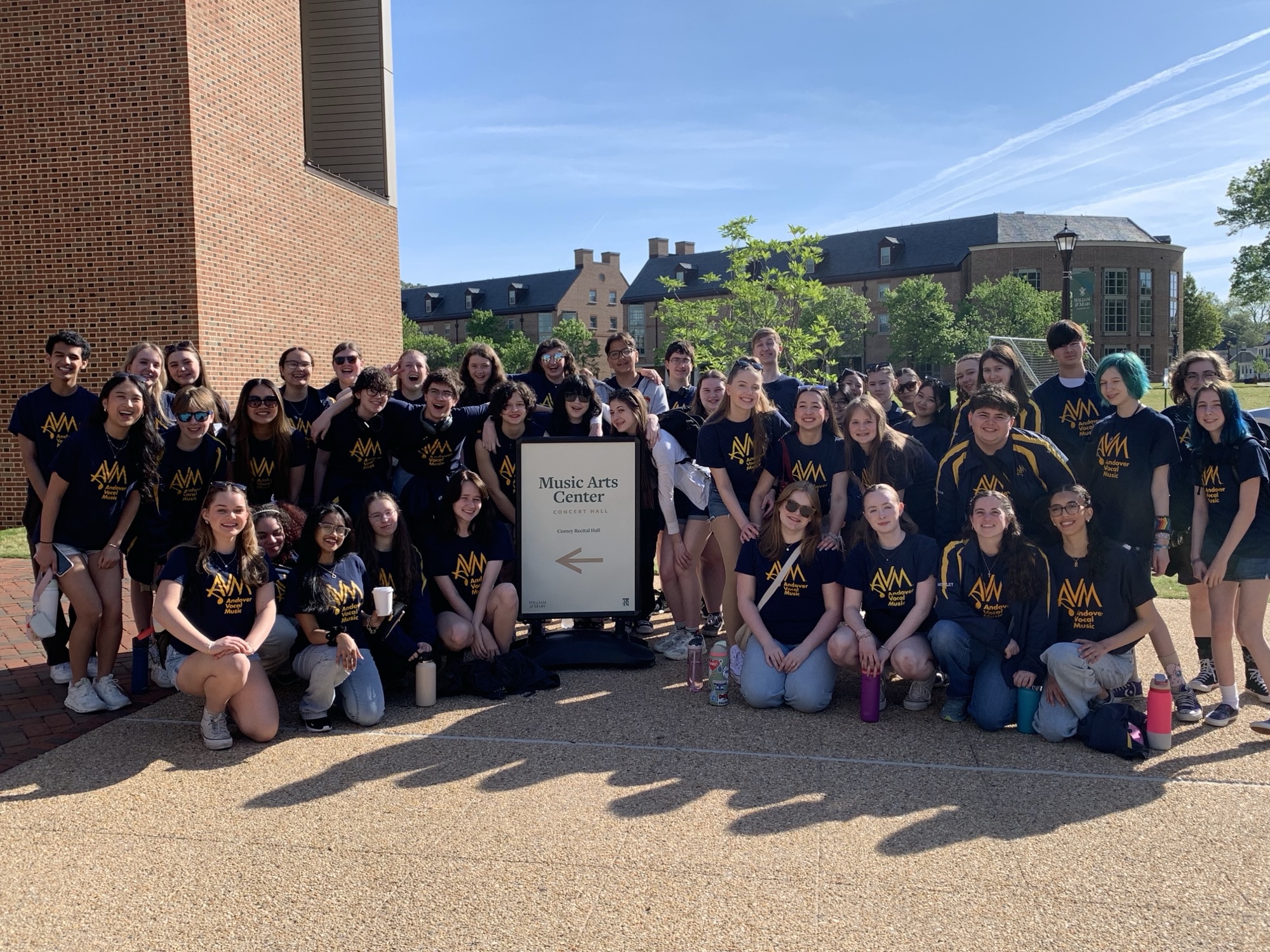
Andover High School’s three show choirs traveled to Williamsburg, Virginia for three days during April Break, to perform and compete, winning first, second, and third place in the show choir category.

On April 24, 44 students and 6 chaperones involved in the AHS show choir program flew to Virginia. They competed on the 25th and attended a workshop with a choral professor before going to Busch Gardens Amusement Park and touring a reenactment of Colonial Williamsburg.

“The competition was not only for choirs, but also for bands, orchestras, jazz bands, jazz choirs,” said Dr. Lauren Peithmann, the show choir director. “In the category of show choir, we won first, second, and third place, which is pretty awesome. We’re happy with that.”

The show choir group Back to Bassics performs their show Weird Science in Williamsburg, Virginia.

“It was cool seeing all of the other choirs, and we got rated really highly.” said Rielyn Leahy, a freshman in Nothing But Treble (NBT), the show choir for high (treble) voices. The other two show choirs are Back to Bassics (BTB) for low (bass) voices, and From Start to Finish (FSTF), a mixed choir for all voices.

Of all show choirs, FSTF placed first, NBT placed second, and BTB placed third. They also placed second, fourth, and sixth, respectively, out of all 27 choirs at the festival. “Also, Grace Lilley (a senior in FSTF) got Best Vocalist of the entire competition, which is a huge accomplishment,” explained Anna Bacchi, a senior in NBT and FSTF.

“We also… did a clinic with a professor at the College of William and Mary. The choral professor there, Dr. Jamie Bartlett, worked with all three of our choirs, which was awesome.” Peithmann said. “It was really lovely to see another person work with the choir directly, give them feedback, and help them to sound even better and do even better in performing.”

While this was their last competition, the show choirs still have two more performances this year. “We have our home show on May 19, which is the last time that we’ll perform our competition sets,” Bacchi explained. “We also have the Alumni Cabaret on June 4, where all the alumni (including the seniors who will have just graduated) are welcomed back to do solos, duos, and small group numbers.”

Show choir auditions for next year will happen on the week of May 19. Email Dr. Peithmann at lauren.peithmann@andoverma.us for more information.

Continue reading
Social Media Marketing Class Plans Snack Shack Raffle in AHS Media Center
  • May 14, 2025

Christina Saad || STAFF WRITER

The media center hosted a raffle on April 19 with a prize of five Snack Shack tickets. The raffle was planned by students from art and business education teacher Meghan Michaud’s Advertising and Social Media Marketing class. 

Three students from the class, junior Sophia Call, junior Sam Archiable, and sophomore Ellie Linehan, planned out the Snack Shack event. The prize winner for the raffle was Kai O’Sullivan.

Michaud’s original assignment was to break into small groups and develop a series of posts around a theme the group chose, which were then posted on the media center’s Instagram along a two-month timeframe.The goal of the assignment was to increase the library’s Instagram page from 700 to 1,000 followers. 

“I felt like it was a good idea for students to have some real-world application of how to use the skills that they were learning in Advertising and Social Media Marketing,” said Michaud.

Students first did an analysis of the library’s Instagram account to look at what kind of followers it had and ways it wasn’t achieving its goals.They also did a competitor analysis of other library and book-related pages to see what kind of content they were producing. The class met with library staff and looked at data the library had about the number of books in the collection and what genres of books students gravitate towards.

“We looked at some real data and they asked questions, treating the library as a client, as they would in a professional relationship,” Michaud said.

The class decided on what their content would like and what would be their brand colors so there was a consistency in the imaging they were sending out. They developed a two-month calendar plan to increase followers. They have surpassed their goal of 1,000 followers and amassed 1,120 followers as of May 12, and they still have a month left in their calendar.

Students said that one of the things that motivates students was getting breakfast and going to the Snack Shack. Call, Archiable, and Linehan looked at Instagram models where the way to enter some sort of contest to win a prize was to like and follow the page. They thought about what would be an incentive for students to win that was easy and achievable to access, and decided that the Snack Shack would be a great incentive for students to like and follow the Instagram page.

“My group’s thought process for choosing the raffle was trying to figure out some way in which we could get the whole school participating and excited about,” said Archiable.

The group looked where students were viewing other types of media to get them to check Instagram. They created and posted flyers all around the school, did announcements over the loudspeaker, and had a feature on AHSNews.

“We tried to post as many [flyers] as possible around the schools, as well as setting them up as 

‘art’ in the hallways,” Archiable said.

They also worked with staff in the cafeteria and the Food Services Department to secure a prize.

Continue reading
New Sophomore APs to Be Introduced in Fall of 2025
  • May 6, 2025

Avery Slaughter || STAFF WRITER

Andover High School recently announced two new courses being offered next fall, AP Seminar and AP Government. AP Seminar will take the place of the combined sophomore English and history class.

Both of the new classes are open to sophomores, making them some of the first APs for underclassmen. AP Government will be open to juniors and seniors as well, whereas AP Seminar is being implemented exclusively for sophomores. It will replace Modern World Studies, which combines the Modern World History and English 10 curricula into one larger joint class. Students and staff alike have expressed confusion as to how AP Seminar will be managed.

Though the name is being used to describe the new collective class, AP Seminar is formally the title of the English class and Modern World Studies is the name of the History class, though the latter is colloquially used to refer to the current combined course as a whole. While AP Seminar will be taken as an Advanced Placement class, students have the choice to take Modern World Studies for an Honors or College Prep credit.

It’s important to note that AP Seminar, which is an English course, is not exactly the same as English 10. Fundamentally rooted in developing research skills, the curriculum follows a slightly different path than its sister English course while still covering similar topics. According to the College Board’s description, “in AP Seminar, you choose real-world or academic topics to investigate. AP Seminar teaches you how to find and use evidence from experts, and how to present the case from your own perspective effectively, both through writing and multimedia presentations.”

“AP Seminar is a course designed to develop students’ skills in research, analysis, and communication,” Sara Sympson, a representative from College Board, said. “It encourages critical thinking and collaboration, preparing students for college-level work. The course can be organized in a variety of ways to best address student interests, state and/or country and district goals and requirements, and local school traditions and culture.”

Despite the new title, AP Seminar will not be changing much when compared to Modern World Studies. Michael McCarthy, advisor of the Social Studies program in Andover Public Schools, explained that the class will remain nearly identical to its predecessor. Stacy Giggie, program advisor for the English program for grades 6-12, agreed. There will be little change in the overall curriculum, but some of the learning material and assessments will be altered to match the newfound AP-level difficulty of the class.

Modern World Studies and AP Seminar cover important and sensitive topics, and it’s important to ensure they are both prioritized equally. When asked if he was concerned about one subject being emphasized over the other, McCarthy said, “Yes, a little bit, but I’m very confident that the teacher who is teaching it will ensure that the skills we value will be taught.”

AP Government will be offered as a full-year elective like many other APs at AHS. Given the importance of understanding the government as an American citizen, McCarthy suggested that it would be a valuable addition to the course offerings for students.

“We want students to be active citizens, to understand the local government, their state government, their federal government, and to see the government as agents of change,” McCarthy said.

Continue reading
The Underclassmen’s Race to College
  • May 6, 2025

Andover High School’s AP restrictions called into question by students, graduates

Avery Slaughter || STAFF WRITER

By the time the Class of 2028 first stepped foot in the lobby of Andover High School, it was abundantly clear that Advanced Placement courses were going to be off-limits for a while. During the student orientations that had occurred in the months previous, they had been told they weren’t ready for classes of such rigor; they weren’t mature enough and would have to wait until they were juniors to handle a responsibility so vast.

The rule barring APs seems innocent, but for some freshmen and sophomores, it is a cause of great stress. “After high school” is a concept that hopeful college prospects begin to consider as early as elementary school, and the inability to maximize APs as soon as ninth grade can be concerning with that in mind. That being said, the reasoning and logic behind the restriction is sound—how could underclassmen manage the workload and intensity of college classes, given the well-known academic difficulty of APs? Despite the good intentions, is it possible the act of minimizing that stress inadvertently causes more?

It’s important to note that two new APs are being introduced in the fall of 2025. These two courses include AP Seminar, open exclusively to sophomores, and AP Government, open to grades 10-12 (see sidebar for more details). AP US History and AP Java Programming was also made available to sophomores this year. These four courses are the only APs typically offered before junior year, though infrequent exceptions are made for students who demonstrate advanced proficiency in math and/or computer science.

For Shauna Murray, the question about APs is a loaded one. Working as both a high school teacher in New Hampshire and a School Committee member in Andover Public Schools, she’s deeply involved in the lives of students. Murray noted that the rules regarding APs and general course restrictions are not decided by the School Committee and are instead up to the discretion of the guidance department. The College Board also does not have a say in how the classes are run in individual schools beyond the administration of the AP exams. (Multiple attempts to reach Aixa de Kelley, coordinator of the guidance department, by email were unsuccessful.)

“I think there are some kids that are ready, but it’s really a student-by-student basis,” Murray said. “It’s tricky because you know the requirements are there for a reason, but maybe it could be a little bit more flexible.”

Current AHS students have varying opinions. Sophomore Connor McGovern expressed frustration with the policy and its possible implications on his future. He worried that his college chances were slimmer compared to future graduates of other schools with more lax restrictions and that ultimately it would damage his experience after high school.

“I think [the rule] probably does [hurt my chances],” McGovern said, “and you could also shorten the amount of years you have to take in college if you take a lot of APs in high school. I think about that.”

Canyu Li, who has eight APs under her belt as a senior, had an opposing view. She wondered if the stress she would have felt as an underclassman would have been insurmountable had she had the option to take APs, though she acknowledged that, when she was younger, she did wish to take them. Ultimately, she thought that the downside to taking these courses early on tends to outweigh the benefits, especially with college admittance in mind. She explained that, in her experience, colleges often compared you to other students in your school to ensure fair consideration in the admission process.

Many people were inclined to agree with that assessment, though former college admissions officer Jayne Jones suggested it was a bit more complicated.

“It all depends,” said Jones, now an AHS guidance counselor. “It depends upon the student, the college, and many other factors that make up a decision for admissions. Some more selective colleges want to see several AP classes, and less selective colleges may want to see a few APs, and still other colleges may be fine without any APs.”

While the freshmen at AHS were acclimating to the environment of the school this past fall, Diya Ganesh exited the bus she took from her lab at Northeastern University to her dorm. Having graduated from AHS in 2023, she had recent experience with how the AP restriction impacted her college experience. She took six APs herself, and she recognized that she was at a disadvantage in terms of college credits compared to her classmates, who had AP counts ranging from eight to twelve.

Jordan Altaffer, 2017 graduate of AHS and family friend of Ganesh, agreed at that moment. Though he had recently concluded his time at Georgia Tech, the toll his shortage of AP credit hours had taken was still present in his life. In addition to an increased amount of time filling his degree course requirements, taking more courses was financially inconvenient.

“If I had been able to take more [APs], I could’ve skipped my [college] freshman English classes and my freshman history,” Altaffer said. Not taking those courses would have both cut an entire semester from his college experience and minimized the cost of his classes.

Ganesh had similar sentiments. “People that are graduating sooner tend to get a higher priority in picking classes. […] I cannot emphasize how helpful having those credit hours ahead of time are,” she said.

The question of whether or not freshmen and sophomores should be able to take APs brings to light what Murray considered a larger social problem. How can high school students possibly have enough time in their lives to balance such hefty course loads and their own personal health? According to her, the “race to college” represents the flawed values in our society. Instead of prioritizing the well-being of students during the transition to adulthood and independence, we drive students to overwhelm themselves with academics to fulfill arbitrary requirements for further education.

“One of the things that is happening in society is that we’re pushing kids way too hard,” Murray said. “It’s just this vicious cycle of wanting to do more and wanting to achieve more.”

Continue reading
AHS Spring Show Announced: Selection Process Revealed
  • May 6, 2025

Janaesa Macasaet || STAFF WRITER

Andover High School’s anticipated spring production has been announced to be You’re A Good Man, Charlie Brown. Susan Choquette, Director of Theatre Arts, revealed the process of selecting a production. For the spring show, whether a musical or play is chosen is dependent on several factors, including the results of the Drama Fest. 

Preparation has recently begun, with the show taking place mid-May. The Theatre Guild always produces a musical in the fall, and a play for Drama Fest—an annual competition between schools—in the winter. The spring show, however, can either be a play (10-minute, one-act, Shakespearian), or a musical, which is largely impacted by the results of Drama Fest.

Kai Cruz, a senior who has been in the Theatre Guild for four years, said, “I think that making it to finals, because it extends so much of our time in the Theatre Guild to focusing on the festival, eats into some of the time that we have for the spring show.”

Time constraints for the spring show not only include time from the Drama Fest, but also time taken away due to the Collins Center being rented out almost every weekend to dance companies. Licensing and budget also play a role in the choice, with musicals costing more for royalties and the rental of orchestra scores each night. 

In general, however, Choquette approaches her process of choosing a production with a four-year cycle, where a different type of play or musical is done each year to ensure students of each grade experience a variety of shows. 

“I want them to look at the list of shows that they have participated in and look at a very diverse list,” said Choquette. “I feel that’s my mission as an educator—to make sure that kids get lots of exposure to different kinds of theater.”

Choquette also looks for different themes and messages when choosing a production. When dealing with more serious topics, the administration’s approval is always taken into account, though it has rarely been an issue.

“Our administrators have always been super supportive…. One of my mottos is if we can talk about it in health class, we can put it on the stage. If these topics are not forbidden in our health and wellness classes, then we should be able to tell stories that involve those themes,” said Choquette. 

Choquette also aims to choose productions that best fit with the Theatre Guild, and make changes when necessary. In the fall production of Into The Woods, roles were added to the story, though a few actors were cut, which is not a common occurrence. 

“There haven’t been many changes to how productions are run lately… They only really cut people once every ten years or so,” said Anna Bacchi, a senior in the Theatre Guild. “I don’t have many things that I would change because I think our creative team does a really good job with running things.”

While students are not directly involved in the decision-making process, they are able to make suggestions. For the seniors, the spring show is more than their typical production. 

“This spring is a time for celebrating, and for the graduating seniors, it’s their last show, so it’s always just a bittersweet moment, but I think that this spring show is sort of the culmination of everything that we’ve done as a guild together,” said Cruz.

Continue reading