CollegeBoard Scores 1/5 on AP Testing Administration
  • June 9, 2025

“Once you enter the start code, you may begin.” With these words, hundreds of AP Psychology students at AHS expected to start their AP exam. Instead, they were greeted by a laggy, glitchy BlueBook testing app that refused to cooperate. For the students who were unable to coax the app into functioning, the exam was delayed to May 21—a poor solution for students who spent a whole year preparing for that moment. 

We at ANDOVERVIEW believe that the fragile testing infrastructure of CollegeBoard is absolutely unacceptable. One would assume that a nonprofit organization that claims to be “paving the path for college success” would ensure that its testing platform relies upon servers that are able to handle the increased traffic on testing day. CollegeBoard provided very little consolation to the adrenaline-crashing students. “Most students have had a successful testing experience, with more than 5 million exams being successfully submitted thus far,” the organization defended. The statement was tellingly short—PR representatives at CollegeBoard couldn’t be bothered to devote any longer than a five-minute coffee break to drafting this “apology.” 

Unfortunately, technical glitches are not the only issues that CollegeBoard has encountered this AP season. After a slew of hate comments were slung in author Namwali Serpell’s direction, she discovered that the vitriol was directed towards one particular passage in one of her books. The infamous “Look at Me” passage was recognized by this year’s AP Lang students as an indecipherable jumble of content followed by some seriously difficult multiple-choice questions (MCQs). After learning this, Serpell revealed that CollegeBoard had included the passage in the test without her permission and distorted its meaning in the MCQs that followed. Adding insult to injury, Serpell also clearly stated that she was against standardized testing as a concept. As of late May, CollegeBoard had yet to address these comments.

The negligence of CollegeBoard has created a sorrowful state of affairs for those looking to take advantage of the benefits of AP courses and exams. To no one’s surprise, the corporatization of education has introduced far more harm than benefit to all involved. We can only hope that CollegeBoard will hear and fix some students’ criticisms.

Continue reading
Oval Office Showdown: Trump’s Diplomatic Disaster
  • May 1, 2025

ANYA GOROVITS || STAFF WRITER

“I think we’ve seen enough. This is going to be great television.” 

With these words, President Trump concluded February 28’s disastrous meeting with Ukrainian President Volodymyr Zelenskyy—a meeting that was intended to strengthen alliances but instead heavily damaged them. Taking place in the Oval Office, a room representing utmost diplomacy, decorum, and statesmanship, the meeting was anything but diplomatic.

Zelenskyy arrived in Washington, D.C. on the morning of February 28. He then met with Trump, Vice President JD Vance, and other US government officials. Reporters from all over the world were also present, bombarding the presidents with questions throughout the meeting. The leaders aimed to discuss continued US support for Ukraine, establish plans on ending the war, and agree on a US mineral deal on Ukraine’s resources. However, the meeting was far from productive, with Trump quickly launching a personal attack against Zelenskyy, Ukraine, and former President Biden rather than trying to stop the war. 

“It was appalling seeing supposedly the leader of the free world, the most powerful person in the world, act like a little child,” expressed half-Ukrainian sophomore Armand Omelko. The end of the meeting was so full of interruptions and insults on Trump’s part that it indeed sounded more like children fighting than a discussion among the highest officials of two nations. Not only was Trump constantly interrupting his guest, but he actually yelled at Zelenskyy for trying to speak about his own country’s opinions. 


“You don’t have the cards right now” was the catchphrase Trump repeatedly used to interrupt Zelenskyy. While speaking to a person tasked with one of the most difficult careers, the president of a country at war, Trump called Zelenskyy’s job a game of cards. 

The meeting started off all right, with the presidents calmly answering the press’s questions. Yet things began to escalate when Republican reporter Brian Glenn asked Zelenskyy why he didn’t wear a suit to the meeting. The disrespect of such a question is unbelievable. Not only is there a valid reason for Zelenskyy’s outfit—in the duration of the war, the president has been wearing army attire to show support for his military—but the question seems incredibly hypocritical considering how US government official Elon Musk has, on numerous occasions, worn very informal attire to the Oval Office.

What I don’t understand is why the international press was at the meeting in the first place. The conference was meant to decide the outcome of millions of lives, which doesn’t seem like something that should be showcased to the entire world. 


“I was horrified by what I was watching. I just couldn’t believe this was playing out in front of cameras in the Oval Office,” said AHS history teacher Kathryn Vives. 

It is obvious that Trump simply wanted to humiliate Zelenskyy. As seen in Trump’s quote about making “great television,” he only wanted more attention for himself. “He just wants to be seen on the news, not to actually accomplish anything,” Omelko said.

Yet the most disrespectful comment came from Vance when he asked Zelenskyy, “Have you said thank you once?” He then attacked Zelenskyy for not being grateful for the US’s aid, which is false. According to UNITED 24, the official fundraising platform of the Ukrainian government, Zelenskyy has publicly thanked the US at least 94 times in speeches and social media posts. Yet Vance still demanded that Zelenskyy thank Trump over and over. When Zelenskyy tried to return to the subject of fixing the war, Trump interrupted him with “No. You’ve done a lot of talking,” as if he was shutting down a child’s remarks and not a president’s. 

“They want him to grovel,” said history teacher Lauren Ream, who was also shocked at how Trump and Vance treated Zelenskyy. “We shouldn’t treat any other country like that,” she added. Considering how Ukraine has been a US ally for over 30 years, this treatment is even more disgraceful.

During the meeting, Trump also managed to lie several times, not just to Zelenskyy but to everyone watching. He made multiple false claims about US aid given to Ukraine during the war. Trump first stated that the US had given over $300 billion to Ukraine, when, according to the Kiel Institute, the correct number as of February 2025 is $128 billion, less than half of Trump’s claim. “And he kept referring to it as being stolen,” added Ream. This money was certainly not stolen. The Biden Administration voted and chose to contribute this aid to Ukraine. Additionally, Trump stated that Europe has given $200 billion less in aid than the US has. However, at that point, Europe had given around $258 billion to Ukraine, more than twice as much as what the US had given.

Furthermore, Trump took pleasure in pivoting the conversation to insult previous presidents. He called Biden “a not very smart person,” which doesn’t seem like something one president should say about another, especially during a meeting that didn’t concern Biden. As for Obama, Trump said to Zelenskyy, “Obama gave you sheets. In fact, the statement is: Obama gave sheets, and Trump gave Javelins (missiles). You’ve got to be more thankful because let me tell you, you don’t have the cards.” I think that bit speaks for itself.

Vives connected the meeting to the 1938 Munich Agreement, when the UK and France appeased Germany, letting it take over land in Czechoslovakia, which led to World War II. Trump also hopes to appease Russia by having Ukraine give up its currently occupied land, which could pose a serious danger for the rest of Europe. “This war isn’t just for Ukraine. If Ukraine really falls, who’s to say Russia will just stop there?” said Omelko.

Since this meeting, many nations and people have lost trust in the US. Because of our network of alliances, any war including Russia can pose an extreme danger to the world. Previously, the US and most European nations agreed on this and worked together to prevent the situation from escalating. Yet Trump’s disrespect for Zelenskyy and positive comments about Russian President Vladimir Putin have changed this. “The US isn’t on [Europe’s] side anymore. The US has switched sides,” said Omelko. The meeting has sent a message to our allies that the US can no longer be trusted. “The greater damage has been done to our reputation across the world—that we are not an ally to be depended on,” agreed Vives.

Continue reading
Mental Health at AHS: A Growing Focus, but More Could Be Done
  • May 1, 2025

ABBY CHACHUS || STAFF WRITER

As a student at Andover High School who has encountered and experienced a fair share of mental health struggles, I see the progress that AHS is making when it comes to supporting and understanding students like me. Students and staff are trying to make a difference related to the social-emotional well-being of students at AHS. Whether through the Yellow Tulip Project or the social emotional training that staff are going through, each action makes a difference. At school, mental health is often overlooked or even stigmatized. 

“We live in a very fast-paced society, particularly here in New England, where… most kids are aiming for college, and that brings a lot of pressure,” guidance counselor William Hutchins said. With college preparation, extracurricular activities, and the quest for academic excellence, the weight of expectations on students can feel immense, and many struggle with stress that can be tough to manage. “[As] a whole, we need to do a better job,” Hutchins said, and I agree, in the sense that it’s not just about grades—students are also competing for their futures.

Supporting student well-being depends heavily on the care that AHS staff members provide. I find this to be true—when I feel supported and cared for, I am more likely to be engaged in my learning and participate in class.  “Teachers at AHS are being trained in ‘RULER,’ a nationwide social-emotional curriculum designed to equip staff with tools to help students better handle their emotions,” Hutchins said. ‘RULER’ training is currently being implemented at the middle schools and will soon become integrated at AHS.  While this program may sound promising, its true impact will rely on how effectively it is used by students, staff, and the wider school community.

Despite the introduction of this new training, an obstacle still stands in the way of a strong teacher-student connection—many students often feel bad about reaching out for help. 

“Typically, teachers do care about their students and ask how they’re doing, and we have several guidance counselors,” sophomore Hannah Lang said. “However, I think we need to create a space where students feel more at ease approaching their guidance counselors because many are hesitant.” 

Despite available resources, many still deal with the stigma that surrounds mental health issues, making it difficult for them to seek assistance when needed. Sophomore and Yellow Tulip Project member Savannah Ross believes this stigma must be confronted more directly. “I believe AHS offers a lot of resources for students facing mental health challenges,” she said. “[But] we need to address mental health more openly, as the stigma around it still looms.”

 It’s evident that while resources are in place, the school’s attitude toward mental health needs to be better for students to feel truly supported. I believe Ross is right—we need people to feel comfortable asking for help if we expect our school to give them the support they need. We can’t go into it with the attitude that previously nothing has been achieved in terms of mental health, so nothing will be in the future. Ultimately AHS needs to take the past out of the equation and think about what could be done in the present and future. 

Ross also proposed a thoughtful idea: “We could have speakers come in to educate and raise awareness about mental health. Also, we could have student leaders who could speak out and be recognized as go-to individuals for help,” Ross suggested.

This could bring awareness to the topic, like Ross suggested, but we also have adults like guidance counselors and social workers at AHS to bring awareness and help students whenever they need it for whatever reason.

Jayne Jones, another guidance counselor at AHS, talked about the commitment counselors have towards supporting students, not only academically but also socially and emotionally. “When students come to us as counselors, we collaborate with them to understand what’s happening, whether it’s academic, social, or something else,” she explained. However, as a mandated reporter, Jones also recognizes the importance of teamwork in managing more serious issues, which may involve reaching out to assistant principals, social workers, and families when necessary. This should not scare students away from asking for help; in the long run, all these amazing adults and student leaders want to do is help people feel comfortable in school. Whether the issue is inside of school or not, don’t be afraid to reach out because sometimes external issues can still affect students in school.

Addressing mental health issues while we, as students, are still in school can lead to better long-term outcomes for students, including improved social skills and overall well-being. As someone who has experienced mental health issues, I find this to be true because I have become more socially comfortable as my anxiety in school has lessened. 

I believe AHS is on the right path, but the conversation around mental health is far from over. For the efforts to reach their full potential, the work of “smashing the stigma,” building trust, and creating a supportive environment must continue. As Hutchins said, “We need to do a better job.”

Continue reading
OPINION: Time to Ditch Test-Optional Policies
  • December 13, 2024

By Luka Oatman
STAFF WRITER

Test-optional college applications sound like a dream. Applying to your first-choice school without having to submit an SAT or ACT score is enticing. It feels nice not to worry about taking a test for your application. Realistically, though, students everywhere fall victim to the negative effects of this newly developed procedure.

Test-optional applications gained popularity during the COVID-19 pandemic. They were introduced as an option for students who were unable to take standardized tests due to the global restrictions at the time. Although test-optional policies were expected to be a temporary solution, they have since remained as an alternative for applicants who feel less confident in their test-taking abilities and wish not to declare their scores. What some students fail to recognize, though, is that in many cases it is more harmful than beneficial to withhold their scores when applying. In fact, it is often helpful to include an ACT or SAT score in situations where the applicant is uncertain.

The primary issue with test-optional applications is that their academics are more heavily scrutinized than those with a test score attached. William Hutchins, a guidance counselor at AHS, said, “What I usually say to my students is that if a school is test-optional, then other aspects of your application, such as your college essay, become more important.” The lack of a score gives admissions officers one less area of focus and increases the importance of a student’s transcript, admissions essay, and supplemental essays. Applicants are told that applying without standardized test scores will not affect their application results, and while it may be true that officers will not base their opinion on whether or not a student submits their results, their overall interpretation of the application will change if a score is not sent in and the weight of other aspects increases.

Applicants on a global scale face drawbacks from test-optional policies. Since 2020, some schools that implemented and maintained test-optional applications have seen a sizable rise in average scores for the SAT and ACT among their students. This is the result of selective submissions, only including scores that match or exceed the school’s average. As students begin neglecting to report lower scores, there is a steady increase in test result averages. This trend occurs when students stop including their standardized tests in their college applications out of fear that they do not measure up to the rest of the applicant pool. While some colleges avoid this by collecting test scores post-admission, many neglect to do so. Allowing students to apply with undeclared test results catalyzes this problem which, if it continues in this manner, will eventually render standardized test results as utterly meaningless numbers in a sea of schools boasting perfect 1600 average SAT scores.

Test scores function as an equalizer for college applications. Hutchins mentioned, “It can be tough sometimes to compare states against states, or schools against schools… If you have a 4.2 GPA at Andover, that’s not necessarily the same as a 4.2 GPA at North Andover.” He elaborated that standardized test scores do exactly what their title suggests by standardizing an aspect of the application process. The SAT and ACT exams are designed in such a way that they measure students’ capacity to take one similar exam and bypass factors such as teaching policies, available resources, or academic rigor that vary by school, and provide a simple, unchanging criterion for a college application.

I find that these combined effects of test-optional applications hinder the success of students and justify the eradication of the policy as a whole. Disallowing students from withholding standardized test scores would lead college admissions officers to view all applicants through the same lens. It would lower average scores at schools across the country and universally benefit students by increasing the likelihood of their results exceeding the school’s benchmark. 

I am guilty of refusing to provide my test results on some of my college applications, but each time I have chosen not to submit them, I have wished they were a required element. Test score mandates would not only reduce the stress of deciding whether or not to submit but would also create more opportunities for applicants of different strengths to be admitted to the college of their choice. I feel as though this obligatory report would diversify the applicant pool and greatly improve students’ acceptance probability, easing the process for people of varying academic success.

Continue reading
My Pencil is Smarter Than My Laptop
  • November 13, 2024

Technology in schools might be doing more harm than good

Tommy Kruecker-Green

OPINIONS EDITOR

Technology is everywhere we look. It is inescapable. At AHS, it has become a reflex to open one’s laptop at the start of every class. “Submit your homework on Schoology,” “check your grades online,” “use Google Slides for group projects”—you get the point. Technology in schools has become so deeply embedded that we hardly question it anymore. We should.

More often than not, I feel that technology is a distraction to learning. Don’t get me wrong, I’m as dependent on my devices as anyone else. And I think that there are good reasons to use our devices in an educational setting. But I can’t help but wonder if we’re losing something in the process.

Lindsey L’Ecuyer, a science teacher here at AHS, told me something that stuck with me: students are starting to feel disconnected from their work when it’s done on the computer. “I have more students say that when they do something online, it feels like it’s not real or like it doesn’t count,” L’Ecuyer reflected. When she first said that, I wasn’t entirely sure what she meant. Upon further reflection, however, I realized that I know exactly the feeling. There’s something about typing that feels temporary, as though the newly acquired knowledge exists in a digital bubble that could disappear at any moment. Oh wait, that’s actually true—I close my browser, and boom, it’s gone. Schoology is down (isn’t it always?)—gone. It’s just not really there. When I handwrite notes, though, I feel a much stronger connection to the material. There’s a permanence and physicality to writing that makes it feel like the information is sinking in.

It’s not just about vague impressions and gut feelings that can’t really be qualified. There’s science to back it up. Multiple studies have shown that handwriting notes actually improves memory and understanding. One 2014 study, “The Pen Is Mightier Than the Keyboard,” found that, in their words, “students who took notes on laptops performed worse on conceptual questions than students who took notes longhand.” Why? Because handwriting is slower than typing. When you write by hand, you’re forced to process and summarize information as you go. With typing, you can easily fall into the trap of copying things down verbatim without actually thinking about them.

A lot of you may have already heard the argument that handwriting helps with memory retention. That’s one important point, but what I think may be more important is the effect that constant screen exposure is having on our attention spans—and our development. I see this play out every day in my own life and the lives of my classmates. We start with the intention of focusing on a lesson or finishing an assignment, but somehow, we end up down a rabbit hole of distractions—checking social media, clicking on New York Times alerts with the latest swing state polls or the most recent atrocity in the Middle East, watching YouTube videos of roller-skating hamsters, or even scrolling through online shops. Yes, I have seen students drooling over Air Jordans during class.

Screens are incredibly good at what they’re designed to do: capture our attention and keep it for as long as possible. A laptop that’s supposed to be a tool for learning can easily become a vehicle for procrastination. Even if I tell myself, “I’m just going to quickly check this one thing,” it’s never just that. Before I know it, 20 minutes have passed, and I’ve completely forgotten what I was working on. Moreover, according to Gloria Mark, a professor at UC-Irvine, it can take more than 20 minutes for the brain to get back into the focused mindset that it was in, prior to the email/social media/web browsing break. In a way, technology feels like it’s actively working against me, tempting me to veer off course. And as much as I hate to admit it, I know I’m not alone in this. I see my friends struggling with the same thing—starting off with good intentions but getting sidetracked by the endless allure of the internet.

This can be especially problematic for younger students. Imagine growing up in a classroom where the boundary between learning and entertainment is so thin it’s practically invisible. Kids who are just beginning to develop focus and study habits are being handed tools that can so easily pull them away from their work. It’s a slippery slope, and once you fall into the abyss of distraction, it can be incredibly hard to climb back out.

Consider this: Silicon Valley executives enroll their children in Waldorf schools where they bake pies, build shoe racks, and read books—anything to learn by doing and, importantly, to keep off the screens. These executives know how addictive and detrimental to learning and development screens can be. If Massachusetts public schools want to be progressive, they would do well to reconsider the role of technology in our classrooms.

Continue reading
Who Let the Dogs Out?
  • November 13, 2024

Open-toed shoes at AHS have got to go

Carissa Dessin

EXECUTIVE EDITOR

However, despite their popularity, this lackadaisical type of footwear feels out of place in a school environment. In a place of learning, it is quite jarring to see dozens of students’ feet on a daily basis. While flip-flops and other open-toed shoes may scream “summer vibes,” they’re a far cry from the sense of professionalism, focus, and safety that a school setting should aim to foster.

The sound of squeaking and plastic slapping on the floor echoes through the halls at any given hour during the spring, summer, and warmer autumnal months, indicating an unfortunate trend at AHS: flip-flops. When the weather heats up, so does the presence of open-toed shoes in every corner of the school, from the cafeteria to the classrooms, as students opt for comfort and ease over more traditional footwear.

One significant concern with flip-flops and sandals in schools is the lack of protection they provide. In the bustling halls, it’s not rare to get stepped on. Senior Kai Cruz has personally witnessed “people’s feet getting trampled in the hallway.” In high-traffic halls like the ones in AHS, shoes should be practical, and flip-flops are anything but.

This lack of practicality becomes even more glaring when students are in gym or science classes. In settings where physical activity or exposure to hazardous materials is part of the curriculum, wearing open-toed shoes is not only impractical but downright dangerous. Teachers require students to wear closed-toed shoes in labs for good reason—broken glass or spilled chemicals could cause serious injuries. Chemistry teacher Sarah Fisher said, “In the lab, it’s absolutely a safety issue. I’ve seen students hurt themselves pretty badly because they were wearing slippers.” 

Gym teacher Meredith Emery has witnessed many injuries from students not wearing proper footwear, not only flip-flops but also slippers. She consistently emphasizes the importance of wearing sneakers in all of her Personal Fitness classes. “The first day of class two years ago in 2021, [a student] broke his toe because he was wearing Crocs,” she said. This is not an isolated incident, Emery stated; injuries like this are a recurring issue every year. 

Then there’s the issue of hygiene. While the cleanliness of a person’s feet is not a strong concern, the mere thought of seeing other students’ feet day in and day out feels uncomfortable. Cruz summed it up perfectly when she said, “Most people hate feet, as they should, and keep them as private as possible. I personally think feet should always be hidden.” Open-toed shoes add a level of discomfort that goes beyond style, whether it’s the sight of exposed toes or the after-smell of sweaty sandals after hours of walking through school.

What makes the situation even more perplexing is that many students, who would never wear flip-flops or sandals in a professional context, see nothing wrong with wearing them to school. This type of thinking ignores the reality that school serves as a practice run for adulthood in many ways. Emery pointed out, “You wouldn’t go to your job in inappropriate clothing. And this is, to me, your job.”

Given that flip-flops are simple to put on, and ideal for warm weather, it’s no wonder students choose to wear them all the time. However, there is a price for that convenience. Schools are places where focus and safety should come first, and open-toed shoes just do not fit that bill. Whether it’s the distraction of frequent foot exposure, the safety dangers in labs and gym courses, or the lack of professionalism that flip-flops imply, these casual shoes are better suited for weekends and summer vacations—not for school.

In the end, it’s about respect. Respect for the learning environment, respect for peers who don’t want to see or smell your feet, and respect for the safety standards that schools are responsible for maintaining. So, next time you reach for those flip-flops, think twice. After all, some comforts are worth saving for when the final bell rings, and you’re heading anywhere but school.

Continue reading
OPINION: Freedom vs. Control in the Digital Era: Balancing Privacy and Security
  • October 7, 2024

Anushka Dole
STAFF WRITER

Pavel Durov, the founder of Telegram, a secure messaging app, was arrested on August 24 in France under allegations of allowing terrorist activities and other abuses to take place on the platform. The arrest has had a ripple effect across the globe, as Durov was an openly pro-privacy figure who is being penalized for it like many before him. 

Privacy was a cornerstone of Telegram, which protects user’s privacy by not sharing user data to third parties and enabling end-to-end encryption for certain chats. Durov’s arrest has led to collective anxiety about what can be shared online—even in a simple phone call or text to a friend—and has opened up conversations at AHS about online freedom. To protect our freedoms, we must completely reform the legal system to accommodate for the digital era and encourage companies to moderate content with algorithms rather than immediately handing data over to the government.

Digital freedom and privacy of data is especially important for teenagers, as we live much of our lives online. Since we are free to communicate in person without fear of the government listening in and regulating our conversations, then it shouldn’t be any different online. However, government surveillance of the internet has been prevalent since its inception—this is not necessarily a bad thing, because government intervention is necessary in criminal activity, but there is a line between protecting user safety and infringing on their privacy. 

Junior Milena Tiernan said she thinks, “It is our liberty to be able to communicate privately with each other, but [the government] should be able to see if people are trying to hurt other people in the real world.” 

Senior Aaryan Deshwal expressed similar views. “There should be a balance between free speech and using speech to incite violence and crime,” he said. “Free speech should not be regulated at all unless there are clear indications of bad intention.” 

 In Massachusetts, and the overall United States, COPPA (Children’s Online Privacy Protection Act) is set in place to protect children’s data from being exploited online, but the act only protects people 13 and under. High schoolers—even adults—are still vulnerable and impressionable, and if they make a mistake or fall in with the wrong digital crowd, their digital footprint will condemn them for the rest of their life. Making a mistake online directly escalates to law enforcement, something that has not been seen in the past.

In the past, even for adults who had their own home and privacy, the reliance on others in order to be able to send communications provided checks and balances on misdeeds. The mailman noticing a questionable package or neighbors noticing suspicious activity from the house next door served as informal obstructions to those who would attempt to perform illegal activity. 

Today, parents find it difficult to police their children’s content due to the sheer volume of production. And for the community surrounding the perpetrator? It’s very difficult to find signs of unlawful activity when there is no access to physical records or patterns of behavior to examine. 

Law enforcement has simply not caught up to the leaps that technology has made. The systems that are currently in place to safeguard us are built on a shaky foundation and are far too outdated. Algorithmic analysis of content could be a necessary intermediary—like neighbors or mailmen—to keep the balance between total anarchy and total surveillance.

Sophomore Arnav Josh had similar thoughts. “Tech companies should have basic, non-invasive filters meant to accurately recognize obvious illegal activity… it would be a huge breach of privacy for companies to be able to look at every conversation between people,” he said.

“You would need some sort of think tank, philosophers, people across the political spectrum, privacy experts, legal experts… You need a whole 360-degree view of people who can talk this through,” Bezaire added. “You need people from different walks of life, different education, different backgrounds to be able to put together a new ‘tech bill of rights’ that protects people but also helps keep us safe.”

Durov’s arrest may leave more questions than answers. And that’s okay—these are deep, complex issues that strike at the very core of humanity. Resolving them will require much more thought, countless conversations, and inevitably, even more questions. The tension between privacy and security will always be challenging to navigate, but it’s a balance we must find. The future of our society depends on it.

Continue reading
Myriads of Joy, Laughter, and Happiness at AHS: How do students practice self care in their free-time?
  • May 6, 2024

By Grace Wang
STAFF WRITER

As the third term comes to a close, it’s important to continue self-loving. During this tumultuous time of the year, everyone’s enduring through the most difficult portions of their classes. Right in the thick of all this classwork, remember: love yourself.

Personal Fitness teacher Meredith Emery is a particularly avid advocate for self-care. During her classes, she often encourages everyone to practice self-care. “Andrew Huberman is my go-to guy…[I] absolutely love his philosophy.” 

“Take care of yourself and take care of others,” says Emery. “Daily investment in the 6 pillars is the way: morning sunlight, daily movement, quality nutrition, stress control, healthy relationships, deep sleep. Re-up every 24 hrs so you can contribute and support others consistently too.” 

So, what is self-care? The World Health Organization defines self-care as “the ability of individuals, families, and communities to promote health, prevent disease, maintain health, and cope with illness and disability.” Essentially, self-care is taking care of yourself physically and mentally. Hygiene, nutrition, and seeking medical care when needed is crucial. Most importantly though, we mustn’t neglect our mental health. It’s important to love yourself. Be happy. Do things you love.

At AHS people channel their self-love through activities that bring them gargantuan joy. Some people like to focus on physical activities. 

Senior Tamar Kojokaru says, “Sometimes I color.” According to the Mayo Clinic Health System, “coloring is a healthy way to relieve stress. It calms the brain and helps your body relax. This can improve sleep and fatigue while decreasing body aches, heart rate, respiration, and feelings of depression and anxiety.” Wow, how relaxing! 

Another Senior, Shambhavi Jayakumar, states, “I read.” Reading reduces stress. Studies have shown reading helps reduce stress, likely because it requires concentration and focus. What an academic weapon!

“I listen to music while baking,” adds Junior Micaela O’Connor.

“I like to hangout with people. I like getting outside of the house, and I bake,” summarizes Senior Enrico Panzica. 

Meanwhile, others emphasize focusing on themselves and keeping themselves busy with an interest. 

Senior Mallaury CarbelZekpa chirps, “I bought so much skincare for myself. I have a 7-step skincare routine.” Delving into the expansive world of skincare is another great adventure one can take in pursuit of joy. With all the brands on the market from all over the world, it’s hard to run out of things to look at. It’s something lighthearted that could give someone an escape from the stressors of school and daily life. Along the same thought process, shopping online is something many teenagers derive joy from. Although it’s not what you think of for a typical hobby, shopping is something many teenagers derive joy from. And that’s great! It might not be making the healthiest impact to your bank account, but it’s something fun. 

Senior Emily Packer “[likes] to keep a very organized space because when [she] feels that [her] life is in order, [she’s] happy.” 

“If students are struggling to find ways to reduce stress, they can definitely talk to their guidance counselor or health teacher,” says AHS Guidance Counselor Kimberly Bergey. “Maybe go out with a friend outside to get that fresh air and get that vitamin D from the sun. Exercise is always a natural endorphin.” 

Amongst these varieties of activities, there is one thing that seems to be the key to happiness. The process of investing time and energy into something you love is important for everyone’s mental, physical, and spiritual health. 

Ultimately, Bergey concludes, “it’s really easy to get very caught up…with our schoolwork, our friends, our family, and our extracurricular activities. Sometimes, it piles up so much that we forget we need to stop, breathe, take a break, and take care of ourselves.” Most importantly, “the more we take care of ourselves, the better we’ll be able to perform in all our other responsibilities.” She herself goes to Zumba and watches Modern Family in her free time. 

Continue reading
Navigating the Teacher Lottery: Addressing Grading Disparities in High School Education
  • April 4, 2024

By Tommy Kruecker-Green
STAFF WRITER

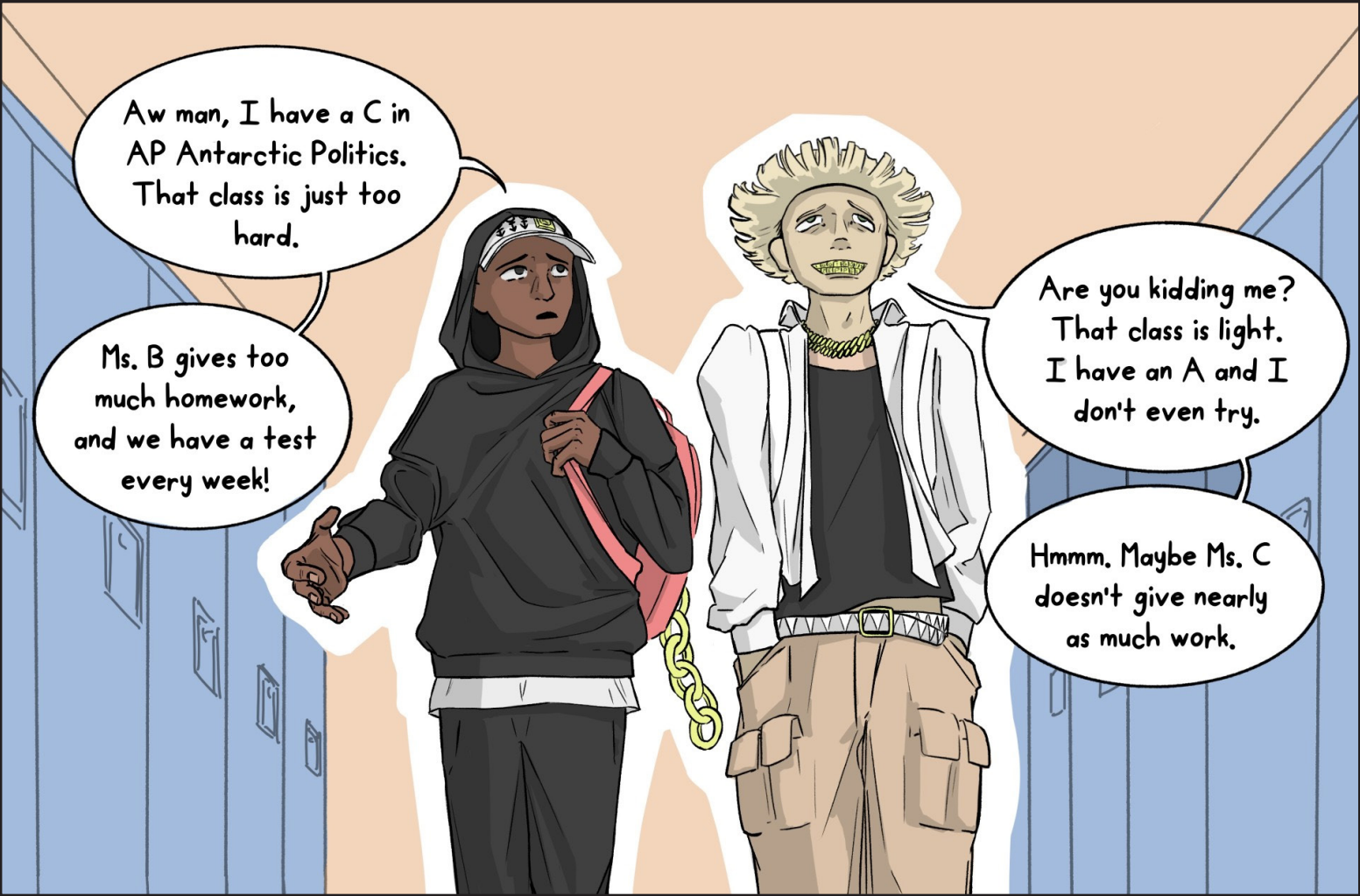
Since time immemorial students have braced themselves at the beginning of each new school year for the latest round of academic roulette as they are handed their class schedules. AHS students are no different. Will I get Professor Sprout for biology? Or Professor Snape for chemistry? Is Professor Lupin the new calculus teacher now that AP “Defense Against the Dark Arts” is no longer offered at AHS?

I have noticed a broad spectrum of opinions regarding teacher expectations. For many students, the coursework in a given class is more challenging compared to other classes at the same level. Conversely, there are those who report a significantly lighter workload compared to their peers taking equivalent classes. This is largely due to differences in teachers expectations. Inevitably, teachers have varying teaching styles, and to some extent, differing content. This is a good thing. However, to have considerable disparity in grading styles for the same course level feels problematic to many. One teacher’s idea of “exceeds expectations” is another’s “needs improvement”.

When teachers enforce much higher standards, obtaining a certain letter grade requires significantly more time and effort. With two students taking the same class and course level, but with different teachers, one may have to work twice as hard to get the same final grade. This is a concerning disparity.

Although some may argue that academic resilience requires some degree of inconsistency—or in other words, variety —course levels at AHS should already account for most differences in rigor.

The emphasis should be, indisputably, on learning rather than grades. Unfortunately, because of how the system is set up, the letter grade matters tremendously to students and families at the end of the day.

These grading differences have further negative impacts beyond just student stress and equity concerns. Students receiving “inflated” grades in classes with less rigorous expectations may struggle when they are later held to higher standards in college or the workplace. On the other hand, students in equivalent classes, facing heavier workloads and/or more stringent grading, have less time for extracurriculars, family, sleep, and other important aspects of adolescent development like contemplating existential angst and formulating a skin-care plan.

Moreover, with college admissions becoming increasingly selective, GPA carries greater weight than ever before. Class rank also plays a major role in academic scholarships and other opportunities. Two students with equal skills and work ethics should not have markedly different GPAs simply due to a “teacher lottery”.

Moving forward, teachers can do more to align grading expectations across sections of the same courses. Teaching styles can and should vary, in the interest of piquing students’ curiosity and engagement. Variety is the spice of life; if teachers taught the same way, school would be quite bland. However, the standard of assessment should be more consistent.

Still, this can be difficult, so the solution lies in transparently accounting for differences in idiosyncratic teacher expectations rather than getting teachers to grade the same way. This solution is used in countries with strong education systems like Canada: it entails publishing class averages on report cards. According to high school student parents Anna Chang of Ottawa, Ontario and Paul Cisek of Montreal, Quebec, Canadian high school report cards show percentage grades rather than letter grades. More importantly, they also list the class average for comparison. This context allows parents, teachers, counselors, and even college admissions officers to better interpret the meaning of students’ grades. For example, an 84% grade appears very competitive alongside a class average of 61%, whereas getting an excellent grade in a class with a 95% class average suggests that it was not difficult to meet the expectations in that class.

Showing class averages provides a helpful perspective when assessing academic rigor. An “easy A” class can skew perceptions of students’ abilities and undermine those taking equivalent courses with more rigorous grading schemes. Admissions officers reviewing transcripts can gain insight into ability and/or work ethic beyond simply the grades earned or the class level. Furthermore, by comparing class averages over time, teachers and administrators can track grading trends to identify issues like shifting rigor or grade inflation.

Of course, there may be drawbacks to disclosing class averages. Students struggling in a course may feel embarrassed or demotivated if their grades fall far below the average. Publishing averages could potentially create unhealthy comparisons and competition. (In extreme cases, it could lead to rampant sabotage, as students try to lower the class average by spiking fellow students’ Stanley Cups with sleep-inducing drugs before exams.) And teachers may also hesitate to share statistics that could invite questions about their grading tendencies being too lenient (“Ah, Mr. Dingleberry, the one who hands out A’s like Oprah giving away cars”) or too harsh (“Behold, the feared Professor Umbridge, with her blood-quill red pen”).

These risks deserve consideration. Still, used judiciously, class averages could provide more academic transparency and be used to benefit students and parents alike.

Continue reading
Caught in the Middle
  • February 29, 2024

By Tommy Kruecker-Green and Isabella Yan
STAFF WRITERS

As sophomores, our view of the future oscillates between daydreams and despair. One moment we envision delivering valedictorian speeches and accepting awards in our dream career. In the next, we sink into the uncertainty of plotting life trajectories without a map or compass. Who will I become? Can I afford college? What if I never figure out what career inspires me?

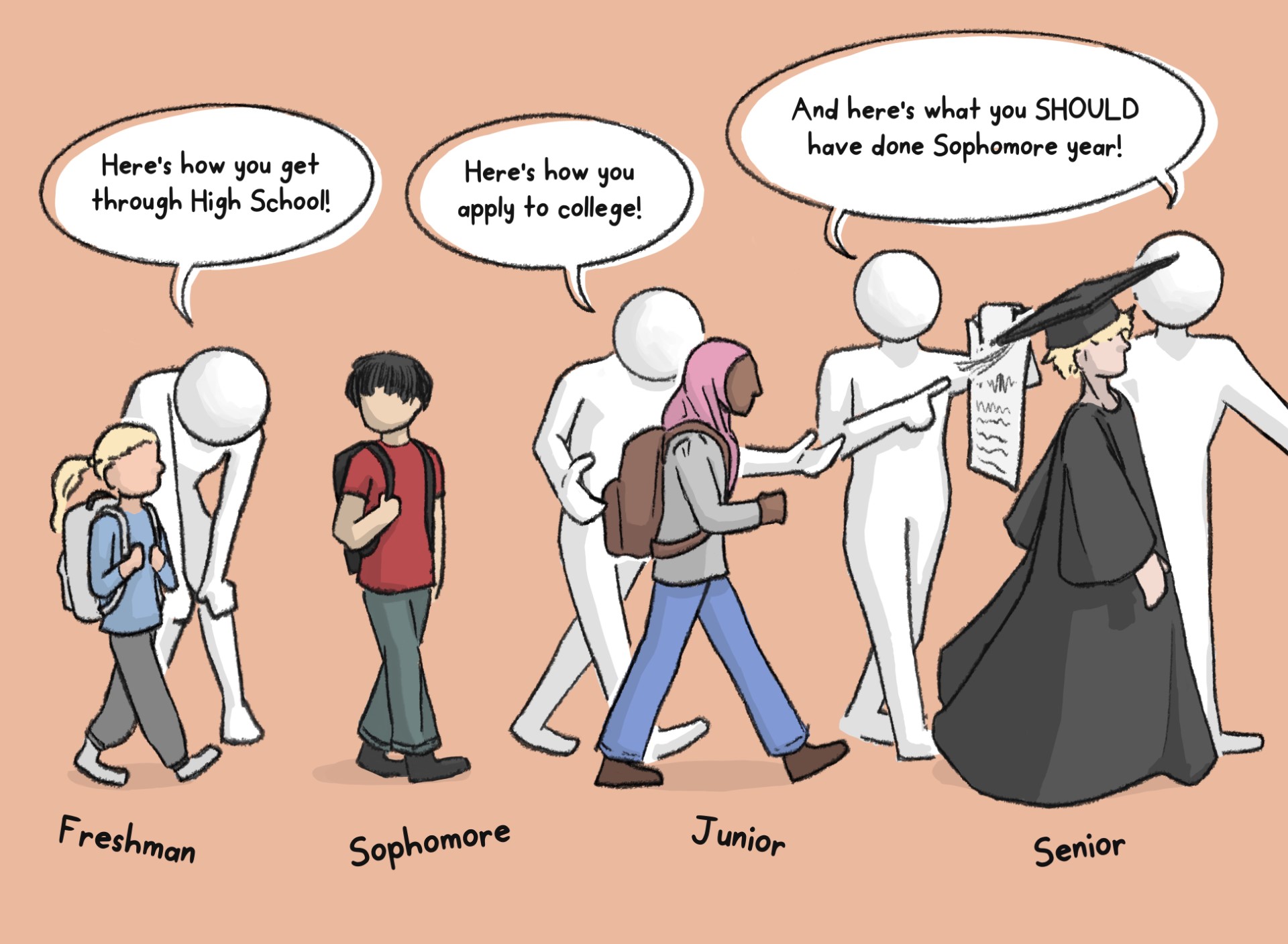
Interviews with tenth graders led to a general consensus: our school could do more in sophomore year to help students prepare for their futures. Counselors and teachers often devote the most attention to freshmen adjusting to high school and upperclassmen applying to college. Sophomores inhabit an awkward middle ground—no longer wide-eyed but not ready to prepare ourselves for graduation’s looming deadline. 

From the school’s perspective, limited career advising for sophomores prevents overburdening students and counselors alike. With over a hundred students apiece, counselors prioritize helping those most in need of support. “[Sophomores] are not as needy as a group,” explained counselor Jayne Jones. “You are not applying to college right now, you are not creating a college list, you are not needing a recommendation per se… Sophomores are just sort of left a little bit because they can be left.”

This is a fair point. However, what we choose to participate in during sophomore year holds much greater weight given today’s ultra-competitive admissions landscape. With more students applying for limited spots at top institutions, colleges increasingly seek evidence of commitment and leadership from prospective applicants’ earliest high school years. Admission officers don’t expect us to have life figured out at fifteen or sixteen, but they want signs we’re purposefully sampling activities aligned with our emerging strengths and passions. The stakes feel uncomfortably high for sophomores who are simply hoping to discover their interests, and the hard truth is that involving ourselves with the “right” organizations now can make or break our candidacy down the road. As anxious as it makes students to strategize so far ahead, not scoping out extracurricular opportunities with admissions checkboxes in mind means losing a prime chance to build the “hook” that gets us noticed from the overflowing stacks of applications.

It is because of this intense pressure that sophomores feel they need more personalized guidance on extracurriculars and future planning. Sophomore Eva Nguyen summarized the common sentiment: “Counselors can do more to open up the door to students for discussion about their futures.”

A lack of early career planning is felt especially strongly by sophomores Pranav Yadla and Noor Bhatti, who come from immigrant families without experience with the American college system. 

“I have no idea what colleges want; I didn’t even know what the process was, [so] I had to find it out myself,” said Yadla. Like many students with immigrant parents, his parents received a college education outside the U.S. where there is a completely different admission system.

Over the last few decades, college admissions in the United States have changed tremendously, including significantly higher tuition and changes to general application expectations. These are critical factors that sophomores who intend to attend college should begin to consider.

In a maze of unfamiliar requirements, many sophomores whose parents “don’t know anything” turn to outside sources such as advice from college friends, the internet, or even private college counselors. But, astronomical costs put the latter out of reach for most. Somehow, students from families new to America must solve a complex puzzle missing half the pieces.

More robust sophomore advising would benefit every tenth grader. But this could overburden the already strained counseling department. Perhaps the answer lies in empowering students to self-organize the guidance lacking from formal administration sources. Students could lead group discussions on college essay writing, scholarship opportunities, or lessons learned from older siblings now in college. Retired teachers may volunteer to moderate these student gatherings and offer their advice.

For students from immigrant families, group sessions could help decipher unfamiliar aspects of American college prep: differences in application timelines and requirements between the U.S. and other countries, a breakdown of key standardized tests like the SAT, or nuts and bolts overviews detailing how financial aid functions here. These sessions don’t need a lot of funding—they could operate on a shoestring budget or by student volunteers.

Until we start troubleshooting ways to do more with less, sophomores will continue to be caught in the middle, dangling between childhood dreams and adult decisions. Like trapeze artists without a net, we twist anxiously in the space between launch and catch. The time has come for schools to position the mesh—a safety net of supportive guidance.

Continue reading