Caught in the Middle

  • Opinion
  • February 29, 2024
  • 0 Comments

By Tommy Kruecker-Green and Isabella Yan
STAFF WRITERS

As sophomores, our view of the future oscillates between daydreams and despair. One moment we envision delivering valedictorian speeches and accepting awards in our dream career. In the next, we sink into the uncertainty of plotting life trajectories without a map or compass. Who will I become? Can I afford college? What if I never figure out what career inspires me?

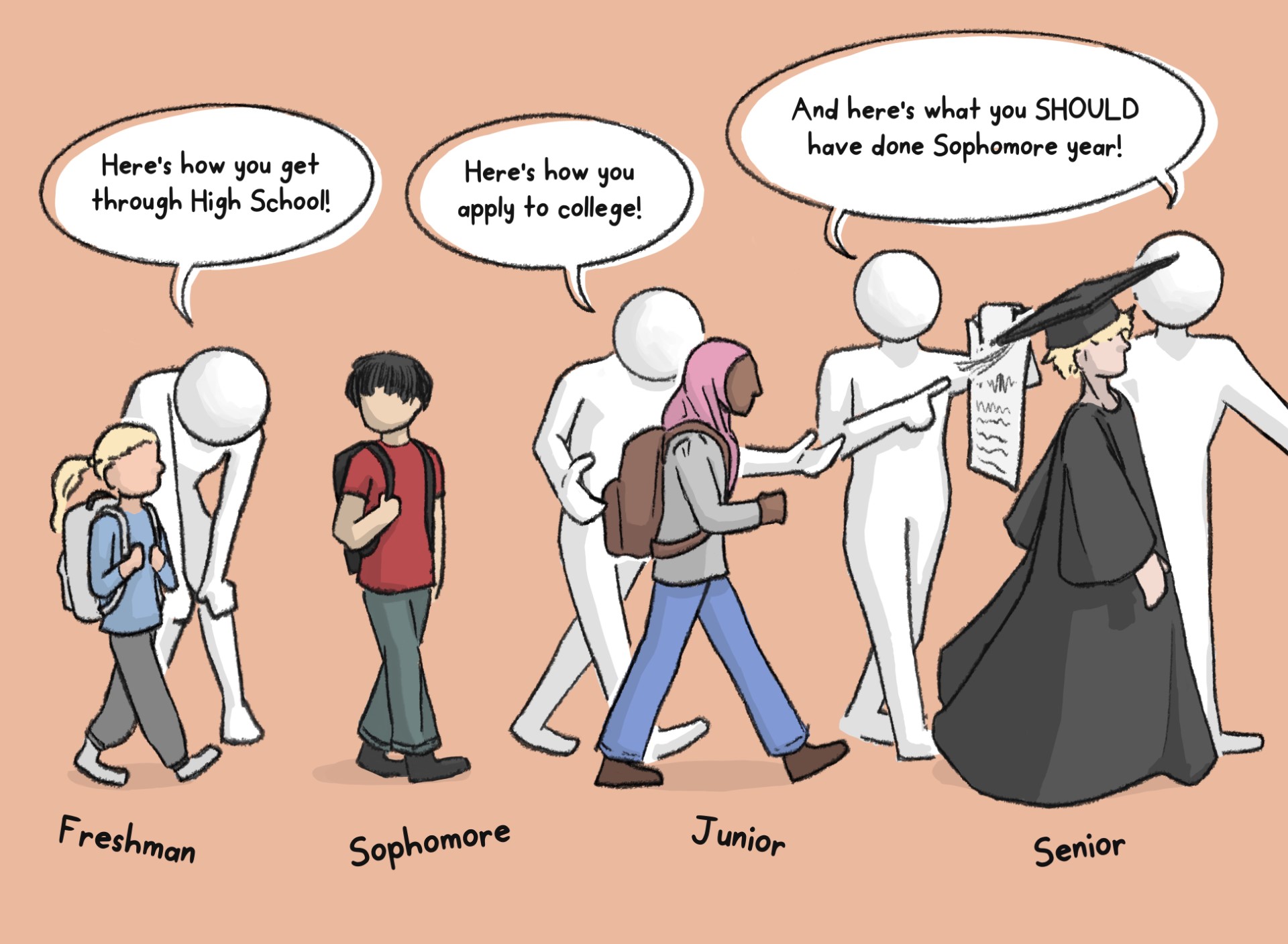
Interviews with tenth graders led to a general consensus: our school could do more in sophomore year to help students prepare for their futures. Counselors and teachers often devote the most attention to freshmen adjusting to high school and upperclassmen applying to college. Sophomores inhabit an awkward middle ground—no longer wide-eyed but not ready to prepare ourselves for graduation’s looming deadline. 

From the school’s perspective, limited career advising for sophomores prevents overburdening students and counselors alike. With over a hundred students apiece, counselors prioritize helping those most in need of support. “[Sophomores] are not as needy as a group,” explained counselor Jayne Jones. “You are not applying to college right now, you are not creating a college list, you are not needing a recommendation per se… Sophomores are just sort of left a little bit because they can be left.”

This is a fair point. However, what we choose to participate in during sophomore year holds much greater weight given today’s ultra-competitive admissions landscape. With more students applying for limited spots at top institutions, colleges increasingly seek evidence of commitment and leadership from prospective applicants’ earliest high school years. Admission officers don’t expect us to have life figured out at fifteen or sixteen, but they want signs we’re purposefully sampling activities aligned with our emerging strengths and passions. The stakes feel uncomfortably high for sophomores who are simply hoping to discover their interests, and the hard truth is that involving ourselves with the “right” organizations now can make or break our candidacy down the road. As anxious as it makes students to strategize so far ahead, not scoping out extracurricular opportunities with admissions checkboxes in mind means losing a prime chance to build the “hook” that gets us noticed from the overflowing stacks of applications.

It is because of this intense pressure that sophomores feel they need more personalized guidance on extracurriculars and future planning. Sophomore Eva Nguyen summarized the common sentiment: “Counselors can do more to open up the door to students for discussion about their futures.”

A lack of early career planning is felt especially strongly by sophomores Pranav Yadla and Noor Bhatti, who come from immigrant families without experience with the American college system. 

“I have no idea what colleges want; I didn’t even know what the process was, [so] I had to find it out myself,” said Yadla. Like many students with immigrant parents, his parents received a college education outside the U.S. where there is a completely different admission system.

Over the last few decades, college admissions in the United States have changed tremendously, including significantly higher tuition and changes to general application expectations. These are critical factors that sophomores who intend to attend college should begin to consider.

In a maze of unfamiliar requirements, many sophomores whose parents “don’t know anything” turn to outside sources such as advice from college friends, the internet, or even private college counselors. But, astronomical costs put the latter out of reach for most. Somehow, students from families new to America must solve a complex puzzle missing half the pieces.

More robust sophomore advising would benefit every tenth grader. But this could overburden the already strained counseling department. Perhaps the answer lies in empowering students to self-organize the guidance lacking from formal administration sources. Students could lead group discussions on college essay writing, scholarship opportunities, or lessons learned from older siblings now in college. Retired teachers may volunteer to moderate these student gatherings and offer their advice.

For students from immigrant families, group sessions could help decipher unfamiliar aspects of American college prep: differences in application timelines and requirements between the U.S. and other countries, a breakdown of key standardized tests like the SAT, or nuts and bolts overviews detailing how financial aid functions here. These sessions don’t need a lot of funding—they could operate on a shoestring budget or by student volunteers.

Until we start troubleshooting ways to do more with less, sophomores will continue to be caught in the middle, dangling between childhood dreams and adult decisions. Like trapeze artists without a net, we twist anxiously in the space between launch and catch. The time has come for schools to position the mesh—a safety net of supportive guidance.

Related Posts

CollegeBoard Scores 1/5 on AP Testing Administration
  • June 9, 2025

“Once you enter the start code, you may begin.” With these words, hundreds of AP Psychology students at AHS expected to start their AP exam. Instead, they were greeted by a laggy, glitchy BlueBook testing app that refused to cooperate. For the students who were unable to coax the app into functioning, the exam was delayed to May 21—a poor solution for students who spent a whole year preparing for that moment. 

We at ANDOVERVIEW believe that the fragile testing infrastructure of CollegeBoard is absolutely unacceptable. One would assume that a nonprofit organization that claims to be “paving the path for college success” would ensure that its testing platform relies upon servers that are able to handle the increased traffic on testing day. CollegeBoard provided very little consolation to the adrenaline-crashing students. “Most students have had a successful testing experience, with more than 5 million exams being successfully submitted thus far,” the organization defended. The statement was tellingly short—PR representatives at CollegeBoard couldn’t be bothered to devote any longer than a five-minute coffee break to drafting this “apology.” 

Unfortunately, technical glitches are not the only issues that CollegeBoard has encountered this AP season. After a slew of hate comments were slung in author Namwali Serpell’s direction, she discovered that the vitriol was directed towards one particular passage in one of her books. The infamous “Look at Me” passage was recognized by this year’s AP Lang students as an indecipherable jumble of content followed by some seriously difficult multiple-choice questions (MCQs). After learning this, Serpell revealed that CollegeBoard had included the passage in the test without her permission and distorted its meaning in the MCQs that followed. Adding insult to injury, Serpell also clearly stated that she was against standardized testing as a concept. As of late May, CollegeBoard had yet to address these comments.

The negligence of CollegeBoard has created a sorrowful state of affairs for those looking to take advantage of the benefits of AP courses and exams. To no one’s surprise, the corporatization of education has introduced far more harm than benefit to all involved. We can only hope that CollegeBoard will hear and fix some students’ criticisms.

Continue reading
Mental Health at AHS: A Growing Focus, but More Could Be Done
  • May 1, 2025

ABBY CHACHUS || STAFF WRITER

As a student at Andover High School who has encountered and experienced a fair share of mental health struggles, I see the progress that AHS is making when it comes to supporting and understanding students like me. Students and staff are trying to make a difference related to the social-emotional well-being of students at AHS. Whether through the Yellow Tulip Project or the social emotional training that staff are going through, each action makes a difference. At school, mental health is often overlooked or even stigmatized. 

“We live in a very fast-paced society, particularly here in New England, where… most kids are aiming for college, and that brings a lot of pressure,” guidance counselor William Hutchins said. With college preparation, extracurricular activities, and the quest for academic excellence, the weight of expectations on students can feel immense, and many struggle with stress that can be tough to manage. “[As] a whole, we need to do a better job,” Hutchins said, and I agree, in the sense that it’s not just about grades—students are also competing for their futures.

Supporting student well-being depends heavily on the care that AHS staff members provide. I find this to be true—when I feel supported and cared for, I am more likely to be engaged in my learning and participate in class.  “Teachers at AHS are being trained in ‘RULER,’ a nationwide social-emotional curriculum designed to equip staff with tools to help students better handle their emotions,” Hutchins said. ‘RULER’ training is currently being implemented at the middle schools and will soon become integrated at AHS.  While this program may sound promising, its true impact will rely on how effectively it is used by students, staff, and the wider school community.

Despite the introduction of this new training, an obstacle still stands in the way of a strong teacher-student connection—many students often feel bad about reaching out for help. 

“Typically, teachers do care about their students and ask how they’re doing, and we have several guidance counselors,” sophomore Hannah Lang said. “However, I think we need to create a space where students feel more at ease approaching their guidance counselors because many are hesitant.” 

Despite available resources, many still deal with the stigma that surrounds mental health issues, making it difficult for them to seek assistance when needed. Sophomore and Yellow Tulip Project member Savannah Ross believes this stigma must be confronted more directly. “I believe AHS offers a lot of resources for students facing mental health challenges,” she said. “[But] we need to address mental health more openly, as the stigma around it still looms.”

 It’s evident that while resources are in place, the school’s attitude toward mental health needs to be better for students to feel truly supported. I believe Ross is right—we need people to feel comfortable asking for help if we expect our school to give them the support they need. We can’t go into it with the attitude that previously nothing has been achieved in terms of mental health, so nothing will be in the future. Ultimately AHS needs to take the past out of the equation and think about what could be done in the present and future. 

Ross also proposed a thoughtful idea: “We could have speakers come in to educate and raise awareness about mental health. Also, we could have student leaders who could speak out and be recognized as go-to individuals for help,” Ross suggested.

This could bring awareness to the topic, like Ross suggested, but we also have adults like guidance counselors and social workers at AHS to bring awareness and help students whenever they need it for whatever reason.

Jayne Jones, another guidance counselor at AHS, talked about the commitment counselors have towards supporting students, not only academically but also socially and emotionally. “When students come to us as counselors, we collaborate with them to understand what’s happening, whether it’s academic, social, or something else,” she explained. However, as a mandated reporter, Jones also recognizes the importance of teamwork in managing more serious issues, which may involve reaching out to assistant principals, social workers, and families when necessary. This should not scare students away from asking for help; in the long run, all these amazing adults and student leaders want to do is help people feel comfortable in school. Whether the issue is inside of school or not, don’t be afraid to reach out because sometimes external issues can still affect students in school.

Addressing mental health issues while we, as students, are still in school can lead to better long-term outcomes for students, including improved social skills and overall well-being. As someone who has experienced mental health issues, I find this to be true because I have become more socially comfortable as my anxiety in school has lessened. 

I believe AHS is on the right path, but the conversation around mental health is far from over. For the efforts to reach their full potential, the work of “smashing the stigma,” building trust, and creating a supportive environment must continue. As Hutchins said, “We need to do a better job.”

Continue reading

Leave a Reply

You Might Also Like

Spanish Department to Host Day of the Dead Fair

  • November 12, 2025

Funding the Future of Science: Proposed NIH Funding Cuts Throw US Biomedical Research Into Uncertainty

  • November 4, 2025
Funding the Future of Science: Proposed NIH Funding Cuts Throw US Biomedical Research Into Uncertainty

Student-Hosted Video Game Hackathon Scheduled for Late September

  • September 22, 2025
Student-Hosted Video Game Hackathon Scheduled for Late September

World Languages Coordinator Reflects On Career, Retirement

  • June 9, 2025
World Languages Coordinator Reflects On Career, Retirement

CollegeBoard Scores 1/5 on AP Testing Administration

  • June 9, 2025

AHS Student Directs Coming-of-Age Film, ‘Horizon’

  • June 9, 2025

Discover more from AHS NEWSPAPER

Subscribe now to keep reading and get access to the full archive.

Continue reading