By Avi Shapira
STAFF WRITER
Opinions on remote learning have been mixed across the AHS student body, but learning remotely, whether in remote academy or hybrid, has been difficult for many.
Online school has caused many health issues because of extended screen time, lack of movement throughout the day, and inability to interact with other students often. Those health challenges are also hindering people’s ability to do well in school.
“I have really bad headaches and it’s gotten so much worse this year due to online school,” said junior Ollie Neilly. “It’s very painful and it makes it hard for me to concentrate or have my camera on.”
“It’s been difficult to get outside and get fresh air, or interact with friends, pets and family,” added Atlas L., a junior.
Anya Lazar, a junior, also said that remote learning negatively affected her posture.
“We worried even before this pandemic about how much screen time students are getting, it creates a sedentary lifestyle… you’re not moving around and being social,” said health teacher Candice McVeigh.
During remote days, students interviewed said they have to spend between six to eight hours on a computer just for school-related work, and in remote academy or when hybrid is all remote teachers hold class-long meets. Most homework also requires going online to complete, and most teachers spend the entire class lecturing.
Abby Clement, a sophomore, said “A lot of the time, after spending a day completely online without much of a break, I do not want to go back online and do more school work so I put it off, procrastinate, and end up becoming more stressed.”
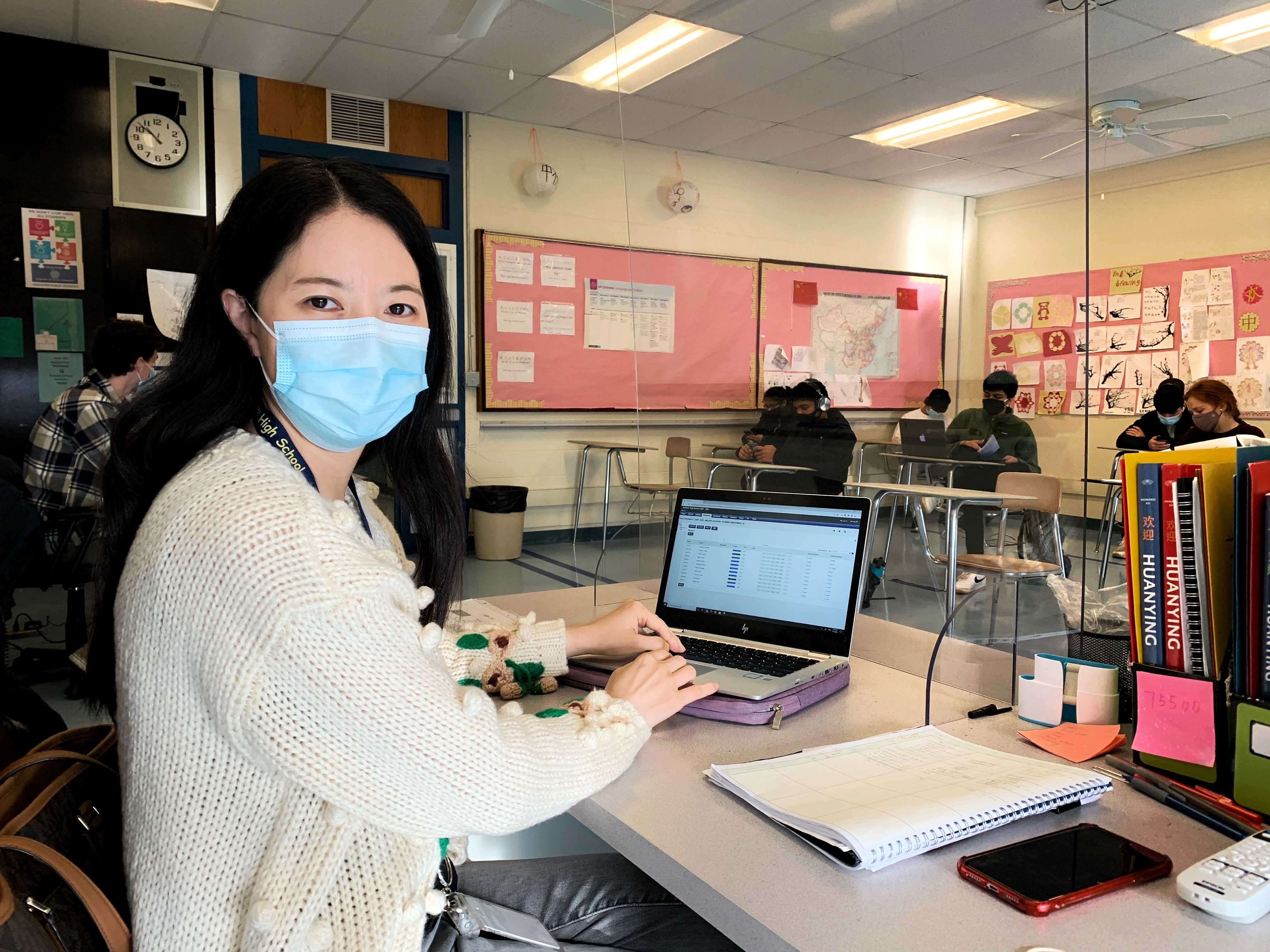
Teaching online is also difficult for teachers, whose health is affected and have to design “more engaging activities [online], while also considering the time that students need to look at the screen,” according to Chinese teacher Lin Wu.

Ms. Wu teaches in-person and remote students at the same time during an H Block.
Despite all the challenges with online school, it’s possible to make it easier for both students and staff.
Some students said they prefer having independent work rather than a live remote class.
Neilly said it’s easier to concentrate on independent work, and Google Meets can be stressful.
L said both types of classes have benefits. “It’s easier to learn when I can hear the teacher talking about a subject, but I overall spend less time sitting in front of my computer and it’s easier to get work done when it’s independent work… it’s easier to go at my own pace.”
Sophomore Shannon Chu suggested a mix of both would be good. “My French teacher… gives the beginning of class off for us to do some [independent work] and then our actual class is only 45 minutes.” Other students expressed similar ideas.
To make remote classes easier, McVeigh mixes independent work and lecturing, and also makes sure to include group work in her health classes. “I heard from some kids that they appreciate that,” she said.
Many students said that mask breaks, or any short break in the middle of class, were helpful for them.
“Our brains can’t focus for long periods of time so having a ten to twenty minute break in the middle of class would help our productivity and focus levels and give us time to get away from the screens and stretch,” said Neilly.
Students said it would be helpful if they got less homework in general.
L said less homework would mean they wouldn’t “burn [themself] out by spending all of [their] time focusing on school work.”
Chu questioned whether homework is necessary. “If homework is making kids more stressed how is that helping at all?” she asked.
“Our education is already being affected by our mental health and the inability to concentrate,” Neilly explained. While he agrees that some homework are necessary, many teachers could give lower amounts of homework.
Because of these challenges, many students have had to skip or miss classes because of technological issues or headaches. Due to the online platform, making up this work is more difficult, and students interviewed suggested that teachers post an agenda and don’t take points off late work to make making up work easier.
Some students thought having physical textbooks and getting more assignments on paper would be helpful.
I think physical books [are better than] online books, for the reading experience,” said Chu. Physical books would also mean students have to look at screens less.
Lazar had a mixed opinion. “I actually hate doing assignments on paper because writing hurts my hand, so I prefer being able to type everything. Physical textbooks would be great because I have a lot of issues with loading the online ones.”
Multiple students suggested teachers should change the way they grade assignments.
“Teachers could not rely on tests and quizzes for grades as much as they do right now, since it’s very hard to learn an entire topic when everything around you is a distraction and you can’t pay attention,” said L.
“[Teachers should] give more opportunities to improve grades, be more lenient, etcetera,” said Clement. She suggested teachers grade on completion rather than accuracy of homework assignments.