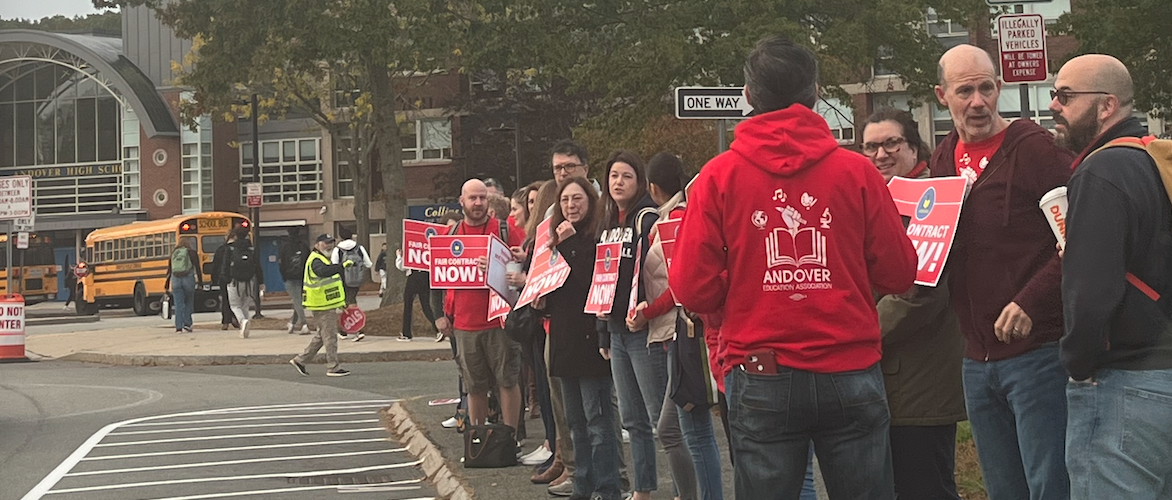
Andover Public Schools (APS) students showed up downtown to support their teachers at an Andover Education Association (AEA) rally on Friday, November 10.
Kids ranging from first grade to high school seniors rallied in support of the AEA. Most, if not all, of the students’ sentiments were the same: “I’m here to support our educators who deserve fair pay,” said sophomore Tess Moglia.
“We are making sure that IAs specifically get better pay and get liveable wages,” AHS senior Nate Allen said. There was overwhelming support for the teachers seen by the turnout of students alone. Senior Nick Vacarro said he “would not be the person [he is] today without the teachers’ support”.
Junior Mitran Kumar, who gave a speech and is a member of the student organization Respect Our Teachers, stands strong in his support. “So far, there have been 27 rounds of unsuccessful negotiation,” Kumar said. “And we’re hoping today’s strike can show that that’s not acceptable, and students are now behind you.”
STAFF PHOTO / Julia Rodenberger Mitran Kumar makes a speech during the strikeout.
Oscar Gillette, founder of the Respect Our Teachers organization and AHS Class of 2023 graduate, expressed similar sentiments towards Andover educators. Several students from the organization also took part in a rally on Wednesday, November 8, showing up at the Senior Center to support the AEA negotiation team.
Another senior, Hannah Lehmann, said, “They are demanding resources to be able to be better teachers for us so we owe it to them to support them.” Abinaya Ganesh, a senior and participant in the high school’s production of Rent, stated that while the production has been allowed to continue and her extracurricular life hasn’t been interrupted too much, she is “willing to have my life disrupted” for the cause.
While 8th graders Aiden DeLuca, Sam Bossieux, Jack Walsh, and Jack Difiore enjoyed the day off, DeLuca explains that they came to “check out the strike and see all of [their] teachers.”
With the School Committee being a group of parents, Ganesh thinks it’s the parent’s job to look out for students. “It may seem [to the Committee] like that’s what [they are] doing right now, but what will really benefit the students is teachers being able to do their job properly.”
“We will not accept these locked-in negotiations and we will not stop until they bring a proper agreement, a fair contract, and livable wages which is why we as the students will stand by it until those agreements are met,” Kumar said adamantly. “One more thing. Warriors don’t cross the picket line.”
During the November 10 AEA demonstration, members of the Andover community all over Massachusetts came together at the Town Commons. They shared sentiments regarding the Andover School Committee’s offers and refusals to meet the AEA’s demands.
Brian Shea, AHS English Teacher, opened the stage by defining what Andover Public Schools (APS) truly is, saying that APS is not merely a set of numbers to be analyzed but a thriving community based on love, care, and compassion. Although school is closed, Shea wanted “to be clear that APS is not closed today because APS is right here!”
Kathryn Conti, Woodhill Middle School (WHMS) eighth-grade special education teacher of 20 years and army veteran thanked the rally: “Your personal life and commitment to the common good are an inspiration to students and teachers alike.”
Daniel Donnavon, AHS Science Teacher and marine veteran, declared, “Service is something we model every day in our teaching. We have to stand up for ourselves and model that for our students.”
STAFF PHOTO / Julia Rodenberger Matthew Bach makes a speech at the strikeout.
Matthew Bach, AEA President and AHS History Teacher, shared his eagerness to get back to the classroom but said that [the AEA] “is doing this because it is the right thing to do, and if [they] didn’t do it [he] wouldn’t be able to…look [his] students in the eye. There is a time when what’s just and what’s right has to overcome fear and a reluctance to get out of our individualism. And [the AEA is] here collectively to do that today. And we’re going to win.”
Julian Digloria, AEA Vice President and WHMS History Teacher, reflected on his personal and familial connection to the town as an educator and how important public education is. “It’s something that people do not have across the globe and in some cases in this country and…. something that our armed forces are fighting to protect,” he said. Andover “has been a lighthouse district for public education,” he continued, “[and] we want to keep it that way.” Digloria urged the School Committee to work with the AEA, to offer them a fair contract, and to respect their employees in order to keep Andover a lighthouse district in the commonwealth and in the nation.
Karen Torres, Instructional Assistant Unit Chair, reminded all instructional assistants of their value to the district and how critical their work is for the success of their students. Torres emphasized how the school committee “can’t fill instructional assistant positions that are posted and open, because it’s a difficult, low paying job, and now the district values [instructional assistants] so much that they’re willing to pay an outside company $65 an hour to fill that position.” Torres ended her speech by demanding that the school committee “Do [their] job!”
Chrissy Lynch, Massachusetts AFL-CIO (American Federation of Labor–Congress of Industrial Organizations) President, explained her role and reason for joining the AEA strike: “The job of the AFL-CIO is when one union gets picked on you got a whole bunch of other ones standing in solidarity.” The AFL-CIO represents over 800 local unions across Massachusetts from every sector. Lynch said “Our educators deserve everything that our cities and our state can give them. This is the future of our world.” Although Massachusetts passed the Fair Share Amendment, expected to generate about $2 billion in yearly support for transportation and public education, Lynch said, “Now is the time to use those investments to make sure our schools are getting the resources they need.”
Kara Routier, AHS Instructional Assistant, shared how difficult it is to pursue a career in education because the “starting wage for IAs here is not adequate to pay for housing, food, any student loans, transportation, clothing, and routine bills.” Routier expressed her concern for Andover’s diminishing appeal to young educators, lack of recognition for experienced educators, and the School Committee’s disregard for students, particularly those with special needs.
Dayshawn Simmons, Somerville Educators Union (SEU) President, expressed solidarity with AEA, highlighting their shared struggle for fair wages and conditions. Drawing from Somerville’s experience, he encouraged the AEA to trust in their collective power, emphasizing that their fight will only yield positive changes for educators but will also inspire and empower students: “You all made the brave, courageous, and righteous decision to advocate for yourself, your students, and the Andover community,” said Simmons, “remember what you are fighting for and know that you deserve it.”
STAFF PHOTO / Julia Rodenberger Erica Uyterhoeven makes a speech at the strikeout.
Erica Uyterhoeven, Somerville State Representative, shared her personal connection to labor struggles through her mother’s union. “My first picket line was in the womb,” said Uyterhoeven. She encouraged educators to remember their courage during challenging times and dispelled myths related to funding, the misconception that “Somehow because [teachers] care [about the students], [they] should be paid less,” and the belief that public sector unions are different. She emphasized the right to strike is crucial for negotiation for a fair contract, and she has proposed a bill advocating for the restoration of the right to strike for public sector workers, expressing strong support for the educator’s actions in Andover.
Maura McCurdy Santiago, Andover Parent, read a letter she sent to the School Committee and the Superintendent. She expressed deep disappointment with the School Committee for the prolonged negotiations and lack of urgency in addressing teachers’ concerns. Santiago highlighted teacher’s efforts during the pandemic and argued for a fair wage that considers the cost of living and matches neighboring communities. She asked the School Committee to consider if they “make a good enough living wage to support [their] own family if [they] had to take an unpaid leave to support a sick loved one?”
Students from the AHS Respect Our Teachers Organization, stepped up and shared their personal experiences with the Andover education system. Mitran Kumar, an AHS junior, highlighted the historical significance of the Bread and Roses movements and drew parallels to the ongoing struggle for a fair contract for teachers in Andover. Mitran said, “This is said to be the land of the free and the home of the brave. But I ask you this: when you don’t have the fundamental right to strike, do you feel free? When you don’t have any meaningful impact or input over your curriculum, do you feel free? When you can’t take time off of work for the death of a family member, do you feel free? But I also ask you this together as we stand here in solidarity, just how powerful we are together. Do you feel brave?”
President Michael Zilles, President of the Newton Teachers Association (NTA), stated that the NTA is working with the same law firm, using similar tactics to resist contracts. Ziles said, “They think they can beat us, but they can’t. I’m coming away from here feeling stronger because what [the AEA] is doing here is going to help 2000 members in Newton and we are going to win just as [the AEA is] going to win.” Max Page, Massachusetts Teachers Association (MTA) President and Deb McCarthy, MTA Vice President addressed the crowd in solidarity and expressed admiration for the union members fighting for living wages, paid parental leave, and adequate recess time. Page said, “You are not going to be getting this by asking. You are doing this by demanding a fair contract for all your members and for the students in this district… The fight for racial gender, education, and justice, runs through the AEA and runs right through Andover, so you do this for yourselves and your students, but you do this for a larger labor movement that is on the rise.”
The Andover Education Association (AEA) rallied outside schools and at Andover Commons on Friday, November 10, after voting to strike Thursday night.
For the first time in 30 years, the AEA strikes gathered a crowd of red at the Town Commons.
With schools closed due to the Union’s strike, many students came out to show their support for educators. In the crowd of nearly 1000, there were also parents and other educators from neighboring districts like Haverhill, Woburn, and North Andover.
Parent Lauren Kinney hopes that the school committee will come to see “the value that our teachers provide and agree that their requests are not unreasonable.” AHS Senior Michaela Buckley said that educators “do so much for us and the least we can do is have them paid a liveable wage.” 2023 Alumnus John Macy agreed with Buckley and stood with the AEA saying “They did a great job educating me and I want to get them a fair contract.”
Arlington teacher and Methuen resident, Jenna Maderios, said it was important to her “to come out and show teacher solidarity.” Strikes like this have been successful in other Massachusetts towns and while “it’s unfortunate that it has to get to this, it is what Andover educators deserve,” Maderios said.
With the AEA’s decision to strike, the Commonwealth Employment Relations Board (CERB) at the Department of Labor Relations ordered the Union to cease and desist after they broke the law (M.G.L. c. 150E, s. 9A). The CERB also ordered a state mediator for the negotiations held on November 10.
Oscar Gillette, a 2023 alumnus of AHS, created Respect Our Teachers, “a group of students and alumni who support the union” said Gilette. The group is taking two approaches, electoral (where they will gather signatures, and if they get 200 signatures from registered Andover adults a town meeting will be triggered) and civil disobedience (where students will refuse to attend school without a fair contract for their educators).
STAFF PHOTO / Julia Rodenberger Seniors rally in support of the AEA.
The School Committee’s proposal on Friday included enhanced paid parental leave (including 11 weeks of paid leave for any parent) and an increase in sick days for Instructional Assistants which now have a total of 15 sick days.
While the Committee is dedicated to “negotiating in good faith” as said in their statement on November 11, the AEA has made it clear that enough is enough even though they have yet to respond.
For more information on negotiations visit aps1.net
The Andover Education Association (AEA) voted to go on strike Thursday afternoon and rallied yesterday, November 10, outside the closed schools and Andover Common.
After the November 8 bargaining session fell through, the AEA voted overwhelmingly in favor of striking the following afternoon on November 9. Yesterday at around 8 a.m., teachers and Instructional Assistants (IAs) from respective negotiation Units A & B demonstrated at all Andover Public Schools to show their support for the strike. At 12 p.m., joined by many other teachers and union leaders from all over the state, they began gathering outside of the Memorial Auditorium.
STAFF PHOTO / Julia Rodenberger AHS Teachers make their way to Andover Commons to continue the strike.
The School Committee’s proposal from Thursday and AEA’s most recent proposal from October 25 include increased wages for both entry-level teachers and IAs, a greater amount of prep time per day, and more parental leave.
An emergency negotiation session between the AEA and the School Committee, along with a mediator sent by the Massachusetts Commonwealth Employment Relations Board (CERB), took place yesterday afternoon at 2 p.m. The parties bargained for eight hours.
The School Committee published a statement this morning, November 11, at 5 a.m. detailing their further offers of increased paid parental leave and sick time. The AEA has not publicized any counterproposals.
The Andover School Committee had filed a petition shortly before the Thursday afternoon vote with CERB at the Department of Labor Relations to prevent the strike. They “[urged] the AEA to end the theatrics [to]… negotiate in good faith.” When the AEA continued with the strike, CERB found the union in violation of Massachusetts state law and ordered the members to concede the strike by tomorrow, Sunday, November 12.
At the rally yesterday, AEA Chair Matthew Bach said the union was “doing this today because it was the right thing to do… to overcome fear… and individualism.” The AEA has not yet publicly responded to CERB’s order.
Harry Guo, Brandon Nguyen, and Eva Liss Layout Editors and Copy Editor
Students bustle into school as an early autumn breeze flows through the clear morning air. The large oaks out in front bear hues of orange and yellow, signaling that a new school year is well underway. And yet, there is an unfamiliar sight donning the entrance of Andover High School: the teachers and staff, dressed in red. As AHS enters the full swing of the new academic year, the Andover Education Association has begun demonstrations and a new Work-to-Rule policy every Friday in response to continuing contract negotiations with the School Committee.
In late January 2022, the Andover Education Association (AEA) began negotiating a new contract with the Andover School Committee. These negotiations have tackled issues on planning time, faculty meetings, parental leave, sick days, and personal days. Currently, all APS staff are working without a contract, as the previous one expired on August 31 of this year. The AEA represents about 850 educators in the district and the majority of Andover Public Schools staff.
According to Matthew Bach, the chair of the AEA and a history teacher at AHS, the “work-to-rule” policy was adopted for several reasons. These include raising awareness among the public, fostering community concern for the issue, and showing “that the school committee is not taking the teachers seriously,” said Bach. Throughout the week, teachers involved with the union at each school have chosen one day to strictly adhere to state-mandated contract hours. For AHS, this means the teachers have worked from 8:15 to 2:51 every Friday, so they were not available for before-school or after-school help.
Bach pointed to one of the largest issues that have yet to be settled— the salaries for instructional assistants, who work closely with the students who are most in need. “[Instructional assistants] make poverty wages,” said Bach. “They are [diverse and] should be given a boost in this time of historic inflation.” The instructional assistant’s previous contract states that they are paid $19.26 to $28.60 an hour based on a 184-day work year. According to Bach, this previous contract and the school committee’s current proposals only moderately boost their roughly $25,000-a-year salary, which may not adequately keep up with inflation.
With teachers, the AEA says it’s not as much about avoiding poverty wages, as AEA’s main goal with their contract negotiation is to keep up with comparable schools and districts.
STAFF PHOTO / Eva Liss AEA members gather outside.
According to Tracey Spruce, the chair of the Andover School Committee, the School Committee has not been able to accept the AEA’s proposal as they are restricted by the town’s budget. The AEA’s initial proposal on January 17, when negotiations started, was a tuition reimbursement and a wage increase of 16% over 3 years. The total financial impact of that proposal over 3 years would be over 10 million dollars. The town’s budget, which comes from taxpayers, allows only a 3.75% increase to the school department’s yearly budget. That increase must fund staff salaries plus every other need within the district, such as transportation, curriculum, school athletics, fine arts, and more.
“Our annual budget is close to $100 million,” said Spruce. “So you can see how accepting the union’s salary proposal would make it nearly impossible to pay for anything else.”
During the planned session on October 11, negotiations were paused due to disagreements on the negotiation space and the number of representatives the AEA and School Committee were allowed. The law states that both the teachers and school committee can constitute their bargaining team and that both can’t interfere with who the other party brings to the table. At the time of the meeting, the AEA advocated for the use of the Doherty Middle School auditorium to negotiate with the school committee to allow more member support. However, the school committee said they would only meet in the school committee room, which has a much smaller capacity.
According to Spruce, “The school committee is not required by law to engage in open bargaining, nor is it required to agree to negotiate directly with hundreds of union members, and the committee does not believe that would be an efficient or productive way to reach an agreement.” To the AEA, it felt like the school committee was trying to modify their bargaining team and restrict who was going to be on it. “For us, it’s really important [to have] transparency and democracy [where] everybody sees what happens,” said Bach.
According to their October 11 update on their website, the School Committee is currently offering “a 9.65% pay increase over three years of the contract… and a one-time $2,000 increase for [teachers with] the top [level of education]. For approximately 25% to 30% of APS teachers at [this top level], their salary in year one of the contract will be $112,058, and [they will have] a 9.5% increase to stipends.” The AEA’s bargaining team presented its proposal to increase salaries by 16% over 3 years and payment of a $2500 bonus, reduced from its previous proposal of 16% plus payment of two $2500 bonuses.
“I would not have expected the union to accept the School Committee’s initial set of proposals without negotiation,” said Spruce. “I would be surprised if the union expected the School Committee to accept its initial set of proposals without negotiation.” Both the School Committee and the AEA have said they would like to reach an agreement soon in order to return the school year back to normal. “It’s an inconvenience to [teachers] as much as it is an inconvenience to students or parents,” said Bach.
As for when the two sides may reach an agreement, a date for resolution is yet to be seen. However, the School Committee’s next proposal will be released today, November 8, with the next negotiations meeting anticipated for a week later on November 14.
Further commentary from AHS staff and AEA members was requested but denied.
By Melody Tang, Angela Mac, and Julie Mahoney ONLINE EDITOR, LAYOUT EDITOR, and STAFF WRITER
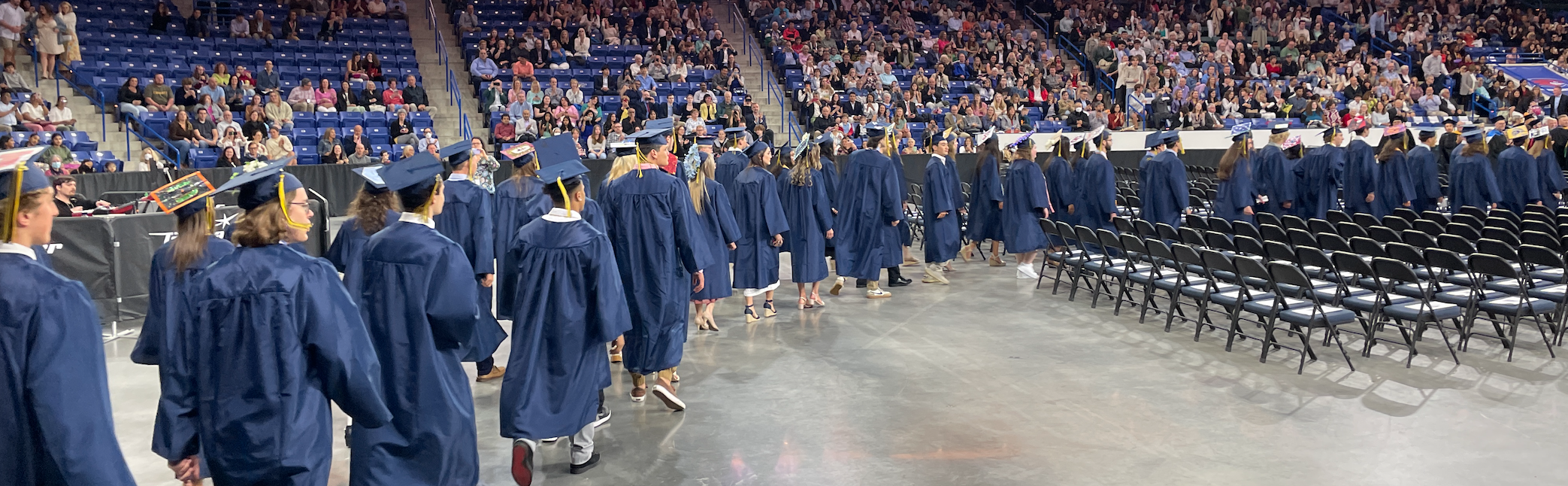
Three years after COVID cut short their freshman year, the 2023 Seniors graduated on June 5, 2023. Held at the Tsongas Center in Lowell, the graduation of the class of 2023 reflected on their resilience, hope, community action, and creation of an incredible bond throughout their four years at AHS.
STAFF PHOTO / Harry Guo Seniors lining up before being seated.
Reminiscing on Schoology conferences and the struggles of online learning, class essayist Gabby Erowac recalled how the class of 2023 was stripped away of their normalcy and exposed to fear. However, more importantly, this year’s seniors pushed through the pandemic and left a lasting impact through clubs, communities, programs, and social justice movements.
“Who would have thought the least amount of normalcy in high school left the biggest impact?” Erowac said.
Superintendent Dr. Magda Parvey echoed similar sentiments and stated, “Failure is not final, but a stepping stone towards success.” Parvey shared her appreciation for the seniors’ resiliency and encouraged them to embrace life’s challenges—to overcome them and grow.
Principal Caitlin Brown congratulated the class of 2023 for finally making it to the end of their high school careers. Brown reminded the seniors that they “have within [them], the strength, the patience, and the passion to reach for the stars and change the world.”
STAFF PHOTO / Brandon Nguyen Senior greets librarian Mary Coombs.
The senior class presented the 2023 distinguished citizen award to AHS librarian Mary Coombs. From keeping the library a safe and fun place for learning, to always having a book for any topic, Coombs won the hearts of the 2023 senior class. Coombs has been with AHS for four years and the seniors decided it was about time the librarian be congratulated for her excellence.
At the ceremony, nerves and excitement bubbled together. While waiting for the graduation to begin, Maddie Blanchette stated she was a little nervous. “I’ve never graduated in a big arena like this before,” said Blanchette.
While waiting for the ceremony, the graduating class spoke on their past four years, sharing memories and regrets. “I dissolved my homework one time in water and I had to say I dropped my homework in the pool and the chlorine ruined all the writing in it,” said senior Noah Allard as he recalled the humorous story. “So I took a cup of the paper water into school with me [as] proof, but it was just a normal piece of paper and I didn’t do the homework.”
STAFF PHOTO / Brandon Nguyen Senior waves at crowd at the Tsongas Center.
When asked to describe his high school experience in three words, Salutatorian Vincent Xu said that “it was fulfilling, fun, and enjoyable.”
Others mentioned the stressful aspects. Manavi Vajhallyai mentioned it was “chaotic [and] stressful, but fun.” Nikita Falsetia agreed and said it was “long, fun, and a rollercoaster.”
A common theme from the seniors seemed to be wishing that they had procrastinated less and worked harder. Kiarra Lucas added to these ideas, saying she wished she had “definitely just [aimed] higher and [stopped] believing [she] couldn’t do some things and just [did] them.”
In contrast, other seniors wished they could have been more present. “I would just live in the moment more [because] it’s easy to just let things fly by,” reminded Tyler Ardito. “Take in every moment, no matter how good or bad.”
Principal Brown told the class, “You have left your mark on Andover High School. I cannot wait to see the mark you leave on the world.”
STAFF PHOTO / Harry Guo Seniors throwing their caps in the air.
Additional reporting by Carissa Dessin, Xander MacKay-Kao, Vismay Ravikumar, and Grace Wang
The nation is buzzing about a new course presented by the College Board that is currently being piloted in some schools, AP African American Studies.
This new course presents the opportunity for students to learn about the deep history of the African American people, which is often skimmed over during US History classes. It is not the fault of the curriculum of US History, but it is simply because of the lack of time during the school year.
Many members of the history department have expressed interest in AP African American Studies, even to the point where history teacher Fred Hopkins “would probably like to take it,” himself. The implementation of this course would be a great opportunity for “teachers and students to explore issues regarding both race and also important demographics in the United States in a much deeper way than the current US History class allows for,” history teacher Kathryn Reusch said.
Secretary of Education for Massachusetts Patrick Tutwiler showed immense support for the new class, saying, “Any opportunity to engage in a deeper exploration of a people’s history and culture is beneficial.” History teacher Matthew Bach provided another benefit of this new course: “academic freedom” and “an additional choice for students.”
In January 2023, the New York Times reported that Florida Governor Ron DeSantis had banned this course’s curriculum from being taught. It would not be unreasonable to believe that some other people could have the same opinion as him. While it is difficult to predict people’s reactions, there is bound to be at least one person that is uncomfortable with acknowledging the mistakes of America’s past. “As teachers and as a school, it’s our job to explore issues that make us uncomfortable,” said Reusch.
Hopkins had some good advice for people that would be against this new course: if anyone “doesn’t want African American Studies to be offered, then they probably shouldn’t take it.”
Though there may be some naysayers in this whole ordeal, Tutwiler believes that “this [course] will be well received.” He thinks “the introduction of an opportunity to dive deeper into the exploration of a people’s history and culture is a good thing,” and he “applaud[s] the College Board for introducing this new class.”
History department head Gregory Hurley does have “some concerns about what [he has] seen the College Board do in terms of how they’ve changed the class,” referring to the topics that have been cut from the curriculum in order to please DeSantis. In response to the course topic itself, Hurley feels that could be “good for raising the voices of some of our more underrepresented populations in this town who may not always feel seen or heard in the curriculum.”
Most of the opposition for the course comes from the uncomfortable feeling of showing America’s mistakes. “There are people who don’t want anything about American history to be taught if it’s critical to America,” said Hopkins. He followed up by saying, “You can’t examine a topic accurately if you’re not critical of it.”
As for this course’s implementation at AHS, it lies in the hands of the people. “If we hear from enough people that it is something we want to pursue then we could look at it as a group of administrators, teachers, students, and community members to see if it’s right for our school,” said Hurley.
We all know the holiday well. Pink and red streamers thrown across the rails and rafters, heart-shaped decorations plastered up on bulletin boards throughout the halls. If that wasn’t enough of a sign that Valentine’s Day was afoot, maybe the other signs would make it clearer: The sudden uptick of PDA, which is nearly impossible to avoid, or the classmate upset about the lack of flowers from their partner.
While Valentine’s Day can be a wonderful occasion to celebrate a relationship, it is one that has become extremely capitalized on, especially over the last couple of years. According to the National Retail Federation, that spending added up to $23.9 billion last year—the second highest to the $27.48 billion spent on Valentine’s Day in 2020. “Capitalism has done what it has done with every holiday,” said Andover High School senior Andrew Magner. “[It made] it into a day that requires gifts and fancy items.”
Unfortunately, that large amount of spending intensifies and is intensified by the societal pressure and expectation to give gifts, mostly to romantic partners. This occurs even in high school. “There should be no expectation to spend money, regardless of age,” said Diya Ganesh, AHS senior. She added that many students may not have jobs or a source of income, and if they do, they may be more focused on saving it for college or their after school plans. “Showing your love through gifts is not the only way to show love.”
Bar graph of Valentine’s Day spending in the US (Source: NRF)
On that note, some students said that the cost of a gift is not the only determining factor of its value. “I think gifts are a really nice way of showing that you love someone, but I don’t think that it’s the price that matters,” said AHS senior Grace Young. “It’s how personal the gift is because it shows that you thought of them.” Magner agreed, saying, “What really matters is the effort put into it.”
Additionally, there are alternatives to gifts that are not only more cost-friendly, but can be just as meaningful. “The magic of holidays like Valentine’s day is that it is really up for interpretation and can be celebrated in a number of ways,” said Magner.
All of the students interviewed agreed that the most valuable gift on Valentine’s Day is spending time with their loved ones. “I think being present and showing active interest in their personal life shows affection,” noted Emma Pantazi, AHS senior. “I am so much more touched if someone asks me how my guinea pigs are doing than if someone gives me a card.”
Ultimately, though, it is completely up to each person’s own love language for what they choose to do, if they plan on celebrating. “My favorite way to celebrate is to go to CVS the day after Valentine’s Day and buy all the chocolate that is on sale,” said AHS senior Rachel Irza. She also noted that people shouldn’t feel ashamed if they opt out of the festivities.
Magner agreed: “As long as you and whoever you spend your time with are doing something you both enjoy, no matter how big or small, it’s a successful Valentine’s Day.”
Climate. Change. On their own, these words are as common as any others; something not worth a second thought in the busy commotion of our daily lives. Yet, when these unassuming words are put together, they create a bombshell of a phrase that threatens to destroy the very fabric of our society. The topic itself is shrouded in controversy, and discussions often end poorly. However, it doesn’t have to be this way. We must open up the conversation if we are to solve this issue.
“Biodiversity is in crisis, the climate is in crisis, there’s going to be big, big changes in the 21st century, and I think it’s really important that people know and understand,” said Alexis Valenti, who teaches environmental science at Andover High School.
In order to truly understand climate change, asking questions is essential, and one of the key questions in many of our minds is, “Why is it so hard to get rid of climate change?”
Melanie Cutler, who teaches AP Environmental Science and the Environmental Sustainability Internship Course (ESIC) has the answer. “The biggest challenge,” she said, “has been that, for whatever reason, fighting climate change has become a more political issue than it needs to be.” Indeed, as per Truthout News, in the US Senate, one in every four senators holds investments in the fossil fuel business. The giant industry has generated nearly $2 trillion in profits since 1990, making it very lucrative to invest in.
Besides the political snags, there are also scientific issues to contend with. The problem lies at the heart of modern living: almost all the contemporary comforts we enjoy are fueled by fossil fuels. Everything, from our TV to home heating to transportation, relies on fossil fuels—even things we wouldn’t normally consider, like concrete (the world’s third largest emitter of CO2, according to the BBC.)
One may argue, “Why don’t we just shut down the production of oil as soon as possible?” Though it may seem like the obvious solution, implementing it is not as simple as it seems. The renewable energy technology we have right now is just not up to the mark. Scientific advancements, along with political coordination, must be made if we are to use entirely renewable energy.
Fortunately for us, there is no shortage of ideas in searching for solutions. Valenti and Cutler both have insightful thoughts on ways that society as a whole could tackle this problem. “Environment shapes behavior, so if you want people to behave in a certain way you have to set up the environment… to make it easier to do the right thing,” said Valenti. An excellent example she gave was that in New York City, “many people… don’t own cars because of the high costs and big hassle of owning and driving a car there; it’s much easier to walk and take public transportation.”
For Cutler, the biggest thing that American society can change in order to contribute to solving climate change is “wean ourselves off of fossil fuels and switch towards renewable.” In addition, she said “we need to improve our whole electricity grid and develop a lot more battery technology to store wind and solar power.” In this aspect, there is good news: according to a recent article from the Boston Globe, carbon emissions from the national electric grid have fallen—a sign that innovations are being made thanks to the coordination of science and politics. If political leaders give science the funding it needs, it is possible to revolutionize renewable energy technologies.
Climate change is a wide-reaching problem with dire impacts, but that doesn’t mean we should lose hope. “The most important thing is to help people understand we need to be more conscious of how we live,” Valenti said. Spreading awareness and taking action are things that we can all do together, whether it be through participating in our school’s Environmental Club, using a carbon footprint calculator to find and eliminate our personal emissions, reducing our meat consumption, or even bringing a zero waste lunch. We can also lobby our local and state governments to act for climate change. Our involvement and enthusiasm is what will propel us forward.
The pursuit of science and politics will be essential in tackling global warming, and our school has opportunities for education here as well, including the Intro to Environmental Science course, Advanced Placement Environmental Science, and ESIC. There are a number of ways we can contribute to combating climate change in our own town, and perhaps use the same skills to improve larger communities.
As Cutler eloquently phrased it, “For every problem we talk about, we talk about lots of solutions, and there’s lots of good news on the horizon.”