Club Spotlight: Ink Magazine
  • November 13, 2024

Avery Slaughter

STAFF WRITER

ANDOVERVIEW sat down with Ink Magazine co-Editor-in-Chief Keira D’Angelo to discuss the literary club’s purpose and impact within AHS. 

When and where is it?

Thursdays after school, Room 222.

What does a typical club meeting look like?

It depends what we’re working on. The past couple of weeks, it’s been us trying to figure out how we’re going to get this year up and going. We have a lot of ideas for different themes we could do for our magazine. Last week, we were working on how to publicize, so we were talking about flyers and social media and stuff like that. But it’s all still up in the air as of right now. This Thursday, we’re gonna solidify some stuff [and]  make it more intentional.

How will students who attend benefit from this club?

We’re a literary magazine, so we do a lot of art stuff. We’ll pick a theme, and then you can submit anything from photographs to short stories. A lot of people submit poems, and a lot of people submit drawings. You’ll benefit from learning what it’s like to be in a published magazine. You’ll also learn how to be creative within a theme. I think that’s a lot of what holds people back from submitting. They feel like the theme isn’t what they fit in to, but it can be interpreted in so many different ways and I’m sure whatever you’ve created will be totally fine.

How does the club impact and contribute to the Andover High community?

I think it offers a creative outlet for a lot of people, because a lot of clubs here are very STEM-based. It’s all very, “this is what’s gonna look good on college apps or resumes,” and I think it’s really important to have a place where you can go to just have fun at the end of the day. I think a lot people can benefit from just letting their STEM side take a break and letting their creative side take over a bit.

Ink is currently looking for submissions to the magazine (which has no theme at this time). Please email your pieces to ahs.ink.magazine@gmail.com!

Continue reading
‘Into the Woods’ Expands with New Characters 
  • November 13, 2024

Janaesa Macasaet

STAFF WRITER

Andover High School’s fall musical, “Into the Woods,” incorporates new fairytale characters into the beloved 1986 Stephen Sondheim musical, adding more roles.

The new characters Hansel, Gretel, Goldilocks, Rumpelstiltskin, the Huntsman, and Tom Thumb each shed light on views never seen before. Director of Theater Arts Susan Choquette previously directed the musical 18 years ago, and has once again decided to add new characters to challenge the cast and include more people in the production. 

While “Into the Woods” has many feature roles, there is no ensemble. Gabriel Cordio, a freshman playing Rumpelstiltskin, finds the new characters make the stage and songs sound fuller. 

“On the stage, all the fairytale characters are going to be in their costumes, so it’s cool to see there’s Rumpelstiltskin, there’s Goldilocks… It helps fill out the play.  [Because] “Into the Woods” is all the fairytales combined, adding more is going to look cooler,” said Cordio. 

Many find the addition of new characters to be beneficial to give more people a chance to participate in the show. In addition to supporting upperclassmen who plan to pursue theater beyond high school, the production also provides underclassmen, especially freshmen like Cordio, valuable opportunities––even in smaller roles.   

“It allows the Drama Guild to be more inclusive,” said Grace Armstrong, a sophomore playing Goldilocks. “I think they added the parts to show that you [could] still be in the production even if you don’t have a main role.”

The lack of ensemble in the original “Into the Woods” leaves out many possibilities––the incorporation of new characters explores these possibilities. 

“I think it creates a larger world,” Choquette said. “To expand the world, especially when the giant starts to wreak havoc… the giant impacts more characters than are in our focus. There’s a whole kingdom out there that’s being affected.” 

Armstrong echoed this opinion, pointing out that the added characters give the audiences different perspectives and reactions to the conflicts in the musical. 

Nonetheless, the addition of new characters does not come without a lack of challenges. Without direct guidance from the original script, actors must research and explore the resources given to them by Choquette in order to depict their characters the right way. 

“When you’re trying to portray a character that’s not in the actual play, you have to make sure you portray the character, but also not take away from the actual story,” said Cordio.

Some roles, on the other hand, have a different type of challenge altogether. Armstrong mentioned that as Goldilocks, she doesn’t have any lines, making it difficult to show different emotions. Some actors must rely on body language to portray their characters.

Despite these unique challenges, the fundamental work stays the same. All roles require research, whether the role is a fictional character or one that has always been part of the script, according to Choquette.

“I hope this experience has given actors in this show some practice doing that research, because the next play they do, they’re going to have to do the same thing,” said Choquette. “What they can’t find, they get to add. And that’s really the fun of being an actor.” 

Still, when choosing new characters, Choquette made sure they contributed to the original musical’s theme. They go into unfamiliar territory, which creates conflict and drives the story. 

“They go into the woods, wherever that is, in search of something…they get in trouble, and a lot of these characters share that,” said Choquette.

Continue reading
“What do you think of the world?”
  • November 13, 2024

AHS History Department Tackles American Politics

Eva Liss

EXECUTIVE EDITOR

As the 2024 presidential election hovered in everyone’s minds, the Andover History Department continuously tackled difficult topics, hoping to improve students’ abilities to think critically about their world. 

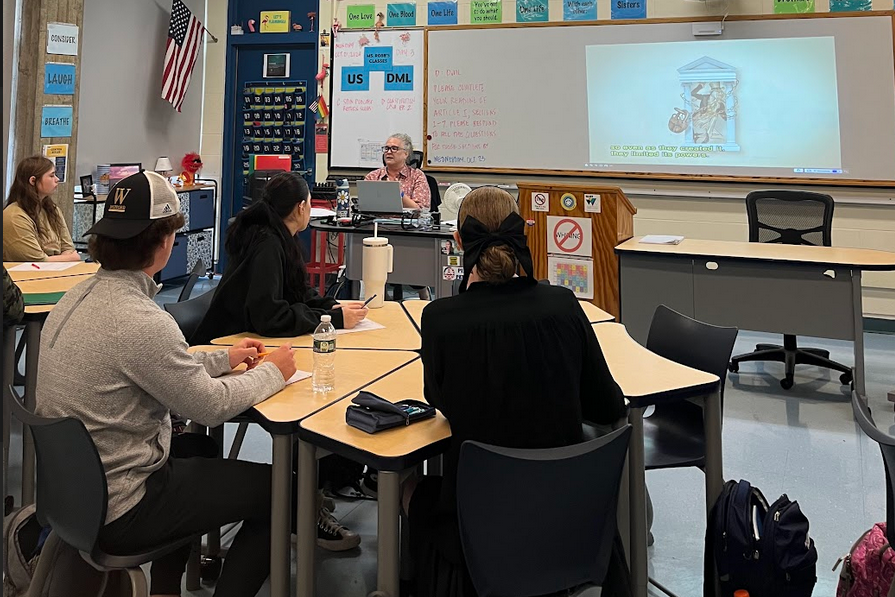
During election years, courses such as World History, US History, and Democracy & Media Literacy face a unique challenge to teach students thoughtfully and neutrally. To face this challenge, teachers like Mary Robb and Brendan Gibson use homegrown frameworks and supervised discussion to encourage students, especially voting-age seniors, to become involved and informed decision-makers. The Massachusetts Department of Elementary and Secondary Education (DESE) also sets guidelines for what can and cannot be taught at the high school level. 

A major aspect of political awareness within history classes is active engagement with the current political environment. Democracy & Media Literacy, a course unique to AHS, aims to instruct students in being critical thinkers and decision-makers. Students in the class have regular news reviews, in which they research a current event from multiple news sources across the political spectrum and analyze how the differences found affect outlook on the event. 

Robb, who teaches multiple sections of Democracy & Media Literacy, said she believes the course is crucial to students’ development as active consumers of media, especially when it deals with political freedom. “One of the key skills our students sharpen [in this class] is their ability to recognize bias,” she said. “[They] then say ‘okay, now, what are the facts in this story?’ and [draw] their own conclusions.”

This is similar to strategies found in Gibson’s ninth- and tenth-grade World History classes, where students choose their own current events stories every 8-day cycle and prepare for class discussions on the topic. 

Gibson’s World History sections deal with both chosen current events and more complicated or controversial topics, such as gun violence, abortion, or the vice presidential debates. Gibson said he has not observed much controversy between students, and he believes students are naturally respectful of each other’s opinions. 

“I think students are still trying to learn about these issues by and large… If ever there is a contentious topic, I try to keep things as rooted in fact as possible,” Gibson said of the discussions he’s observed. 

Anna Bacchi, a senior in Democracy & Media Literacy, expressed a similar opinion. “I think we’ve all been very good so far at not getting straight-up angry at each other and what we’re seeing,” she said. “We usually try to express our ideas as our own and are able to disagree without yelling.”

“We focus more on policy than personality,” Gibson said when interviewed prior to the election.  “We [looked] at polling data from the seven main swing states [each cycle]… Polling is not a perfect science, but… it’s interesting to keep a [finger] on the pulse of these states which… largely [determined] the [election’s] outcome.”

Students in Democracy & Media Literacy also use the widespread media coverage of the presidential election. They explore political patterns found in the modern world through both research and class discussions. 

Assignments consisted of watching the presidential and vice-presidential debates, as well as taking notes on documentaries about the candidates. The framework students were provided for note-taking, created by history teacher Kathryn Reusch, goes deeper than simply observations. In it, students are asked to record policies the candidates discussed and their behavior: evasion of questions, criticism or insults, and whether their words were fact-checked and proven false. 

“I think [they have] really highlighted how separated our country is politically in comparison to previous generations,” Bacchi said on class discussions and analysis assignments. “I don’t think [they’ve] changed many of my political beliefs, but [they’ve] made me very conscious of how I talk about my opinions and ideas.”

Ultimately, history classes at AHS do not seek to convince students one way or the other. Instead, they are there to prepare students to engage thoughtfully with the world around them, especially as they grow up into a fraught political climate. 

“[Students should] be healthy skeptics [and] consciously thinking about what they know,” said Robb. “The goal is for them to know as much as they can about candidates [and] ballot questions so… they can take all that information and [decide] what they need and want from their government.”

Continue reading
Ballot Question Challenges Necessity of the MCAS 
  • November 13, 2024

Areeta Faiz

STAFF WRITER

Question 2 on the November 5 ballot sought to abolish the mandate that high school students must pass the Massachusetts Comprehensive Assessment System (MCAS) in order to graduate.

The MCAS has been a hotly contested topic for years now, and both proponents and opponents of Question 2 presented a variety of factors to consider. Passage of the ballot question would not change the administration of the test but would lift the requirement and likely some of the pressure associated with it. The shift would take effect immediately for this year’s senior class. 

ANDOVERVIEW went to press prior to Tuesday’s election results being finalized, so this article aims to capture how community members felt about the ballot question in the weeks leading up to this important vote.

Graduating isn’t the issue: according to the Massachusetts Department of Elementary and Secondary Education, about 99% of students pass the exam. So, one of the most important changes to consider in Andover is the effect of the requirement on results.

Alan Hibino teaches a range of courses in the math department from Algebra I to Statistics. He noted the importance of reliable data to help serve students, align curriculum, and ensure material is adequately but not excessively reviewed each year.

“Whether it’s a requirement or not, that data is valuable to… math teachers to help us shape our program of studies here at the high school.” Hibino hoped that “students would continue to take the administration of the MCAS seriously.”

This, however, might not completely be the case.

“I try to do my best, but I know a lot of people don’t,” offered sophomore Mina Kacemi. “If you take away the requirement, I feel like nobody would care at all. I hear a lot of people say that they just don’t try during MAP testing because it doesn’t actually impact them. I think the same thing would happen for MCAS.”

The Massachusetts State Secretary of Education, Patrick Tutwiler, expressed a similar opinion. “High school students will not take it seriously going forward,” he said, “so it won’t be a useful assessment anymore.”

The biggest effect felt by students at AHS is anxiety caused by the exam. Many students have expressed that the MCAS is at least somewhat stressful, perhaps more than it’s worth.

“I’m kind of stressing about the math one already, in the back of my mind,” said Kacemi, who is set to take her math and language arts MCAS tests this spring. 

“I am concerned about [high-stakes testing] in terms of the well-being of our students,” said Hibino.

Many supporters of Question 2 argue that the exams disproportionately affect students from low-income households, English Language Learners (ELLs), those with learning disabilities, and those who may otherwise struggle.

“It’s really difficult to do well in the MCAS due to the language barrier, even though this year I feel more confident,” said one ELL at the high school. He also suggests that doing one’s best does not have to be synonymous with pressure and that a singular test determining a student’s ability to graduate feels unreasonable.

Much of the debate, Hibino added, lies in whether the state truly needs a concrete measure of a student’s abilities. “Ultimately I think MCAS provides a basic standard; the basic ability to do fractions, for example, or to understand context for the English MCAS,” he said. “And I think a lot of these skills happen organically from the classes we take. So, the question is, do we really need a test to definitively prove that?”

“[Another] one of the things that we talk about in our faculty is the ‘vision of the graduate.’ What do we expect of a student that is graduating [from] Andover High? And so if not the MCAS… what [is] part of our vision?” said Hibino.

Tutwiler pointed out that the ballot did “not propose something as a replacement. All it [did was] deconstruct the current system…you’ll just have a local assessment and understanding of how students are doing,” he adds, “and I’m saying that’s not enough.”

Continue reading
Election Literacy Among AHS Seniors Higher Compared to Previous Years
  • November 13, 2024

Ella Hu

STAFF WRITER

Many students at AHS plan on participating and actively voting in the upcoming election on November 5, and AHS elective Democracy and Media Literacy provides students with further information on the topic. 

Senior Kara Stefani, along with other seniors who will be voting in the upcoming election, recalled learning about the voting process mostly from their parents. The idea of voting seems daunting at first, but Stefani said her parents will guide her through the voting process. Other students enrolled in the Democracy and Media Literacy class are learning about the process as well through projects and finding their own political stance. 

“I listen to the news—mostly CNN every morning—and that’s where I get most of my information from. However, I usually just get the information from my parents, who were the ones that pushed me to vote in the first place,” Stefani said. 

Students in the AHS elective course Democracy and Media Literacy taught by Mary Robb learn about the U.S. elections and gain an in-depth understanding of United States democracy, and how the election functions. “The elective is designed to teach students about the election and other parts of our democracy,” Robb said. “This is so when they leave high school, they can be well-informed and active members of their community.” 

According to Robb, Many students who do not have guidance and are not well-informed about the election process tend to back away from voting, one of the most crucial parts of our democracy. She observed that one of the most critical issues behind election illiteracy is the increase in AP classes. Since most students try to take as many AP classes as possible for college, they tend to overlook electives that will prove useful for them in participating in their community in the future. 

With the amount of false information surrounding the election spreading on social media and online, students can easily be influenced. “Essentially, you learn how to keep track of what the government is doing in the class, with the goal for students to find their political voice,” Robb said. “We talk about what it is to be conservative and what it is to be liberal, and we hope they can navigate their way through the sea of political chaos that has been going on and find their own political philosophy.” 

Continue reading
OPINION: Freedom vs. Control in the Digital Era: Balancing Privacy and Security
  • October 7, 2024

Anushka Dole
STAFF WRITER

Pavel Durov, the founder of Telegram, a secure messaging app, was arrested on August 24 in France under allegations of allowing terrorist activities and other abuses to take place on the platform. The arrest has had a ripple effect across the globe, as Durov was an openly pro-privacy figure who is being penalized for it like many before him. 

Privacy was a cornerstone of Telegram, which protects user’s privacy by not sharing user data to third parties and enabling end-to-end encryption for certain chats. Durov’s arrest has led to collective anxiety about what can be shared online—even in a simple phone call or text to a friend—and has opened up conversations at AHS about online freedom. To protect our freedoms, we must completely reform the legal system to accommodate for the digital era and encourage companies to moderate content with algorithms rather than immediately handing data over to the government.

Digital freedom and privacy of data is especially important for teenagers, as we live much of our lives online. Since we are free to communicate in person without fear of the government listening in and regulating our conversations, then it shouldn’t be any different online. However, government surveillance of the internet has been prevalent since its inception—this is not necessarily a bad thing, because government intervention is necessary in criminal activity, but there is a line between protecting user safety and infringing on their privacy. 

Junior Milena Tiernan said she thinks, “It is our liberty to be able to communicate privately with each other, but [the government] should be able to see if people are trying to hurt other people in the real world.” 

Senior Aaryan Deshwal expressed similar views. “There should be a balance between free speech and using speech to incite violence and crime,” he said. “Free speech should not be regulated at all unless there are clear indications of bad intention.” 

 In Massachusetts, and the overall United States, COPPA (Children’s Online Privacy Protection Act) is set in place to protect children’s data from being exploited online, but the act only protects people 13 and under. High schoolers—even adults—are still vulnerable and impressionable, and if they make a mistake or fall in with the wrong digital crowd, their digital footprint will condemn them for the rest of their life. Making a mistake online directly escalates to law enforcement, something that has not been seen in the past.

In the past, even for adults who had their own home and privacy, the reliance on others in order to be able to send communications provided checks and balances on misdeeds. The mailman noticing a questionable package or neighbors noticing suspicious activity from the house next door served as informal obstructions to those who would attempt to perform illegal activity. 

Today, parents find it difficult to police their children’s content due to the sheer volume of production. And for the community surrounding the perpetrator? It’s very difficult to find signs of unlawful activity when there is no access to physical records or patterns of behavior to examine. 

Law enforcement has simply not caught up to the leaps that technology has made. The systems that are currently in place to safeguard us are built on a shaky foundation and are far too outdated. Algorithmic analysis of content could be a necessary intermediary—like neighbors or mailmen—to keep the balance between total anarchy and total surveillance.

Sophomore Arnav Josh had similar thoughts. “Tech companies should have basic, non-invasive filters meant to accurately recognize obvious illegal activity… it would be a huge breach of privacy for companies to be able to look at every conversation between people,” he said.

“You would need some sort of think tank, philosophers, people across the political spectrum, privacy experts, legal experts… You need a whole 360-degree view of people who can talk this through,” Bezaire added. “You need people from different walks of life, different education, different backgrounds to be able to put together a new ‘tech bill of rights’ that protects people but also helps keep us safe.”

Durov’s arrest may leave more questions than answers. And that’s okay—these are deep, complex issues that strike at the very core of humanity. Resolving them will require much more thought, countless conversations, and inevitably, even more questions. The tension between privacy and security will always be challenging to navigate, but it’s a balance we must find. The future of our society depends on it.

Continue reading
“Can U Do Me a Favor?”: Hacker Pirates AHS Instagrams
  • October 4, 2024

By Ella Hu
STAFF WRITER

All hacked accounts are managed by the hacker, who turned accounts into baits for money and places to post art content. Many AHS students mentioned receiving DMs on Instagram from hacked accounts asking for $50 or to use their profile picture. 

Junior Ana Murray first received a DM from a friend on her Instagram account asking for help, for Murray’s phone number and for her to answer a link sent to her number. Everything happened quickly, and Murray offered her help without suspecting anything. With a hold of Murray’s phone number, the hacker had full access to her information, including access to her passwords and accounts. 

STAFF PHOTO / Ella Hu
Sophomore Anya Gorovits receives text message from compromised Instagram account asking for a favor.

“The text sounded normal coming from my friend,” Murray said. “The timing and the tone really sounded like her and something she would say.” Murray followed the hacker’s instructions, which ended up compromising her Instagram account. 

Later, she discovered her friend’s Instagram account was hacked, and now her account was too. “After I provided my phone number, I lost access to my account and couldn’t open it,” she said. “The whole thing disappeared, and I started getting weird texts… when I blocked them, I would get another message from a new email or phone number asking for money.”

Principal James D’Andrea was made aware of the hacking phenomenon, which has also been affecting students’ access to their school email accounts. “If students’ Instagram accounts are hacked with their email logged on, they will be locked out of their emails as a protection management,” he said. “A lot of things in the school system are designed to ensure that systems in the school district remain safe from potential cyber-attacks or threats.”

It is difficult for apps to keep up with all the ways hackers can compromise user accounts using unsuspecting messages. However, D’Andrea said, “We know new technologies are developing and evolving so we have to constantly monitor what is happening behind the scenes… it is our priority that beyond academics, students are physically safe… emotionally safe, and ultimately, technologically safe.” 

Continue reading
Union Members Across MA Stand in Support of Andover Educators 
  • November 13, 2023

By Melody Tang
ONLINE EDITOR

Teachers’ union members statewide gathered at the Friday, November 10 demonstration in support of the Andover Education Association (AEA) at the Town Commons. In addition to lending support, union attendees from other towns voiced empathy for the AEA’s current situation. These districts included Newton, Wellesley, North Andover, Haverhill, Malden, Woburn, Somerville, Melrose, and Dartmouth according to the Massachusetts Teacher Association (MTA) President Max Page.

Having faced a similar situation last October resulting in a four-day strike, members of the Haverhill Education Association attended the rally to support the AEA. “We saw our School Committee not put students first, not put staff first, and push teachers and parents and the community to have to go on strike to do what’s best for our students,” said president of the Haverhill Education Association Barry Davis. “When we were on strike, the [AEA] came and supported us, and we’re here to support them.” 

The North Andover Teachers Union also faced similar negotiation affairs with their School Committee that have been resolved as of November 10, the day AEA went on strike. Juliette Damon, president of the North Andover Teachers Union, expressed gratitude to North Andover’s School Committee, who “gave [them] an amazing contract.” Damon additionally was sympathetic towards the AEA. “If I had been in the same boat as the Andover teachers, I would have loved for the president of Andover to come and support me if my members were in the same position,” Damon said.

STAFF PHOTO / Julia Rodenberger
Teachers and supporters gather at the strikeout.

The AEA strike may also act as an inspiration for other towns’ teacher unions. “I am here to support a fair contract or help with the bargaining going on right now,” Page said. “As we have seen, there were over 15 different districts represented [at the rally]. They inspired Andover and Andover will inspire them. There’s a lot of communication [that’s going] on about what we need to do in our schools.”

Continue reading
MTA President On What Ongoing Dispute Could Mean for MA
  • November 13, 2023

Anusha Sambangi 
CO-EDITOR-IN-CHIEF

Max Page, current president of the Massachusetts Teachers Union (MTA), attended the Andover Education Association’s (AEA) first day of the strike on Friday, November 10. As an educator himself and having served as the MTA’s president for almost over a year, Page shared his perspective on the events that have been unfolding over the past few days. 

STAFF PHOTO / Julia Rodenberger
Strikeout attendee holds up an “ANDOVER EDUCATORS ON STRIKE!” sign.

Why are you here at the strike today? 

Well, I’m the president of this state’s Teachers Association. This represents 117,000 public school and college educators in 400 local areas and Andover is one of those areas. We represent them, stand behind them, and support them in their fight for a fair contract. 

What inspired you to come here and support Andover educators? 

I mean, it’s so inspiring when you have a group of educators who want to demand what’s right for the schools, including the betterment of students and educators, especially the instructional assistants. It’s the educators who know best what students need. I love that they’re standing up and willing to do whatever is needed to get it right.

Have you seen similar movements across Massachusetts, for example, teachers fighting for different contracts?

Absolutely. You know, really, there’s been this growing momentum over the past decade of educators not willing to just accept whatever is being offered, and they’re demanding more–they’re raising their level of expectation for their students and for themselves as educators and that’s been going on for the past number of years. It’s been really exciting.

How do you feel about it being illegal here in Massachusetts to strike?

You know what Representative Erica Uyterhoeven from Somerville was saying in her speech–we’ve worked on [a bill] with her, which [would] remove the prohibition of striking [in Massachusetts.] There’s a great history and terrible history [to the bill] which goes back to the time when Boston Police officers went on strike in 1919. And I can tell you there’s a lot of stories around that. But that eventually became this tradition of “Oh, we don’t let public sector workers go on strike” and it was eventually enshrined in law. And it’s a bad law. It’s wrong. It’s frankly, immoral. So we’ve been working to change that law. But clearly educators after nine months decided that this is what they needed to do.

Do you see any of the demands here getting enshrined in state law in the near future?

You know, one of the things that we do believe is that paid parental leave should be universal. It is universal for private sector workers and many public sector workers, but not municipal workers. So it’s a huge problem. The MTA helped win this for most workers, but it excluded municipal workers. So educators who are two-thirds of women who are most likely to take the paid parental leave, do not have it by right. So while people are fighting for it here in Andover, we hope eventually to have that be state law.

Continue reading
South Elementary Teacher Comments on AEA Strike
  • November 12, 2023

Anusha Sambangi 
CO-EDITOR-IN-CHIEF

COURTESY PHOTO / Melissa Nussbaum
Melissa Nussbaum smiles for the camera.

Melissa Nussbaum, fifth-grade teacher at South Elementary School and member of the Andover Education Association’s (AEA) negotiating team, rallied outside of South School along with other educators on Friday. As cars honked in support of the AEA as they passed by the rally, Nussbaum revealed her outlook on the ongoing dispute. 

Why are you here striking today? 

[The School Committee] is only giving us a portion of what we wanted and what we’ve asked for. [We come] off [as] ridiculous [for] what we’re asking for, but they’re not being honest. One of the reasons we wanted to rally is so the whole town could watch us [and] listen to everything, [the School Committee] didn’t, which is their prerogative. [But] then they follow up all of our bargaining sessions by using their unique ability to email all families at once in the whole town, which we cannot do… They’re sharing only what little teasers they want to share that put them in a better light and make us look terrible. If we were allowed to do the same, people would know the real story. 

When do you think this strike will end, or how long are you planning to strike? 

We’re going to strike until we get a fair contract and a return-to-work agreement that keeps everyone safe.

Do you mind explaining a little about what the “return-to-work” agreement is? 

Depending on how long a strike is, in general, you have to bargain a return-to-work agreement because… there are some teachers that have professional status. You have to make sure that each retaliation that comes their way—so if there are fines or losses or loss of wages—that all needs to be bargained back. A strike day is just like a snow day, right? We’re going to have to make the day up. I think it just makes [for]  better transitioning so that going back to work goes smoothly for everybody.

How has the administration generally responded to the strike? 

We really respect our principal. She’s been great and very respectful to us. There’s the administration that’s uptown, and then there’s the administration that’s in your building. For me, they’re two different entities. 

How do you think the strike affects the students at South and across APS?

I think it affects kids in different ways [in each grade]. I think how parents talk to kids matters as well. Of course, I’m not talking to elementary schoolers about strikes or anything political. In middle and high school, I think the kids [are] affected differently, and I think it has to do with how much involvement they… have in this issue and… in the community. Some want to be part of it and others don’t understand or they’re not interested in it. I like that the kids are organizing themselves and speaking out about what they believe and that’s great.

Continue reading