A Tale of Two Towns
  • March 17, 2025

Carissa Dessin, Harry Guo, Eva Liss, & Brandon Nguyen || EXECUTIVE EDITORS

After an unexpected varsity basketball loss to North Andover on January 3, Andover students faced North Andover’s pride and resentment in the form of heckling and physically threatening behavior. This occurrence was only the most recent in a long line of Andover-North Andover rivalry standoffs. 

Tensions between Andover and North Andover have always run high, dating back to 1854 when the Massachusetts General Court split Andover’s South and West Parishes from the North Parish, giving North Andover its own identity. While the towns have coexisted amicably, their sports rivalry—fueled by proud and devoted students—has been anything but friendly as of late.

While members of the basketball team said they could not comment on the event on January 3, senior and Jungle Leader Jed Gallaudet gave some details on what occurred from his perspective: “[There was] a lot of colorful language. There [were] some personal chants going on during the game,” he said. But the main altercation occurred in the parking lot after the game, where “there was a lot of swearing, F-bombs, stuff like that.” From what Gallaudet could recall, “[he] mostly heard [comments] from North Andover. There’s definitely bad blood, so they weren’t the only ones doing anything, but they were the ones starting it.” 

ANDOVERVIEW sought comment from North Andover High School administration for this article. Interim Principal Deborah Holman directed the ANDOVERVIEW to North Andover High School Athletic Director Steve Nugent; however, repeated emails and multiple phone calls to Nugent were not returned. Emails to Assistant Principals Scott Young and Allynn Graham were also not returned. 

Physical altercations between the Andovers are nothing new. “Last year I saw North Andover students spit on our gym floor after we beat them in basketball,” said Gallaudet. “There have been fights [after] the Thanksgiving games… so it’s kind of par for the course for this rivalry.” He acknowledged the history between the towns: “It’s a fun thing to be a part of. [We’ve] just got to keep it on the court, on the field, on the track, on the rink, and not in the parking lot.” 

Boys’ Basketball Coach David Fazio remarked that the rivalry against North Andover remains strong among players. Before every season, Fazio has his players write their three biggest goals for the season, and “the majority of the kids put down ‘I want to beat North Andover.’” 

Fazio gave this advice on avoiding conflict altogether to his team: staying off social media. “Someone will say something on Instagram, and then someone will give a [rebuttal], and then it doesn’t stop,” he said. “Just avoid the noise that’s out there.” 

Fazio also commented on the North Andover student section, comparing them to Andover’s other rival, Central Catholic. Being a Central alum himself, he reflected that the best rivalries are the ones that are based on fun banter, not aggressive competition. “The thing with Central is that we’ve always had fun with it,” Fazio said. “Sometimes I think the North Andover crowd crosses the line with the things they say and do.” He also gave his praises to the Jungle: “Our [students are] second to none. They’re classy, witty; they could easily be thrown into the fire of retribution unscathed.” 

According to Athletic Director Wayne Puglisi, the athletic office takes advantage of the long-standing rivalry in order to promote games and increase student attendance. “By shaping the rivalry, it allows us to promote the games that are coming up,” said Puglisi. “If there’s a big, big game that happens to be coming up in our schedule, we want to try to get as many people here as possible.” 

However, the athletic department is also cognizant of how easily a rivalry of this nature can escalate, and have since implemented measures to limit interactions between students of opposing schools at home games. According to Principal Jimmy D’Andrea, for games following the January 24 game against Central Catholic, the ticket stand was moved to be in front of the doors to the Dunn Gym, and students were instead to enter the gymnasium through separate entrances; one for AHS students, and one for visiting students. 

“The way that we had things set up, students who were in the visiting student section had to walk in front of our student section to get to that other side, which increased interaction between opposing audiences,” said D’Andrea. Visiting and home audiences will also continue to be dismissed at staggered times, with visiting students exiting first, allowing AHS students to speak with friends on the team. This plan was successfully enacted at the February 7 varsity boys’ basketball game.

“We want to make sure that what our students are doing in the Jungle is appropriate for the game, that we’re not being disrespectful or rude,” said Puglisi. But, as long as the comments and back-and-forth during games remain appropriate, the Jungle is looking to continue the verbal rivalry. “We’re just going to try to be louder than them, be better than them at cheering, then hopefully we beat them. But there’s not going to be any extra… chirping or fighting or anything like that, because that’s not what we do,” said Gallaudet.

image credit: eagle tribune

Continue reading
Non-Cut Sports: Do the Benefits Outweigh the Disadvantages?
  • March 17, 2025

Anya Gorovits & Diya Manikandan || STAFF WRITERS 

Andover High School’s many non-cut sports have become increasingly popular, accepting students regardless of skill level or experience.

From track to e-sports, AHS offers countless options for students who have been cut from a different sport. This year, football, gymnastics, unified basketball, e-sports, wrestling, and all track sports are non-cut. 

As we approach the spring sports season, AHS Athletic Director Wayne Puglisi urges students who have been cut from a team to join a non-cut sport. Around half of the students who are cut typically do this. Most choose track, an incredibly popular AHS sport. According to Puglisi it’s a team that’s easy for students to join.

“Students sort of naturally gravitate to [track]. They just want to do something that’s competitive and social and more individual than a team sport,” said Puglisi. 

Other non-cut sports are also common options for students who’ve been cut. AHS wrestling coach Kelvin Davila encourages all students to join wrestling, no matter what sport they’re coming from.

Drawing more attention from students, these non-cut sports are growing rapidly. This year, the wrestling team is the biggest it’s ever been, at around 45 members. Winter track had more than 250 participants this year, and even more will join for the spring season. 

However, there are disadvantages to a non-cut team. Puglisi says, the main disadvantage is that non-cut sports are usually a student’s second choice. Many non-cut sports are also not the best fit for all students. “When you have an option like wrestling, that takes a very unique individual to be able to do,” said Puglisi. 

Davila agreed, saying that each year, some students leave the wrestling team mid-season because it isn’t the sport for them; they don’t feel the same connection they did to their old sport, or can’t adjust to the differences of this new one. Davila however, believes that wrestling should remain a non-cut sport, and is always happy when new students join. “There are more advantages than disadvantages to it being non-cut,” he said. That same sentiment was echoed by Track coach Peter Comeau, “That’s the secret ingredient to hav[ing] fourteen state championships: not cutting people.”

The track team has reached numbers above 300 in previous years which has caused a host of difficulties. Comeau is faced with numerous challenges as the growing indoor team must practice with restricted space and time. 

Also, both Puglisi and the Track coaches have noticed students coming to practices without signing up, which can lead to disorganization.  “What they do is they just assume it’s okay for them to start going and they go. What they need to do is make sure that they have everything taken care of,” Puglisi explained. 

In high school, Comeau’s main sport was football, and track was a tool for keeping fit during football’s off-season. However, Comeau and his coaches soon realized his passion and talent for track. Comeau then switched his focus to track, leading him to a scholarship at Northeastern University. Now as a coach, he’s noticed that students often sign up for track to stay in shape for their main sport before discovering their hidden talent in track events.

Continue reading
Andover High’s DECA Transition
  • March 17, 2025

Arshiaa Prem || STAFF WRITER

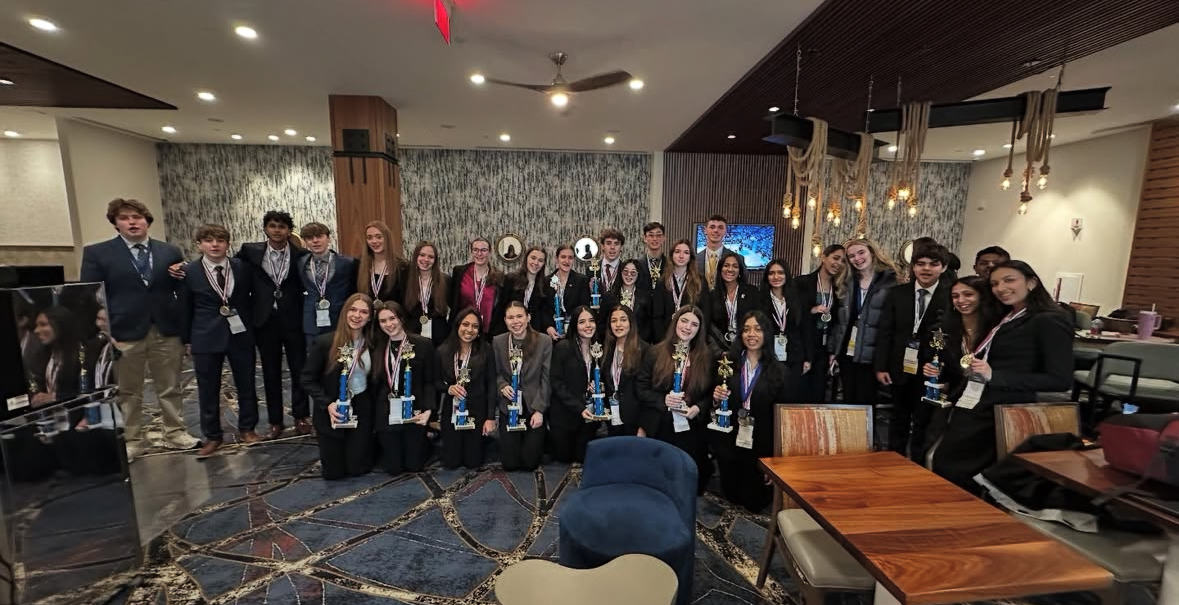
The DECA team changed their district from Boston to Lawrence over the summer.

The change in districts for DECA has received mixed reactions from both students and teachers. They now go against harder opponents and attend competitions in different locations than in previous years.

“I don’t know how much the district change has benefited, but it also hasn’t had a negative impact,” noted Kari Belson, a junior and three-year member of DECA. Belson said that facing strong teams, like Westford Academy, has encouraged members to work harder and perform better in competitions. 

The advisor of DECA, Business teacher Ashley Kinsman said, “The people in charge of DECA made district changes based upon enrollment for each district to make the sizes of each district closer.” She said they want all of the districts to have about the same amount of people competing.

DECA is a program that is designed for high school students who are passionate about business. It is a competition in which students prepare for one of three categories: role-plays and case studies, prepared events, or online simulations. DECA has many categories which include marketing, finance, hospitality, management, entrepreneurship, and personal money skills.

Kinsman believes that the change has had minimal impact on students. “You’re still getting the same level of competition,” she said. She views the change as potentially beneficial for students. District 5 (Lawrence) is slightly smaller than District 4 (Boston), so there’s just slightly less competition. 

Since each district decides when they compete, this year’s competition was held a month later than usual, which gave them more time to prepare. The extra time allowed leaders to work individually with more participants and provide guidance that some of the newer members hadn’t gotten the chance to receive before.

Marina Ten, a senior and co-president of DECA, shared her perspective from a leadership role. Her initial reaction to the district change was one of surprise, primarily due to the change in competition location. “The biggest thing about the district change is that you’re going up against schools that you’ve only really seen at states,”  Ten explained. “We were able to hold more meetings and provide more information to the members.”

According to DECA members, the new competition venue at UMass Lowell was nice too, having been described as less confined than previous venues. The new setup, which Ten described as having an “airplane hangar vibe,” provided a refreshing change and more freedom for participants. Ten stated that she was also pleased with the club’s success in the new district, saying that many members placed well in their competitions.

Continue reading
Korean Exchange Students at AHS
  • March 17, 2025

Clara Strong || STAFF WRITER

The week before midterms, 24 South Korean students came to Andover to learn about our language and culture.

These high school students arrived on January 8 and stayed for a week before visiting Boston and New York, and eventually flying back to Korea. While most of them visited Andover High School, eight students explored Wood Hill Middle School. The experience aimed to broaden their horizons and teach them about our culture, while also improving their grasp of the English language. They also held a few presentations for AHS students and our community about Korean language and culture. 

Peter Hall, World Language program coordinator, said the exchange students were “bridging cultures, which is really the purpose of the whole program, to promote intercultural understanding.” He also said this exchange program is not alone in its goal: “The world language philosophy, the global pathways philosophy, and these organizations all have the similar goal of promoting cultural understanding.” Students invited veterans from the Korean War to a presentation for the community as a way of achieving this goal.

Korean student Sun You-Chan said that he and his fellow students learned a lot. With his American friends, he said,  “I talk to them about Korean culture and they talk to me about [American] culture.”

While the program started over 10 years ago, it paused during the COVID-19 pandemic and only resumed last year. It is run by a group called the Academy at Harvard Square, which is part of a larger non-profit organization, Educational Divide Reform. This organization focuses on giving opportunities to students in Asia. The AHS chapter of Global Pathways, a program that creates opportunities for students to learn more about the world, collaborates with them to create this experience for students.

While the students were in the United States, they were all assigned students whom they shadowed throughout the school day. “During the school day, essentially the students visited classes and did whatever their Andover partners were doing, and after school, they had another two hours when they would meet and prepare for their presentation,” Hall said. Sun added, “We went to the museums or toured the universities, and we also have workshops.” 

 Although exchange students generally shadow kids from their host family, some students this year had no host family and instead stayed in hotels.

“The only reason the second group didn’t have host families was because last year we struggled to find enough host families,” explained Hall. The organizers were worried that the same would happen this year, so they planned for a hotel. 

However, there are many benefits to being a host family, such as getting a more personal experience with someone of a different culture, and helping to open one’s mind to new cultures and experiences.

Armand Omelko is a sophomore at AHS and hosted two 11th-grade Korean students, Shin Chaemin and Jeong Seungwon. He said, “It was neat to have people visit like this, especially from a culture that’s actually similar to mine, because I’m half-Korean, so that was interesting. It was also interesting to see the difference between being in the Korean diaspora versus actual Koreans.”

Currently, AHS offers a French exchange program, as well as many opportunities with Global Pathways. Hall also hopes to send students to Korea in a reciprocal exchange, but he expects this to take at least a year to work out.

Sun lived in a city in South Korea, so he shared, “I like the countrysides in America… we tend to experience local things, and I like that.” Also, he explained a big cultural difference in our school systems: “Students move [around school] here, [but] to take their classes in Korea, teachers go around.” He means that teachers are the ones switching rooms each period, not students.

As for why the Koreans came right before midterms, Hall said, “That’s their best time for them to travel in Korea. I know it was not ideal for us. Some years they’ve come a little bit at the beginning of the new semester, which is a little better than right before midterms. But, that was their best dates… the way their vacation times fell.”

Continue reading
It’s OK to Make Mistakes
  • March 17, 2025

Isabella Yan || ARTS EDITOR

As a student, I’ve heard the phrase, “It’s OK to make mistakes” all too often in the classroom. Within education, failure is advocated as a stepping stone for learning and succeeding as a student. Failure allows you to target your weaknesses and teaches the resilience and determination necessary in the process of success. It’s essential to be able to embrace failure, especially in the broader context of tackling the hardships faced in life after graduation. It certainly is a true, well-intentioned, and encouraging phrase, but I struggle to believe it in its entirety.

It feels like everything is at high stakes. Good grades equate to a good college, which equates to a decent and stable life. If you mess up a single step along that road, your life will be doomed—or so it seems. While that is often far from reality, it’s hard for many students to see anything beyond that scope of vision as practical. As such, there’s a hyper-fixation on transcripts and the lovely combination of numbers and letters they provide to auction your potential as a student to colleges. 

“I don’t want to be penalized for making these mistakes, which puts a limit on my willingness to mess anything up,” said junior Sofia Fahkiri. When that is the environment that has been created, is it truly OK to make mistakes when every mistake is graded? As Fahkiri added, “It puts a pressure on students to always be perfect.”

The bar for failure has been set incredibly high and disappointment comes easily. Many students recognize any grades below an A-minus or B-plus as failure. “I’ve had tears. I’ve had breakdowns,” said chemistry teacher Sarah Fisher, referring to the reactions she has witnessed from students who received upsetting grades.

Often, the prospect of failure and the disappointment that it brings is so daunting that we would rather not try at all to step outside of our comfort zone. During class discussions, Fahkiri explained, “A lot of students are…scared to make mistakes so they’d rather not participate at all.”

This looming pressure to avoid failure has exhausted much of the joy in learning. It feels as though the question why do we learn? has been responded to wrongly. Of course, we should learn because it will benefit us to be able to apply our knowledge in meaningful ways as adults, but we should also learn because we want to.

The curiosity and hunger to learn are just not the same as they used to be when walking into an elementary school classroom that radiated an overwhelming excitement for knowledge. As high school students, many of us learn only as much as we are given. We do the bare minimum. We don’t learn what’s beyond the textbook because it’s not on the test. We learn as much as we need to do well on the test and can’t be bothered to dig further because that knowledge does not have an immediate purpose.

There’s a sense of satisfaction in overcoming failure, but I often notice that we as students focus so much on the result—the glamorous A-grade we received and how good it will look on college applications—that we fail to acknowledge the process it took to get there. As Fisher said, “[Students] get to that point and they’re like, okay, I did it. I got an A, moving on. It’s like, no, stop and smell the roses.”

So, are students really prepared to embrace failure in the real world? Last year I listened to a speaker, psychologist Jenny Wang who specializes in clinical psychology and mental health. Wang spoke at Phillips Academy, a school that is much more academically focused than AHS, and shared that many students who enter top institutions after high school often struggle when confronted with failure. Simple things like getting rejected from a job seem to gauge and destroy self-worth when you have been continuously shooting for and attaining perfection.

Whether it is failing at a recipe, failing at a relationship, failing at a business venture, or failing to meet a personal goal—we will continue to be met by failure after graduation. For good reason, educators will continue to preach that ‘it’s OK to make mistakes,’ but when students struggle to handle receiving a B grade, it raises a larger issue about our educational system as a whole. 

We’ve created an environment that treats failure as something that is catastrophic rather than instructional. In the pursuit of fostering the highest academically achieving and the most career-ready kids, we’re failing to teach students the most important lesson to success: that in the journey to get there, they will always be met by defeat.

Continue reading
A Setback for Educational Progress
  • March 17, 2025

Tommy Kruecker-Green || Opinion Editor

President Trump has launched an initiative to dismantle the US Department of Education (ED). Such a move requires an act of Congress, which may be unlikely to occur. Nonetheless, recent calls by Trump to abolish the ED have ignited a debate that raises questions about equity, access, and the role of government in ensuring that every student, regardless of background, has a fair shot at success.

Contrary to what some believe, the ED was not created to dictate what is taught in classrooms—curriculum decisions remain the purview of states and local school boards—but to serve as a guardian of equity. Since its inception under former President Carter, the federal agency has played a role in ensuring that no student is denied an education because of sex, ethnicity, income, disability, or other factors. By administering programs like Title I funding and the Individuals with Disabilities Education Act (IDEA), ED has helped level the playing field for schools serving low-income communities and students with special needs. Moreover, federal funding is tied to schools meeting non-discrimination requirements. Removing this layer of support would risk undoing decades of progress in educational equity. 

Local and state governments provide the bulk of K-12 funding, and federal contributions make up only roughly 10 percent of public school budgets. For a school like AHS, dismantling the ED might not be felt very much at all. However, for underprivileged districts, the loss of federal aid would be devastating. When there is a system in which the amount of funding for schools is tied to property taxes, and hence, property values, one can understand why it is so important for an entity like the ED to step in and do what it can with a flawed system, to balance the scales and give all students, regardless of their zip code, a fair shot.

Andover High School Principal Jimmy D’Andrea provided insight into how federal education funding is allocated. “If the [ED] were to be abolished, that doesn’t automatically mean that the funding is abolished,” he explained. Federal funds pass through state agencies before reaching school districts, but their removal would significantly impact schools that rely on them the most. He pointed out that for Fiscal Year 2025, Andover Public Schools received approximately $3.7 million in federal funding out of a total $103.6 million budget. Perhaps Andover may not feel the effect, but he acknowledged that “if you were to look at, for example, Lawrence Public Schools next door or other city school systems in Boston public schools, you would likely see a much greater percentage of resources coming from the federal government.” The reality is that these underprivileged districts could suffer if federal education funding disappeared.

D’Andrea also addressed IDEA and Title I funds, which benefit students with disabilities and those from low-income families, respectively. “When they were initially talking about a funding freeze, they specifically said that Title I and IDEA money was exempted from that,” he noted.

I was wondering what is motivating conservatives intent on abolishing the ED. Many are socially conservative and say they want “woke” out of the schools. However, the federal ED is not in the business of developing curricula, and consequently, it is not “promoting” any social agenda in public schools. States set the rules and curriculum standards, while local school districts set policies and actual curricula. Nevertheless, in threatening to dismantle the ED, President Trump persists in claiming that it is time to return schools to state and local control. History teacher Fred Hopkins suggested that politicians who attack the ED are perhaps not being honest about their intentions. Although they say they want to return control of public schools to the local level, it’s just a fact—and they are well aware—that K-12 public schools are already, for the most part, controlled at the local level. He suspects that those attacking the ED are actually more interested in privatizing all education, in particular at the postsecondary level; they want to reduce spending on higher education. 

Indeed, in addition to K-12 funding, the ED administers Pell Grants and student loans, making higher education attainable for low-income students. These programs, which distribute approximately $30 billion annually, help millions afford college. Without federal oversight, these essential funding mechanisms could be dismantled or privatized, making higher education even more inaccessible to working-class Americans. Importantly, these grants and loans towards higher education make up more than half of the ED’s budget.

If the ED is eliminated, its functions could be folded into other departments and agencies. In fact, some legislated programs, like Title I or IDEA predate the creation of ED and would likely continue to be administered in some way. This is nonetheless not ideal; the idea behind the creation of the cabinet-level ED was to elevate the issues of education. Still, one could imagine something worse: that the responsibilities are not just shifted to other agencies but the ED’s role is abolished, and many programs eliminated. Then one would hope that the states would be able to take over the role that the ED had in promoting equity. I’m confident it would happen in Massachusetts. But I’m not sure about some other states. Above all, I believe that the ED is needed so that students seeking postsecondary education are not deterred by their financial situations. We need to have public colleges/universities. The cost of private postsecondary education in the US is obscene. I don’t say that lightly. So what are our priorities? If we are to be a nation that offers “opportunity to all,” dismantling the ED sounds like a bad idea, any way you measure it.

Continue reading
Bledsoe’s Back is Back, Science Teacher Returns After Strenuous Surgery
  • March 17, 2025

Kaveri Dole || STAFF WRITER

Ralph Bledsoe, a beloved science teacher at AHS, recently took a two-month leave of absence due to surgery on his spine.

Bledsoe reluctantly left AHS from October 31 until December 20. This time included surgery preparation, a 5-hour surgery, and over a month of recovery.

“I could not [walk] without my feet disappearing [and it felt] like walking on stumps,” said Bledsoe. Bledsoe was having trouble simply walking from his car into the school, and had to get permission to park directly outside of his class to reduce the distance of this simple yet agonizing experience he had to overcome twice a day.

The source of this issue stemmed from Bledsoe’s spine, where three 

inter-vertebral discs were missing, causing movement in his vertebrae, leading to several issues.

At first, Bledsoe experienced extreme symptoms such as his legs and feet becoming numb after standing up still for prolonged periods, hindering his ability to walk and get around.

It became increasingly evident for Bledsoe that action would need to be taken. At first, he tried a chiropractor, who said that his symptoms were too severe and that he would need to turn to a surgeon.  

Bledsoe repeatedly expressed his gratitude for the extensive research that Massachusetts General Hospital had been doing. “Getting into Massachusetts General Hospital was one of the best things because they are a research teaching hospital,” Bledsoe said.

Researchers were using a new robot for Bledsoe’s case that read MRI bone densities to determine the best location for the eight screws that were to be inserted into his vertebrae. Thus guaranteeing the spinal structural support that Bledsoe had been lacking.

“On Halloween night I was carved like a pumpkin because the day of my surgery was Halloween day,” Bledsoe said regarding his lengthy five-hour surgery. “The operating room was as large as a physics lab but stuffed to the gills with equipment.” 

In Blesoe’s absence, He left his students under the instruction of Cole Hauser, a substitute teacher. “This is the first time I’ve had experience taking over someone’s class like that,” Hauser said. “I think it’s really good to help out where you can for teachers. These life events can take you by surprise.”

However, Hauser seamlessly handled the transition for freshmen in physical science between teachers, ultimately extracting a beneficial experience for himself and his students. “They made that transition really easy, ” Hauser said, referring to his students. “I enjoyed it and had a great time”

Hauser studied Marine Biology and teaching in college. However, he received glowing reviews from his students in his Physical Science class. “I think Mr. Hauser prepared us really well for his tests so I don’t think my education was really impacted,” said Ishwa Dharan, a freshman currently in Bledsoe’s physical science class.

“He makes the class really fun so I was just glad he was back,” Dharan said. It’s not a secret that Bledsoe is adored and revered by students and staff. “He’s a pretty happy guy,” said Sydney Steddom, a sophomore and a former student of Bledsoe.

Continue reading
AHS Introduces New H-Block Numbering
  • October 7, 2024

Isabella Yan
ARTS EDITOR

In the winter of 2023, the H-Block Planning Team surveyed students and faculty to gather opinions regarding the H-Block schedule and offerings. Following the feedback received from the survey, H-Blocks have been renumbered, aligning with the days on the 8-day rotation. The previous H-Blocks followed a consecutive order where H2 was the second H-Block in the schedule, H3 was the third H-Block in the schedule, and so forth. After the change, H2 became H3 because it occurs on Day 3, and H3 became H4 because it occurs on Day 4. Altogether, H-Blocks will now consist of H3, H4, H6, and H8 rather than the previous H2 through 5.

The H-Block Planning Team—currently in its third year running—is responsible for overseeing these changes. The team includes faculty members across various departments at AHS who meet monthly to discuss and plan the advisory curriculum and H-Block offerings. Reflecting on the student and faculty feedback received from the survey, Assistant Principal Alicia Linsey, the administrative facilitator of the H-Block Planning Team, shared that the previous schedule was confusing and needed a change.

STAFF PHOTO / Isabella Yan
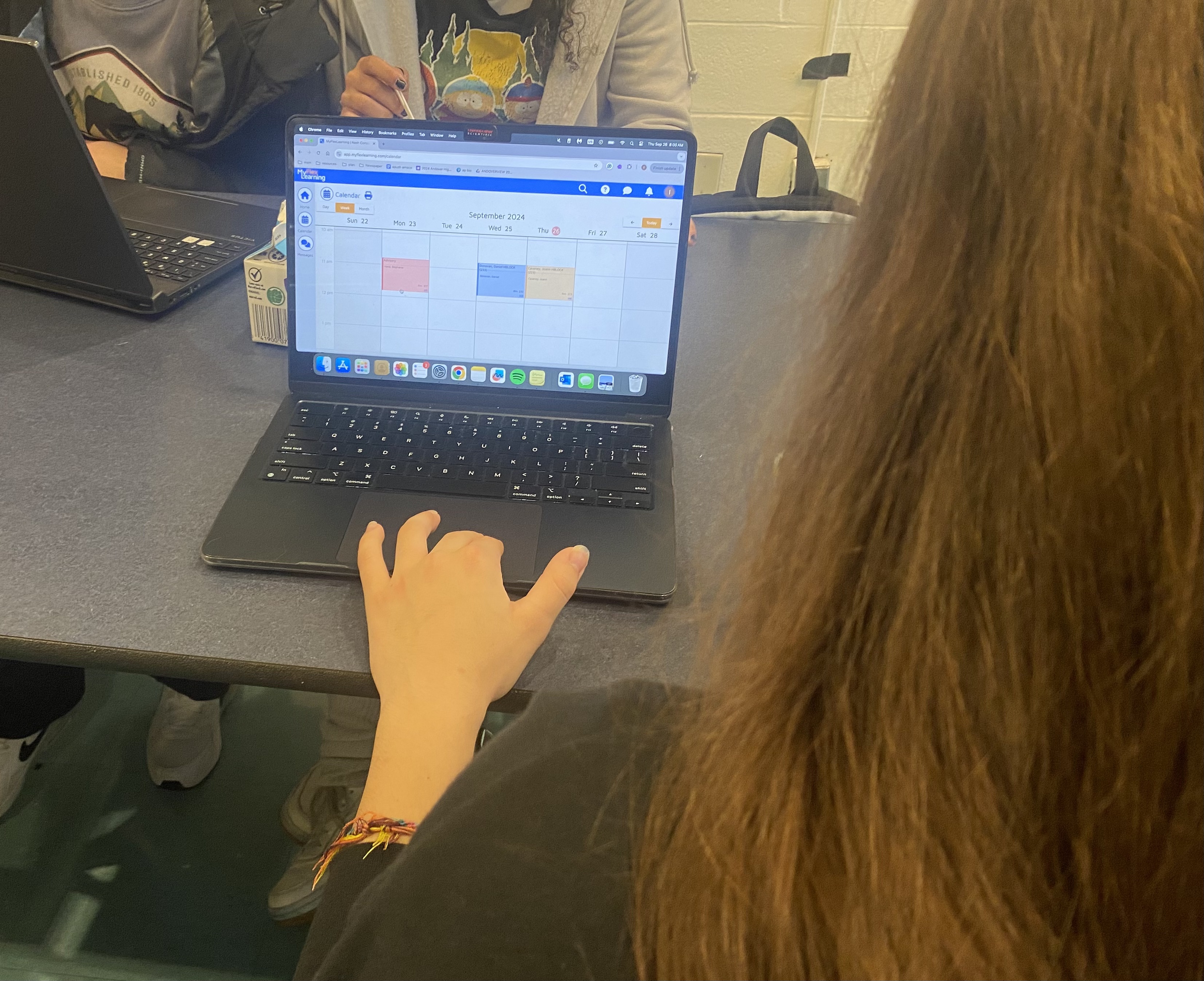
Student chooses H Blocks.

In the previous school year, the H-Block Planning Team began implementing the change of renaming H1 to Advisory. “It was important to clarify… [that] H1 has a distinct purpose [more so] than other H-Blocks,” according to Linsey.

The change of renumbering the H-Blocks has posed a challenge for students adapted to the old H-Block schedule. “I think it’s more confusing now,” said senior Sharayu Josh. She points out a communication hurdle, “You have to clarify whether you mean H4 meaning Day 4 or H4 meaning the fourth H-Block.”

However, students like junior Pranav Yadla have appreciate the new change, finding that the previous schedule was difficult to follow. “It’s more simple than last year,” he said. With the new schedule, Yadla offers a perspective that the new change has created clarity in navigating the schedule. “It’s way easier to know H4 is on Day 4 and not on Day 6,” he said. “You also know what day is coming up. So, it’s not just using the H-Block name just for H-Block, but also to find out what schedule that day is.”

While this change may take some time to get adjusted to as people settle in for the new school year, Josh acknowledged, “People will get used to it. It’s not really impactful on anything other than H blocks.”

Continue reading
First Year Mentor Program Aims to Cultivate Community 
  • October 7, 2024

By Samantha Sun
SOCIAL MEDIA EDITOR

Health teacher Holly Breen and Assistant Principal Alicia Linsey devised the program as a way to smooth the transition into the AHS community. Each advisory has two or three mentors who visit once every six to eight weeks to help out ninth grade students throughout their entire freshmen year. The mentors include sophomores, juniors, and seniors. The pairs are in different grades to resolve conflict with any grade specific activities done in their advisories, such as class meetings. 

”It is a school priority to continue to cultivate a community that fosters a culture of belonging and collaboration,” Linsey said. Breen added that she feels responsible to support relationships between students.  “I want [freshmen] to feel that this is home for them and… welcomed,” she explained. 

Not every freshman has siblings or friends who already attend AHS, Linsey noted. These are the kids the program intends to reach, in order to provide an upperclassmen support system to incoming students. Mentors and freshmen first meet during freshmen orientation so that they are familiar with each other throughout the entire school year. 

COURTESY PHOTO / Alicia Linsey
Alan Hibino and Allison Peters’ freshmen advisory class poses for a photo.

“I think [it gives] perspective for some of the mentors,” said Linsey. “You forget what it’s like to be a ninth grader [and how] it’s really big when you get to high school.” 

“I really like being a role model for others,” Lana Huynh, a junior and mentor, said. “The freshmen were very unsure and scared of what to do next, so [mentoring is] like being there as their older sibling in the school and [helping] them with things I’ve already experienced.” 

Junior Daphne Hatzigiannis has also enjoyed her experience being a mentor. “It’s a relatively simple job,” she said. “So far, the most memorable part has been the initial tour we gave our group, [and] it honestly got me pretty excited for school to start.”

“When I was a freshman I thought that upperclassmen were helpful when figuring things out,” Huynh said. “It made my transition a lot easier.” 

The leadership training, called Student Empowered Leadership (SEL), was designed by a group called Ignite Nation and funded by the Andover Coalition for Education. Ignite Nation collaborates with schools to help students feel connected and inspire students to lead and mentor their peers. There was a one day training session in January 2024 and a two day training session in June 2024, after the school year ended, to help prepare mentors for the following year.

The mentors learned how to facilitate conversations, how to be a great leader, how to act with integrity, and how to help with the transition process, Breen said. They also did trust-building exercises, skits, and fun games, such as a rock paper scissors tournament.

“It’s important [to] have this be a community to people, and the first step in that is building relationships,” said Breen. The First Year Mentor Program has been getting a lot of positive feedback from freshmen, mentors, and advisors. ”[The program] has really helped build connections across the AHS community,” Linsey concluded.

Continue reading
AP Econ Debuts at AHS
  • October 7, 2024

By Carissa Dessin
EXECUTIVE EDITOR

This course, taught by Digital Learning and Business teacher Ashley Kinsman, marks a significant shift from the school’s previous elective business courses.

Kinsman, who has previously taught electives such as Intro to Business Finance and Social Media Marketing, now teaches two sections of AP Econ. On top of this, Kinsman continues to teach one section of a class she taught years prior, Intro to Business. AP Econ covers both Microeconomics and Macroeconomics, offering students a challenging education in economic theory. 

Despite making the huge transition from unleveled classes to teaching an AP, Kinsman said she’s “really enjoying it.” One challenge she described is “staying on top of the students and going over the units beforehand, to make sure [she has] everything ready for them.”

STAFF PHOTO / Carissa Dessin
AHS has added an Advanced Placement (AP) Economics course to its business curriculum this year, providing students with a deeper understanding of economic principles.

AP Econ introduces students to complex concepts like the production possibilities curve and marginal analysis, which Kinsman integrates with real-world applications. She conducts classes in a way that maximizes engagement, spending the first part of class lecturing and then transitioning to “hands-on engagement experiences in class time, so students can see how it [relates] to different scenarios in their day-to-day life.”

Senior Gavin Mottley described the class as going really well so far. “Economics is new for me,” he continued, “but it’s a lot easier to internalize information even though it started out as a totally foreign language.” 

Mottley initially found interpreting two-way tables that demonstrate comparative advantage between countries challenging but gained clarification from Kinsman’s teaching method. “[She] had us work together in groups in a game that had us practicing exactly that. It helped me a lot because I got to work with my classmates; asking them questions helped [reduce] the confusion I had, and helping them when they needed it reinforced the ideas I was more comfortable with.”

Senior Arushi Biswas also reflected on the challenges and rewards of the class. She initially found the production possibilities curve and related graphs confusing but credited the summer work with helping her stay on track.

When it came to registering for the class last spring, Biswas was first drawn to the class because she was interested in pursuing a degree in business and wanted to get a feel for her future classes. “I think students should get educated in economics because it teaches you how the economy works, when to save and when to invest, how to make informed decisions,” she said. “It gives you a good understanding of society and policy.”

Looking ahead, Kinsman is eager to dive into more advanced topics and continue making the material of the course relevant to the students’ lives. She hopes for them to see how truly applicable all of the information that they are learning is in their lives. “I think it’s just really applicable to your day-to-day life like…we do a lot of economic theory, without really realizing that’s what it’s called.”

Continue reading