EDITORIAL: AHS Phone Policy Teaches Compliance, Not Responsibility
  • October 7, 2024

There’s a new phone policy at AHS, and you’ve probably noticed it. Our phones go into what one might call a “phone jail”—those numbered slots where our devices are locked up during class, sometimes with an actual lock and key. The rationale is clear: no phones in class, no distractions. But let’s ask the question: why have we gone to such extremes? 

We at ANDOVERVIEW strongly believe that class time is for learning, and phones can be and have been a major distraction. The administration has had enough of our glowing faces, aglow not from intellectual enlightenment, but from under brightly lit phone screens. Our teachers are concerned about our development; it is not that it gives them pleasure to deprive us of our hypnotic devices. But does locking up our phones, as if they’re dangerous contraband, teach us the right lesson?

This is high school. We’re constantly being told to act maturely and take responsibility for our actions. Some of us are already 18—legally adults—yet we’re treated as though we can’t be trusted with even the smallest responsibility. By removing the temptation completely, the administration is not teaching us how to manage it. It is just kicking the can down the road. Very soon, many of us will be heading off to college or entering the workforce. In those environments, policies like this one don’t exist. There won’t be phone jails. No one will force us to lock up our devices. It is up to us to learn to make responsible choices.

The phone policy creates a false sense of order. It’s easy for students to follow the rules because we don’t have a choice. But the moment the structure is gone, those who never learned self-discipline may be the first to revert to bad habits. What if, instead, we were trusted with our phones? If someone is caught using their phone during class, they face immediate consequences, as well as potentially being singled out for phone jail—with no parole—for the rest of the year. This is about accountability. We learn by making mistakes and facing consequences. If we’re shielded from making mistakes in the first place, we’ll never learn.

The new phone policy does enforce compliance with rules, but one should remember that we are expected to follow rules, even without heavy-handed enforcement. We need to be treated like the almost-adults that we are. It’s time to trust us to learn from our choices, not lock them away.

Continue reading
Navigating the Teacher Lottery: Addressing Grading Disparities in High School Education
  • April 4, 2024

By Tommy Kruecker-Green
STAFF WRITER

Since time immemorial students have braced themselves at the beginning of each new school year for the latest round of academic roulette as they are handed their class schedules. AHS students are no different. Will I get Professor Sprout for biology? Or Professor Snape for chemistry? Is Professor Lupin the new calculus teacher now that AP “Defense Against the Dark Arts” is no longer offered at AHS?

I have noticed a broad spectrum of opinions regarding teacher expectations. For many students, the coursework in a given class is more challenging compared to other classes at the same level. Conversely, there are those who report a significantly lighter workload compared to their peers taking equivalent classes. This is largely due to differences in teachers expectations. Inevitably, teachers have varying teaching styles, and to some extent, differing content. This is a good thing. However, to have considerable disparity in grading styles for the same course level feels problematic to many. One teacher’s idea of “exceeds expectations” is another’s “needs improvement”.

When teachers enforce much higher standards, obtaining a certain letter grade requires significantly more time and effort. With two students taking the same class and course level, but with different teachers, one may have to work twice as hard to get the same final grade. This is a concerning disparity.

Although some may argue that academic resilience requires some degree of inconsistency—or in other words, variety —course levels at AHS should already account for most differences in rigor.

The emphasis should be, indisputably, on learning rather than grades. Unfortunately, because of how the system is set up, the letter grade matters tremendously to students and families at the end of the day.

These grading differences have further negative impacts beyond just student stress and equity concerns. Students receiving “inflated” grades in classes with less rigorous expectations may struggle when they are later held to higher standards in college or the workplace. On the other hand, students in equivalent classes, facing heavier workloads and/or more stringent grading, have less time for extracurriculars, family, sleep, and other important aspects of adolescent development like contemplating existential angst and formulating a skin-care plan.

Moreover, with college admissions becoming increasingly selective, GPA carries greater weight than ever before. Class rank also plays a major role in academic scholarships and other opportunities. Two students with equal skills and work ethics should not have markedly different GPAs simply due to a “teacher lottery”.

Moving forward, teachers can do more to align grading expectations across sections of the same courses. Teaching styles can and should vary, in the interest of piquing students’ curiosity and engagement. Variety is the spice of life; if teachers taught the same way, school would be quite bland. However, the standard of assessment should be more consistent.

Still, this can be difficult, so the solution lies in transparently accounting for differences in idiosyncratic teacher expectations rather than getting teachers to grade the same way. This solution is used in countries with strong education systems like Canada: it entails publishing class averages on report cards. According to high school student parents Anna Chang of Ottawa, Ontario and Paul Cisek of Montreal, Quebec, Canadian high school report cards show percentage grades rather than letter grades. More importantly, they also list the class average for comparison. This context allows parents, teachers, counselors, and even college admissions officers to better interpret the meaning of students’ grades. For example, an 84% grade appears very competitive alongside a class average of 61%, whereas getting an excellent grade in a class with a 95% class average suggests that it was not difficult to meet the expectations in that class.

Showing class averages provides a helpful perspective when assessing academic rigor. An “easy A” class can skew perceptions of students’ abilities and undermine those taking equivalent courses with more rigorous grading schemes. Admissions officers reviewing transcripts can gain insight into ability and/or work ethic beyond simply the grades earned or the class level. Furthermore, by comparing class averages over time, teachers and administrators can track grading trends to identify issues like shifting rigor or grade inflation.

Of course, there may be drawbacks to disclosing class averages. Students struggling in a course may feel embarrassed or demotivated if their grades fall far below the average. Publishing averages could potentially create unhealthy comparisons and competition. (In extreme cases, it could lead to rampant sabotage, as students try to lower the class average by spiking fellow students’ Stanley Cups with sleep-inducing drugs before exams.) And teachers may also hesitate to share statistics that could invite questions about their grading tendencies being too lenient (“Ah, Mr. Dingleberry, the one who hands out A’s like Oprah giving away cars”) or too harsh (“Behold, the feared Professor Umbridge, with her blood-quill red pen”).

These risks deserve consideration. Still, used judiciously, class averages could provide more academic transparency and be used to benefit students and parents alike.


Continue reading
Caught in the Middle
  • February 29, 2024

By Tommy Kruecker-Green and Isabella Yan
STAFF WRITERS

As sophomores, our view of the future oscillates between daydreams and despair. One moment we envision delivering valedictorian speeches and accepting awards in our dream career. In the next, we sink into the uncertainty of plotting life trajectories without a map or compass. Who will I become? Can I afford college? What if I never figure out what career inspires me?

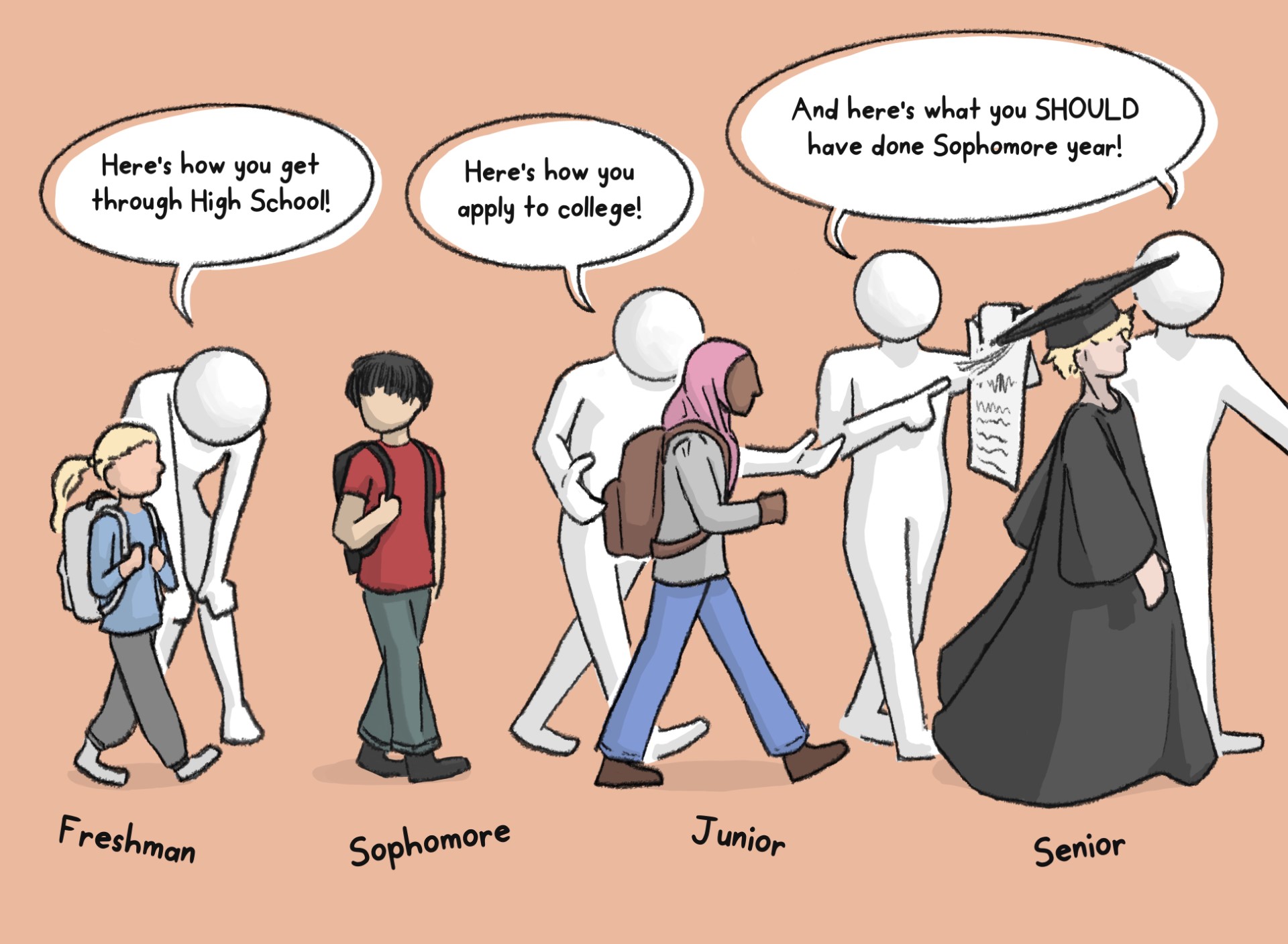
Interviews with tenth graders led to a general consensus: our school could do more in sophomore year to help students prepare for their futures. Counselors and teachers often devote the most attention to freshmen adjusting to high school and upperclassmen applying to college. Sophomores inhabit an awkward middle ground—no longer wide-eyed but not ready to prepare ourselves for graduation’s looming deadline. 

From the school’s perspective, limited career advising for sophomores prevents overburdening students and counselors alike. With over a hundred students apiece, counselors prioritize helping those most in need of support. “[Sophomores] are not as needy as a group,” explained counselor Jayne Jones. “You are not applying to college right now, you are not creating a college list, you are not needing a recommendation per se… Sophomores are just sort of left a little bit because they can be left.”

This is a fair point. However, what we choose to participate in during sophomore year holds much greater weight given today’s ultra-competitive admissions landscape. With more students applying for limited spots at top institutions, colleges increasingly seek evidence of commitment and leadership from prospective applicants’ earliest high school years. Admission officers don’t expect us to have life figured out at fifteen or sixteen, but they want signs we’re purposefully sampling activities aligned with our emerging strengths and passions. The stakes feel uncomfortably high for sophomores who are simply hoping to discover their interests, and the hard truth is that involving ourselves with the “right” organizations now can make or break our candidacy down the road. As anxious as it makes students to strategize so far ahead, not scoping out extracurricular opportunities with admissions checkboxes in mind means losing a prime chance to build the “hook” that gets us noticed from the overflowing stacks of applications.

It is because of this intense pressure that sophomores feel they need more personalized guidance on extracurriculars and future planning. Sophomore Eva Nguyen summarized the common sentiment: “Counselors can do more to open up the door to students for discussion about their futures.”

A lack of early career planning is felt especially strongly by sophomores Pranav Yadla and Noor Bhatti, who come from immigrant families without experience with the American college system. 

“I have no idea what colleges want; I didn’t even know what the process was, [so] I had to find it out myself,” said Yadla. Like many students with immigrant parents, his parents received a college education outside the U.S. where there is a completely different admission system.

Over the last few decades, college admissions in the United States have changed tremendously, including significantly higher tuition and changes to general application expectations. These are critical factors that sophomores who intend to attend college should begin to consider.

In a maze of unfamiliar requirements, many sophomores whose parents “don’t know anything” turn to outside sources such as advice from college friends, the internet, or even private college counselors. But, astronomical costs put the latter out of reach for most. Somehow, students from families new to America must solve a complex puzzle missing half the pieces.

More robust sophomore advising would benefit every tenth grader. But this could overburden the already strained counseling department. Perhaps the answer lies in empowering students to self-organize the guidance lacking from formal administration sources. Students could lead group discussions on college essay writing, scholarship opportunities, or lessons learned from older siblings now in college. Retired teachers may volunteer to moderate these student gatherings and offer their advice.

For students from immigrant families, group sessions could help decipher unfamiliar aspects of American college prep: differences in application timelines and requirements between the U.S. and other countries, a breakdown of key standardized tests like the SAT, or nuts and bolts overviews detailing how financial aid functions here. These sessions don’t need a lot of funding—they could operate on a shoestring budget or by student volunteers.

Until we start troubleshooting ways to do more with less, sophomores will continue to be caught in the middle, dangling between childhood dreams and adult decisions. Like trapeze artists without a net, we twist anxiously in the space between launch and catch. The time has come for schools to position the mesh—a safety net of supportive guidance.

Continue reading
Seniors Learn Financial Literacy at Credit for Life Fair
  • May 31, 2023

By Julie Mahoney
STAFF WRITER

This year’s Credit for Life Fair took place on April 4 during H4 in the Field House, giving seniors a chance to practice financial decision-making and prepare them for their future. 

The seventh year running, the fair incorporates hands-on activities that teach seniors how to budget money in all areas of life, ranging from medical needs, housing, food, transportation, and more. Students go around to various booths and learn how to manage money. The fair has various partners, including the Andover Service Club, Andover Public Schools, FitMoney, Andover Rotary Club, Savings Bank of Andover, and members of the Andover School Committee. Taking months to prepare, the fair took “a lot of organization,” according to Gregory Hurley, the Program Coordinator of the Social Studies Department who helped run the event. 

While seniors were told about the event on the previous H1, some felt confused or annoyed about not being well-informed. However, some seniors like Olivia Murphy thought it was “really important now because in college a lot of us probably won’t have our parents close-by to answer our questions about this stuff.” For others, like senior Quinne Dowe, the information wasn’t new due to already working a job. 

Another senior, Andrew Magner, thought it was a good use of the H-Block and “fun because you could hang out with your friends while learning about managing your money for the future. It was much more engaging than any video in an H-Block could be.” However, other seniors like Diya Ganesh thought the information could have been arranged better, as she “just went through the motions and didn’t gain much from it,” which she thought may be due to her previous information on finances.

Most seniors seemed to have already known how to budget money in some sense and thought that the information was redundant, although many like Magner and Murphy thought that it was useful. Amelia Hanscom agreed on its relevance, stating, “It taught me about some of the best ways to approach money management once I reach adulthood.”

“As students graduate from high school, there is an expectation for them to take on a level of independence which also comes with responsibilities,” Hurley said. “That includes financial independence and financial responsibility.” The fair is targeted at seniors due to them being less than a year away from further education and financial independence, although the fair is being adapted for willing juniors in future years “so that students who are interested have a little more information about financial literacy,” said Hurley. In the future, both seniors and juniors will be able to attend although as of right now it is unsure who would be required to. 

While this was the first normal year after COVID-19 that contained the fair, the event didn’t come to a halt during the pandemic. Similar to school, Hurley added that the fair “has been going in either hybrid, remote, or in-person format, for the last seven years and it has continued to grow each year.” The organizational staff hopes to expand the fair and make it more engaging for the students so they can better understand financial skills and reduce stress before entering the real world.

Continue reading