TEDxAndover Uplifts AHS Voices
  • December 13, 2024

By Janaesa Macasaet & Ariana Teasdale
STAFF WRITERS

A room full of people. A stage, bathed in light. The spotlight on Graham Igo. Murmurs spread throughout the crowd as the unexpected 15-year-old confidently strides out onto the stage. As cameras face him, he takes his spot in the middle. Clad in a professional blue velvet suit and tie, Igo captivates the audience’s interest. 

Igo spoke at the inaugural TEDxAndover event held at the Andover Country Club this past October. As he stepped on stage, Igo posed the question “how many of you have ever heard the term ‘be yourself’?” His speech, “The Cost of Fitting In,” featured personal anecdotes and skillful commentary on the societal pressures to conform, and the emotional effects of those pressures.

“I focused on others instead of myself, and when I did experience short-term satisfaction, I felt unfulfilled,” Igo said. “I was [just] doing what others were doing, which built up a lot of emotions.” 

TEDx events, different from TED conferences, are local and independently organized events. TEDxAndover is a newly established platform, organized by Andover resident Menka Hariani, that provides people with an opportunity to share meaningful ideas. Hariani was determined to create a platform in which she could empower diverse voices. Driven by a strong sense of purpose, she started working on the event application last year, and obtained the license for it in August. 

“As an organizer I was responsible for everything:” Hariani said, “finding the right speakers… pitching them… refining their scripts, finding the venue, all of the marketing… [in addition to] developing and designing the entire website.”

In just eight weeks, Hariani organized the first event, featuring five speakers and one performer. With overwhelming support from the Eagle Tribune and the AndoverMums Facebook page, the event was quickly assembled, and sold out with 100 people attending.

STAFF PHOTO/ Janaesa Macasaet
Organizer Menka Hariani introducing the first speaker.

“With very little time, and not having enough background in event management, there were a lot of challenges…,” said Hariani. “I feel very fortunate and lucky that I got to work with people who delivered very high quality…work and made it…successful.”

 Featured speakers presented on a range of topics, from health and well-being to life strategies. In the lineup was AHS sophomore Graham Igo. Sharing the stage with highly accomplished individuals—an Olympic gold medalist, a Harvard professor, two CEOs, and an NBA dancer—Igo was surrounded by those with far more experience. As a high schooler, he provided a unique, younger perspective. Drawing from his middle school days, he discussed his own struggles with identity and how he was pressured by peers to fit in. 

Even as a first-time formal public speaker, Igo was confident in his abilities to deliver a talk. In order to prepare, speakers work with volunteer coaches to completely memorize their speeches. After intense practice, Igo presented with ease.  

“I read my speech a million times,” Igo said. “Just went over it line by line, trying to remember each part.”

Igo was not the only AHS student on stage, however. Hariani’s daughter, sophomore Jiya Jotwani, was the host. Hariani proposed the idea, though Jotwani was still required to go through the application process, with the chance of being rejected. With note cards in hand, she warmly introduced the speakers, supported by friends in the audience. 

“At first it made me really nervous. I felt a lot of pressure to not mess up,” Jotwani said. “But then, when we took a break… all of my friends told me I did super good and so I felt a lot more confident.”

Though initially attending the event to support host Jiya Jotwani, sophomores Grace and Hannah Arnold were quite impressed with Igo’s courage. 

Grace Arnold said, “[Igo’s speech] was really interesting…because he’s speaking to a room of primarily adults, by himself, and…giving a speech on something that a lot of people might…not accept him for. I think that was a really good example to set.”

The journey to uplift Andover voices has yet to end, however. A full-day TEDxAndover event is scheduled for June 2025, with hopes for ten speakers and two performers regarding the topic of invisible threats, which are problems people often disregard as harmful.

Hannah Arnold, approached by Hariani, has newfound inspiration to deliver her own speech after seeing well-established speakers and fellow classmates gain the chance in a lifetime. From her own experiences, she’s interested in speaking on learning strategies as well as how to handle chronic pain as a longtime soccer player. 

Hariani encourages people of all kinds to speak. “When I am looking for a speaker, I am only looking for great ideas. I don’t care what the background of the person is, I don’t care where they’re coming from; I’m only looking for diverse voices and great ideas that are worth spreading,” she said. All she hopes for is to “strike conversation in the community”.  

Interested in being a TEDxAndover speaker? Applications open January 2025. Refer to tedxandover.com for more information. 

Continue reading
Ralph Bledsoe Remembers Time at High School, College
  • May 23, 2022

Angela Mac
STAFF WRITER

Science teacher Ralph Bledsoe is well known and loved by students and faculty members at Andover High School. 

Prior to high school, Bledsoe went to Southern California Military Academy (SCMA), a junior high boarding school. He then attended Northfield Mount Hermon (NMH), a boarding school in Massachusetts. After high school, he went to the University of Southern California (USC). Bledsoe noted that his experience was out of the norm: boarding in high school and commuting to college when most students did the opposite. 

When Bledsoe made the switch from SCMA to NMH, he recalled that “all of a sudden, I was getting C’s and D’s, from A’s and B’s, because the work was at an upper level. It was no freaking joke.” 

Compared to AHS students, Bledsoe had a lot more freedom and time off from classes. At NMH, students would only have classes three or four days a week. On some days, there would be free periods where Bledsoe “could go anywhere [he] wanted. You know [at AHS] every second is regulated.” Private schools like NMH would load up on schoolwork and then have days off for the students to complete it. Bledsoe admires AHS students for their constant work and compared it to a workday: “A lot of kids here will have 14-hour day jobs, where the job has to get done. Doesn’t matter the hours. You work through Saturday and you work through Sunday.”

With the free time Bledsoe had, he didn’t spend it thoughtlessly. As a work-oriented person, he studied in the library and prepared for the next class. At USC he made sure to study at all 11 libraries on campus. Bledsoe’s favorite subject in college was organic chemistry. Though organic chemistry may be regarded as one of the hardest classes, for Bledsoe, it came naturally. However, he reflected that his mind developed over time. “Don’t think your mental capabilities are going to stay static. Throughout your life, you’re still developing, and your mind is going to be clearer and clearer and clearer,” he stated. 

Physical chemistry was the subject that challenged Bledsoe the most: “It was just, like, beyond my reach. A little bit. You know? So I blunted my drive, which was a mistake.” He explained that taking classes to get them out of the way is the wrong way to go about school. The right attitude was to take classes to learn a skill and to remember it, that way it could be used later on in life. To high school students, Bledsoe said, “You got to fight everybody. Got to fight yourself. You got to fight for what you need to do.”

In NMH, Bledsoe enjoyed being a part of the Afro-AM, a club for African Americans. The club located in the basement of the Cutler Science Center was called Harambee Umoja. Members of the club would go to socialize and throw parties in between classes, and even go to Phillips Academy to beat the students there in basketball. 

Now in his 8th year at AHS, Bledsoe is proud of the students at AHS. In the mornings that he comes in tired, seeing the students energizes him and it gets him ready to start the lesson. As much as teachers love their students, each has their own pet peeves about them. However, Bledsoe’s pet peeve wasn’t about the students, but himself. He asked, “Why am I such a school person. It’s absurd. Why do I enjoy faculty meetings? No teacher enjoys faculty meetings.” After a pause, he asked himself again, “Why do I cry every single graduation and miss the kids?”

Continue reading
Krista Hibino Offers Students Advice
  • May 23, 2022

Melody Tang
STAFF WRITER

Krista Hibino, a mathematics teacher at Andover High, experienced high school as the “quiet student.” 

COURTESY PHOTO / Krista Hibino
Hibino’s photo from when she was in high school

While Hibino went to high school at Lowell High School, being located in Massachusetts gives it many similar qualities to life at AHS. She also remembers preferring STEM classes more than humanities classes, and pursued her interest in mathematics and education at Merrimack College. This led Hibino to teaching at AHS as a student teacher, and she has since decided to stay permanently in the AHS
mathematics department.

Hibino encourages students to try at least one activity that is out of their comfort zone. “If there’s some type of activity that the school’s putting on… and it’s really not something you think you’d like, if you just grab a friend and go, it might be something you end up liking,” says Hibino. “I wish I had done something like that.”

When asked about any pet peeves she experiences as a teacher, Hibino brought up a nuance in words that many students use. Specifically, the nuisance is when students ask if they “missed anything” after an absence from class. At first, some may be confused, but Hibino explains her point of view clearly. “You clearly missed a whole class; we didn’t sit here and do nothing,” she jokes. Instead, Hibino suggests students use the phrase “what did I miss?” as an alternative.

Continue reading
Teachers Express Concern Over Organization of Fire Drills
  • May 23, 2022

Grace Wang
STAFF WRITER

Teachers expressed their concerns and critique on the plan and execution of fire drills. They mentioned the growth mindset and that there is always room for improvement. 

Fire drills, in theory, are great because they prepare teachers and students to react accordingly in time of emergency. The goal is to have the proper actions be an automatic response whenever fire alarms sound, so that everyone safely evacuates the area in an orderly manner. Moreover, the purpose of a fire drill is to familiarize and reinforce proper evacuation roots and practices. Research has found as well that well-implemented drills can improve children’s knowledge and execution of emergency response actions and build their confidence and resilience. The high school is required by law to have four fire drills per year. However, AHS’ fire drills aren’t going the way teachers want them to. 

For the new, current fire drill system, each class was given a letter location to group at. The fence was supposed to be labeled A-Z and classes lined up along the fence at their respective location. Unfortunately, the letters got taken down twice by people over the weekends this year. This forced teachers and students to have to guess where their letters are instead of knowing.

“Nobody knows where to go,” said AHS teacher Nicole Campbell. “The numbers aren’t up and it’s hard to get through.” She mentioned that students often get lost from class and don’t know how to find it again.

In response, Scott Darlington, vice principal, said, “We will be putting the letters back up probably not until the summer because we want to find a way that they don’t get taken down right away.” The administration is trying to come up with a better, more permanent solution to the previous paper signs. They’re planning to get plastic, metal, or even painted signs. Darlington thought that perhaps the signs were taken down as vandalism. Additionally, the administration is thinking about painting on the letters.

In comparison, there used to be an old system where the class lined up their room number to a parking space. Before getting repainted, Campbell mentioned that the senior lot used to have all the parking spots labeled. Then, the classes could find their parking spot which would be the same as their class number. “When you went to your parking spot everyone knew where they would go, and they knew the routine…as opposed to ‘am I N?’” explained Campbell.

On the contrary, Darlington revealed the reason they switched the old system. “A lot of the classes were coming out of the building by the cafeteria, and they were meeting by the senior lot. So, they were crossing the driveway, and that’s the same place the fire truck came in a real emergency. So, we redid the plan so that nobody crosses the main driveway,” stated Darlington. 

In addition to assigned locations, teachers are given a green thumbs up and red thumbs down sheet. Supposedly, someone would check each group to make sure every class has all their students signified by a green thumbs up. If not all the students are present, the monitors would radio to the school. However, there’s a shortage of monitors this year because many retired. “I’ve held my thumb down the entire time and nobody’s checked on me,” said AHS teacher Thomas Gardner. Adding on, Campbell said that once they get out there, she usually doesn’t see all her students nor does she see people checking for the green thumbs. 

Ultimately, the root of the problem for the teachers is the confusion that takes place during a fire drill. “People need places so that the checkers know where to check…but again it’s hard because once we get out there and we’re N, there’s no N and you’re guessing,” emphasized Gardner.

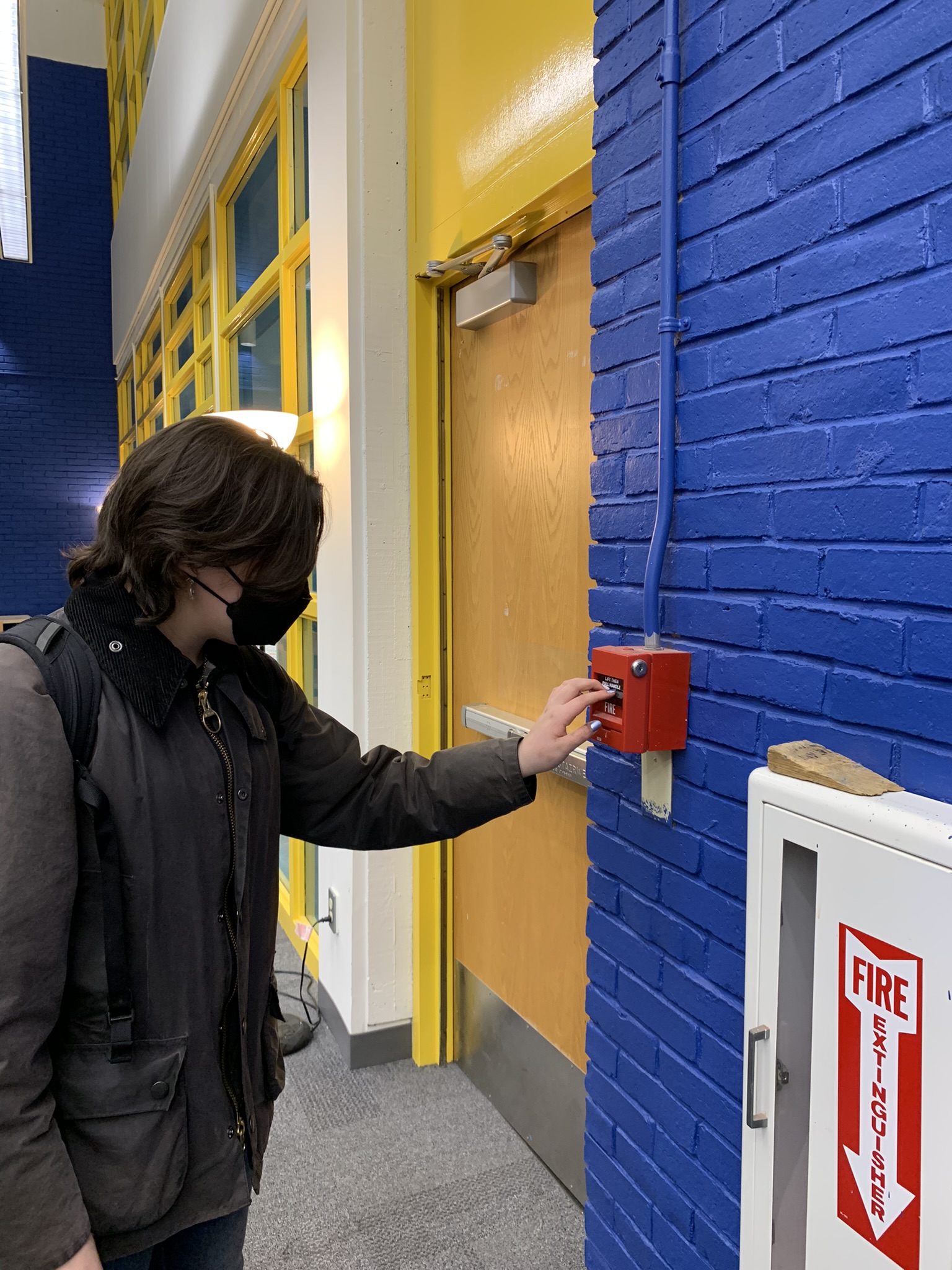
STAFF PHOTO / Grace Wang
AHS sophomore Hannah Lehmann mock pulls the fire alarm

Darlington mentioned that the teachers are given diagrams where they can explain to the students on where to meet for a fire drill except he agrees that “it’s just harder to find when you’re outside and there are over a thousand students.”

Finally, Darlington explained that pre-COVID the school was better at the organization aspect of fire drills. However, after COVID hit, the administration was more focused on combating COVID itself than ALICE or fire drills.

Fortunately, the students are still doing a great job at getting out of the school fast. “The priority concern is to get everyone out how quickly…The second concern is meeting up outside,” said Darlington. 

All in all, “[AHS] need[s] to get better at it though…we were really good before COVID, but we are not as strong after COVID,” said Darlington. As agreed upon by interviewed teachers, there’s a lot we can improve upon like getting the signs up and monitors checking all the students again. 

Adding on, in the student perspective, AHS junior Ankee Zhang said, “Sometimes they can be very disruptive of classroom material, like when teachers are giving lectures, it can destroy the flow.”

Continuing on, Zhang backed up the opinions of the teachers and said that fire drills were disorganized because of the missing signs. She explained, “People get scattered around and students can’t take attendance well because students don’t know which letter they are.” 

In the end, students interviewed didn’t have much more to say about fire alarms. Of course, one common opinion is that students are less happy when fire drills happen during their lunches, when they’re absorbed into class, or during bad weather. Although, another AHS junior Athena Yung concluded, “Depending on what class, I love them.” 

Continue reading
Locker Room Thefts Die Down 
  • May 23, 2022

Jocelyn Barton
STAFF WRITER

While locker room thefts have declined, concerning issues still remain. 

“Thefts have been an ongoing issue over the years, some more than others,” explained John Norton, an Andover High School Assistant Principal. Vending machine thefts have also been an issue earlier this school year in addition to the locker room thefts. 

The most common places thefts occur are usually the locker room and cafeteria. Meredith Emery, a physical education teacher, describes the locker room as “an ideal place for things to happen that shouldn’t be happening.” 

Procedures have been implemented, purposefully targeting hotspots for thefts. Now, a P.E. teacher must stay behind to make sure the door is shut and to thoroughly inspect the room in order to make sure that anything left behind either goes to their office or the main office. This system of prevention was implemented right after a consequential ski team theft. 

This winter, the locker room theft crisis had struck the girls ski team. Typically on race days, racers leave backpacks and other unnecessary equipment in the team room so they don’t need to carry them around for the rest of the outing. During this three to four-hour period, the room was left unlocked, leaving it open to unwanted guests. “At least eight or nine pairs of AirPods were stolen, up to 300 dollars of cash, a few gift cards, and a wallet,” recalled Katie Machold, captain of the girls ski team. “It was a disaster.”

Most teammates were able to retrieve their stolen belongings after investigations were conducted. Still, this situation continues to serve as a warning to others. 

Similarly, Emery and Assistant Athletic Director Kerry Cashman had one day found a total of seventeen backpacks left on the floor of the locker room instead of locked up in lockers. This recklessness is proven only to result in stolen items, and the Physical Education staff highly recommends against it. 

There are many theories as to why these thefts have been inconsistent over the year. Emery claimed that the cause may be the “pressure of gift-giving”. This is supported by the fact that this rise mainly occurs around the holidays, such as Thanksgiving or winter break. She speculated that students may feel the need to give gifts to others around this time. In contrast, Norton contemplates that it may be due to the adjustment from hybrid schooling to the normalcy of fully in-person school. Now, more than ever, students may be prone to forgetting to protect their property and are overlooking the possibility of an occurrence.  

Regardless of these possible causes, one answer stays constant: students MUST protect their belongings in order to battle this issue. Norton recommends that students bring their belongings with them on mask breaks and refrain from bringing large amounts of cash to school and flaunting their belongings. It is clear that prevention is the best way to fend off the possibility of theft. 

When asked for some final advice, Norton furthers his point: “Protect your items: you’ve worked hard for those things, guard them with your life,” he said with a laugh.

Continue reading
The New Standard: Importance of Community Service Today
  • March 14, 2022

Jocelyn Barton
STAFF WRITER

Standardized tests and scores are now becoming optional in college applications. With this, colleges are becoming more dependable on a student’s personal values and accomplishments. What better way to offer this insight than presenting your interests and offerings to helping your community through community service?

Anne-Marie Fortier, a guidance counselor at Andover High School, explained that community service is extremely valuable to colleges. She stressed the importance of finding a service where you get something in return as well. “You want to be connected to the community service that you’re involved in,” said Fortier. “You want to get value from it.” Finding something that you enjoy doing is just as important as donating your time and effort. 

Mary Testa, also a guidance counselor, said that she volunteered at a hospital when she was in high school. Not knowing if medicine may be a possible future career, community service helped her to explore this interest. “It was really nice helping people and seeing what people did for a living,” said Testa. 

Volunteering offers real-world experience and builds career prospects, which is especially important to students finding themselves. Testa explained, “[Community service] can be something that builds your character and builds your reputation, which is really important when you’re going through life and asking, ‘Who do you want to be?’”

COURTESY PHOTO / Mara Durán-Clark
AHS’s Key Club and the Kiwanis Group participate in the annual George Street Bridge cleanup

Community service also aids in bringing you closer to the needs of your community. Organizations in need of help take to heart the energy you put into making an impact on those in need. “It makes you appreciate what you have and you get to see the difference you can make in a short amount of time with sometimes minimal effort,” said Testa. It can empower you to make a difference even if it is only affecting one person. 

Now, more than ever, organizations are in need of help due to COVID. Whether it be signing up to volunteer at an organized facility or doing kind deeds throughout the day, every act counts. “Any gesture of kindness, giving back, or putting other people’s needs first can really give you that same feeling of helping others,” said Testa. 

Interestingly enough, AHS does not require community service to be completed. Letting students find their own ways of giving back to their community shows an individual’s initiative.  

AHS also directly offers some community service opportunities that are led by students and provide local help to Andover’s community. Clubs such as Key Club, Interact Club, Neuroscience Club, and countless more offer opportunities to support the Andover community through a student lead organization. 

On a much broader scale, the town of Andover prides itself on its Community Services Department, which is composed of the Andover DIVERSE, Elder, Recreation, Veteran, and Youth Services. These divisions are focused on building a better Andover with the benefit of community initiative.

To begin your search for community service opportunities, take a look at some provided sources that would welcome your help below! (Be aware: Some organizations may not be taking volunteers at this time due to COVID.)

Continue reading
Vending Machine Thefts Decrease
  • February 14, 2022

Jacqueline Zhu

COPY EDITOR

The introduction of personal identification numbers (PINs) for the vending machines has triggered a rash of PIN thefts, prompting administrators to issue warnings against vending machine theft.

The issue of students stealing others’ PINs began in early fall, after the vending machines were put online. Offending students would take pictures or videos of other students putting their PINs in, and then use the PINs for themselves and their friends. Students who have had their PINs compromised would have to obtain a new PIN, a 30- to 40-minute process that involves the administration and cafeteria workers transferring the student’s funds to a new account. 

Gail Koutroubas, Director of Food Services at Andover High School, explained that despite having PINs consisting of a five-digit number and a four-digit number to maximize security, some students are still able to copy down others’ PINs. “We didn’t think that kids would be videotaping other students putting their numbers in and then sharing it,” she said.

Andover High School has had the vending machines with codes for four years, said Koutroubas, but vending machine theft has never been an issue until this year. “We very rarely had an issue: kids were very respectful of each other,” she stated. “But, for whatever reason, this group of kids didn’t realize the severity of what they were doing. They’re stealing money, and a lot of money in some cases.”

The general consensus among students is that stealing others’ PINs is unacceptable. “You should not be using other people’s PINs to buy stuff,” said junior Nathan Chu. “That’s like using someone else’s credit card to make your own payments. If you really want something from the machine but either don’t have enough money or don’t have a PIN, then all you need to do is ask your friend to buy something for you.” 

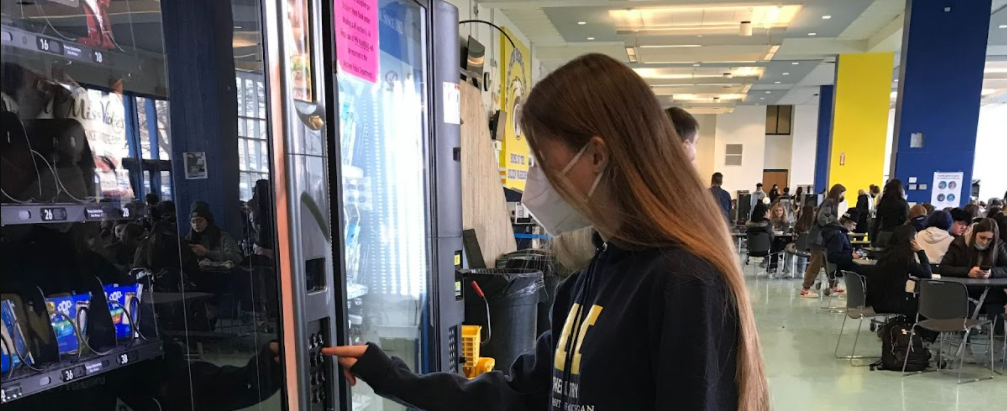
STAFF PHOTO / Jacqueline Zhu
Juliet Herrick, a junior, enters her PIN into one of the vending machines

Some students are not sure if sharing PINs amongst friends is as significant an issue. “I think that while sharing your PIN so your friend can get a snack is considerate, lots of people are abusing this power and causing problems in the long run,” said Madelyn Blanchette, a junior.

“In my mind, sharing PINs is okay as long as it’s mutual,” stated freshman Gavin Cleary, “but if it is not or if it’s stealing PINs, then it is not okay.”

Koutroubas explained that students sharing their PINs with friends is also inappropriate. “When we assign you the PIN, there’s a letter that says ‘Do not share your PIN’. That’s like your mom or dad sharing their PIN to their bank account.”

Several students suggest that offending students’ PINs be deactivated as a countermeasure against PIN theft. “I think if sharing a PIN is becoming an issue, a suspension of the PIN could work,” said Blanchette.

Sophomore Megan Zhang agrees. “I think appropriate consequences for those who share their PIN numbers is to have their PIN deactivated for a certain amount of time, such as two or three weeks,” she said.

Zhang believes a possible solution would be to use biometric technology instead of codes. “Having everyone’s finger (of their choice) to be used for scanners marked/identified and then using those for the ‘codes’ would make sure that it is the correct person using the account,” she explained.

Koutroubas’ idea is similar, only students’ ID cards would be scanned instead of their fingers. “We really would love for students to carry their IDs and be able to scan everything,” she said. “It would eliminate lines, and it would eliminate theft. I think that it would be a little more secure, unless you lose your ID or something. Until there’s enforcement from the administration on carrying IDs, we’re just left with the PINs.” 

Since holiday break, there has been a decrease in vending machine theft. “There was a decrease right after the students that compromised the numbers were punished,” stated Koutroubas. “As soon as we found out who they were through the cameras, it stopped.”

Koutroubas’ ultimate advice to students is to not share their PINs. “Be conscious of who’s around you when you’re putting your PIN in. Make sure there’s no kids videotaping you,” she said.

Continue reading