Grace Wang
STAFF WRITER
Teachers expressed their concerns and critique on the plan and execution of fire drills. They mentioned the growth mindset and that there is always room for improvement.
Fire drills, in theory, are great because they prepare teachers and students to react accordingly in time of emergency. The goal is to have the proper actions be an automatic response whenever fire alarms sound, so that everyone safely evacuates the area in an orderly manner. Moreover, the purpose of a fire drill is to familiarize and reinforce proper evacuation roots and practices. Research has found as well that well-implemented drills can improve children’s knowledge and execution of emergency response actions and build their confidence and resilience. The high school is required by law to have four fire drills per year. However, AHS’ fire drills aren’t going the way teachers want them to.
For the new, current fire drill system, each class was given a letter location to group at. The fence was supposed to be labeled A-Z and classes lined up along the fence at their respective location. Unfortunately, the letters got taken down twice by people over the weekends this year. This forced teachers and students to have to guess where their letters are instead of knowing.
“Nobody knows where to go,” said AHS teacher Nicole Campbell. “The numbers aren’t up and it’s hard to get through.” She mentioned that students often get lost from class and don’t know how to find it again.
In response, Scott Darlington, vice principal, said, “We will be putting the letters back up probably not until the summer because we want to find a way that they don’t get taken down right away.” The administration is trying to come up with a better, more permanent solution to the previous paper signs. They’re planning to get plastic, metal, or even painted signs. Darlington thought that perhaps the signs were taken down as vandalism. Additionally, the administration is thinking about painting on the letters.
In comparison, there used to be an old system where the class lined up their room number to a parking space. Before getting repainted, Campbell mentioned that the senior lot used to have all the parking spots labeled. Then, the classes could find their parking spot which would be the same as their class number. “When you went to your parking spot everyone knew where they would go, and they knew the routine…as opposed to ‘am I N?’” explained Campbell.
On the contrary, Darlington revealed the reason they switched the old system. “A lot of the classes were coming out of the building by the cafeteria, and they were meeting by the senior lot. So, they were crossing the driveway, and that’s the same place the fire truck came in a real emergency. So, we redid the plan so that nobody crosses the main driveway,” stated Darlington.
In addition to assigned locations, teachers are given a green thumbs up and red thumbs down sheet. Supposedly, someone would check each group to make sure every class has all their students signified by a green thumbs up. If not all the students are present, the monitors would radio to the school. However, there’s a shortage of monitors this year because many retired. “I’ve held my thumb down the entire time and nobody’s checked on me,” said AHS teacher Thomas Gardner. Adding on, Campbell said that once they get out there, she usually doesn’t see all her students nor does she see people checking for the green thumbs.
Ultimately, the root of the problem for the teachers is the confusion that takes place during a fire drill. “People need places so that the checkers know where to check…but again it’s hard because once we get out there and we’re N, there’s no N and you’re guessing,” emphasized Gardner.

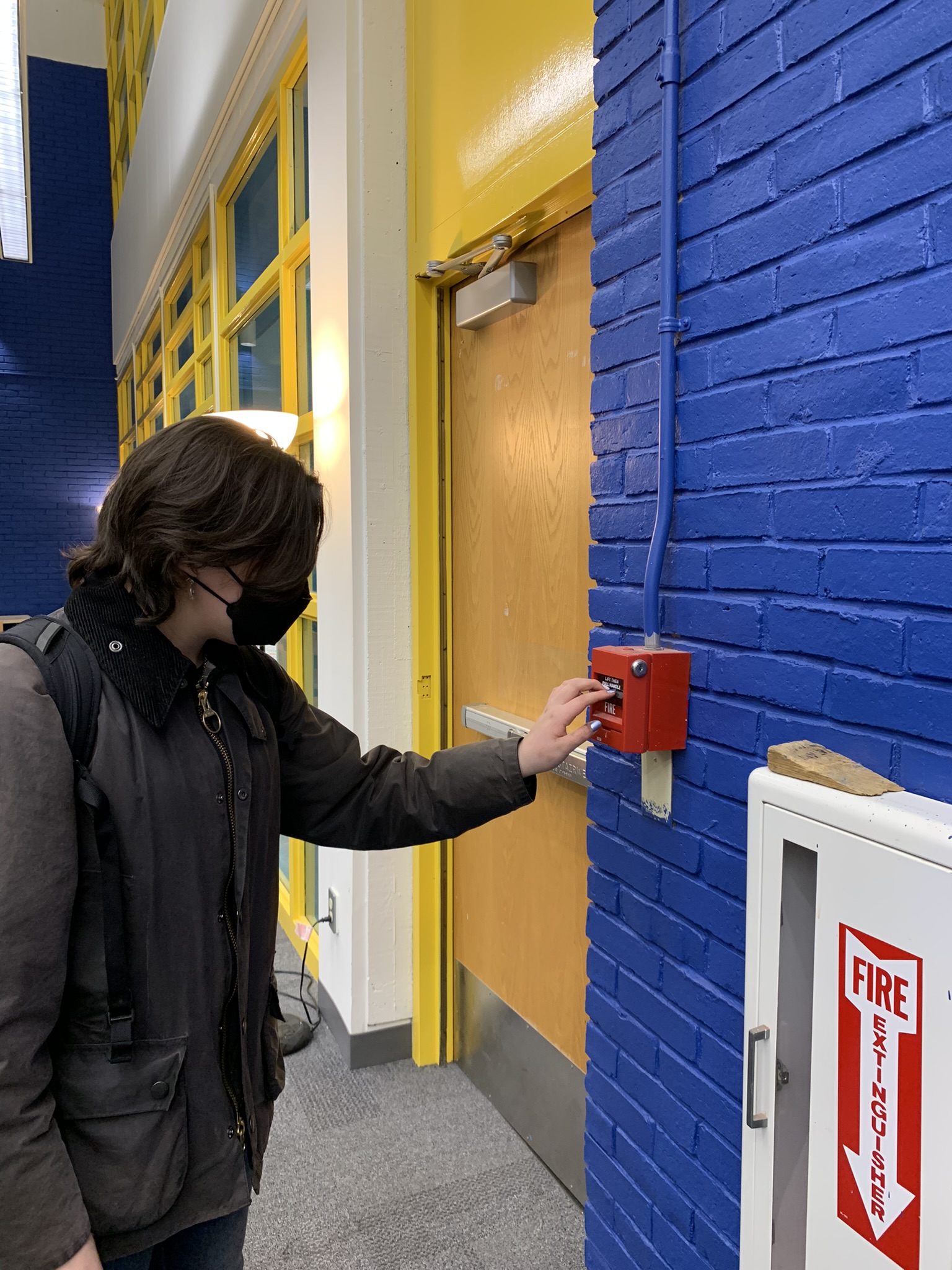
AHS sophomore Hannah Lehmann mock pulls the fire alarm
Darlington mentioned that the teachers are given diagrams where they can explain to the students on where to meet for a fire drill except he agrees that “it’s just harder to find when you’re outside and there are over a thousand students.”
Finally, Darlington explained that pre-COVID the school was better at the organization aspect of fire drills. However, after COVID hit, the administration was more focused on combating COVID itself than ALICE or fire drills.
Fortunately, the students are still doing a great job at getting out of the school fast. “The priority concern is to get everyone out how quickly…The second concern is meeting up outside,” said Darlington.
All in all, “[AHS] need[s] to get better at it though…we were really good before COVID, but we are not as strong after COVID,” said Darlington. As agreed upon by interviewed teachers, there’s a lot we can improve upon like getting the signs up and monitors checking all the students again.
Adding on, in the student perspective, AHS junior Ankee Zhang said, “Sometimes they can be very disruptive of classroom material, like when teachers are giving lectures, it can destroy the flow.”
Continuing on, Zhang backed up the opinions of the teachers and said that fire drills were disorganized because of the missing signs. She explained, “People get scattered around and students can’t take attendance well because students don’t know which letter they are.”
In the end, students interviewed didn’t have much more to say about fire alarms. Of course, one common opinion is that students are less happy when fire drills happen during their lunches, when they’re absorbed into class, or during bad weather. Although, another AHS junior Athena Yung concluded, “Depending on what class, I love them.”