Dough-licious Discovery: Take a Deeper Dive into the History and Legacy of Andover High School’s Focaccia Bagels 
  • May 2, 2023

By Grace Wang
STAFF WRITER

It’s a Monday morning at Andover High School and you sink your teeth into the tender dough of a warm, pillowy-soft bagel. As you bite down, the savory aroma of freshly baked focaccia fills your nostrils. The irresistible fragrance of rosemary, garlic, and butter envelops your senses as you are overcome by the mouth-watering flavor overflowing your taste buds. The lightly crisp, outer crust adds a delightful crunch, while the soft, chewy interior offers a subtle contrast to the creamy richness of the bread. The delicate balance of flavors swirls together to perfectly complement each other and leave you craving for more.

 Loved by many, the focaccia bagels are delicious, savory, and “literally life-giving elixirs,” according to AHS sophomore Valerie Chu. 

But have you ever wondered about their origins? “I think they’re from Perfecto’s,” Chu hypothesized, although she noted that the school’s bagels were a lot bigger. So, are the bagels really from Perfecto’s, or is that simply a rumor?

After a little deeper digging, the question was answered at last. “They are from Perfecto’s,” confirmed Gail Koutroubas, the director of food services for Andover Public Schools. It all began 17 years ago, when AHS became the first school to enter into a contract with Perfecto’s Caffe. The company was given nutritional specifications and they worked with their team to meet the guidelines. The result? The mouth-watering focaccia bagels served at AHS today. 

After working with our school district, Perfecto’s now serves several other districts with its own bagel line specifically catered to schools. The bagels sold to schools are completely different from the ones in stores and vary nutritionally. However, what doesn’t vary is that the bagels are here to stay in the school and in our hearts.

 For the past 17 years, the focaccia bagels served at AHS have remained the same. “Same bagel, same guy,” said Koutroubas. Essentially, the bagels you eat today taste the exact same as the bagels 17 years ago. 

At AHS alone, around 1,600 bagels are served each week. The focaccia bagels are delivered frozen and partially pre-cooked from Perfecto’s. Every morning, lunch ladies Croteau and Sharis bake the bagels at a blazing 325 degrees Fahrenheit for exactly 11 minutes before serving them steaming hot for breakfast. Croteau and Sharis themselves have tried the bagels and admitted that “the focaccia bagels are delicious.” One of the most popular bagel flavors, students agree. 

 “I had 50 last month, and I can’t even make that number up,” Chu confessed. “Eat them.”

 “I love them. I used to think they were scary because they had so much stuff on them, but now I love them. They have flavor,” AHS senior Cindy Chen added. 

“The bagels at AHS are great, especially when they are fresh and hot in the morning,”  AHS junior Maria D’Urso said. 

Not only do the cafeteria staff at AHS serve delicious bagels, but they also do it with a smile and a warm attitude. Croteau and Sharis, who run the Snack Shack, said they treat each other like sisters and genuinely love serving students. Most importantly, they wanted to tell students, “We love you guys!”
Continue reading
Vending Machine Thefts Decrease
  • February 14, 2022

Jacqueline Zhu

COPY EDITOR

The introduction of personal identification numbers (PINs) for the vending machines has triggered a rash of PIN thefts, prompting administrators to issue warnings against vending machine theft.

The issue of students stealing others’ PINs began in early fall, after the vending machines were put online. Offending students would take pictures or videos of other students putting their PINs in, and then use the PINs for themselves and their friends. Students who have had their PINs compromised would have to obtain a new PIN, a 30- to 40-minute process that involves the administration and cafeteria workers transferring the student’s funds to a new account. 

Gail Koutroubas, Director of Food Services at Andover High School, explained that despite having PINs consisting of a five-digit number and a four-digit number to maximize security, some students are still able to copy down others’ PINs. “We didn’t think that kids would be videotaping other students putting their numbers in and then sharing it,” she said.

Andover High School has had the vending machines with codes for four years, said Koutroubas, but vending machine theft has never been an issue until this year. “We very rarely had an issue: kids were very respectful of each other,” she stated. “But, for whatever reason, this group of kids didn’t realize the severity of what they were doing. They’re stealing money, and a lot of money in some cases.”

The general consensus among students is that stealing others’ PINs is unacceptable. “You should not be using other people’s PINs to buy stuff,” said junior Nathan Chu. “That’s like using someone else’s credit card to make your own payments. If you really want something from the machine but either don’t have enough money or don’t have a PIN, then all you need to do is ask your friend to buy something for you.” 

STAFF PHOTO / Jacqueline Zhu
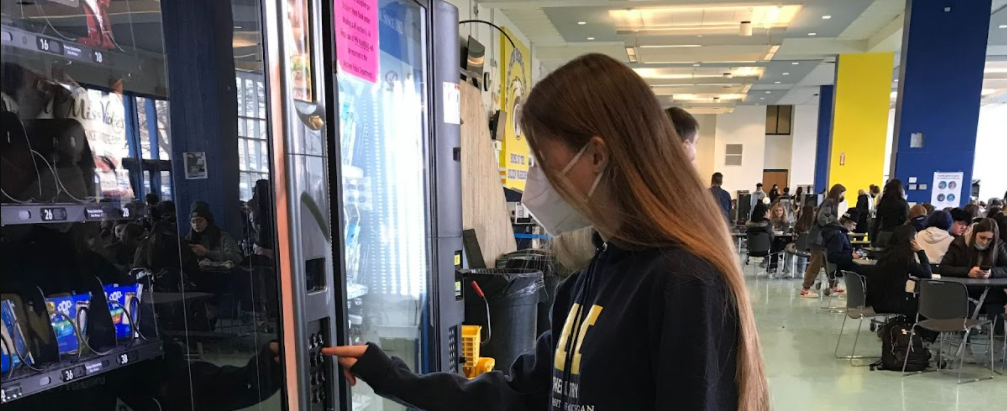
Juliet Herrick, a junior, enters her PIN into one of the vending machines

Some students are not sure if sharing PINs amongst friends is as significant an issue. “I think that while sharing your PIN so your friend can get a snack is considerate, lots of people are abusing this power and causing problems in the long run,” said Madelyn Blanchette, a junior.

“In my mind, sharing PINs is okay as long as it’s mutual,” stated freshman Gavin Cleary, “but if it is not or if it’s stealing PINs, then it is not okay.”

Koutroubas explained that students sharing their PINs with friends is also inappropriate. “When we assign you the PIN, there’s a letter that says ‘Do not share your PIN’. That’s like your mom or dad sharing their PIN to their bank account.”

Several students suggest that offending students’ PINs be deactivated as a countermeasure against PIN theft. “I think if sharing a PIN is becoming an issue, a suspension of the PIN could work,” said Blanchette.

Sophomore Megan Zhang agrees. “I think appropriate consequences for those who share their PIN numbers is to have their PIN deactivated for a certain amount of time, such as two or three weeks,” she said.

Zhang believes a possible solution would be to use biometric technology instead of codes. “Having everyone’s finger (of their choice) to be used for scanners marked/identified and then using those for the ‘codes’ would make sure that it is the correct person using the account,” she explained.

Koutroubas’ idea is similar, only students’ ID cards would be scanned instead of their fingers. “We really would love for students to carry their IDs and be able to scan everything,” she said. “It would eliminate lines, and it would eliminate theft. I think that it would be a little more secure, unless you lose your ID or something. Until there’s enforcement from the administration on carrying IDs, we’re just left with the PINs.” 

Since holiday break, there has been a decrease in vending machine theft. “There was a decrease right after the students that compromised the numbers were punished,” stated Koutroubas. “As soon as we found out who they were through the cameras, it stopped.”

Koutroubas’ ultimate advice to students is to not share their PINs. “Be conscious of who’s around you when you’re putting your PIN in. Make sure there’s no kids videotaping you,” she said.

Continue reading
What Happened to the Composting and Recycling Bins?
  • January 13, 2022

Jillian Slotnick

CORRESPONDENT

The district was not supporting recycling and composting in the cafeteria at the start of this year because compostable lunch trays and silverware are not as accessible.

As of January 3rd, 2022, recycling has returned to the cafeteria. 

According to Melanie Cutler, a member of the green advisory board and an environmental science teacher at Andover High School, about 60% of all cafeteria waste at Andover High can be recycled or composted, but because of supply chain issues, almost everything was being trashed this year. Principal Principal Brown recalled that last year when there were two different lunch rooms, it was difficult just getting the lunch materials to each lunchroom so there was no discussion surrounding composting and recycling bins being brought back. This year, even though everyone is in the same lunchroom, there was no composting or recycling happening at the beginning of the year. 

“I was told the district would not be supporting compost this year [and] I was very disappointed in that,” said Cutler. “It took us a very long time to get compost in the high school in the first place. We spent years on it so it’s very frustrating.” 

STAFF PHOTO / Avi Shapira
Sophomore Anat Briskin standing next to the new recycling bins at lunch

Senior Eva McKone, head of the Environmental Club at Andover High said, “Not having any composting leads to a lot of waste in our environment.” She went on to say that “It takes hundreds of years [for trash] to actually break down and it’s just kind of left in piles. If we did have a compost system it could be reused for plants and fertilizing [and] for recycling; everything we use in the cafeteria could be given a second life.” According to National Geographic, 5.25 trillion pieces of waste are in the ocean at this moment and over 100 million animals are killed by it each year. 

Even when we did have both composting and recycling bins, many students were still contributing to the problem by not putting their waste in the correct bin. Approximately four years ago, when AHS first got composting and recycling bins, parents volunteered to make sure students put their waste where it was supposed to go. Once COVID started, the parent volunteer program was stopped and students didn’t take the time to sort their waste anymore. “Our lunches are so short, people prefer to, and I understand, sit and eat lunch with their friends,” said Cutler. “You don’t want to spend five whole minutes sorting your waste. It’s a lot easier for everybody, when the bell rings, to get up, dump their lunch, and run.”

When students just dump their waste, that causes contamination. Contamination is when waste is sorted into the wrong bins (compost in recycling bins, trash in compost, etc.). When this happens, the batch of waste that is contaminated has to be thrown out and the school pays a fine. Brown urged students, once composting and recycling is brought back, to make sure they are putting their waste in the correct bins.  She went on to say that the school has to pay for the contaminated compost and recycling piles when they shouldn’t have to.

In regards to whether composting will be back at the high school, Brown said, “I was supposed to have a meeting [in November] with the cafeteria, the facility staff, Ms. Cutler, and some people from the town in terms of composting and recycling, and [we were supposed to be] trying to figure out the best way to start [composting] again.”

Continue reading
Mask Rules in Cafeteria Raise Questions, Concerns
  • November 19, 2021

By Eva Liss

STAFF WRITER

Most Andover High School students are doing their best to follow the masking and social distancing rules in the AHS cafeteria this year. 

When in the cafeteria, social distancing isn’t required, and students are only required to wear their masks when walking around. These rules were created by Massachusetts’ Department of Elementary and Secondary Education (DESE) in accordance with the Center for Disease Control and Prevention’s guidelines. The mask mandates were extended through October 1, then November 1, and have since been extended through January 15 as of October 26. Although the vaccination rate in the high school is high, at 85 percent, it is still important for students to follow the guidelines to keep the school safe. 

“I’m very glad we have masks,” junior Juliet Herrick said. “But how can you eat food with a mask on? If we’re distanced it’s awkward. [The cafeteria rules are] like a compromise. It gives you a taste of normal.”

Freshman Carmina Merrill said that she believes it’s harder to enforce the masking rules in the cafeteria than in the classroom. Senior Tessa Barcelo said “Sometimes people don’t follow [the rules],” and that she feels the rules should be a little more enforced. 

With the amount of students and the large space, it’s hard for the monitors to keep track. Ron Ramsey, an AHS monitor, has a different opinion than Merrill and Barcelo. He said that kids are generally more willing to follow the rules, especially ones who were at AHS last year. 

STAFF PHOTO / Eva Liss
Masked and unmasked students sit in cafeteria during their lunch block

The rules for eating in the cafeteria last year were much more severe. There were two eating spaces—the cafeteria and the Dunn Gym—and students ate at desks spaced six feet apart. Sophomore Ingrid Cotta said, “[The masking rules] make it easier to hang out with your friends at lunch, and I think most of the people are following the rules. It works out pretty well.” Students seem to be willing to cooperate with the current rules if it means they don’t have to go back to the old ones. 

Scott Darlington, an assistant principal at AHS, said he believes that students need to focus a little more on following the rules and keeping themselves and others safe. He also said students are doing a good job so far. “It takes a certain amount of discipline to remember to [mask up],” said Darlington. “Sometimes people take off their masks, put them down, and then they stand up to get a glass of water and they’re halfway there, and we remind them, and they’re like, ‘Oh my gosh, I didn’t even realize that!’”

Darlington said he believes AHS is doing the best it can with the guidelines it has. “Everyone thinks ‘Oh, why do we still have to wear masks?’ Because you probably would have a hard time keeping your school open if you didn’t,” he added.

Continue reading
Snack Shack Closed Due to Staff Shortage
  • October 13, 2021

By Shravya Sathi

CO-EDITOR IN CHIEF

Many of the cafeteria staff have not returned to the school after AHS went remote in 2020. Due to this shortage of staff in the cafeteria, the Snack Shack is closed indefinitely. 

The Snack Shack was a reliable option for many students as it provided an alternative for lunch and snacks before and after school activities. However, it was not open during the 2020-2021 school year and has continued to remain shut down. 

“It was really great, as school meals often weren’t enough to get me through the school day and cross country practice. Getting a yogurt parfait or a muffin really helped get me through the day and I miss it a lot,” said Brandon Zhao, a senior. 

Many believed that the closure was due to the COVID restrictions. “The Snack Shack isn’t ‘necessary.’ It’s an add-on to lunch, so I think that the school wanted to limit crowding in large areas with food. And so, they decided to not open it these past two years,” said Carol Yu, a senior.

STAFF PHOTO / Shravya Sathi
The doorway to the Snack Shack in the cafeteria

However, Gail Koutroubas, the director of food services, revealed that she would be very happy to bring back the Snack Shack if she can find more staff. “All the staff is new, and the new staff that we have is limited because there are no applicants,” said Koutroubas.

She is hoping to get some more staff in order to put back the Snack Shack and made-to-order deli. “They just need to love kids. They don’t need a food service background to serve lunch. Parents could even come in and help us… we would hire them on a temporary basis!”

Even if she gets more staff, another complication is getting the food for the Snack Shack to the high school. There is a bigger supply chain problem going on past the school. On top of that, there are not many drivers, nationwide, to get the food from the warehouses to the schools.  

“When the pandemic came, and everything shut down, there was a certain percentage of people that left the workforce. A certain amount of people left the food service,” Koutroubas said. 

While the future of the Snack Shack is still in question, there is a consensus that it is a part of AHS that is very missed. 

The Snack Shack was a place that had many options that the students liked, such as bagels, yogurt, smoothies, popcorn, coffee, muffins, and candy. Some students claimed to use the Snack Shack more than the regular lunch lines. If they were hungry, students would grab something quickly between classes. Teachers would even bring their classes down to the cafeteria so that their students could grab food from the Snack Shack. 

“If you can get me some parent volunteers or something, I will open up that Snack Shack faster than you can say Snack Shack,” Koutroubas said.

Continue reading
Reasons for Lunch Complications
  • October 13, 2021

By Philippa Konow

STAFF WRITER

Everyone loves lunch. You get to sit with your friends after your classes, you get to socialize with them, and this year, you also get free lunch on top of that! Unfortunately for students, an issue has been arising, especially during fourth lunch. 

For the past couple weeks, some students in fourth lunch have experienced the cafeteria running out of food to serve. Students going into the lunch line have come to the front only to be told, “Sorry, we are out of lunch.” I, myself, have experienced this issue. It was on one of my days where I’m at the school until 7 p.m. due to clubs so having lunch is very important. Some lunches are even locking the kitchen doors, refusing to allow students to get food ten minutes after lunch starts in order to combat students grabbing a second lunch. 

“I’m a person who eats a lot and therefore needs seconds,” said junior Abby Spewock, “I know if I go to take seconds, someone in the fourth lunch will probably not get food. No student in the public school system should feel guilty for taking more food or being hungry.” This is a point that many people in the student body share as this is a very big issue. Another key fact that seems to be overlooked is the need for larger portion sizes, especially as many students are involved in afterschool activities that require a significant amount of fuel to give them energy. One piece of pizza and a small serving of salad might be enough for one person, but might be very little energy for someone else. Having more of a variety in serving sizes would help more students in feeling fueled up after lunch. 

Many of the students who need more to eat either do sports or stay after school for clubs, hours after school has ended. Now imagine if they didn’t receive lunch during the school day. They would be famished by the time they came home, especially if they didn’t have breakfast. The students then take seconds during the school to accommodate for the fact that they are still hungry after one serving, which, as Spewock mentioned, risks taking another student’s lunch away during fourth lunch. 

The reason for these troubles are pretty simple: COVID-19. This has caused many problems for everyone of all ages and professions. During the beginning of the pandemic, it was difficult for many individuals to keep their jobs, with the restaurant industry suffering heavily. When Andover schools closed, many of the kitchen staff left and never returned. Since schools continued to remain fully remote for the rest of the 2019-2020 school year, the kitchen staff had to leave to seek other employment elsewhere. 

STAFF PHOTO / Philippa Konow
View from the cafeteria stairs during breakfast on Tuesday October 5, 2021.

Many truck drivers working for food shipment delivery services also lost their jobs. According to Gail Koutroubas, the APS Nutrition Director, “There is a huge nationwide shortage of truck drivers. An example is, I ordered fresh produce… I ordered 25 cases of snack pack carrots. I didn’t get any of them in shipment. I ordered 25 cases of sliced apples. I didn’t get any.” This issue with the shortage of drivers is causing individuals, like Koutroubas and her kitchen staff, to struggle to find ways to make ends meet. This isn’t an issue about not ordering enough food for all the students, this is an issue with there being no one to deliver the ordered food to the schools. 

For parents, graduated siblings, etc., who are looking for some work, APS schools are hiring in the kitchen. “We pay $15.97 an hour to start, and we need people even if it’s just for 4 hours,” stated Koutroubas. Just those four hours alone can help bring back the fully functioning cafeteria for the ease of the students and the staff as well! 

As suggested by Koutroubas, there is a possibility for student assistants during H-block class so students can help serve food for those who missed breakfast! This will give all students the opportunity to have some breakfast in their stomach so they can get through the day. this would be able to bring together the students to achieve a common goal; avoiding hunger in the student body during the day. 

There are steps being taken to help this situation get resolved. We all love lunch and miss the beloved Snack Shack, but if we all work together as a community, we will be able to get to a very much normal as close as we can. We just need some good old team work to help! If you think that one lunch won’t be enough for you, bring one from home until this is sorted out. If you see someone without food and they are hungry, if you have something that you are too full to eat, offer it to them!

If anyone is interested for a staffing position in the APS kitchens, please visit this link: https://www.aps1.net/401/Employment-Opportunities.

Information: 

  • Pays $15.97/hr
  • Flexible Hours

Requirements: 

  • Friendliness to kids of all ages
  • Ability to work with others
  • Training will be provided

Continue reading