New Music Era Begins With Departure of Catherine Revetria

By Eliza Marcy

MANAGING EDITOR

How many people does it take to replace one AHS music teacher? Turns out, more than you might think.

After an eight-year run, Catherine Revetria left her numerous musical posts in early April after announcing her pregnancy and her plans to take care of herself and her family. She was the director of the high school’s band and orchestra, the remote instrumental program, the Golden Warrior Marching Band, Tri-M Music Honor Society, and all middle school bands. 

Replacing her until the end of the school year are Dennis Shafer, Dr. Derek Voigt, Sean Walsh, and David Rice. Shafer, one of the school jazz band instructors, has taken over Revetria’s teaching assignments. Voigt, the middle school orchestra teacher, has assisted with the high school’s orchestra. Walsh, the Fine Arts Program Coordinator for Andover Public Schools, has been working with Tri-M students. Rice, the Assistant Marching Band Director, has stepped up to fill out the year and helped cheer on the varsity football team.

So that makes four men replacing one woman. Fierce!

Walsh told ANDOVERVIEW that the district is in the process of hiring permanent replacements and hope to have final candidates by the end of May for the 2021-2022 school year. In the Tri-M Honor Society, Walsh has overseen the annual Instrument Donation Drive and is currently planning to get the high school musicians over to the elementary schools this month to encourage fifth graders to continue their involvement icouldnn band and orchestra. 

“We are [also] excited about new courses next year at AHS, including ‘Beginning Instruments’ and ‘Rock Ensembles,’ and looking to expand programs at elementary and middle school levels,” he said.

STAFF PHOTO / Eliza Marcy
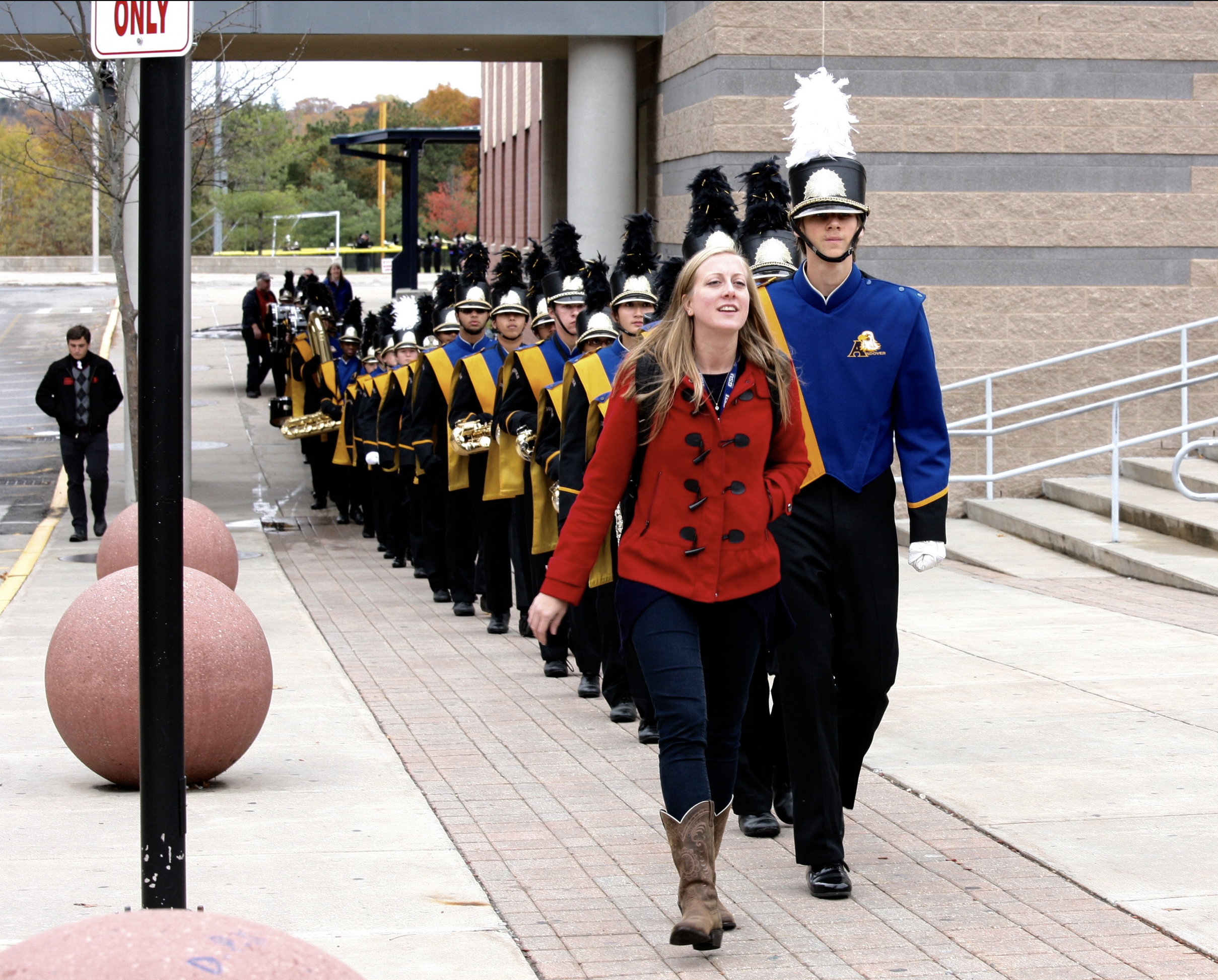
Revetria née Hofius leading the Andover High School Marching Band.

No Regrets

Revetria came to AHS from Georgia and brought with her a fiery passion for music that she passed down to all her students. With no regrets about leaving AHS now, she told ANDOVERVIEW that she planned to return to teaching music one day when the time was right. But one of her greatest challenges over the years was, in fact, “time and the schedule.” 

“Having a limited number of students signing up [for band] has always been tough,” she said. “The challenge is having this robust middle school program and then not being able to have the time to take a band class in high school. On the other hand, my greatest accomplishment here is the shift in the culture of the marching band. It used to be very ‘drum corp-centered’– people had to do push ups when they messed up. The culture shifted to be much friendlier and we doubled the membership. The younger and least experienced players felt more welcome and were lifted up to the rest of the group. We grew because of that. And finally, I’m also very proud of the transition of the orchestra from an after-school program to being in the school day. It’s small but mighty.”

She also told ANDOVERVIEW that she was very proud of her colleagues and working together with them to grow the middle school band so big that they can’t fit on the Collins Center stage anymore. 

“We can’t even have All Bands Night anymore like we used to because there’s too many people in the audience and too many people on stage,” she said. “We maxed out the capacity even before COVID!”

In a letter from the Andover Band Association, President Matt Scully wrote to students and parents about his appreciation for Revetria.  

“Catherine has been an inspiration to all of our children over the past eight years,” he said. “Whether in lessons for Elementary, or band and orchestra in Middle and High School, she’s been there with them teaching and cultivating their love for music in their early musical years. I wish her and her family all the best in the world.”

For now though, music students see Shafer– or Crazy Dennis as he’s affectionately called in jazz band– teaching high school band and orchestra each day, and all middle school bands (co-teaching with Kaitlyn Sicinski). 

“I have thoroughly enjoyed working with all the students, and it is a joy to be teaching in-person again,” he said. “I have enjoyed in particular with the orchestra/string students, as I have conducted orchestras in the past, but it has been a while.”

Shafer has three degrees in Saxophone Performance. He told ANDOVERVIEW that he has a bachelor’s in Music (BM) from Boston Conservatory (2004), a Diplôme d’Etudes Musicales (DEM) with prize in saxophone from the Parisian Conservatory of Boulogne Billancourt in France, and an Artist Diploma (AD) from Longy School of Music which is next to Harvard in Cambridge, Massachusetts. 

“I thoroughly enjoy playing the saxophone, which I’ve worked on perfecting for 30 years, and I’ve almost got it,” he said. “Right now, I’m working on klezmer clarinet, however, [I’m getting some tips from Kaitlyn Sicinski about clarinet playing and from some other artists on Zoom and Youtube. Most of what I learn these days is from YouTube–and it’s free!”

All About Fun

What’s the most important thing Shafer wants to convey to AHS students in the short time he has with them? The most important thing is scales.

“If, by the time I leave here at the end of the year, every student can play all major scales (percussionists included, there are plenty of mallet instruments here), I would consider that a great success,” he said. “Scales unlock the kingdom for playing anything on any instrument. Right now, I’m learning the Freygish scale for klezmer, on clarinet the most popular key for that is E. So its E, F, G#, A, B, C, D, E–Try it! It’s lots of fun! It’s a major scale but sounds minor because of the augmented second in the beginning of the scale.”

In a letter to students in the band classes, Revetria wrote she was saddened to say goodbye as the community in Andover had been such a large part of her life the past eight years. Like Shafer, her parting words are all about sticking with music over the long haul.

“I am nothing but confident in the future of the music program in Andover,” she said. “The program’s growth that I have witnessed is immense and it will continue to grow in the years ahead. I am truly excited knowing how much music can, and will, enrich your lives if you stick with it. I have yet to meet someone who regrets the time they spent learning music—only people who regret giving it up. So keep playing!”


Related Posts

A Numbness We Can’t Afford
  • May 7, 2026

ANYA GOROVITS || OPINIONS EDITOR

In the 365 days of 2025, the U.S. saw 407 mass shootings.These shootings were part of a broader gun violence crisis that caused tens of thousands of deaths across the country, including 226 children and 1,038 teens killed in mass shootings alone, according to the Gun Violence Archive’s official 2025 report.

Most Americans are aware of this stark reality: they’ve watched these numbers rise each year for decades. They watch countless shootings shown hurriedly on the news before returning to their daily lives. In school, students briefly discuss the latest tragedy in their history class before returning to the standard curriculum. Legislators put out quick statements before quickly moving on.

“[Mass shootings] have become a symbol of American culture and American freedom,” said sophomore Ari Friedman. Indeed, they’ve become almost synonymous with America’s identity, present in our history since the 1966 University of Texas Tower Shooting. On the World Population Review’s mass shooting map, most countries report 0–10 mass shootings from 2000–2022. The U.S. reports 109.

A pivotal moment for modern school shooting conversation was the Columbine shooting of 1999, during which two students killed 12 classmates and a teacher. The event fundamentally reshaped how schools, law enforcement, and the public regarded gun violence.

“When Columbine occurred, that was a time that really changed the national consciousness,” said AHS Principal Jimmy D’Andrea. Then came Sandy Hook in 2012, a shooting at a Connecticut elementary school that killed 20 first graders and 6 staff members. Rather than a turning point toward action, this shooting marked a new stage: acceptance. News of recent shootings no longer came as a surprise, and such stories quickly stopped making headlines.

Today, school-age students all around America have become used to yearly ALICE drills. 

“The fact we even have to do these drills is dystopian, but I’ve usually just gone with it. It’s a fact of life,” said sophomore Ari Friedman.

School shootings should never be a fact of life.

“You can’t allow it to numb you, because that’s how things that aren’t normal become normal,” said junior Grace Arnold. Yet that is exactly what has happened. This country has watched children be killed in their classrooms, again and again, and decided that the right to own a gun matters more than the right of a child to survive the school day.

Though communities advocate for “policy not prayers” after each major shooting, nothing ever seems to reach Congress. Around 90 percent of Americans support universal background checks, yet they haven’t been passed, killed by political opposition funded by gun industry lobbying. 

“Profits matter more than people in America,” said AHS history teacher Fred Hopkins. He described how the Second Amendment’s true purpose has become severely distorted. Originally written to enable collective militia defense in a newfound country with limited defense capabilities, the amendment is now interpreted as the right of every American to own murderous weapons. 

Beyond gun legislation, school shootings are driven by a crisis in mental health and an American culture that seems to value silence over support.

Today, America’s emphasis on individualism has created an outlet for violence. AHS junior Tyler Bates expressed that this individualism discourages struggling students from asking for help, leading to their desire for violent expression.

“If people are still angry, this anger and aggressiveness will come out one way or another,” said AHS French teacher Olga Kostousova, who believes that gun restriction laws are very necessary, but they work only if we also address the deeper cause of violence.

Ending this crisis requires both stronger gun legislation and a cultural reckoning around mental health. It requires universal background checks, and real investment in mental health resources at the community level. It requires a culture that stops making shooters famous and starts recognizing people in crisis before it’s too late.

Most of all, it requires refusing to be numb. Many people today feel that there is not much that can be done on a legislative level to achieve peace for American children. They feel that just taking this horror as “a fact of life” is better and simpler than fighting for change. They believe that ordinary people have no voice and no ability to change this cynical symbol of America. Yet it is this belief that limits our ability to stand up for the lives of American children.

“I absolutely have hope that change is possible. But people kind of have to wake up and choose to be affected by it,” said Arnold.

In 2018, survivors of the shooting at Marjory Stoneman Douglas High School in Parkland, Florida, organized a national walkout that drew hundreds of thousands of participants. The pressure was enough to push Florida to pass its first significant gun restriction legislation in decades. So ordinary people, students especially, do have power. When enough people speak up, change does occur. But when we remain numb, we refuse change, and we let our schools remain war zones.

Four hundred seven mass shootings in one year. Two hundred twenty seven dead children. 

These are not statistics to scroll past. They are a demand, one that has gone unanswered because too many people have decided to stop asking for change. America, and Americans, have the power to choose differently. The true question is whether we will, before another classroom becomes a tragedy we forget by next week.

Continue reading
Bubble, Bubble, Toil, Trouble: Failures of Scantron tests
  • May 7, 2026

ADVIKA SINGH ll STAFF WRITER

Are Scantrons a lifesaver or mistake? At Andover High School, the jury is still out. Many favor the quick results, while others say a few filled-in circles doesn’t show what a student really knows. As we keep bubbling in answers, one big question remains: Are we choosing easy grading over critical thinking?

Let’s be realistic: teachers are human. They need sleep and aren’t trying to decipher every student’s chicken-scratch handwriting. For those managing classes the size of a small village, Scantrons aren’t just a tool but a life raft.

“When you have large classes taking large, multiple choice tests, Scantrons can help speed up the grading,” forensics teacher Cole Hauser noted. He suggested the efficiency of the exam benefited both students and teachers: “There’s a quick turnaround on feedback for the assessment. Students are able to see how they did almost right away which can be helpful, especially for students who feel a lot of post-test anxiety.”

In contrast, English teacher Jennifer Percival chooses to skip the bubbles entirely, believing English should focus more on skill development. “I suppose if I gave Scantron tests, feedback would be faster, but I also think … it would be difficult for me to ‘see’ a student’s thinking,” said Percival. “Unless part of the assessment required students to defend their answers, I wouldn’t be able to see the thought process.” 

Furthermore, I believe using Scantrons for subjects such as English and math is unreasonable. English relies on subjectivity and the ability to defend an opinion, none of which is captured by filling in a bubble. Similarly, in math, the process of solving problems is often more important than the answer. When we use Scantrons, we shift focus from critical thinking to luck and accuracy. Education should be focused on our ability to demonstrate intellectual growth and the ‘why’ behind answers, and not centered on a score spit out from a machine.

The subject a teacher instructs often determines the practicality of Scantrons. While many educators appreciate the efficiency they bring to subjects requiring memorization, like science or social studies, freshman Maria Barsegov believes some classes are a better fit for the technology than others. “It’s okay to use Scantrons for social studies because there isn’t solving or thinking, but that it’s unfair to use for math or English,” she observed. In her view, subjects that involve showing work should allow students to demonstrate their abilities.

The student body at AHS is just as split as teachers. While teachers focus on “feedback” and “efficiency” students are more concerned about how the format affects their actual grades. The biggest complaint among students is the lack of partial credit. On a Scantron, you are either 100 percent right or 100 percent wrong.

As a student, I’m familiar with Scantron exams, and to put it bluntly, I detest them. While I empathize with teachers who are tempted by prospects of a lighter workload, these benefits are outweighed by academic costs for students. For struggling students, partial credit is often the line between a C and a D+ or a C+ and a B, and losing that opportunity greatly alters your overall grade.

Junior Adelelaide Buzay found Scantrons stressful. “Scantron tests are efficient but don’t allow room for mistakes. I find them confusing,” she stated. This sentiment is common among students who believe Scantrons to be unfair. An anonymous freshman shared a story about a teacher reliant on Scantron exams: “I have a teacher who gives no partial credit and only does multiple choice and … her tests only have a few questions which makes it harder.” When a test only has ten to twenty questions, each bubble carries a massive weight. Without room for partial credit, students are left distressed.

Despite concerns of fairness and partial credit, the siren song of Scantrons still calls to many. For some, the stress of waiting weeks for a teacher to grade something is more dreadful than the grade itself. Freshman Bhavika Sharma stated, “ I like Scantron exams because the results return quickly.” In a high-pressure environment, this nearly-instant feedback allows students to see their mistakes without the anxiety of a long wait.

It’s ironic for students to be told to think outside the box, when only being rewarded for filling it in. It’s better if a teacher is reading your work because the machine can only see lead marks on a paper, and not the person holding the pencil. A Scantron can’t see the logic, effort, or the ‘almosts’ defining how people actually learn. We’ve built a culture that values convenience over students’ abilities. By handing grades over to a machine, we aren’t just losing partial credit but the most important part of education: growth.

Continue reading

Leave a Reply

You Might Also Like

Spanish Department to Host Day of the Dead Fair

  • November 12, 2025

Funding the Future of Science: Proposed NIH Funding Cuts Throw US Biomedical Research Into Uncertainty

  • November 4, 2025
Funding the Future of Science: Proposed NIH Funding Cuts Throw US Biomedical Research Into Uncertainty

Student-Hosted Video Game Hackathon Scheduled for Late September

  • September 22, 2025
Student-Hosted Video Game Hackathon Scheduled for Late September

World Languages Coordinator Reflects On Career, Retirement

  • June 9, 2025
World Languages Coordinator Reflects On Career, Retirement

CollegeBoard Scores 1/5 on AP Testing Administration

  • June 9, 2025

AHS Student Directs Coming-of-Age Film, ‘Horizon’

  • June 9, 2025

Discover more from AHS NEWSPAPER

Subscribe now to keep reading and get access to the full archive.

Continue reading