By Harry Guo and Brandon Nguyen
STAFF WRITERS
The room is still. The only sound is the buzzing of the fluorescent ceiling lights.
You wait another minute to hear silence, to make sure it’s safe to go. You know you have only a couple more minutes until a custodian comes to take out the garbage. With nothing but courage and hunger, you and your friends bolt toward the ultimate prize:
The trash can.
You dive into a sea of half-empty smoothie cups and crumpled bags of Doritos, and quickly indulge yourself. Suddenly, you catch a glimpse of something moving across the classroom. You look up to see a pair of human eyes staring back at you, before you hear a blood-curdling cry: “A MOUSE!”

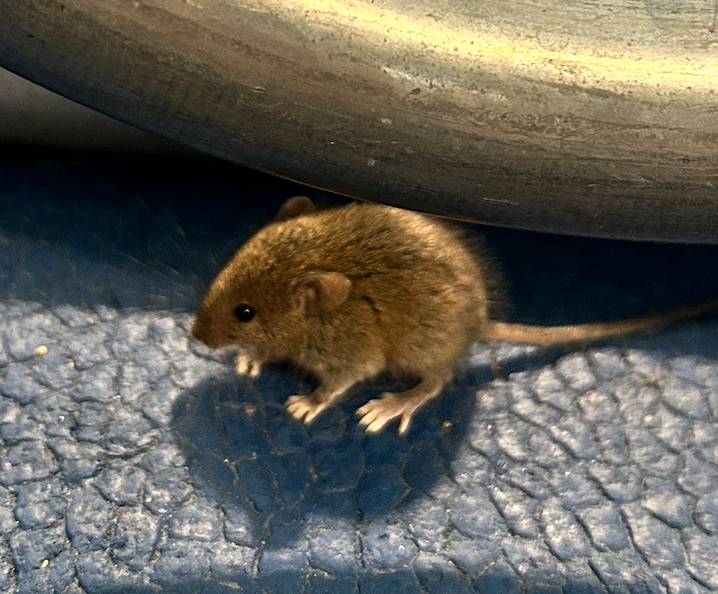
A mouse found in the field house.
Andover High School has been dealing with a rodent problem for decades. Custodians have combated the issue with mouse traps, some teachers banned snacks in their classrooms, and even the food in the teacher’s lounges is kept in mouse-proof plastic containers. Many students and teachers have been victims of rodent sightings, but many of them feel more bothered about the banning of snacks than the rodents themselves.
Minda Reidy, a math and computer science teacher at Andover High School, has encountered several rodents during her teaching career here. “I had been sitting and been really quiet,” said Reidy. “[The mice] thought the coast was clear… one went across, then another one went across, and then another one.”
Nathan Gerow, a sophomore at AHS, claimed he saw a mouse in the cafeteria in the morning, before school. He said that the mouse was small, fat, round, and “kind of cute.” He’s only seen one so far, so the problem doesn’t bother him, even though he understands that there’s probably a lot more in our school.
Many of the rodents living at AHS may be the descendants of a senior prank from many years ago, according to John Berube, a librarian at AHS. “[The seniors] went to various pet stores and they bought up all kinds of mice,” said Berube. “They released them at lunch in the cafeteria, dozens and dozens of them.”
Mary Coombs, another librarian at AHS, points out that the main cause of rodents in the media center nowadays may be people not cleaning their garbage. In 2019, before Coombs arrived at AHS, there were big, open recycling bins in the library, where students dumped leftover food and drinks, which created an invitation for the mice. Since then, she has removed the bins and has seen a great reduction in mouse sightings.
“It’s disconcerting to come in and find droppings on your desk, it’s not a nice thing,” said Berube. “You would find them… on the counter and out back… sometimes I would find them in my office.” But, he has seen an improvement since food was banned in the library, making sure to have a “quiet word” with anyone caught eating there.
Student-wise, there has been an indifferent response to the food ban in the library and other parts of the school. Gerow said, “Personally, I don’t feel like it’s ever really been an issue. I haven’t seen many students eating or drinking in the field house or library, and I don’t think [the ban] impacts many students.”
Other students have a sympathetic attitude toward the ban. “[The ban] makes sense, rodents are definitely a problem,” said Shreya Desai, a sophomore at AHS. “It’s unfortunate because I like going to the library for lunch… people should be responsible for what they eat and clean up after themselves.”
Along with much of the student body, Reidy, who’s also described as a mouse enthusiast by many students, doesn’t mind the rodents if they don’t interfere with her work. “As long as they don’t show themselves, it’s okay… It’s a fact of life,” concluded Reidy.