A Wrap on the AHS Varsity Girls Hockey Season 
  • March 27, 2023

By Julie Mahoney and Grace Wang
STAFF WRITERS

The varsity girls hockey season came to a close after a tough battle against the Duxbury High girls hockey team in the Division 2 semifinals at Loring Arena on Saturday, March 12th. 

They began the season with a rocky start against Shrewsbury, losing 2-0. However, inspired to win, the team came back stronger than ever and ended the season with a strong 17 wins, 4 losses, and 2 overtime games. The team achieved Co-Champs for the second year in the MVC league. They also had many successful games against difficult opponents, such as beating the #1 seed Archbishop, 6-2.  Overall, AHS junior Casey Michael said that “it was a very successful season” for the girls.

Going into the season, the team didn’t only strive for success, they also worked to have a good mindset that focused on persevering. They relied on each other to support and push one another. As one junior on the team, Micheal said, “Everyone is playing for the same goal. We all want to do good and achieve the most.” Michael explained that she uses the people around her to motivate herself to improve and do better for the next game. 

What makes the team successful “is the girls,” Coach Meagan Keefe said. “They set high expectations, and are willing to do the hard work to meet their goals.” All these motivations are what encourage the team towards success. 

The team’s motto is “intensity, desire, and team,” said Michael. “This is part of our chant in the locker room to get us ready for every game. I think it embodies what we want to be as individuals and as a group.”

Keefe said, “Understanding how each person works, what motivates them, how to approach them with feedback, and guide them is the best way to go about it.” The way the team works together and trusts each other is what makes them victorious no matter the outcome of the season. Keefe emphasizes the importance of focusing on both the individual and the team. Each person matters on the team and makes a contribution. Likewise, the team plays an important role in the individual too. 

COURTESY PHOTO / @bluegoldwarriors on Instagram
AHS girls hockey team rejoicing on the rink.

During the season, each individual puts in the effort to set the team up for success. Another driving value of the team is team support and spirit. Michael said, “[The] support that you feel on the hockey team is the biggest motivator for many of the girls.” Even when on the bench, the team’s spirits remain high to cheer on players on the ice. “We never get down on each other and when we feel the energy is low we scream as a team to get the nerves out,” Michael concluded. 

Finally, the team doesn’t forget about the importance of having fun. While “every team’s goal is to get better, it’s also to have fun,” Michael mentions.

 “I also want the girls to have fun every day, make connections, and build a bond that they can have for life,” Keefe concluded. While simultaneously emphasizing the importance of winning, the goal for the team is for them to do their best. At the end of the day, everyone’s happiness and fun are what really matter.
Continue reading
Comic Con Comes to Andover
  • March 21, 2023

Memorial Hall helps students use pin-making machine to turn ordinary paper into fashionable accessories.
Students choose artwork to make into pins.
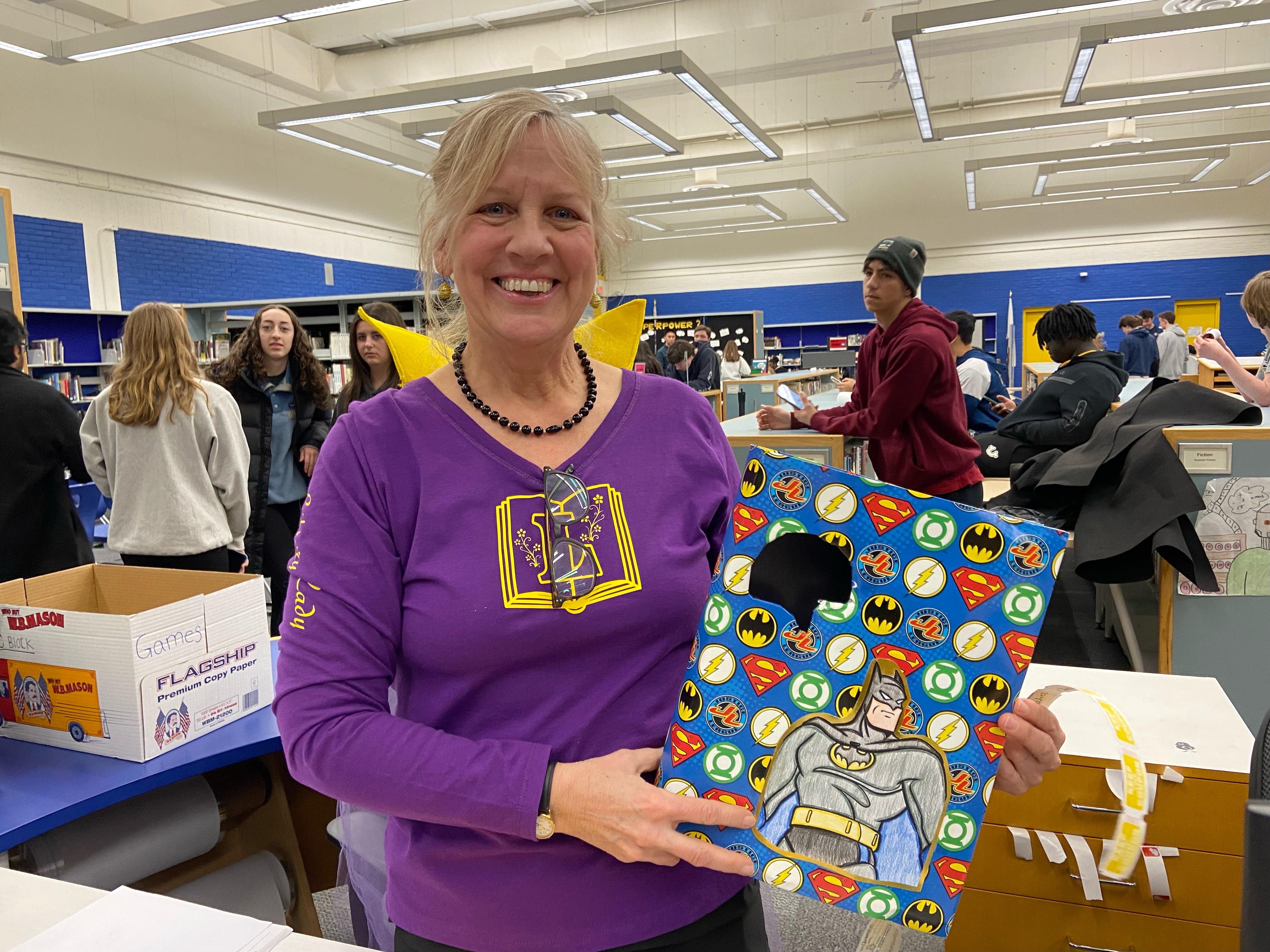
Mary Coombs of the AHS library displayed the raffle ticket collection box. Coombs was the mastermind behind the organization of the event.
The Andover Bookstore offered best-selling comic books to Andover High in its first ever Comic Con.
AHS’ Eagle mascot makes an appearance.
What’s your superpower? Seniors Avanthika Suryadevara and Anya Gupta are excited to find out.
Claudia Wessner and her daughter experience bonding through the delight of Comic Con.
Ellie McGrath contributes to Community Comics with an illustration.
Students come together to bring their imagination to life through community comics
Bori Kim brings Wonder Woman to life through prolific illustration at the Community Comics panel.
Junyi Ye participates in crafts at Comic Con.
Comics and comic merchandise being displayed.

Continue reading
AHS Welcomes New Choral Director
  • March 20, 2023

By Pippa Konow
STAFF WRITER

Lauren Peithmann, the new music and choral instructor at Andover High School, started working at AHS towards the end of the second semester, filling the hole in the music department left by the previous choral instructor. As a new teacher at AHS, she is excited to bring a new passion to the music department for her students. 

What was your school life like? 

“I always wanted to be a music teacher. My parents are both music educators so it seemed like a natural fit for me! After high school, I attended Ithaca College and majored in music education.”

What was your first job?

“My first job was teaching middle school chorus and music classes in Byfield, Massachusetts… I was working directly with middle schoolers but I also assisted with the high school musical [after school]. My office was in the same room as the high school chorus teacher and high school theater teacher, which was great. Both teachers were very helpful and we also had a lot of laughs. I also was able to help out with the high school musical and I enjoyed that experience too.”

What drew you to teaching students in music education?

“I love music and I love making music with students! I find great joy in rehearsing a piece with a chorus and then watching them perform it on stage. High school students have so much energy and enthusiasm for what they do. It’s inspiring!”

What is your favorite part of teaching music to students?

“Teaching singing is tough because everyone’s voice is different. You also can’t touch or see a person’s vocal cords. It can be a challenge to troubleshoot and help everyone work on their own individual voice. I like the challenge though. It’s so exciting to hear a student’s voice change and grow over time.”

What brought you to AHS?

“Prior to working here, I was an arts administrator and I was working mostly behind the scenes to help things run smoothly. While I loved seeing the progress of the students and supporting staff members, I missed conducting, teaching, and making music on a regular basis with students. So when I saw this position open up, I applied!”

What would you like to accomplish as a music teacher?

“I would like to leave a legacy of students who remember their time in chorus fondly, who perhaps are patrons of the arts in their own communities, and who still make music either professionally or just for fun. I like to think that the influence of a good teacher ripples out into the world. I hope that my students keep making and enjoying music their whole lives.”

Do you have a favorite musical composition piece?

“I really love piano music. Rachmaninoff’s Piano Concerto #2 is one of my favorite pieces of music.”

What is your favorite free time activity?

“I like to hang out with my daughters and support them in their activities. They like to swim, dance, sing, and act. We’re pretty busy!”

Continue reading
EDITORIAL: Chat GPT Usage In School
  • March 20, 2023

We’ve all had classmates whip up an essay in barely five minutes with the “help” of ChatGPT, while you actually write yours, only for them to get a better grade. It can be frustrating to see your hard work have a less fruitful production than the AI-generated essay, but in the end, the choices people make say a lot about their sense of honesty and integrity.

Some students think that ChatGPT is a perfect alternative to actually writing their assignments, because it is undetectable cheating. However, AI-detection softwares have been in development and catching some students. This emphasizes that ChatGPT is highly formulaic, so much that it can be picked up by other softwares. Not only could you get caught, the work will also be of worse quality.

And, of course, if you let the AI do your assignments for you, you aren’t actually doing the work. While that may be the point of using it in the first place, and it definitely can get your homework done faster, it may not be done as well, and you will be lacking the actual learning and comprehension skills
gained from completing the assignment.

In the end, it is not worth it to expect the same quality of work from ChatGPT than if you do it yourself, and if you do use it, you could be at risk of getting caught. The benefits don’t outweigh the negatives in this case, and if you really don’t have time for finishing an assignment, try talking to your teacher or guidance counselor about it instead of relying on an AI program to do it for you. The point of writing assignments is to apply your skills and knowledge. People who do put in the work deserve to take pride in it, rather than getting a worse grade than someone who put in close to none.

Continue reading
AHS Musicians Prepare for Junior Festival
  • March 20, 2023

By Jacqueline Zhu
COPY EDITOR

Andover High School students participating in the Massachusetts Music Educators’ Association (MMEA) Northeastern District Junior Festival will perform on March 18, 2023 at Galvin Middle School in Wakefield, MA.

Auditions for Junior Festival took place on January 28, 2023 at Tenney Grammar School in Methuen, MA. According to Sean Walsh, the fine arts program coordinator at Andover Public Schools, students must be in grades six through nine and participate in a school ensemble, such as band, orchestra, or chorus, to be eligible to audition. Music directors must be active members of the National Association for Music Education (NAfME) to register students for Junior Festival.

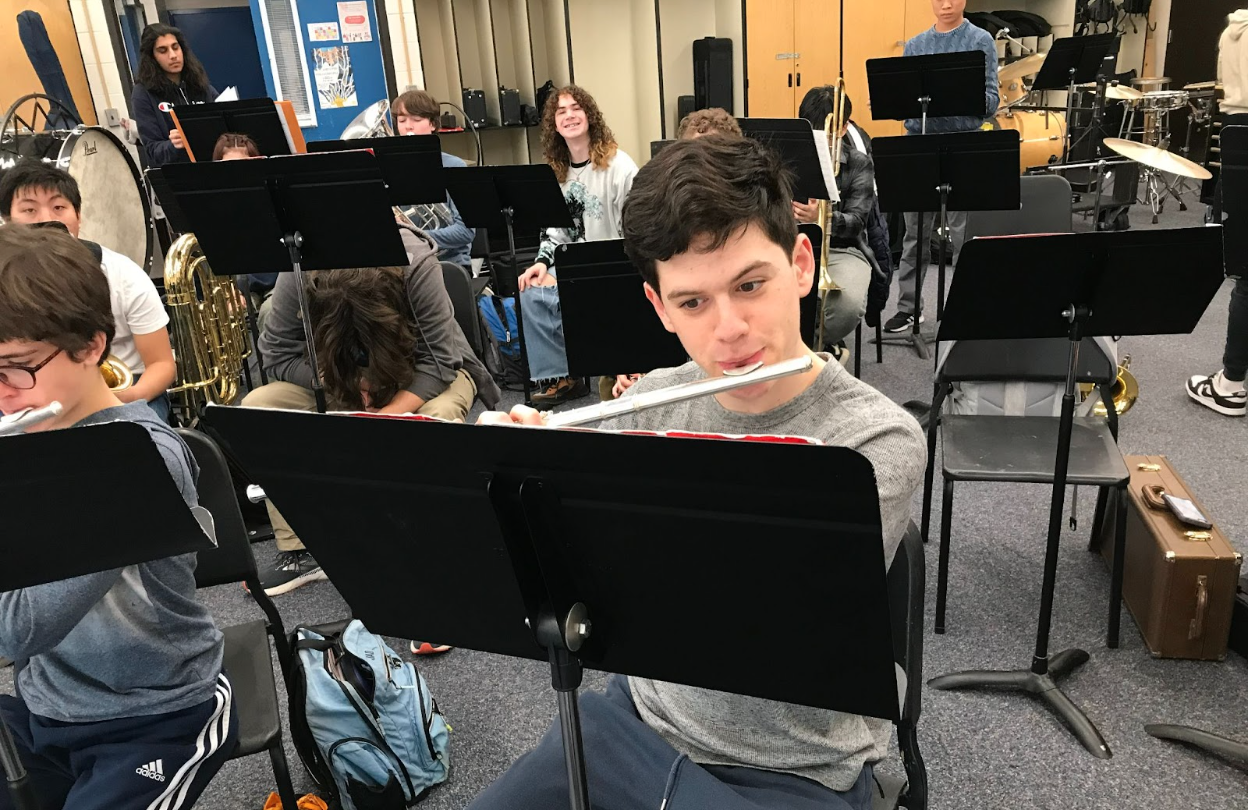
STAFF PHOTO / Jacqueline Zhu
Nitsan Cohen-Yashar, freshman, plays flute during band rehearsal.

The audition entailed performing two scales and an excerpt of a preselected piece in front of an adjudicator.

“Students get the music in advance, and they work on it independently,” explained Walsh. “They’ll usually have around three to four weeks to prepare the music.”

Auditions are evaluated on certain criteria, which include intonation, tone quality, technique, and musicianship. Students who meet the qualifying score for their instrument, which varies from year to year, proceed to perform at Junior Festival.

“This year, we have 18 students districtwide who were admitted into Junior Festival,” stated Walsh. Five AHS freshmen are among those accepted. 

Megan Huang, a violinist, reflected on her experience auditioning for Junior Festival. “When we got there, we basically had a few minutes to practice before our auditions,” she said. “The auditions were short, but they were really nerve-wracking.”

Huang stated that because of her anxiety, she did worse than expected. “I still got in, but I’m not as excited as I should be,” she said.

Violinist Meredith Cummings echoed a similar sentiment. “[The adjudicators] didn’t give us live feedback, but they wrote notes,” she stated. “It was really stressful, because they were just completely silent during the audition. You could hear the clicking of their keyboards as they were typing down their notes.”

In contrast, flutist Nitsan Cohen-Yashar felt more enthusiastic about his audition. “I already knew most of the scales,” he said. “I also practiced the piece beforehand, and it just needed some minor tweaking.”

Regarding the benefits gained from participating in Junior Districts, Walsh explained that it familiarizes students with the audition process. This aspect is particularly important for those interested in pursuing music as a career.

“If you’re able to play with high-level musicians and work with a master instructor, I think that experience is invaluable,” said Walsh.

Continue reading
Springing Forward Time: AHS Speaks on Daylight Savings
  • March 20, 2023

By Melody Tang
ONLINE EDITOR

March 12, the day our clocks jump forward an hour, occurred just over a week ago. However, a bill approved last year by the U.S. Senate but still awaiting action in the House of Representatives would change this ongoing tradition into past tense. Daylight savings has sparked its fair share of conversation after the possibility of its discontinuation was first announced. To gauge the beliefs held at Andover High School, we sought out staff and students to see how they were feeling.

The idea of daylight savings time (DST) was first implemented as a means of energy conservation: “springing” forward time in the summer would delay sunset by an hour, giving more light and warmth and thus conserving the usage of artificial energy like lighting and heating. 

Now, many are arguing for the permanent implementation of DST.

The Sunshine Protection Act was unanimously passed a year ago by the Senate, which would have “[made] daylight saving time the new, permanent standard time, effective November 5, 2023.” The House version of the bill, however, was never introduced before the conclusion of the 117th Congress on January 3, 2023. 

Whether it be a vehement belief or slight nuisance, many dislike the two time skips that occur annually. A representative from congressman Seth Moulton’s office stated that “switching between the two times can throw off our bodies’ circadian rhythm, harming both our mental and physical health.” Junior Christina Ilie echoed the statement, stating that she would get rid of the time switches completely if given the chance. “[When] it becomes dark earlier… my internal clock is thrown off,” Ilie remarked. 

Some students dislike daylight savings for other reasons. Isabella Falco, a junior, mentions that daylight savings can disrupt calls she has with family members living abroad. “When you talk to family abroad and they live really far away, the difference in the difference of time zones makes it harder to find times that work for both parties to be able to talk and connect,” stated Falco. When time zones are already varied between regions, the addition of daylight savings times can make it more difficult to navigate international and even domestic communication throughout the year. 

Further, travel becomes increasingly difficult when time zones are constantly fluctuating. “Time zones are already confusing enough and especially since so many more people travel internationally these days,” mentioned Falco. “It can be a hassle.”

While some cannot find validity in the time switch, others see reasoning behind the custom. Science teacher Daniel Donovan mentioned that when extending daylight by an hour in the summer, it must be taken into account that daylight also starts an hour later in the morning. This could pose a threat to those who commute to work or school, as accidents happen more-frequently in the dark. “People have to commute to work and children have to go to school,” said Donovan. He added that “some kids could be going when it’s not even dawn yet… [which is] dangerous.” 

ILLUSTRATION / Melody Tang

However, Donovan sympathized with those who are against the time skips, adding that “[time switches are] a bit of a pain, [and] it does take… a few days to adjust.” As a remedy, he suggested implementing a permanent time change that accommodates both sides by pushing the normal time forward 30 minutes. That way, the sun can set half an hour later while also allowing commuters more sunlight in the early morning. 

Despite continuing arguments, the possibility of another law regarding daylight savings being passed continues to remain uncertain. However, both sides maintain strong rationale, with Moulton’s office stating that “there is legitimate debate amongst experts over which is better.”

Continue reading
AHS Travels to Portugal this Spring Break
  • March 20, 2023

By Samantha Sun and Saarvi Deshwal
STAFF WRITERS

46 juniors and seniors will be attending the 2023 trip to Portugal this upcoming April vacation.

The trip is organized and planned by Brian Shea, an English teacher at AHS. “I think oftentimes we get so caught up in our lives that we believe the world is very small and that our town is everything. I want them to see how big the world is, and the possibilities they have, [and also] give them some hope and a vision for what’s possible,” Shea said. “I hope they see themselves as part of a world.” 

The cost for the Portugal trip was $4,404, more than the price of student trips abroad in recent years. The trips usually last for ten to eleven days over Spring Break. The travel plans are to take a flight to Europe and a bus to their destination in Portugal. 

Shea presented the Portugal Trip to the school committee to gain approval in December of 2021. As one of the teachers who organizes AHS international travel opportunities for students, he talks to the administration and parents, along with advertising to the juniors and seniors. “I try to do something different every year, [I do the] research, I look for a good price, [and] good value for families,” said Shea. 

“Portugal right now is pretty hot in terms of travel,” said Shea. “A lot of people are choosing Portugal for its culture, food, art, music. It’s got a vibrancy [and] a rich history.” 

Students will be staying in clean, air-conditioned hotels with their peers. They will be busy with activities such as sightseeing, guided tours, and museum visits. “[I am excited to see] the castles, monuments, and historical places,” said junior Raghav Tewari, who will be attending the trip. “[I signed up because] a lot of [my] friends signed up, and I enjoy traveling.”

There are many compelling things to look forward to as a teacher, but Shea said his “favorite part is really just watching the students see and experience [a new] world culture for the first time. [Students want to learn] when they’re traveling and seeing different cultures, [they] are more engaged.”

Planning begins one and a half years prior to the trips. Trips to Italy in 2024 and a 2025 trip to Thailand have already been planned. Students are welcome to sign up by reaching out to Shea. Andover High collaborates with a program called Education First Tours (EF Tours), from which students can enroll for the trip and deposit their money to secure their place. Once the trip is full, a waitlist is kept, if any student were to leave the trip.

“Our tours are educational, with the goal of expanding student perspectives and experiences, and setting them up for success in an interconnected world, through travel,” said Aubrey, a representative at EF Tours. The entire itinerary is planned out, while students do get some downtime, a detailed schedule is arranged beforehand by EF tours. 

Last year’s trip for 2022 was to Iceland. “The landscape was unlike anything I’d ever seen in person. It felt like we were on a different planet,” said senior Grace Jungmann. She said her time in Iceland was memorable as it shaped her perspective on renewable energy from power plants. “This was really eye opening for me. Geothermal power isn’t an option everywhere, of course, but it really made me feel like sustainable energy is a reasonable possibility for the future,” Jungmann noted. 

These excursions are aimed to teach students about new ideas, possibilities, and all the while enjoying a different culture and environment.

Continue reading
ChatGPT: The AI Genius
  • March 20, 2023

By Anika Nagle and Anushka Dole
STAFFWRITERS

ChatGPT (Chat Generative Pre-Trained Transformer), a public AI trained on vast quantities of internet literature, has taken schools across the world by storm. In just two months, its user base skyrocketed to 100 million, shattering the previously held record of one year and two months set by Google+. Its numerous capabilities include writing essays, writing primitive programs, solving advanced math problems, and answering questions. However, with this easy access to solutions, comes the responsibility to use this technology properly; a responsibility some fear we can’t trust everyone to fulfill.

Dr. Robert Michaud, a history teacher, believes that ChatGPT will not “replace the human voice, [or] the human experience.” Michaud teaches AP US History. He demands the best from his students, and ChatGPT does not meet his standards. “Most of the ChatGPT examples of text that I have seen [are] usually grammatically correct, but none of it is incredible writing either,” Michaud said. 

Moreover, when testing this AI platform, Michaud encountered undisputable errors. “Like any historical source, if you accept it as complete truth without questioning it and doing further research, that’s where you are doomed,” Michaud said. However, he does acknowledge ChatGPT’s usefulness and has tentative plans to incorporate ChatGPT into his curriculum. “This is a tool that’s going to be out there, which people are going to use in the real world, so let’s play with it a little bit and see how and if it could help us,” he said.

Stacy Giggie, an English teacher, has a similar opinion regarding this technology. “It’s not surprising that [AI]  is the new frontier of search engines, but at the end of the day if you don’t know the question to ask you are not going to get the right result,” she said. “I don’t think [ChatGPT] can do the real thinking for you, but there is the danger of it doing a bit more than you are used to.”

Giggie has firsthand experience using this AI platform and often utilizes ChatGPT’s numerous features to aid in her teaching. “I might ask [ChatGPT] to curate a list of contemporary poems that pairs with Romeo and Juliet. Or I have asked it to write a sample paragraph to a reflection question I’ve given students,” Giggie remarked. “I’ve always looked at it skeptically though. I don’t trust what I get from the AI, so I’m going back through it and making sure it’s accurate.” 

ChatGPT delves into the field of programming and can write code for virtually any situation presented in a prompt. Dr. Marianne Bezaire teaches many programming classes offered at AHS and she believes cheating via ChatGPT is a valid possibility. “There’s only so much that I can do to prevent [cheating]… I try to teach people, what is the ethical way to make use of resources available to you,” she said.  

STAFF PHOTO / Anika Nagle
An AHS student using ChatGPT.

ChatGPT also has numerous benefits in the field of programming and can make coding accessible to a wider variety of students. “In the future, [AI] could be an integral part of how we develop computer programs,” said Bezaire. She plans to “shuffle the curriculum around so that [students] can spend more time [learning about AI] because it’s such an important topic.”

ChatGPT is a popular platform for students in AHS. Some students use this AI simply for fun, testing questions such as “Which comes first the chicken or the egg?” to which they receive “interesting” responses. Others use this technology to answer questions–simply for curiosity’s sake or elaboration on a challenging topic at school. Others suggest it is unclear where exactly the line between cheating and learning lies. For instance, is asking ChatGPT to cite sources from a list of URLs constitute cheating? How about asking it to find a synonym or run a grammar check? Could a student ask ChatGPT to summarize a dense and lengthy primary source?

While the use of ChatGPT has raised concerns about cheating, new AI-powered cheating-prevention software is being developed to address this issue. As Michaud pointed out, it’s important to remember that the development of technologies such as the search engines and multilingual translators didn’t end learning, but rather made it more accessible and efficient. Similarly, ChatGPT has great potential for education and can enhance the learning experience. As long as measures are taken to prevent misuse, the benefits of ChatGPT in education can outweigh the risks.

Put yourself to the test: would you have guessed that most of the previous paragraph was written by ChatGPT? 

Continue reading
Andover High School Students & Staff Share Mixed Opinions on Animal Dissections
  • March 20, 2023

By Harry Guo and Brandon Nguyen
STAFF WRITERS

Students in sophomore Biology classes dissected fetal pigs to study the body systems of living organisms. According to science teacher Lindsey L’Ecuyer, classes were able to perform dissections earlier this January for the first time since 2017. Dissections had been taken out of the school curriculum over time and money concerns. Since then, various classes have made plans to dissect pigs, cats, squids, and sharks, although other classes have dissected flowers as an alternative to animals. 

According to Jennifer Rodier, another science teacher at AHS, the pig fetuses used in the sophomore classes’ dissections are sourced from a local slaughterhouse, where their mothers are used for meat and other products. These fetuses, which would not have survived without their mothers, are given to schools like AHS to be dissected instead of being thrown out. The cats usually had been living on the street before being dissected. Many of the marine animals, like the squids, are sourced from supermarkets. 

Ella Baldwin and Kaila Bloom, two sophomores at AHS, are firmly against the dissection of any animal. They also run Animal Action Club at West Middle School, a club devoted to teaching kids how to help the animals and wildlife of Andover. According to Baldwin, “dissections shouldn’t be done anymore. It doesn’t make sense. If it’s for learning opportunities, you could do the exact same thing on a computer.” As advocates for ending animal testing, they bring up the concerning amount of waste produced by animal dissections, which, according to the Humane Society of the United States, can result in up to 12 million animals killed per year. 

Bloom believes there should be more effort in educating students on how the animals are sourced, so people can be more informed about their choice to participate in dissections. “We need to be educated before we choose to do these things… these beings’ lives are being taken for our gain,” she said. Bloom proposed that everyone should use online options, such as looking at simulations or videos of others doing dissections, which would only take the life of one animal to educate an entire class. 

Even the teachers had mixed opinions about animal dissections. According to L’Ecuyer, “having an opportunity to do something that’s more real-world and less taking notes… to get in and see [what] those [organs] look like is a more meaningful experience.” She claimed that these hands-on activities can help students envision what they want to do in the future.

Alan Kalf, a Biology and Chemistry teacher at AHS, had a unique perspective on dissections in high school. “Biology is a mandatory course… not everybody will want to do a dissection so that makes me hesitant to do it,” said Kalf. “If it was an elective course like anatomy, then it’s easier because everybody has the choice to take it.”

Rodier believes dissections are worthwhile as long as students are willing to make learning experiences out of them. “Dissections in my past completely helped me understand and visualize what I was being taught out of my textbook,” said Rodier. “After I got over my own fears on the first dissection, I warmed up to the idea, and [dissections] became valuable learning experiences.”  She pointed out that there aren’t many drawbacks to performing dissections: students who are comfortable have the opportunity for a firsthand experience, and students who’d prefer not to dissect have online alternatives available. 

Despite some debate, most teachers do agree that the downsides to dissections are worth it if students can spend enough time and effort on the dissection. “When we think about ethics, we think about whether the benefits outweigh the concerns,” said L’Ecuyer. “By taking a careful, methodical teaching approach in classes and helping students get as much out of it as they can, then the benefits outweigh the concerns.”

STAFF PHOTO / Harry Guo
Aniketh Sherigar, a sophomore in L’Ecuyer’s Biology class, participates in a pig dissection.

Continue reading
Micro or Macroaggressions?
  • March 20, 2023

By Carissa Dessin
STAFF WRITER

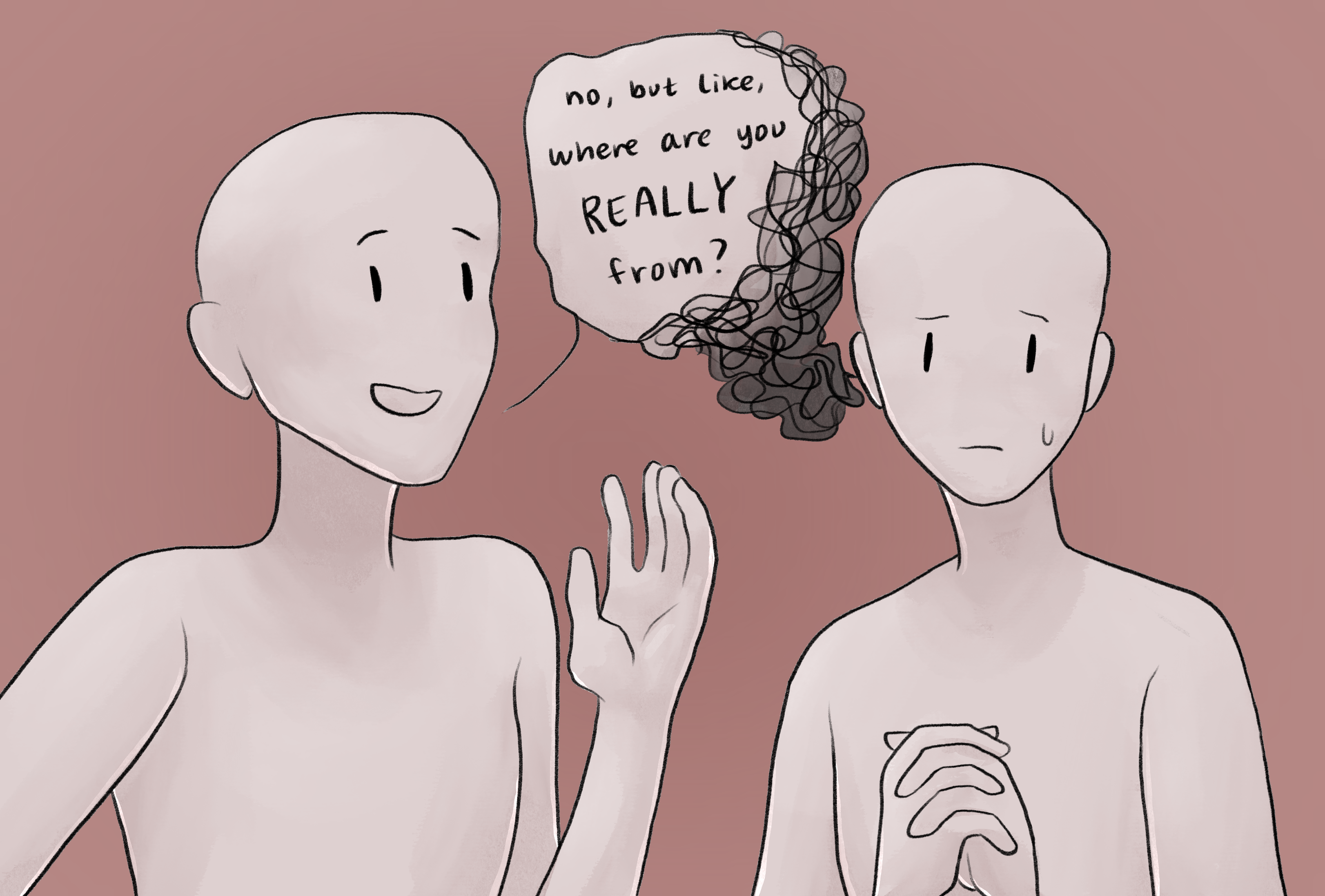
Imagine trying to make conversation with your dentist and they ask you where you’re from. You respond to this seemingly harmless question with your birthplace: Cape Cod. They respond, “No, where are you really from?”

This is the story of mixed-race history teacher Kathryn Reusch. 

Imagine walking into a restaurant with your black father and white mother and having all eyes turn to you at once. The stares from people as you walk down the street with your father, all of them wondering why the two of you would be together.

These were the stories of biracial senior Quinn Dowe.

Now try to imagine your hair being repeatedly being grabbed at and prodded after telling the person to stop and having your hoop earrings being pulled off and clipped back on despite your multiple objections. 

This is what happened to black sophomore Sofía Durán-Clark.

ILLUSTRATION / Naomi Bloom

While these stories may seem outlandish and rare, these experiences happen a lot to people of color in today’s society, often in the classroom. These instances, called microaggressions, are far too overlooked and much too common. The ignorance of this behavior must be stopped. 

According to Oxford Languages, a microaggression is defined as a statement, action, or incident regarded as an instance of indirect, subtle, or unintentional discrimination against members of a marginalized group such as a racial or ethnic minority. When you make an assumption about someone based on their race, you are being microaggressive. If you create an environment where a minority feels unsafe, you have probably been microaggressive.

As serious as microaggressions are, the prefix “micro” devalues the feelings and experiences of those being mistreated. The word implies that the action is small and harmless when it can seriously negatively affect a person. “It can make you feel like an outcast,” said sophomore Nyeema Lewis. Reusch said that these experiences “leave [her] thinking and thinking and thinking about it,” which is just unfair. People can just move on in their lives after saying something offensive while the victim has to live with what they said. Just because these acts are labeled as “micro” does not make them any less innocuous. 

Durán-Clark shares that whenever she experiences a microaggression, she feels like she becomes the center of attention, in a bad way. She describes it as a “zoo-like experience,” which shows how blind people are to how their actions are affecting people. Dowe agreed, suggesting that some “people are just so locked in their own shell,” they feel the need to comment on anything or anyone that looks different. “They kind of think of us like animals,” said junior Alice Segun-Oside. These actions seem to be under the guise of curiosity and innocence, but “some people just don’t understand that a lot of what they’re doing is rooted in racism,” said Durán-Clark.

Janay Cox, sophomore, calls it “crazy how people can be so ignorant and bold.” The lack of self-awareness that people can have is truly shocking to the point where you’re asking: “How can they not know?” Lewis makes a good point: “People are ignorant and ignorance is bliss.” The less people know, the better, apparently, because then they can continue in their ignorant ways and actions.

Hearing these events happen over and over again definitely brings to the table a question of how this problem could be stopped. Sophomore Judy Elktory called on all educators to “not [share] single stories” when describing a certain culture or ethnic group. A single story is a generalized perception of a person, place or thing. “You never really get to learn about how beautiful a culture is,” said Elkotory. Getting rid of these one-sided perspectives would be a great way to prevent microaggression by eliminating ignorance, stopping the problem before it starts.

Now, what happens when the problem does start? What happens when that uncomfortable environment is created? The solution, it seems, is immediate correction and repercussion. “When it happens, fix it immediately, instead of letting it continue to happen,” Lewis states. Whether it is speaking up and correcting when you or someone else has been aggressed upon or, if you aren’t comfortable doing so, telling someone who will be able to more comfortably speak up and correct the aggressor. Junior Ismael Rodriguez had the same opinion, and stated that “being lenient towards it will allow it to continue.” 

While microaggressions and racism are never easy topics to talk about, it is an absolutely necessary discussion to have. The potential discomfort does not outweigh the problem that is all-too-normalized. The lack of open communication and education is the main cause of this problem of ignorance. Therefore, the only logical solution would be to do the opposite and begin combating ignorance before it begins. 

The discomfort that comes with talking about race does not mean ignorant and uneducated people should continue their unintentional reign of abuse.

Continue reading