Areeta Faiz || OPINIONS EDITOR

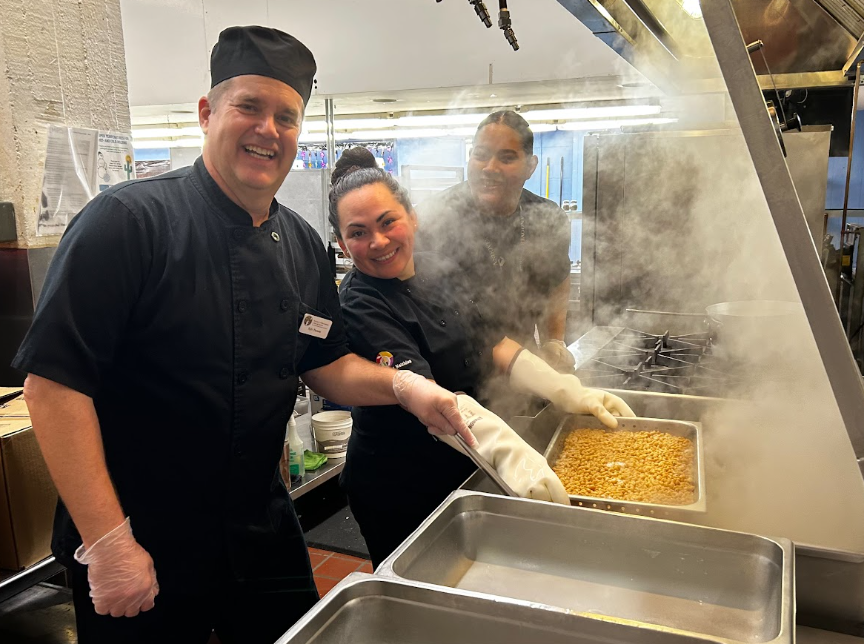
Step behind a metal serving station onto the kitchen’s terracotta tile, and you will find yourself in a world of laughter and steam. Students don’t typically come back here, but the room is alight with camaraderie. It’s loud, and it smells like hard work, spices, and pasta. The staff is busy taking massive trays in and out of multi-tiered ovens, anticipating, like every day, a thousand hungry mouths to feed. This place has been buzzing since the morning hours. Here in the kitchen, it’s all hands on deck.
Today, there’s a new presence taking it all in, calculating, experimenting, imagining. Thinking creatively about how to make it better. His name is Chef Kyle.
He’s a smiley man, donned in an apron and a black chef’s hat. He introduces himself, looking up from a big tray of chicken.
“My name is Kyle Parson, with the John C. Stalker Institute of Food and Nutrition at Framingham State University,” he says.
A culinary chef specializing in school nutrition, Parson is set to visit AHS every Thursday until mid-December. Director of Food Services Taylor Pirog applied to this training program over a year ago as part of a wider initiative to go above and beyond with the meals that AHS offers.
He returns to his work, adding a generous heap of Parmesan cheese to the chicken and sprinkling on a spice blend of his own creation.
“That’ll bring out some nice base flavor,” he says contentedly. “You can smell it already.”
He’s not wrong. An aroma diffuses throughout the kitchen, and it’s hard not to look forward to your next meal.
“Our mission is to work with school lunch programs to…get passion into the food, create new ideas, work on efficiency, and offer suggestions,” he explains.
A chef coach with over 15 years in the field, Parson supports school nutrition programs across Massachusetts by building confidence and skills in scratch cooking. He also works in partnership with the Department of Elementary and Secondary Education (DESE) to develop new recipes.
Bringing recipes to scale is no easy task, nor is making sure meals taste good to hundreds of hungry teenagers.
“I get to play with it,” Parson says. To him, getting a recipe right is all about balance: Maybe a panini isn’t crispy enough, or it’s too crispy. The flavors, ratios, seasoning, and placement all have to be considered.
“How much spinach is too much spinach?” he might ask. “You want to taste it, but you also want to taste the chicken and cheese.”
Nutritional standards are also regulated closely. Rather than relying on sodium to make food more flavorful, Parson experiments with ingredients that naturally brighten a dish.
“Maybe we add a little lemon juice. Maybe we add some acid, or we put a tomato in something to kind of bring that alive,” he explains. “Kitchen cooking is a lot of science.”
For Parson, that challenge is part of the appeal.
“It’s fun,” he says. “It’s a hoot for me.”
Parson also helps utilize ingredients that schools already receive from the US Department of Agriculture (USDA). If DESE tells him that schools aren’t using USDA-issued turkey, his job could look like developing a nice barbecue rub to serve on a turkey sandwich at the deli. Instead of roasting turkey once a year on Thanksgiving, that versatile rub could season a chicken one day and a barbecue pizza on the next without the cafeteria having to purchase new inventory.
Upon DESE’s request for more breakfast recipes, Parson plans to use frozen fruit provided by the USDA to develop a baked oat bar with berry compote and granola.
“Just serving a thawed out strawberry is not ideal, but if I roast it, get all the moisture out, and [concentrate] those sugars…now I’ve got a product that’s whole grain, rich, and is going to taste good,” he says.
Of course, even the most carefully crafted recipe has one final factor: whether students will actually eat it. This year, the kitchen hopes to expand its taste-testing efforts, giving students more opportunities to try new foods and offer feedback.
“We want you coming back,” says Parson. “We want you to be excited.”
He pays close attention to suggestions and trends, and even tries to emulate local restaurants that are successful among the youth. Recently, he’s been developing a breakfast power bar made with chickpea flour to cater to protein-hungry athletes, as well as a Caribbean-style seasoning that he hopes to use to elevate the USDA-issued frozen chicken.
“I know you high schoolers like a lot more heat,” he says. “So I can add that heat to it.”
Parson is just one step in a wider initiative to enhance AHS cafeteria offerings, whose quality and innovation is already nationally distinguished by the USDA Healthy Meals Incentives Recognition Award. As a dietitian, Pirog is well-versed in the nutritional aspect of making menus, though she was delighted to welcome Parson’s culinary skillset, eye for detail, and creative flair.
“It’ll be nice to have a professional chef on staff,” she says.
By the end of Parson’s visit, Pirog’s goal is to allow the kitchen to feel more confident and creative in their cooking. She wants to empower her team to continue to apply all that they’ve learned to the meals that they serve.
And for Parson, the work is about more than the food itself.
“I love the kids. I have 2 of my own. I really just enjoy working with youngsters like [you all],” he says. “And, fortunately, I have the pleasure of being creative.”
In a bustling kitchen, this enthusiasm turns into more than a little extra Parmesan or a newly invented spice blend. It means being innovative, turning lemons into lemonade, and helping others do the same. To Chef Kyle, that is the recipe for success.