The Show Must Go On(line)

The work behind this year’s Broadway Cabaret

By Alana MacKay-Kao

ARTS EDITOR

STAFF PHOTO/ Erin Li
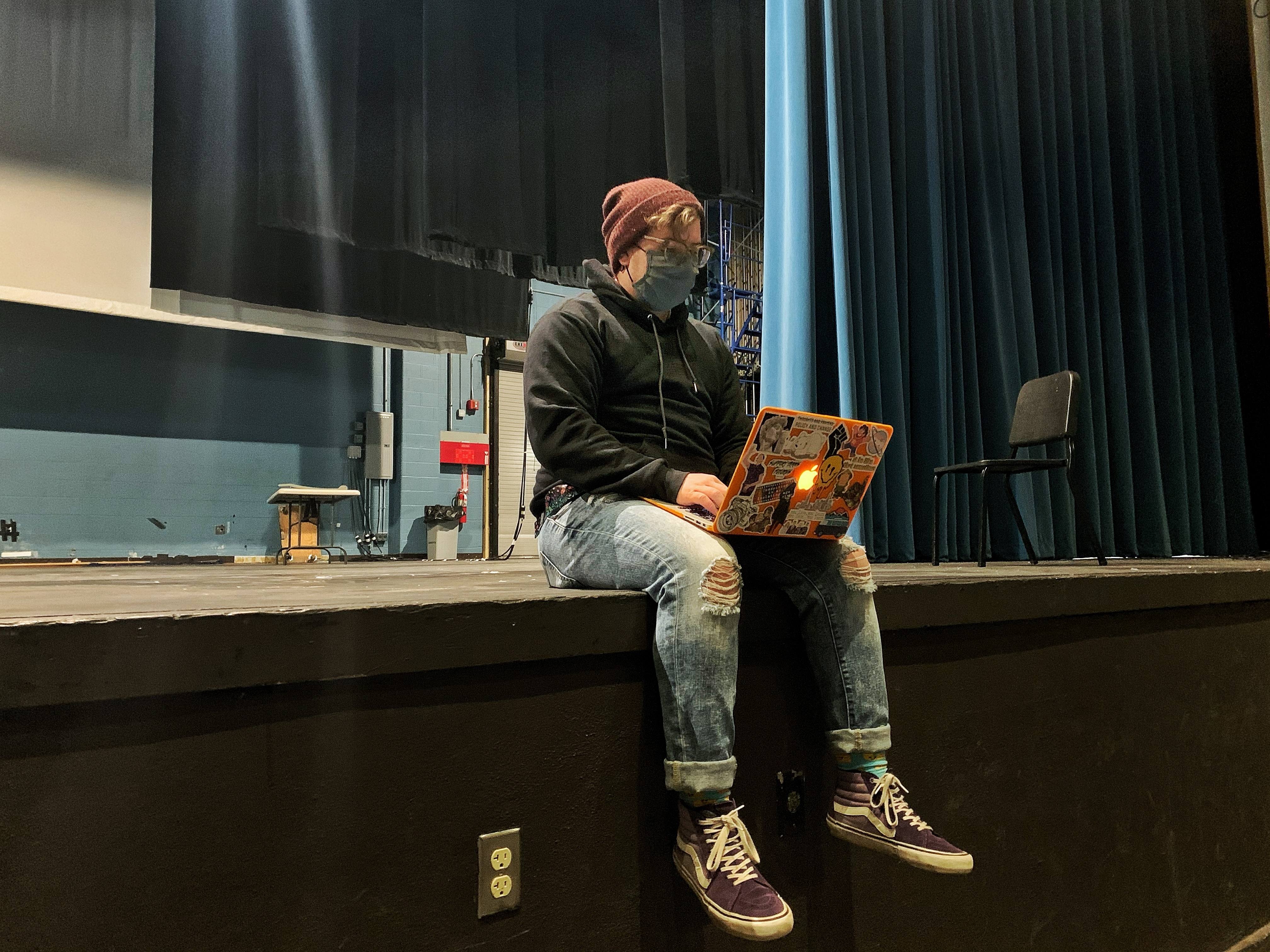
Gio Coppola sits on the edge of the Collins Center stage with his laptop. He was one of many volunteers who worked tirelessly to bring the Broadway Cabaret to fruition.

Andover Vocal Music Association’s annual Broadway Cabaret took place virtually last month, due in no small part to the tireless efforts of several student and teacher volunteers including junior Juliana Kaufman, senior Gio Coppola, and teachers Chris Desjardins (Mr. D), Daniel Brennan, and Beth Kennedy. 

The Cabaret consisted of performances by all of the Show Choir groups, smaller groups, and soloists. Each performer had to submit videos of themselves performing their numbers. Emcees also had to record themselves and send in their videos. Having the most members, the Show Choir pieces took the most coordination and work.

Mr. D was in charge of mixing the audio to make it sound like the groups were actually singing simultaneously. “I use a program called Logic to put all the voices together. Normally the way I do it is I actually group all the recordings by voice part,” he explained. “Then I mix down all the voice parts and then I put the voice parts together with the pre-recorded music and try to line everything up, but it is tedious at best.”

Coppola was responsible for pulling the final Cabaret video together and making it presentable for that Friday night. He also put together the video of “Unruly Heart,” one of the group numbers, being performed.

While it isn’t a craft he usually spends much time on, Coppola enjoys filmmaking and editing. He has been editing videos since middle school when he created videos for YouTube. 

“I started on Windows Movie Maker and I just kind of started playing around with different things,” he explained, describing how he got started. “It was a lot of getting practice with it.” Coppola has also made a promotional video for Show Choir and works at AYS, where he is the instructor for the Movie Makers program.

If you’re looking to learn video editing, he recommended YouTube tutorials. “YouTube honestly is like the best place if you want to learn how to do almost anything. It’s definitely really helpful because these editing softwares can be ridiculously complicated and not fun to look at.” If he was looking for a specific effect, he said, “I knew what I wanted it to do, but I didn’t know how to do it. You just look it up on YouTube and there are 8,000 people who’ve done it who will show you.” 

Finally, once all of the individual numbers were edited, the video and audio clips for each number and emcee could be put together to become the ultimate video that encompassed the entire Cabaret. This wasn’t the end though. Coppola downloaded all of the videos and put them into Final Cut in the running order and inserted the intros done by the emcees. 

That was when he realized that his laptop wasn’t powerful enough to process the video. The night before Cabaret, Coppola and Mr. D discussed this on a Google Meet. They had to come up with a solution fast. Mr. D remembered that Juliana Kaufman, a junior at AHS who also did some of the video editing, had borrowed an iMac from the school. They called Kaufman to ask if they could borrow the iMac so that Coppola could finish the video, and Mr. D drove it from one side of Andover to the other at 10 p.m. It was this dedication from the team that allowed the Cabaret to happen.

Here’s the way Mr. D described it: “We’re all kind of trying to put the ship together while in the middle of the ocean, if you will.” The final video was finished at 4 a.m. on the Friday it premiered, just in the nick of time. Coppola alone spent 26 hours working on the Cabaret.

“Everyone’s been affected by this,” Coppola said in regards to the pandemic, “[but] sports games still get to happen. You get to do your meets and your games…. We don’t have that right now. We can’t perform. Chorus, band, orchestra, Drama Guild, Show Choir, we’re kind of at a standstill and are very much relying on doing these virtual things because it’s quite literally our only outlet right now to do any of it. So next time we do something, maybe go hop on.”

  • Related Posts

    NEASC Visit Highlights AHS Goals
    • April 3, 2026

    Anushka Dole || ONLINE EDITOR

    Andover High School hosted a re-accreditation visit from the New England Association of Schools and Colleges (NEASC) from March 16-18, as part of a decennial review process designed to evaluate how well AHS supports student learning and identify areas of improvement. 

    According to Assistant Principal Alicia Linsey, the process started during the 2023-2024 school year with a visit from the Collaborative Conference team, a group of visiting educators from across the New England area. In preparation for the visit, a team of AHS faculty members and administrators was formed.

    “We picked out priority areas and presented those to this visiting NEASC committee … and they agreed with [our priority areas],” said biology teacher Lindsey L’Ecuyer, the AHS committee’s science department representative. 

    There were five priority areas that AHS pledged to work on starting in the 2023-2024 school year: developing the Vision of a Graduate, implementing consistent curricula throughout all departments, vertical/horizontal alignment across departments and throughout grades, promotion of school pride, and building infrastructure. 

    The Vision of a Graduate outlines the skills and values that the school hopes to instill in every student by the time they graduate. 

    Vertical alignment refers to improving coordination between teachers across grade levels to ensure student skills build progressively, while horizontal alignment emphasizes greater collaboration between teachers across departments. 

    “[The committee is] working on … finding time in the school day for teachers to collaborate more,” L’Ecuyer said, adding that AHS has begun standardizing curricula to support this effort.  

    “There are committees in the school that have been working on documenting curriculum in a consistent format for our core classes … freshman English, for example, [and] biology,” L’Ecuyer said. 

    Linsey mentioned that students and parents also play a role in the accreditation process. A team of visiting evaluators—distinct from the Collaborative Conference team—conduct interviews to gather student perspectives on the school climate and learning experiences. 

    Although the committee leads the reflection process, administrators are then responsible for implementing action plans based on their findings. In accordance with these plans, faculty members must provide evidence of integration of the district goals.

    L’Ecuyer emphasized that NEASC accreditation is more about reflecting on and improving school processes than it is about recognition.

    “It’s less of a badge as it is opening yourself up to reflecting on and documenting what you do well and what it’s like setting goals for your school,” L’Ecuyer said.

    Beyond internal reflection and planning, the “badge” that the reaccreditation process provides does carry additional, tangible benefits for students. It reassures families and colleges that AHS maintains a rigorous academic program, and that it’s constantly working towards improving learning.

    “My understanding is that colleges know Andover High School—they know what our programs are like,” L’Ecuyer said. “[Because] of [accreditation] … they know the kinds of students that graduate from here, and what skills that [they] have.”

    Accreditation also plays a role in the school’s ability to receive funding.

    “NEASC accreditation is required for eligibility to receive some private, state, and federal grants, loans, and other federal funds,” Linsey noted in an email.

    Continue reading
    Rising Costs Impact School Budget
    • April 3, 2026

    Mo Gearin || STAFF WRITER

    Looking forward to the 2026-2027 school year, Andover Public Schools is once again facing a budget deficit, but school committee officials say it’s one they anticipated.

    The district is allotted a 3.75 percent budget increase every year from the town, allowing the school committee to anticipate a $111 million budget. Despite the increase, the district was faced with a $1.3 million deficit. This trend follows last year’s deficit of $1.87 million, and $3.1 million deficit two years ago.

    “The hardest thing is you never want to cut teaching positions,” said Shauna Murray, the school committee chair, when discussing the proposals to close the deficit. Early proposals included the possibility of cutting 11 full-time positions, or full-time equivalents (FTEs). “The biggest part of your bucket of funds is going towards salaries,” said Murray, “because primarily we are a people business.”

    Later proposals, hoping to avoid cutting positions, looked at increasing fees and tuition, most notably a 5 percent increase in preschool tuition fees. The preschool tuition fees had been stagnant for a decade: this increase was the first in ten years. The school committee also approved smaller fee increases for participation in the fine arts and athletic programs.
    There has also been additional savings in the utility budget as a result of reliance on more electricity than gas, a prime example being the solar panels on the new West Elementary building. Transferring the primarily gas utilities to electric ones saves not only money on the utility budget, but the environment too. Remaining costs come from decreases in out-of-district placements, retirements, and leaves. “He’s really turning over every seat cushion—where can we save money, where can we save money?” Murray said in regard to Interim Superintendent Keith Taverna’s creative approaches.

    At a recent presentation, the budget deficit was down to 0.87 FTEs, or $67,000. “As scary as it is to enter any year with a budget deficit, [we have] a lot of faith and trust in our administrative team,” Murray said.

    Ever since the teacher strikes in 2023 the school committee has been undertaking communication on municipal finances with the community. “Mr. Taverna and Dr. Parvey did a really nice job of reaching out more to the community to explain why things are the way that they are,” Murray said, in praise of their work with the Budget Advisory Council, and the ‘budget roadshow.’ The budget roadshow communicated directly with PTOs and PACs.

    Continue reading

    Leave a Reply

    You Might Also Like

    Spanish Department to Host Day of the Dead Fair

    • November 12, 2025

    Funding the Future of Science: Proposed NIH Funding Cuts Throw US Biomedical Research Into Uncertainty

    • November 4, 2025
    Funding the Future of Science: Proposed NIH Funding Cuts Throw US Biomedical Research Into Uncertainty

    Student-Hosted Video Game Hackathon Scheduled for Late September

    • September 22, 2025
    Student-Hosted Video Game Hackathon Scheduled for Late September

    World Languages Coordinator Reflects On Career, Retirement

    • June 9, 2025
    World Languages Coordinator Reflects On Career, Retirement

    CollegeBoard Scores 1/5 on AP Testing Administration

    • June 9, 2025

    AHS Student Directs Coming-of-Age Film, ‘Horizon’

    • June 9, 2025

    Discover more from AHS NEWSPAPER

    Subscribe now to keep reading and get access to the full archive.

    Continue reading