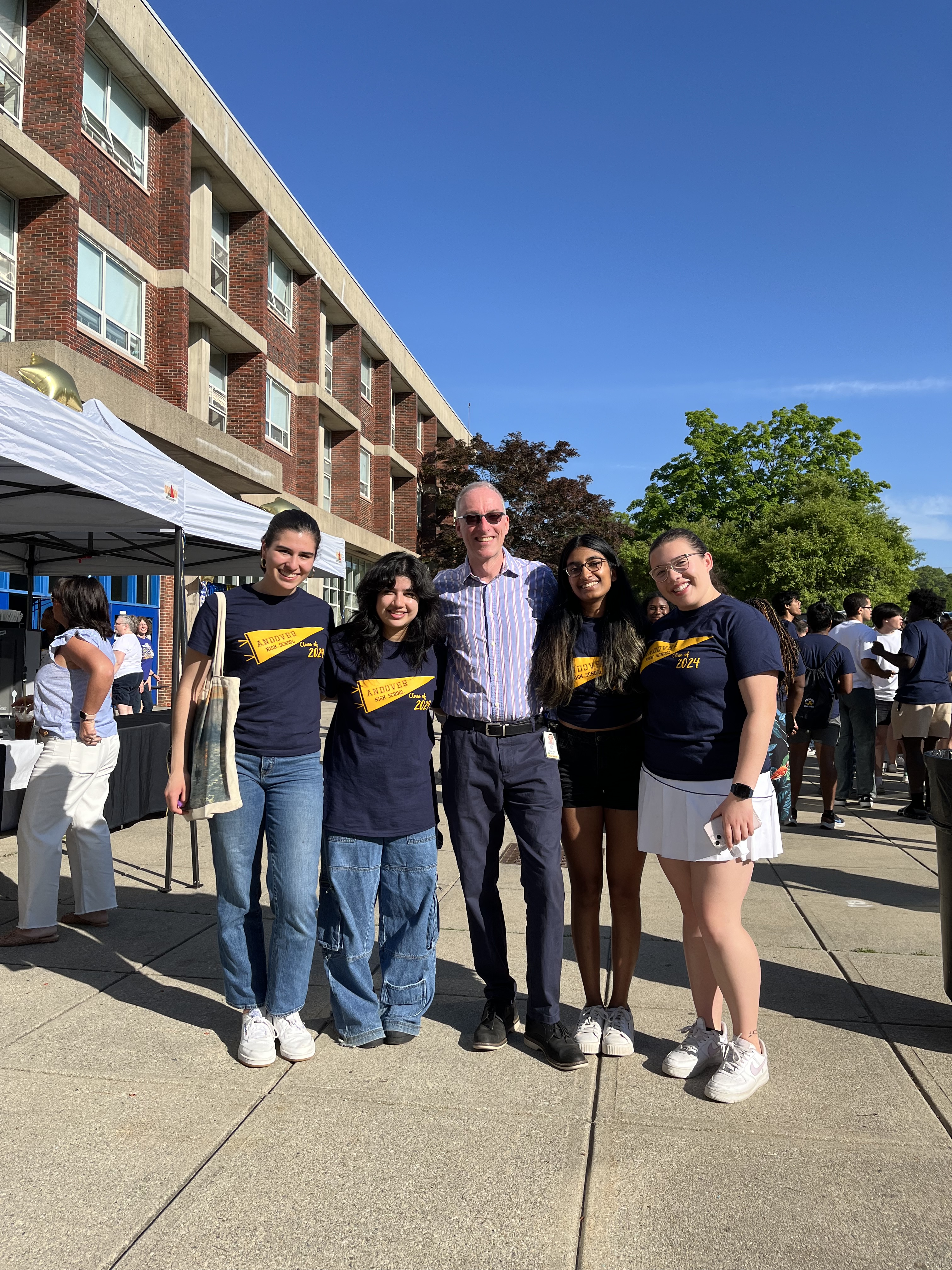
Social Media Marketing Class Plans Snack Shack Raffle in AHS Media Center
  • May 14, 2025

Christina Saad || STAFF WRITER

The media center hosted a raffle on April 19 with a prize of five Snack Shack tickets. The raffle was planned by students from art and business education teacher Meghan Michaud’s Advertising and Social Media Marketing class. 

Three students from the class, junior Sophia Call, junior Sam Archiable, and sophomore Ellie Linehan, planned out the Snack Shack event. The prize winner for the raffle was Kai O’Sullivan.

Michaud’s original assignment was to break into small groups and develop a series of posts around a theme the group chose, which were then posted on the media center’s Instagram along a two-month timeframe.The goal of the assignment was to increase the library’s Instagram page from 700 to 1,000 followers. 

“I felt like it was a good idea for students to have some real-world application of how to use the skills that they were learning in Advertising and Social Media Marketing,” said Michaud.

Students first did an analysis of the library’s Instagram account to look at what kind of followers it had and ways it wasn’t achieving its goals.They also did a competitor analysis of other library and book-related pages to see what kind of content they were producing. The class met with library staff and looked at data the library had about the number of books in the collection and what genres of books students gravitate towards.

“We looked at some real data and they asked questions, treating the library as a client, as they would in a professional relationship,” Michaud said.

The class decided on what their content would like and what would be their brand colors so there was a consistency in the imaging they were sending out. They developed a two-month calendar plan to increase followers. They have surpassed their goal of 1,000 followers and amassed 1,120 followers as of May 12, and they still have a month left in their calendar.

Students said that one of the things that motivates students was getting breakfast and going to the Snack Shack. Call, Archiable, and Linehan looked at Instagram models where the way to enter some sort of contest to win a prize was to like and follow the page. They thought about what would be an incentive for students to win that was easy and achievable to access, and decided that the Snack Shack would be a great incentive for students to like and follow the Instagram page.

“My group’s thought process for choosing the raffle was trying to figure out some way in which we could get the whole school participating and excited about,” said Archiable.

The group looked where students were viewing other types of media to get them to check Instagram. They created and posted flyers all around the school, did announcements over the loudspeaker, and had a feature on AHSNews.

“We tried to post as many [flyers] as possible around the schools, as well as setting them up as 

‘art’ in the hallways,” Archiable said.

They also worked with staff in the cafeteria and the Food Services Department to secure a prize.

Continue reading
New Sophomore APs to Be Introduced in Fall of 2025
  • May 6, 2025

Avery Slaughter || STAFF WRITER

Andover High School recently announced two new courses being offered next fall, AP Seminar and AP Government. AP Seminar will take the place of the combined sophomore English and history class.

Both of the new classes are open to sophomores, making them some of the first APs for underclassmen. AP Government will be open to juniors and seniors as well, whereas AP Seminar is being implemented exclusively for sophomores. It will replace Modern World Studies, which combines the Modern World History and English 10 curricula into one larger joint class. Students and staff alike have expressed confusion as to how AP Seminar will be managed.

Though the name is being used to describe the new collective class, AP Seminar is formally the title of the English class and Modern World Studies is the name of the History class, though the latter is colloquially used to refer to the current combined course as a whole. While AP Seminar will be taken as an Advanced Placement class, students have the choice to take Modern World Studies for an Honors or College Prep credit.

It’s important to note that AP Seminar, which is an English course, is not exactly the same as English 10. Fundamentally rooted in developing research skills, the curriculum follows a slightly different path than its sister English course while still covering similar topics. According to the College Board’s description, “in AP Seminar, you choose real-world or academic topics to investigate. AP Seminar teaches you how to find and use evidence from experts, and how to present the case from your own perspective effectively, both through writing and multimedia presentations.”

“AP Seminar is a course designed to develop students’ skills in research, analysis, and communication,” Sara Sympson, a representative from College Board, said. “It encourages critical thinking and collaboration, preparing students for college-level work. The course can be organized in a variety of ways to best address student interests, state and/or country and district goals and requirements, and local school traditions and culture.”

Despite the new title, AP Seminar will not be changing much when compared to Modern World Studies. Michael McCarthy, advisor of the Social Studies program in Andover Public Schools, explained that the class will remain nearly identical to its predecessor. Stacy Giggie, program advisor for the English program for grades 6-12, agreed. There will be little change in the overall curriculum, but some of the learning material and assessments will be altered to match the newfound AP-level difficulty of the class.

Modern World Studies and AP Seminar cover important and sensitive topics, and it’s important to ensure they are both prioritized equally. When asked if he was concerned about one subject being emphasized over the other, McCarthy said, “Yes, a little bit, but I’m very confident that the teacher who is teaching it will ensure that the skills we value will be taught.”

AP Government will be offered as a full-year elective like many other APs at AHS. Given the importance of understanding the government as an American citizen, McCarthy suggested that it would be a valuable addition to the course offerings for students.

“We want students to be active citizens, to understand the local government, their state government, their federal government, and to see the government as agents of change,” McCarthy said.

Continue reading
The Underclassmen’s Race to College
  • May 6, 2025

Andover High School’s AP restrictions called into question by students, graduates

Avery Slaughter || STAFF WRITER

By the time the Class of 2028 first stepped foot in the lobby of Andover High School, it was abundantly clear that Advanced Placement courses were going to be off-limits for a while. During the student orientations that had occurred in the months previous, they had been told they weren’t ready for classes of such rigor; they weren’t mature enough and would have to wait until they were juniors to handle a responsibility so vast.

The rule barring APs seems innocent, but for some freshmen and sophomores, it is a cause of great stress. “After high school” is a concept that hopeful college prospects begin to consider as early as elementary school, and the inability to maximize APs as soon as ninth grade can be concerning with that in mind. That being said, the reasoning and logic behind the restriction is sound—how could underclassmen manage the workload and intensity of college classes, given the well-known academic difficulty of APs? Despite the good intentions, is it possible the act of minimizing that stress inadvertently causes more?

It’s important to note that two new APs are being introduced in the fall of 2025. These two courses include AP Seminar, open exclusively to sophomores, and AP Government, open to grades 10-12 (see sidebar for more details). AP US History and AP Java Programming was also made available to sophomores this year. These four courses are the only APs typically offered before junior year, though infrequent exceptions are made for students who demonstrate advanced proficiency in math and/or computer science.

For Shauna Murray, the question about APs is a loaded one. Working as both a high school teacher in New Hampshire and a School Committee member in Andover Public Schools, she’s deeply involved in the lives of students. Murray noted that the rules regarding APs and general course restrictions are not decided by the School Committee and are instead up to the discretion of the guidance department. The College Board also does not have a say in how the classes are run in individual schools beyond the administration of the AP exams. (Multiple attempts to reach Aixa de Kelley, coordinator of the guidance department, by email were unsuccessful.)

“I think there are some kids that are ready, but it’s really a student-by-student basis,” Murray said. “It’s tricky because you know the requirements are there for a reason, but maybe it could be a little bit more flexible.”

Current AHS students have varying opinions. Sophomore Connor McGovern expressed frustration with the policy and its possible implications on his future. He worried that his college chances were slimmer compared to future graduates of other schools with more lax restrictions and that ultimately it would damage his experience after high school.

“I think [the rule] probably does [hurt my chances],” McGovern said, “and you could also shorten the amount of years you have to take in college if you take a lot of APs in high school. I think about that.”

Canyu Li, who has eight APs under her belt as a senior, had an opposing view. She wondered if the stress she would have felt as an underclassman would have been insurmountable had she had the option to take APs, though she acknowledged that, when she was younger, she did wish to take them. Ultimately, she thought that the downside to taking these courses early on tends to outweigh the benefits, especially with college admittance in mind. She explained that, in her experience, colleges often compared you to other students in your school to ensure fair consideration in the admission process.

Many people were inclined to agree with that assessment, though former college admissions officer Jayne Jones suggested it was a bit more complicated.

“It all depends,” said Jones, now an AHS guidance counselor. “It depends upon the student, the college, and many other factors that make up a decision for admissions. Some more selective colleges want to see several AP classes, and less selective colleges may want to see a few APs, and still other colleges may be fine without any APs.”

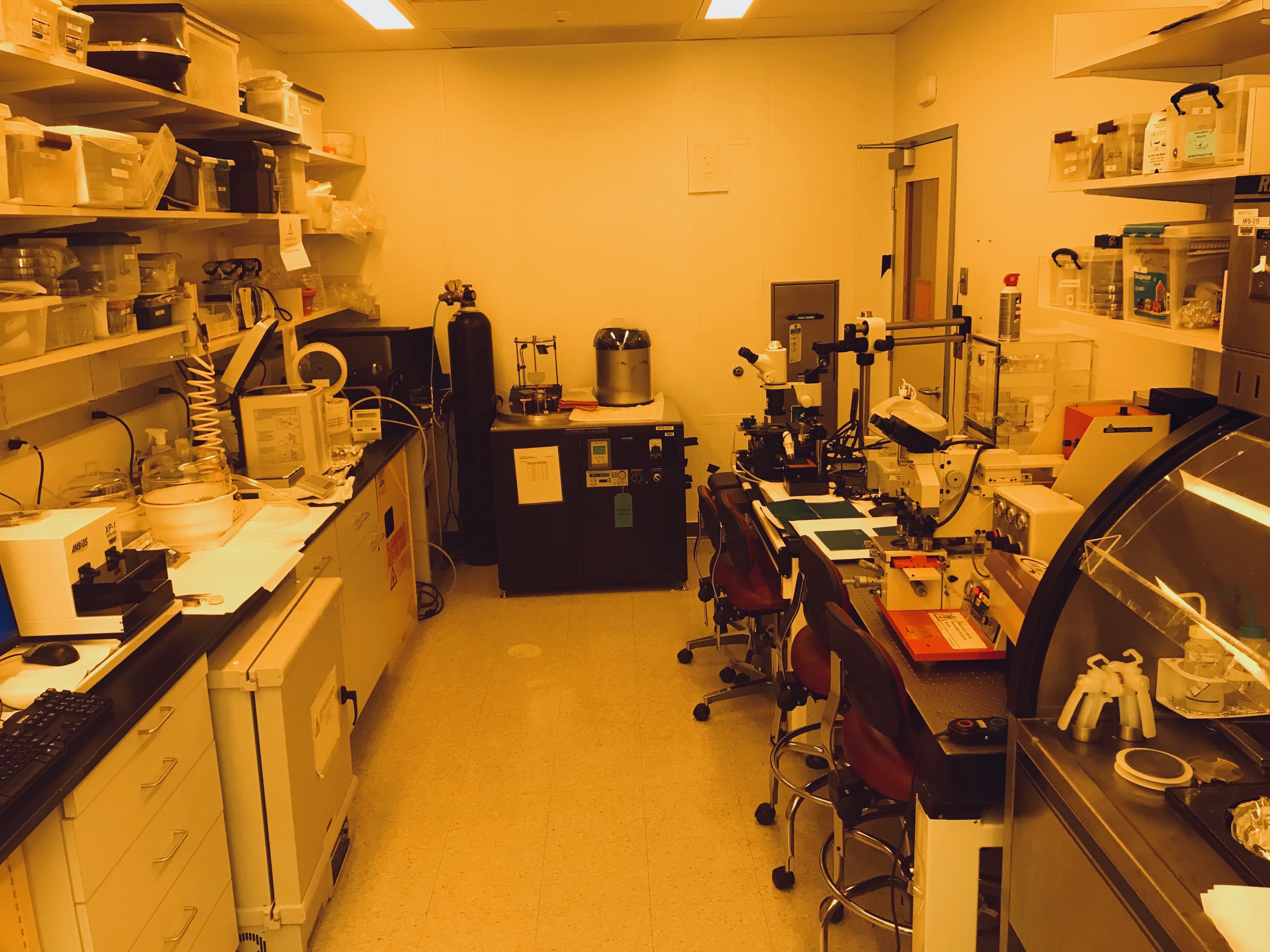
While the freshmen at AHS were acclimating to the environment of the school this past fall, Diya Ganesh exited the bus she took from her lab at Northeastern University to her dorm. Having graduated from AHS in 2023, she had recent experience with how the AP restriction impacted her college experience. She took six APs herself, and she recognized that she was at a disadvantage in terms of college credits compared to her classmates, who had AP counts ranging from eight to twelve.

Jordan Altaffer, 2017 graduate of AHS and family friend of Ganesh, agreed at that moment. Though he had recently concluded his time at Georgia Tech, the toll his shortage of AP credit hours had taken was still present in his life. In addition to an increased amount of time filling his degree course requirements, taking more courses was financially inconvenient.

“If I had been able to take more [APs], I could’ve skipped my [college] freshman English classes and my freshman history,” Altaffer said. Not taking those courses would have both cut an entire semester from his college experience and minimized the cost of his classes.

Ganesh had similar sentiments. “People that are graduating sooner tend to get a higher priority in picking classes. […] I cannot emphasize how helpful having those credit hours ahead of time are,” she said.

The question of whether or not freshmen and sophomores should be able to take APs brings to light what Murray considered a larger social problem. How can high school students possibly have enough time in their lives to balance such hefty course loads and their own personal health? According to her, the “race to college” represents the flawed values in our society. Instead of prioritizing the well-being of students during the transition to adulthood and independence, we drive students to overwhelm themselves with academics to fulfill arbitrary requirements for further education.

“One of the things that is happening in society is that we’re pushing kids way too hard,” Murray said. “It’s just this vicious cycle of wanting to do more and wanting to achieve more.”

Continue reading
AHS Setting for 8th-Grade Career Fair
  • April 29, 2025

Isabella Yan, Saarvi Deshwal, and Tommy Kruecker-Green || ARTS, LAYOUT, AND OPINIONS EDITORS

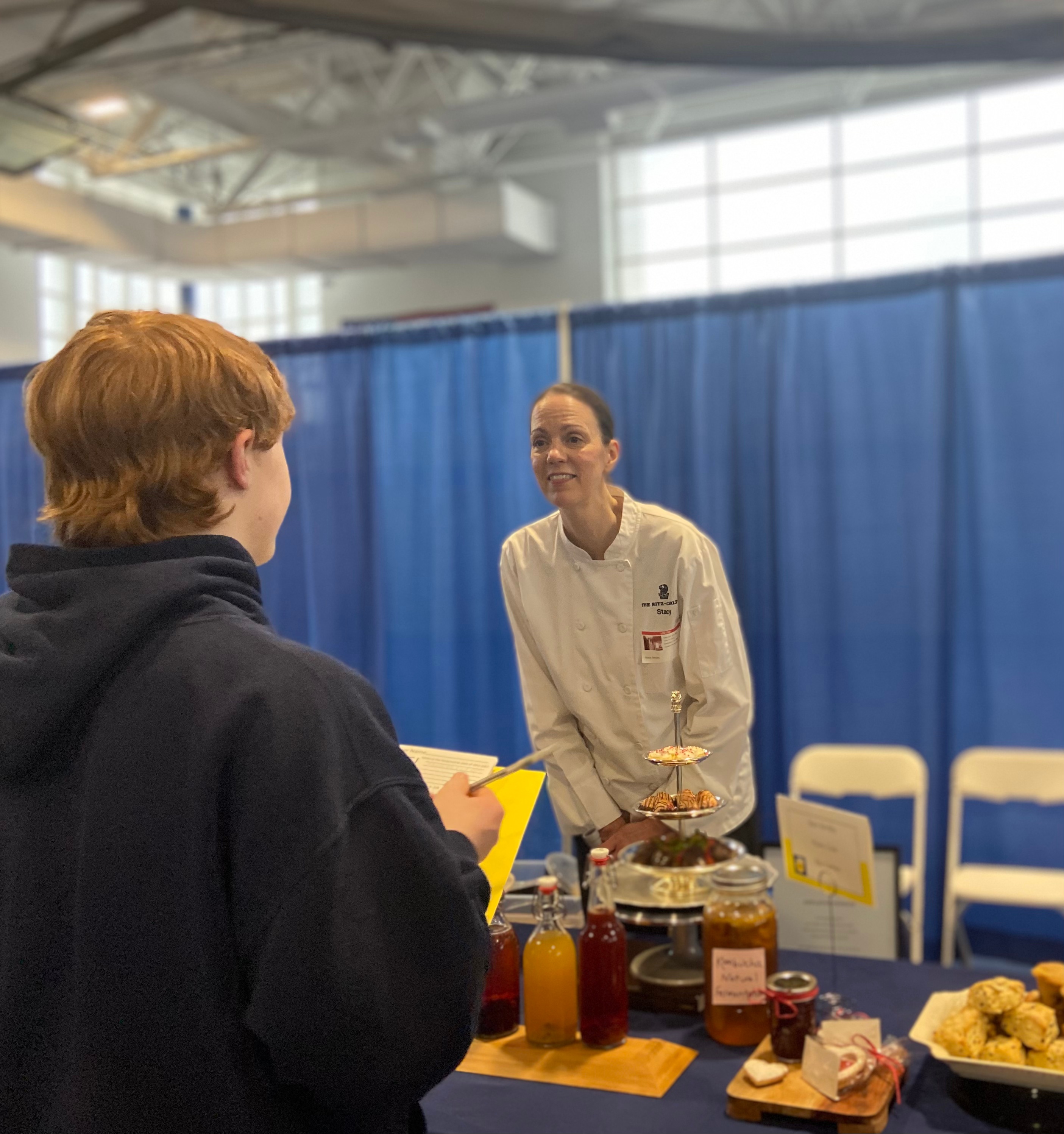
Andover High School hosted a My Career Academic Plan Fair (MyCAP) on April 15 for eighth-graders to explore career options before they enter high school. 

Eighth-grade students gathered in the Field House at AHS for the first-ever joint Career Day with all APS middle schools, organized through the MyCAP initiative, a Department of Education grant program. AHS collaborated with middle school and high school counselors, a team of educators, and volunteers to plan the career day. Prior to the fair, students were encouraged to do their own research on jobs that they are interested in. During MyCAP, students walked around with “passports” in which they could take notes of their discussions.

The purpose of the fair was to help rising freshmen gain insight into possible professions and career paths before they enter high school, so that they have a stronger idea of the courses they would like to take.

“[Students compiled] a list of careers that they’re interested in,” said Aixa de Kelley, Director of Guidance, and event coordinator. “Then they come here and find the careers for which they have questions to ask, and then they get a stamp.”

There were over 50 adult volunteers who shared their experiences from their various professions. Although smaller career days have been hosted at the middle schools in past years, this marked the first year that all three middle schools came together at the high school for a unified event. Volunteers answered questions students had and shared the proper education and experience requirements for their professions. 

Timothy Burgess, an electrician and a volunteer at MyCAP, shared, “[I hope to] inspire [students] that it’s not uncommon in a town like Andover to go to a trade school, because I went to West Middle, [and] it felt like there was a big stigma against going to a trade school.”

Another volunteer, Yissy Perez, a civil engineer and founder of construction company YCP Northeast, shared her motivation for sharing her career experience. “I would love to start a conversation early on. When [kids] hear engineering, they might think, well, that’s so difficult. And it is. But when something is fun, when you enjoy it, it’s worth it,” Perez said.

While studying at Tufts University, Perez enrolled in academically challenging courses, discovering her passion for engineering. She wants to share this experience with students and encourage more young women to pursue STEM professions. 

“I would love to see more women [pursue STEM]. In my view, especially when I’m working for another company, you don’t see this many women. It would be great,” Perez added.

Continue reading
It’s OK to Make Mistakes
  • March 17, 2025

Isabella Yan || ARTS EDITOR

As a student, I’ve heard the phrase, “It’s OK to make mistakes” all too often in the classroom. Within education, failure is advocated as a stepping stone for learning and succeeding as a student. Failure allows you to target your weaknesses and teaches the resilience and determination necessary in the process of success. It’s essential to be able to embrace failure, especially in the broader context of tackling the hardships faced in life after graduation. It certainly is a true, well-intentioned, and encouraging phrase, but I struggle to believe it in its entirety.

It feels like everything is at high stakes. Good grades equate to a good college, which equates to a decent and stable life. If you mess up a single step along that road, your life will be doomed—or so it seems. While that is often far from reality, it’s hard for many students to see anything beyond that scope of vision as practical. As such, there’s a hyper-fixation on transcripts and the lovely combination of numbers and letters they provide to auction your potential as a student to colleges. 

“I don’t want to be penalized for making these mistakes, which puts a limit on my willingness to mess anything up,” said junior Sofia Fahkiri. When that is the environment that has been created, is it truly OK to make mistakes when every mistake is graded? As Fahkiri added, “It puts a pressure on students to always be perfect.”

The bar for failure has been set incredibly high and disappointment comes easily. Many students recognize any grades below an A-minus or B-plus as failure. “I’ve had tears. I’ve had breakdowns,” said chemistry teacher Sarah Fisher, referring to the reactions she has witnessed from students who received upsetting grades.

Often, the prospect of failure and the disappointment that it brings is so daunting that we would rather not try at all to step outside of our comfort zone. During class discussions, Fahkiri explained, “A lot of students are…scared to make mistakes so they’d rather not participate at all.”

This looming pressure to avoid failure has exhausted much of the joy in learning. It feels as though the question why do we learn? has been responded to wrongly. Of course, we should learn because it will benefit us to be able to apply our knowledge in meaningful ways as adults, but we should also learn because we want to.

The curiosity and hunger to learn are just not the same as they used to be when walking into an elementary school classroom that radiated an overwhelming excitement for knowledge. As high school students, many of us learn only as much as we are given. We do the bare minimum. We don’t learn what’s beyond the textbook because it’s not on the test. We learn as much as we need to do well on the test and can’t be bothered to dig further because that knowledge does not have an immediate purpose.

There’s a sense of satisfaction in overcoming failure, but I often notice that we as students focus so much on the result—the glamorous A-grade we received and how good it will look on college applications—that we fail to acknowledge the process it took to get there. As Fisher said, “[Students] get to that point and they’re like, okay, I did it. I got an A, moving on. It’s like, no, stop and smell the roses.”

So, are students really prepared to embrace failure in the real world? Last year I listened to a speaker, psychologist Jenny Wang who specializes in clinical psychology and mental health. Wang spoke at Phillips Academy, a school that is much more academically focused than AHS, and shared that many students who enter top institutions after high school often struggle when confronted with failure. Simple things like getting rejected from a job seem to gauge and destroy self-worth when you have been continuously shooting for and attaining perfection.

Whether it is failing at a recipe, failing at a relationship, failing at a business venture, or failing to meet a personal goal—we will continue to be met by failure after graduation. For good reason, educators will continue to preach that ‘it’s OK to make mistakes,’ but when students struggle to handle receiving a B grade, it raises a larger issue about our educational system as a whole. 

We’ve created an environment that treats failure as something that is catastrophic rather than instructional. In the pursuit of fostering the highest academically achieving and the most career-ready kids, we’re failing to teach students the most important lesson to success: that in the journey to get there, they will always be met by defeat.

Continue reading
Bledsoe’s Back is Back, Science Teacher Returns After Strenuous Surgery
  • March 17, 2025

Kaveri Dole || STAFF WRITER

Ralph Bledsoe, a beloved science teacher at AHS, recently took a two-month leave of absence due to surgery on his spine.

Bledsoe reluctantly left AHS from October 31 until December 20. This time included surgery preparation, a 5-hour surgery, and over a month of recovery.

“I could not [walk] without my feet disappearing [and it felt] like walking on stumps,” said Bledsoe. Bledsoe was having trouble simply walking from his car into the school, and had to get permission to park directly outside of his class to reduce the distance of this simple yet agonizing experience he had to overcome twice a day.

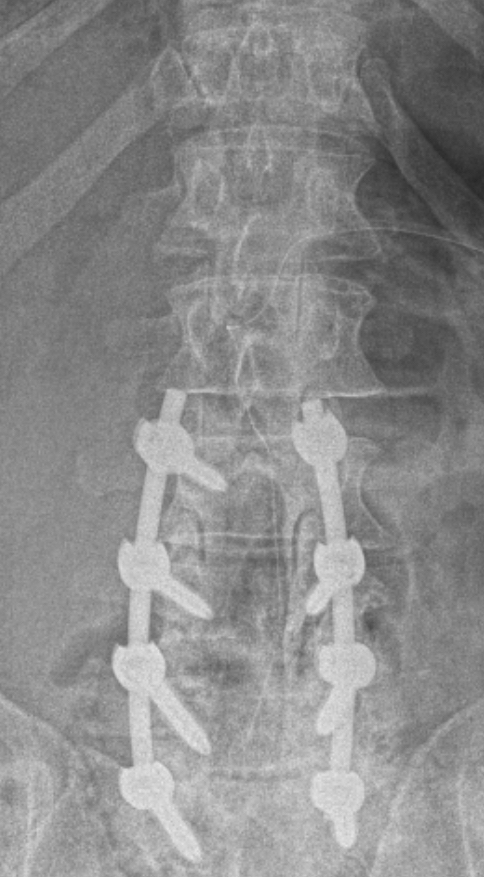
The source of this issue stemmed from Bledsoe’s spine, where three 

inter-vertebral discs were missing, causing movement in his vertebrae, leading to several issues.

At first, Bledsoe experienced extreme symptoms such as his legs and feet becoming numb after standing up still for prolonged periods, hindering his ability to walk and get around.

It became increasingly evident for Bledsoe that action would need to be taken. At first, he tried a chiropractor, who said that his symptoms were too severe and that he would need to turn to a surgeon.  

Bledsoe repeatedly expressed his gratitude for the extensive research that Massachusetts General Hospital had been doing. “Getting into Massachusetts General Hospital was one of the best things because they are a research teaching hospital,” Bledsoe said.

Researchers were using a new robot for Bledsoe’s case that read MRI bone densities to determine the best location for the eight screws that were to be inserted into his vertebrae. Thus guaranteeing the spinal structural support that Bledsoe had been lacking.

“On Halloween night I was carved like a pumpkin because the day of my surgery was Halloween day,” Bledsoe said regarding his lengthy five-hour surgery. “The operating room was as large as a physics lab but stuffed to the gills with equipment.” 

In Blesoe’s absence, He left his students under the instruction of Cole Hauser, a substitute teacher. “This is the first time I’ve had experience taking over someone’s class like that,” Hauser said. “I think it’s really good to help out where you can for teachers. These life events can take you by surprise.”

However, Hauser seamlessly handled the transition for freshmen in physical science between teachers, ultimately extracting a beneficial experience for himself and his students. “They made that transition really easy, ” Hauser said, referring to his students. “I enjoyed it and had a great time”

Hauser studied Marine Biology and teaching in college. However, he received glowing reviews from his students in his Physical Science class. “I think Mr. Hauser prepared us really well for his tests so I don’t think my education was really impacted,” said Ishwa Dharan, a freshman currently in Bledsoe’s physical science class.

“He makes the class really fun so I was just glad he was back,” Dharan said. It’s not a secret that Bledsoe is adored and revered by students and staff. “He’s a pretty happy guy,” said Sydney Steddom, a sophomore and a former student of Bledsoe.

Continue reading
AP Econ Debuts at AHS
  • October 7, 2024

By Carissa Dessin
EXECUTIVE EDITOR

This course, taught by Digital Learning and Business teacher Ashley Kinsman, marks a significant shift from the school’s previous elective business courses.

Kinsman, who has previously taught electives such as Intro to Business Finance and Social Media Marketing, now teaches two sections of AP Econ. On top of this, Kinsman continues to teach one section of a class she taught years prior, Intro to Business. AP Econ covers both Microeconomics and Macroeconomics, offering students a challenging education in economic theory. 

Despite making the huge transition from unleveled classes to teaching an AP, Kinsman said she’s “really enjoying it.” One challenge she described is “staying on top of the students and going over the units beforehand, to make sure [she has] everything ready for them.”

STAFF PHOTO / Carissa Dessin
AHS has added an Advanced Placement (AP) Economics course to its business curriculum this year, providing students with a deeper understanding of economic principles.

AP Econ introduces students to complex concepts like the production possibilities curve and marginal analysis, which Kinsman integrates with real-world applications. She conducts classes in a way that maximizes engagement, spending the first part of class lecturing and then transitioning to “hands-on engagement experiences in class time, so students can see how it [relates] to different scenarios in their day-to-day life.”

Senior Gavin Mottley described the class as going really well so far. “Economics is new for me,” he continued, “but it’s a lot easier to internalize information even though it started out as a totally foreign language.” 

Mottley initially found interpreting two-way tables that demonstrate comparative advantage between countries challenging but gained clarification from Kinsman’s teaching method. “[She] had us work together in groups in a game that had us practicing exactly that. It helped me a lot because I got to work with my classmates; asking them questions helped [reduce] the confusion I had, and helping them when they needed it reinforced the ideas I was more comfortable with.”

Senior Arushi Biswas also reflected on the challenges and rewards of the class. She initially found the production possibilities curve and related graphs confusing but credited the summer work with helping her stay on track.

When it came to registering for the class last spring, Biswas was first drawn to the class because she was interested in pursuing a degree in business and wanted to get a feel for her future classes. “I think students should get educated in economics because it teaches you how the economy works, when to save and when to invest, how to make informed decisions,” she said. “It gives you a good understanding of society and policy.”

Looking ahead, Kinsman is eager to dive into more advanced topics and continue making the material of the course relevant to the students’ lives. She hopes for them to see how truly applicable all of the information that they are learning is in their lives. “I think it’s just really applicable to your day-to-day life like…we do a lot of economic theory, without really realizing that’s what it’s called.”

Continue reading
EDITORIAL: AHS Phone Policy Teaches Compliance, Not Responsibility
  • October 7, 2024

There’s a new phone policy at AHS, and you’ve probably noticed it. Our phones go into what one might call a “phone jail”—those numbered slots where our devices are locked up during class, sometimes with an actual lock and key. The rationale is clear: no phones in class, no distractions. But let’s ask the question: why have we gone to such extremes? 

We at ANDOVERVIEW strongly believe that class time is for learning, and phones can be and have been a major distraction. The administration has had enough of our glowing faces, aglow not from intellectual enlightenment, but from under brightly lit phone screens. Our teachers are concerned about our development; it is not that it gives them pleasure to deprive us of our hypnotic devices. But does locking up our phones, as if they’re dangerous contraband, teach us the right lesson?

This is high school. We’re constantly being told to act maturely and take responsibility for our actions. Some of us are already 18—legally adults—yet we’re treated as though we can’t be trusted with even the smallest responsibility. By removing the temptation completely, the administration is not teaching us how to manage it. It is just kicking the can down the road. Very soon, many of us will be heading off to college or entering the workforce. In those environments, policies like this one don’t exist. There won’t be phone jails. No one will force us to lock up our devices. It is up to us to learn to make responsible choices.

The phone policy creates a false sense of order. It’s easy for students to follow the rules because we don’t have a choice. But the moment the structure is gone, those who never learned self-discipline may be the first to revert to bad habits. What if, instead, we were trusted with our phones? If someone is caught using their phone during class, they face immediate consequences, as well as potentially being singled out for phone jail—with no parole—for the rest of the year. This is about accountability. We learn by making mistakes and facing consequences. If we’re shielded from making mistakes in the first place, we’ll never learn.

The new phone policy does enforce compliance with rules, but one should remember that we are expected to follow rules, even without heavy-handed enforcement. We need to be treated like the almost-adults that we are. It’s time to trust us to learn from our choices, not lock them away.

Continue reading