Environmental Club Pursues Projects
By Alana MacKay-Kao
ARTS EDITOR
On a beautiful, warm, breezy Saturday afternoon April 24, about 30 volunteers worked together to plant over 300 trees in total, exceeding the initial goal of 256 trees by nearly 20 percent.
The initiative was run by the Environmental Club at AHS, headed by co-presidents senior Yashvi Gosalia and junior Eva McKone. They worked with an organization called Tree-Plenish, a platform created to help students offset the carbon footprint of their school’s paper usage. For AHS this means offsetting the use of 2.6 million sheets of paper.
This isn’t the first time the Environmental Club has tried to plant trees on an enormous scale. Last year, their goal was to plant a tree for every student at AHS. Unfortunately, while there were no shortage of saplings, the trees that were available would have needed routine maintenance, and the logistics of caring for that many trees could not be worked out. The Environmental Club tackled the task again on a smaller scale this year, and partnering with Tree-Plenish allowed them to accomplish their goal of planting a huge number of trees. Andover residents purchased either a douglas fir, river birch, or red maple tree to be planted on their private property. April 24, the volunteers drove around and planted the more-than-300-trees they ordered.
While working with Tree-Plenish to accomplish this huge project is one of the more complex undertakings the Environmental Club has pursued this year, it is far from the only one. They have also worked to get electric car charging stations implemented on the AHS campus for future use by students and other Andover residents with electric cars. The goal is to make it more convenient to have an electric vehicle in the hopes that more people will decide to use them. There are 12 buildings in Andover running entirely on solar energy sourced from a solar panel field in Palmer, including AHS. Since the charging stations will be on the AHS campus, they will be in the same electricity zone and will run on 100 percent solar energy.

STAFF PHOTO / Erin Li
A line of electric vehicles meet up at the AHS parking lot to drive down to main street to promote electric cars.
STAFF PHOTO / Erin Li
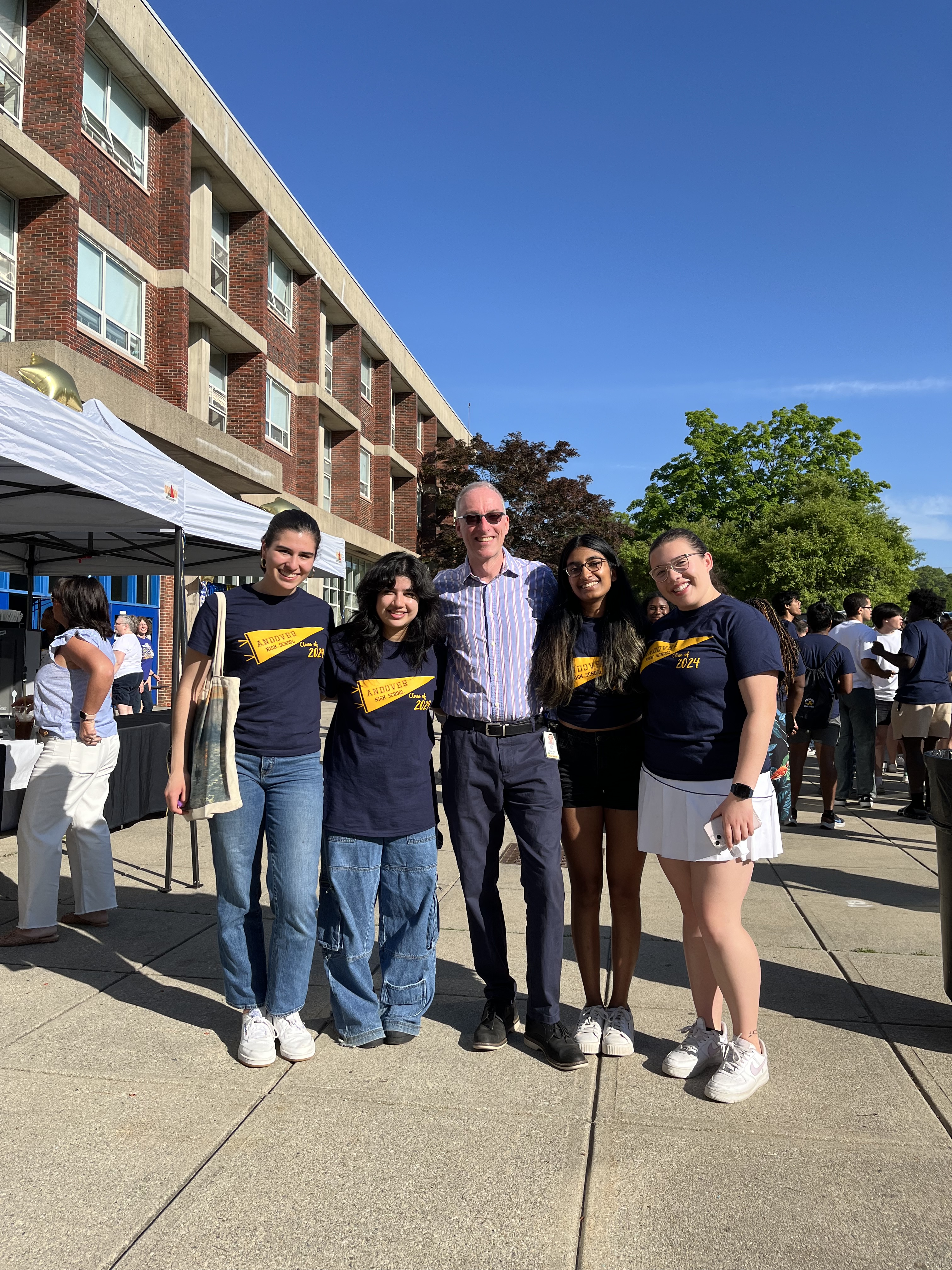
AHS Environmental Club members organize the electric car drive-by event. From left to right: Eva McKone (president), Courtney Duffy, Yashvi Gosalia (president), Ravi Diaz, Sadie Rooney
Not all of the projects the Environmental Club takes on are as monumental ones. They regularly do trail cleanups, an exercise junior Claire Dolan, a member of the club, really enjoys. “It’s always really fun after school to walk around and talk to everyone in the club and pick up some trash just to keep that area [of Baker’s Meadow] clean,” she said. “I also really like working in the garden with students from the club.”

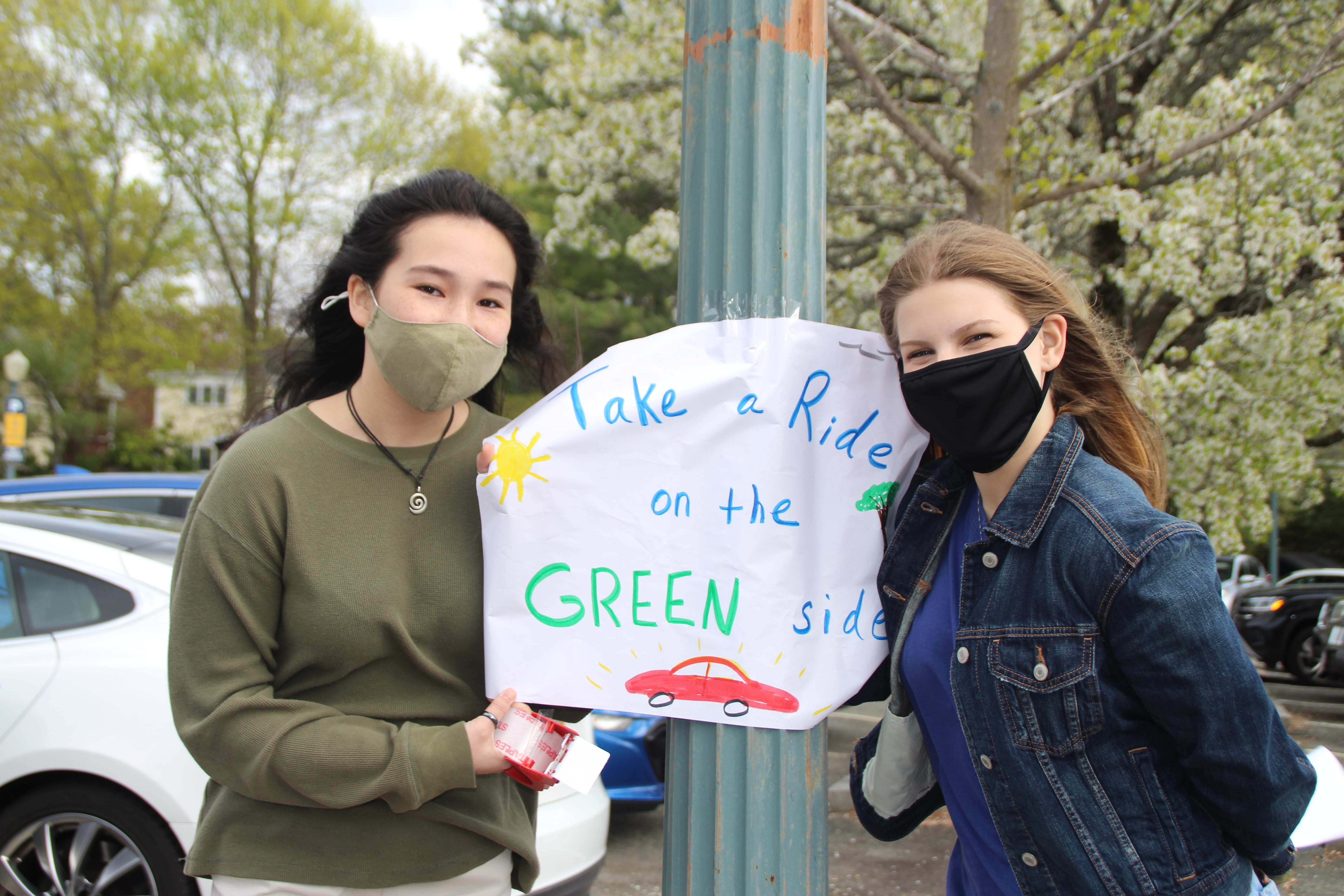
Courtney Duffy and Sadie Rooney stand next to a poster they made for the event to promote electric vehicles. The event occurred on 4/30 and it consisted of an electric car show and educational messages.
The Environmental Club has truly come a long way, being revived under Gosalia and McKone’s leadership after having no clear direction in their sophomore and freshman years respectively. Gosalia recalled, “I had gone to a couple of meetings and the thing that I remember the most about that was just how empty the classroom always was. We had maybe 5 or 6 people that were coming consistently.” When she discussed this with McKone one day, the two became determined to change the way the club was run. They approached Melanie Cutler, science teacher and advisor for the club, and they have been co-presidents ever since (that’s three years running!)
Throughout experience organizing events, volunteering with various organizations, attending strikes and more, McKone said that her favorite part of advocating for the environment is “having a group of like-minded people working toward one goal. It’s really rewarding to see everything follow through and to see that we can make an impact in our community.”
Getting Involved
Senior Sophie Rainville is taking the Environmental Sustainability Internship Course this year. She has been using a grow cart with four racks in a room next to the cafeteria to grow lettuce, basil, and cilantro, which is being used in school lunches.The goal was to provide fresh organic food to the AHS cafeteria. “Working on this project is very fulfilling because the process does not take long and it is fun to see the plants grow,” Rainville said. “My favorite part is being able to bring the food into the cafeteria knowing it will be used,” she added. “It is cool to know that someone who is eating a salad at lunch is eating lettuce grown in the cafeteria.” Her hope is for more grow carts to be used in the future. She would love to get the community involved through bringing her produce to farmers markets, and her ultimate hope is that it could be used as a learning tool in science and special education classes. She said, “I was inspired by the way that growing things can help people. I think it is…a learning opportunity for people to see something they planted grow.”
McKone explained that, as Sophie demonstrated, in environmental advocacy, there are different kinds of work you can do. “There’s the political side and the classic ‘go out in nature and save the earth’ kind of thing,” she said.
On the political side, Dolan had a few tips for how you could get involved. For example, you could volunteer to phone bank for candidates who champion green legislation you support, or you could write postcards to voters. She said, “Climate change is an issue that isn’t really visible in our government. And state-wise, we have a very small percentage going towards work that centers the climate and advocating for that is really important.”
If that kind of work isn’t your thing but you still want to volunteer, there are many other organizations that you can work with. McKone is involved in an organization called the Tomorrow Project (https://www.tomorrowprojectus.org/), a program led by youth volunteers that partners with elementary schools to educate kids about the importance of being sustainable. Hands-on projects and interaction between the older students and younger students aim to make an impact that will excite kids to lead green lifestyles. Another place to volunteer is Andover WECAN (https://andoverwecan.org/), a community-based group of volunteers with all sorts of projects. Dolan helps to write the blog about ways people can help in Andover. Dolan said, “Even joining one organization can get you very far, because people have great connections and everyone’s really helpful with tips.”
On a personal level, there are a number of ways you can make the way you live more sustainable. Sustainability can easily be intimidating, but Gosalia made a fantastic point to remember when it feels this way: “The aesthetic of being sustainable is often a lot more work than it actually is to be sustainable…a lot of times, people feel like in order to be sustainable, you need to buy new things. But that’s actually the exact opposite of what you should be doing…Sustainability really comes with using what you have to the most that it can be used. So instead of buying new clothes that are ethically or sustainably made, just keep wearing the ones you have and mend them…It’s a lot easier than it looks online.”
You can also try going vegetarian one day a week. According to Kathy Freston, health and wellness activist and author in the Huffington Post, enough water to supply every home in New England for four months could be saved if everyone went vegetarian for a day. You can see the article here at https://www.huffpost.com/entry/the-breathtaking-effects_b_181716.
McKone emphasized that the most important aspect of doing this kind of work is not to give up even if you feel disheartened. Dolan echoed this sentiment, saying, “You can feel not very valuable in the issue of climate change because it’s very large, on a global scale. Your work matters a lot no matter how big or small it is. All people are valuable to the movement and working towards combating climate change.”