New Music Era Begins With Departure of Catherine Revetria
By Eliza Marcy
MANAGING EDITOR
How many people does it take to replace one AHS music teacher? Turns out, more than you might think.
After an eight-year run, Catherine Revetria left her numerous musical posts in early April after announcing her pregnancy and her plans to take care of herself and her family. She was the director of the high school’s band and orchestra, the remote instrumental program, the Golden Warrior Marching Band, Tri-M Music Honor Society, and all middle school bands.
Replacing her until the end of the school year are Dennis Shafer, Dr. Derek Voigt, Sean Walsh, and David Rice. Shafer, one of the school jazz band instructors, has taken over Revetria’s teaching assignments. Voigt, the middle school orchestra teacher, has assisted with the high school’s orchestra. Walsh, the Fine Arts Program Coordinator for Andover Public Schools, has been working with Tri-M students. Rice, the Assistant Marching Band Director, has stepped up to fill out the year and helped cheer on the varsity football team.
So that makes four men replacing one woman. Fierce!
Walsh told ANDOVERVIEW that the district is in the process of hiring permanent replacements and hope to have final candidates by the end of May for the 2021-2022 school year. In the Tri-M Honor Society, Walsh has overseen the annual Instrument Donation Drive and is currently planning to get the high school musicians over to the elementary schools this month to encourage fifth graders to continue their involvement icouldnn band and orchestra.
“We are [also] excited about new courses next year at AHS, including ‘Beginning Instruments’ and ‘Rock Ensembles,’ and looking to expand programs at elementary and middle school levels,” he said.

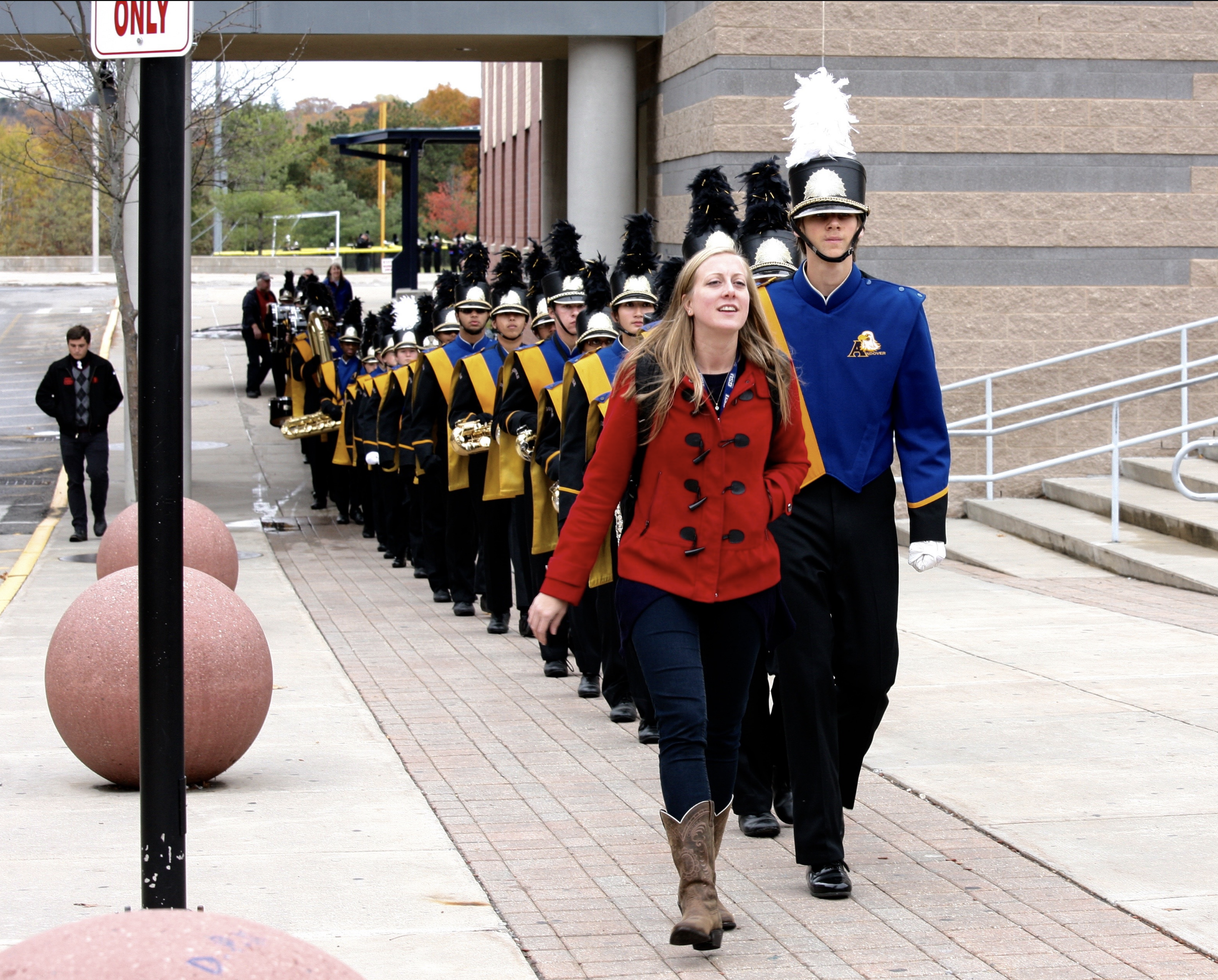
Revetria née Hofius leading the Andover High School Marching Band.
No Regrets
Revetria came to AHS from Georgia and brought with her a fiery passion for music that she passed down to all her students. With no regrets about leaving AHS now, she told ANDOVERVIEW that she planned to return to teaching music one day when the time was right. But one of her greatest challenges over the years was, in fact, “time and the schedule.”
“Having a limited number of students signing up [for band] has always been tough,” she said. “The challenge is having this robust middle school program and then not being able to have the time to take a band class in high school. On the other hand, my greatest accomplishment here is the shift in the culture of the marching band. It used to be very ‘drum corp-centered’– people had to do push ups when they messed up. The culture shifted to be much friendlier and we doubled the membership. The younger and least experienced players felt more welcome and were lifted up to the rest of the group. We grew because of that. And finally, I’m also very proud of the transition of the orchestra from an after-school program to being in the school day. It’s small but mighty.”
She also told ANDOVERVIEW that she was very proud of her colleagues and working together with them to grow the middle school band so big that they can’t fit on the Collins Center stage anymore.
“We can’t even have All Bands Night anymore like we used to because there’s too many people in the audience and too many people on stage,” she said. “We maxed out the capacity even before COVID!”
In a letter from the Andover Band Association, President Matt Scully wrote to students and parents about his appreciation for Revetria.
“Catherine has been an inspiration to all of our children over the past eight years,” he said. “Whether in lessons for Elementary, or band and orchestra in Middle and High School, she’s been there with them teaching and cultivating their love for music in their early musical years. I wish her and her family all the best in the world.”
For now though, music students see Shafer– or Crazy Dennis as he’s affectionately called in jazz band– teaching high school band and orchestra each day, and all middle school bands (co-teaching with Kaitlyn Sicinski).
“I have thoroughly enjoyed working with all the students, and it is a joy to be teaching in-person again,” he said. “I have enjoyed in particular with the orchestra/string students, as I have conducted orchestras in the past, but it has been a while.”
Shafer has three degrees in Saxophone Performance. He told ANDOVERVIEW that he has a bachelor’s in Music (BM) from Boston Conservatory (2004), a Diplôme d’Etudes Musicales (DEM) with prize in saxophone from the Parisian Conservatory of Boulogne Billancourt in France, and an Artist Diploma (AD) from Longy School of Music which is next to Harvard in Cambridge, Massachusetts.
“I thoroughly enjoy playing the saxophone, which I’ve worked on perfecting for 30 years, and I’ve almost got it,” he said. “Right now, I’m working on klezmer clarinet, however, [I’m getting some tips from Kaitlyn Sicinski about clarinet playing and from some other artists on Zoom and Youtube. Most of what I learn these days is from YouTube–and it’s free!”
All About Fun
What’s the most important thing Shafer wants to convey to AHS students in the short time he has with them? The most important thing is scales.
“If, by the time I leave here at the end of the year, every student can play all major scales (percussionists included, there are plenty of mallet instruments here), I would consider that a great success,” he said. “Scales unlock the kingdom for playing anything on any instrument. Right now, I’m learning the Freygish scale for klezmer, on clarinet the most popular key for that is E. So its E, F, G#, A, B, C, D, E–Try it! It’s lots of fun! It’s a major scale but sounds minor because of the augmented second in the beginning of the scale.”
In a letter to students in the band classes, Revetria wrote she was saddened to say goodbye as the community in Andover had been such a large part of her life the past eight years. Like Shafer, her parting words are all about sticking with music over the long haul.
“I am nothing but confident in the future of the music program in Andover,” she said. “The program’s growth that I have witnessed is immense and it will continue to grow in the years ahead. I am truly excited knowing how much music can, and will, enrich your lives if you stick with it. I have yet to meet someone who regrets the time they spent learning music—only people who regret giving it up. So keep playing!”