NEASC Visit Highlights AHS Goals
Anushka Dole || ONLINE EDITOR
Andover High School hosted a re-accreditation visit from the New England Association of Schools and Colleges (NEASC) from March 16-18, as part of a decennial review process designed to evaluate how well AHS supports student learning and identify areas of improvement.
According to Assistant Principal Alicia Linsey, the process started during the 2023-2024 school year with a visit from the Collaborative Conference team, a group of visiting educators from across the New England area. In preparation for the visit, a team of AHS faculty members and administrators was formed.
“We picked out priority areas and presented those to this visiting NEASC committee … and they agreed with [our priority areas],” said biology teacher Lindsey L’Ecuyer, the AHS committee’s science department representative.
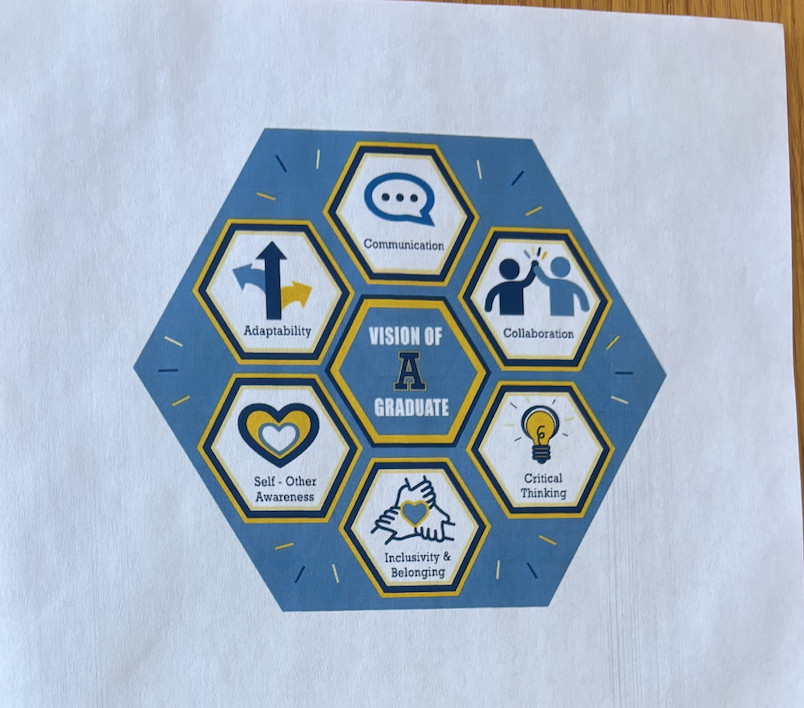
There were five priority areas that AHS pledged to work on starting in the 2023-2024 school year: developing the Vision of a Graduate, implementing consistent curricula throughout all departments, vertical/horizontal alignment across departments and throughout grades, promotion of school pride, and building infrastructure.
The Vision of a Graduate outlines the skills and values that the school hopes to instill in every student by the time they graduate.
Vertical alignment refers to improving coordination between teachers across grade levels to ensure student skills build progressively, while horizontal alignment emphasizes greater collaboration between teachers across departments.
“[The committee is] working on … finding time in the school day for teachers to collaborate more,” L’Ecuyer said, adding that AHS has begun standardizing curricula to support this effort.
“There are committees in the school that have been working on documenting curriculum in a consistent format for our core classes … freshman English, for example, [and] biology,” L’Ecuyer said.
Linsey mentioned that students and parents also play a role in the accreditation process. A team of visiting evaluators—distinct from the Collaborative Conference team—conduct interviews to gather student perspectives on the school climate and learning experiences.
Although the committee leads the reflection process, administrators are then responsible for implementing action plans based on their findings. In accordance with these plans, faculty members must provide evidence of integration of the district goals.
L’Ecuyer emphasized that NEASC accreditation is more about reflecting on and improving school processes than it is about recognition.
“It’s less of a badge as it is opening yourself up to reflecting on and documenting what you do well and what it’s like setting goals for your school,” L’Ecuyer said.
Beyond internal reflection and planning, the “badge” that the reaccreditation process provides does carry additional, tangible benefits for students. It reassures families and colleges that AHS maintains a rigorous academic program, and that it’s constantly working towards improving learning.
“My understanding is that colleges know Andover High School—they know what our programs are like,” L’Ecuyer said. “[Because] of [accreditation] … they know the kinds of students that graduate from here, and what skills that [they] have.”
Accreditation also plays a role in the school’s ability to receive funding.
“NEASC accreditation is required for eligibility to receive some private, state, and federal grants, loans, and other federal funds,” Linsey noted in an email.
Like this:
Like Loading...
Related




great stuff