Steve Zrike Appointed MA Secretary of Education

Avery Slaughter || ONLINE EDITOR

Steve Zrike was appointed Massachusetts Secretary of Education by Governor Maura Healey on February 10. He will assume the position on February 13.

Zrike will succeed Patrick Tutwiler in the role. As Secretary of Education, Zrike will oversee the Executive Office of Education, which is responsible for managing pre-elementary, K-12 and higher education across the state.

“My responsibility is to the children of the Commonwealth,” Zrike said. “I just want to make sure that that is clear–that at the end of the day, the job is about improving the student experience in our public institutions across Massachusetts.”

Zrike is currently the superintendent of Salem Public Schools. Previously, he also served as superintendent of both Holyoke and Wakefield. He has held various other positions in school districts across Massachusetts.

“I feel like I’ve had a lot of experiences in a lot of different types of communities,” Zrike said. “I’m going to rely on the different relationships and different experiences I’ve had across all those places. Of course, I have a lot to learn, and I’m excited to get started with better understanding the many different types of education programs that exist across Massachusetts.”

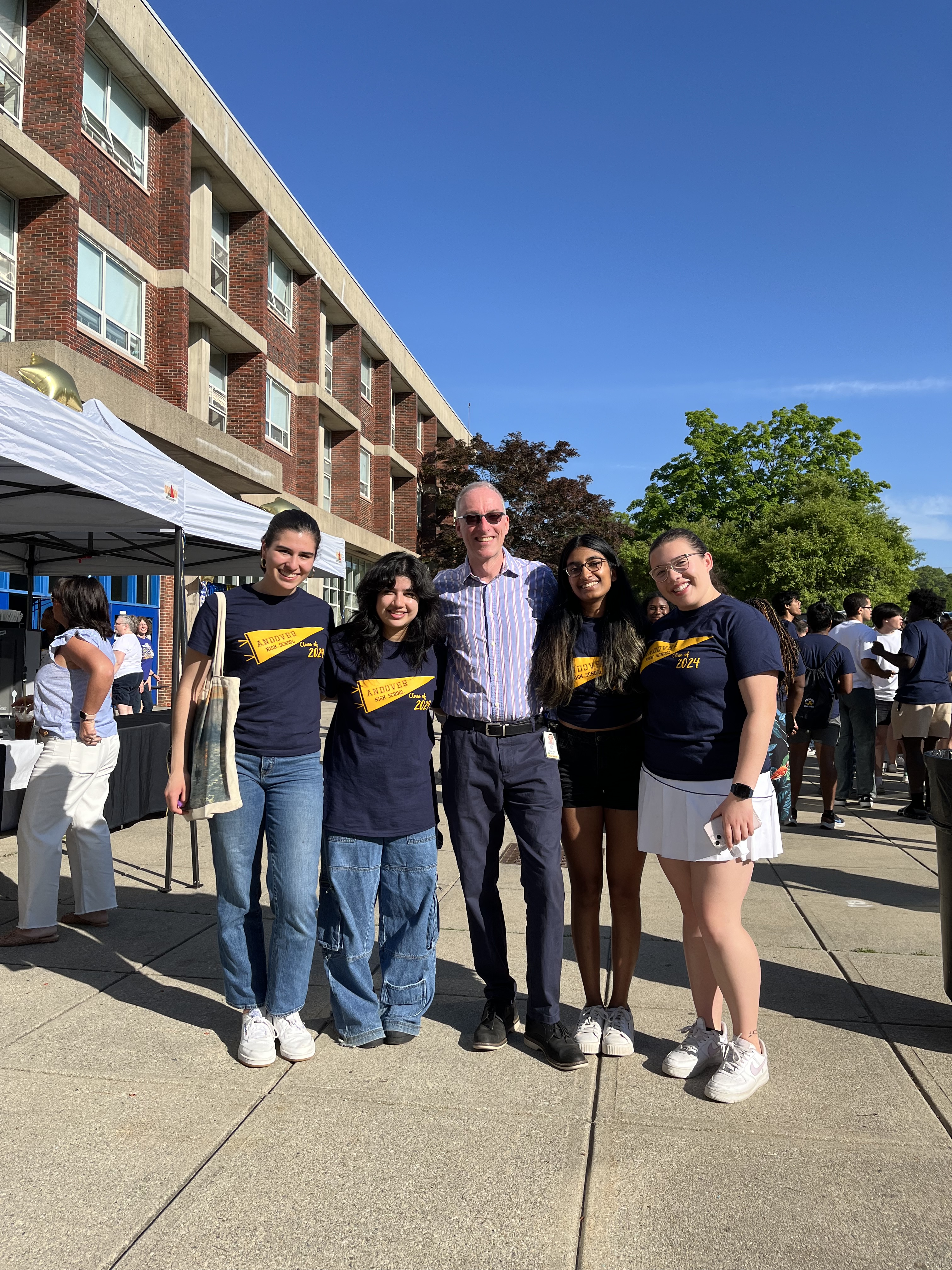
An Andover resident, Zrike began his career in education as a fifth grade teacher in Andover Public Schools. Prior to this, he received education at Dartmouth College and attended the Harvard Graduate School of Education.

“Andover was an amazing place for me to start my career,” Zrike said. “I learned a lot from the people that I worked with. I’ve carried that experience with me since.”

  • Related Posts

    NEASC Visit Highlights AHS Goals
    • April 3, 2026

    Anushka Dole || ONLINE EDITOR

    Andover High School hosted a re-accreditation visit from the New England Association of Schools and Colleges (NEASC) from March 16-18, as part of a decennial review process designed to evaluate how well AHS supports student learning and identify areas of improvement. 

    According to Assistant Principal Alicia Linsey, the process started during the 2023-2024 school year with a visit from the Collaborative Conference team, a group of visiting educators from across the New England area. In preparation for the visit, a team of AHS faculty members and administrators was formed.

    “We picked out priority areas and presented those to this visiting NEASC committee … and they agreed with [our priority areas],” said biology teacher Lindsey L’Ecuyer, the AHS committee’s science department representative. 

    There were five priority areas that AHS pledged to work on starting in the 2023-2024 school year: developing the Vision of a Graduate, implementing consistent curricula throughout all departments, vertical/horizontal alignment across departments and throughout grades, promotion of school pride, and building infrastructure. 

    The Vision of a Graduate outlines the skills and values that the school hopes to instill in every student by the time they graduate. 

    Vertical alignment refers to improving coordination between teachers across grade levels to ensure student skills build progressively, while horizontal alignment emphasizes greater collaboration between teachers across departments. 

    “[The committee is] working on … finding time in the school day for teachers to collaborate more,” L’Ecuyer said, adding that AHS has begun standardizing curricula to support this effort.  

    “There are committees in the school that have been working on documenting curriculum in a consistent format for our core classes … freshman English, for example, [and] biology,” L’Ecuyer said. 

    Linsey mentioned that students and parents also play a role in the accreditation process. A team of visiting evaluators—distinct from the Collaborative Conference team—conduct interviews to gather student perspectives on the school climate and learning experiences. 

    Although the committee leads the reflection process, administrators are then responsible for implementing action plans based on their findings. In accordance with these plans, faculty members must provide evidence of integration of the district goals.

    L’Ecuyer emphasized that NEASC accreditation is more about reflecting on and improving school processes than it is about recognition.

    “It’s less of a badge as it is opening yourself up to reflecting on and documenting what you do well and what it’s like setting goals for your school,” L’Ecuyer said.

    Beyond internal reflection and planning, the “badge” that the reaccreditation process provides does carry additional, tangible benefits for students. It reassures families and colleges that AHS maintains a rigorous academic program, and that it’s constantly working towards improving learning.

    “My understanding is that colleges know Andover High School—they know what our programs are like,” L’Ecuyer said. “[Because] of [accreditation] … they know the kinds of students that graduate from here, and what skills that [they] have.”

    Accreditation also plays a role in the school’s ability to receive funding.

    “NEASC accreditation is required for eligibility to receive some private, state, and federal grants, loans, and other federal funds,” Linsey noted in an email.

    Continue reading
    The Road to Finals: AHS Theater Guild’s Proven Progression with Proof
    • April 3, 2026

    Abby Chachus || STAFF WRITER

    The AHS Theater Guild just performed in the Massachusetts Educational Theater Guild (METG)  festival competition’s final round. They performed an abbreviated production of Proof by David Auburn. Due to the maximum running time of 40 minutes, the Director of Theater Arts Susan Choquette, had to cut part of the play. Choquette, the cast, and crew spent around two months rehearsing and transforming the Collins Center stage into a setting for  a refined production.

    The play follows Catherine, played by sophomore Romy Obbard, a young woman who spent many years caring for her extremely intelligent but mentally unwell mathematician father, Robert, played by junior Channing Pekock. After his death, her sister Claire, played by sophomore Mia Tosch, tries to take control of Catherine’s life. One of Robert’s former students, Harold (Hal), played by senior Luke Fugere, works through all of Robert’s 103 notebooks while ultimately developing a romantic relationship with Catherine. 

    “I hope the audience and judges leave thinking about what it means to be afraid of inheriting the illness of one’s parents, and how that can inhibit someone’s ability to visualize their own future,” said Obbard. “It’s an incredible message that resonates with many.”

    Rehearsals for the guild are about more than simply memorizing lines. They collectively participate in activities to better themselves as performers.  During a rehearsal on February 10, the cast of Proof practiced “percussive enunciation,” a strategy that Choquette uses to ensure that every syllable reaches the back wall of the Collins Center. Each cast member spread out to a different corner of the auditorium, and as each student said their lines, other cast members raised one hand if they could hear them but could not understand the words, and two hands if they were not heard or understood. If all was well, they would continue. The system provided instant feedback on clarity and reflected Choquette’s philosophy that the three parts of acting are, “to be seen, to be heard, and to be understood.”

    Assistant Director Nina Bond, a junior, emphasized that this collaborative environment is what makes small productions thrive.

    “Everyone comes to rehearsal prepared, with ideas to share to help improve the product,” Bond said. “We also use collective brainstorming to understand the plot and characters on a deeper level.” 

    The Preliminary Round of the METG festival took place on Saturday, February 28 in the  Collins Center. Proof placed in the top three productions at the Andover site along with Peabody Veterans Memorial High School and Swampscott High School. The five individuals who received awards were: Hugo Vieuxloup-Boulain for excellence in set design, Ethan Lapointe for excellence in lighting design, Evan Leary for excellence in stage management, and Fugere and Obbard for excellence in acting.

     The group’s accomplishments allowed the AHS Theater Guild to move on to the semi-finals, which took place on March 14 at Framingham High School.

    The individuals who received awards at semi-finals includes: Lapointe for excellence in lighting design, Vieuxloup-Boulain for excellence in set design, Bond, Grace Armstrong, Joy Chave and Amelia Liss for best assistant directors, and finally Obbard and Tosch for excellence in acting. At the semi-finals the group was within the top two groups at their site, enabling them to move into the final round, where Fugere, Lapointe, and Vieuxloup-Boulain won individual awards.

    Continue reading

    Leave a Reply

    You Might Also Like

    Spanish Department to Host Day of the Dead Fair

    • November 12, 2025

    Funding the Future of Science: Proposed NIH Funding Cuts Throw US Biomedical Research Into Uncertainty

    • November 4, 2025
    Funding the Future of Science: Proposed NIH Funding Cuts Throw US Biomedical Research Into Uncertainty

    Student-Hosted Video Game Hackathon Scheduled for Late September

    • September 22, 2025
    Student-Hosted Video Game Hackathon Scheduled for Late September

    World Languages Coordinator Reflects On Career, Retirement

    • June 9, 2025
    World Languages Coordinator Reflects On Career, Retirement

    CollegeBoard Scores 1/5 on AP Testing Administration

    • June 9, 2025

    AHS Student Directs Coming-of-Age Film, ‘Horizon’

    • June 9, 2025

    Discover more from AHS NEWSPAPER

    Subscribe now to keep reading and get access to the full archive.

    Continue reading