Whether it’s video, music, literature, or something else, media is undeniably helpful in times of turmoil. It can be a pathway to distraction, an oasis of momentary calm, a drop of joy, a way to process current events, and much more.
Many students turn to a platform like YouTube, which is accessible to everyone and seemingly has videos to suit every taste. Anya Lazar, a junior at AHS, said some of their favorite channels are Unus Annus and Strange Aeons. You can still find Strange Aeons on YouTube. Unfortunately, Unus Annus has been deleted (the concept was a channel where a video would be posted every single day for a year, and then deleted upon the completion of this goal). It encouraged making the most of the time we have, an idea that hit close to home for many viewers while quarantining. Lazar said about the channels: “They are entertaining in a way that somehow caters to my hyper specific sense of humor.”
PROMOTIONAL IMAGE Unus Annus’ logo.
Senior Griffin Caruso enjoys watching the YouTube channel, “Fire of Learning.” He is taking college courses, classes at AHS, and VHS classes. Each format has a completely different feel and pace, and switching between them constantly is exhausting. “It’s a good break from the duel my high school and college work is having,” he said.
YouTube isn’t just for consuming media, it’s great for creating media as well. Senior Anderson Hsiao has been working on videos to post on his channel. He posts both music and comedy videos, which can be found under his name, Anderson Hsiao.
Speaking of music, musician and senior Declan Woodring said, “I find music of all kinds just generally soothing and overall fun to listen to. Finding that right song, album, or artist makes all the difference in my day and I hope that it will help others too.” He’s spent the pandemic listening to various music that improves his mood.
Digital media isn’t all there is though, Spanish and French teacher Peter Hall has found that old-fashioned books have been the most important form of media to him during the pandemic. “Reading can be my form of escape, a way to learn about other people or cultures, or gain a new perspective,” Hall said. Trevor Noah’s Born a Crime, Purple Hibiscus by Chimamanda Ngozi Adiche, Unorthodox by Deborah Feldman, and The Nickel Boys by Colson Whitehead are some of his favorites.
Although we have entered a new year, we’re not out of the woods yet with regards to the pandemic and other stressful events. But the media surrounds us, whether it’s digital, like a TV show, or physical like a book or art. It is a gift to be taken advantage of, whether you share it with others or use it as a time for yourself.
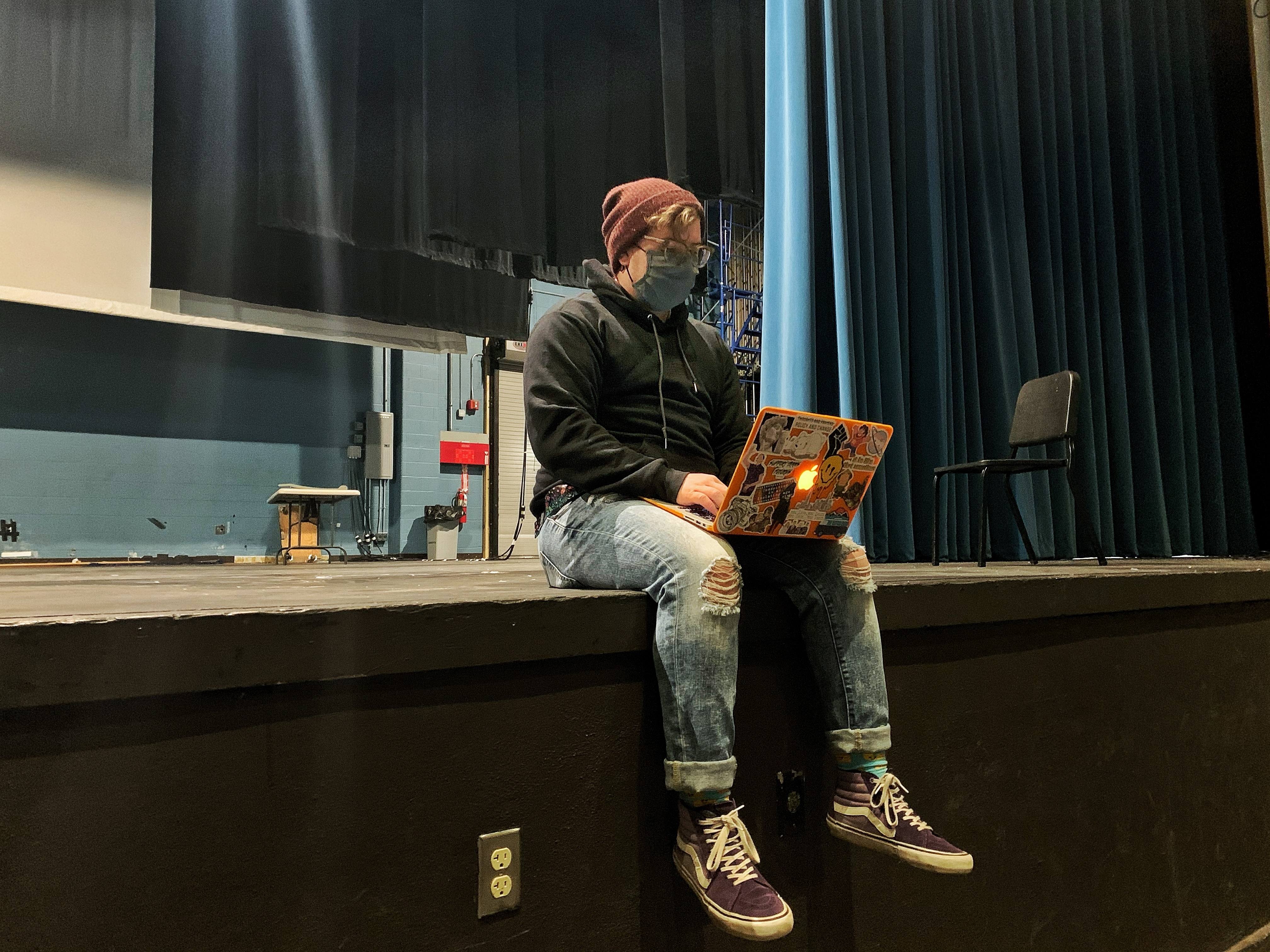
STAFF PHOTO/ Erin Li Gio Coppola sits on the edge of the Collins Center stage with his laptop. He was one of many volunteers who worked tirelessly to bring the Broadway Cabaret to fruition.
Andover Vocal Music Association’s annual Broadway Cabaret took place virtually last month, due in no small part to the tireless efforts of several student and teacher volunteers including junior Juliana Kaufman, senior Gio Coppola, and teachers Chris Desjardins (Mr. D), Daniel Brennan, and Beth Kennedy.
The Cabaret consisted of performances by all of the Show Choir groups, smaller groups, and soloists. Each performer had to submit videos of themselves performing their numbers. Emcees also had to record themselves and send in their videos. Having the most members, the Show Choir pieces took the most coordination and work.
Mr. D was in charge of mixing the audio to make it sound like the groups were actually singing simultaneously. “I use a program called Logic to put all the voices together. Normally the way I do it is I actually group all the recordings by voice part,” he explained. “Then I mix down all the voice parts and then I put the voice parts together with the pre-recorded music and try to line everything up, but it is tedious at best.”
Coppola was responsible for pulling the final Cabaret video together and making it presentable for that Friday night. He also put together the video of “Unruly Heart,” one of the group numbers, being performed.
While it isn’t a craft he usually spends much time on, Coppola enjoys filmmaking and editing. He has been editing videos since middle school when he created videos for YouTube.
“I started on Windows Movie Maker and I just kind of started playing around with different things,” he explained, describing how he got started. “It was a lot of getting practice with it.” Coppola has also made a promotional video for Show Choir and works at AYS, where he is the instructor for the Movie Makers program.
If you’re looking to learn video editing, he recommended YouTube tutorials. “YouTube honestly is like the best place if you want to learn how to do almost anything. It’s definitely really helpful because these editing softwares can be ridiculously complicated and not fun to look at.” If he was looking for a specific effect, he said, “I knew what I wanted it to do, but I didn’t know how to do it. You just look it up on YouTube and there are 8,000 people who’ve done it who will show you.”
Finally, once all of the individual numbers were edited, the video and audio clips for each number and emcee could be put together to become the ultimate video that encompassed the entire Cabaret. This wasn’t the end though. Coppola downloaded all of the videos and put them into Final Cut in the running order and inserted the intros done by the emcees.
That was when he realized that his laptop wasn’t powerful enough to process the video. The night before Cabaret, Coppola and Mr. D discussed this on a Google Meet. They had to come up with a solution fast. Mr. D remembered that Juliana Kaufman, a junior at AHS who also did some of the video editing, had borrowed an iMac from the school. They called Kaufman to ask if they could borrow the iMac so that Coppola could finish the video, and Mr. D drove it from one side of Andover to the other at 10 p.m. It was this dedication from the team that allowed the Cabaret to happen.
Here’s the way Mr. D described it: “We’re all kind of trying to put the ship together while in the middle of the ocean, if you will.” The final video was finished at 4 a.m. on the Friday it premiered, just in the nick of time. Coppola alone spent 26 hours working on the Cabaret.
“Everyone’s been affected by this,” Coppola said in regards to the pandemic, “[but] sports games still get to happen. You get to do your meets and your games…. We don’t have that right now. We can’t perform. Chorus, band, orchestra, Drama Guild, Show Choir, we’re kind of at a standstill and are very much relying on doing these virtual things because it’s quite literally our only outlet right now to do any of it. So next time we do something, maybe go hop on.”
SCOIR, the new college search and preparation platform brought to the Andover High School sophomores and juniors during the 2020-2021 school year and the seniors the year prior, is a platform for students to make their college searching experience much easier. SCOIR allows you to do anything from keep track of applications to request a teacher’s letter of recommendation.
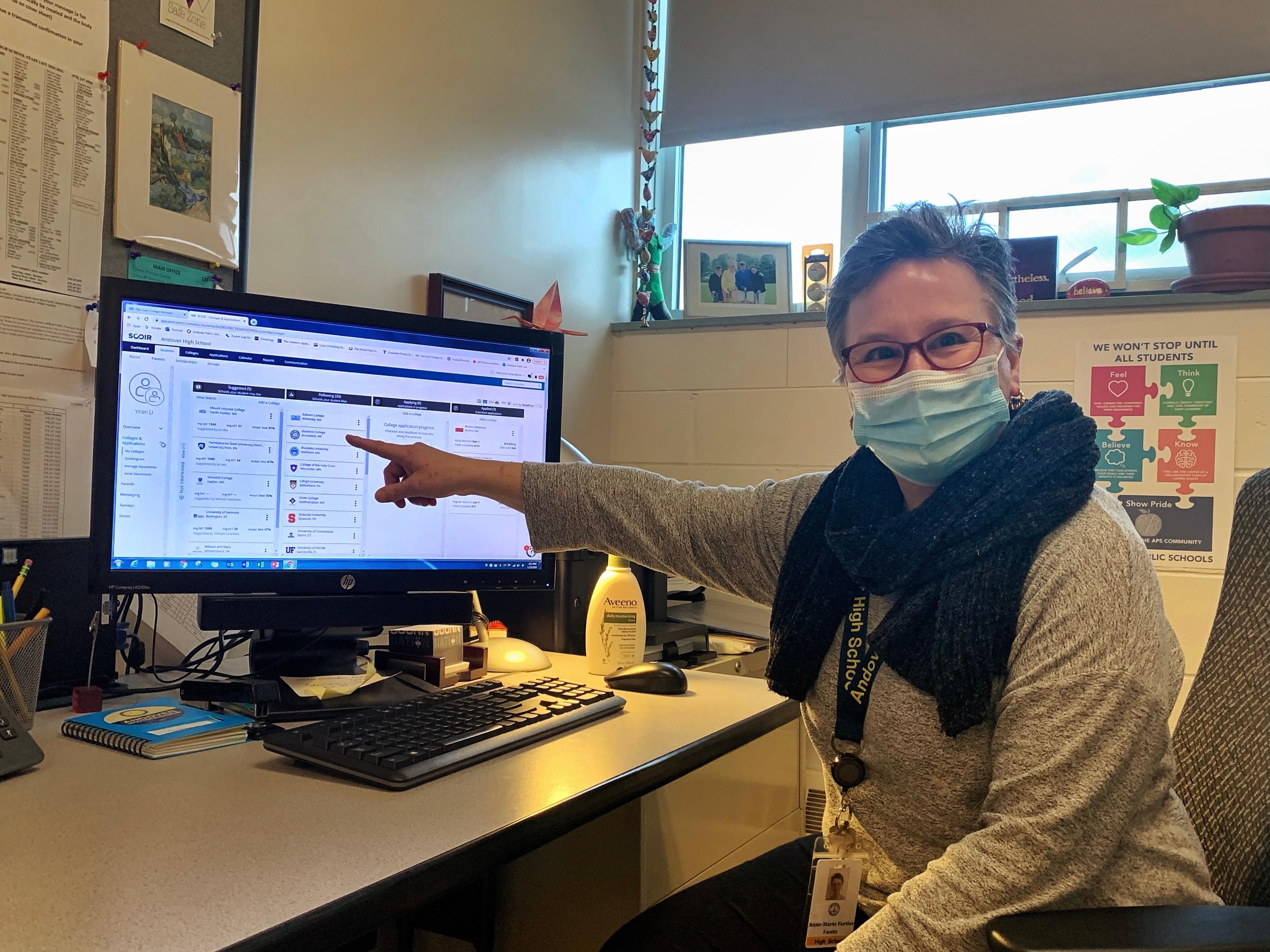
Anne-Marie Fortier, one of the AHS guidance counselors, talked about this program during an interview stating that “it’s far more user friendly” (SCOIR is the predecessor of Naviance) Juniors can use SCOIR for their college searching process and see what is out there for colleges and universities. “There’s a search function that allows students to select a number of fields that are important to them… size, location, major, any specific activities, athletics,” and more.
STAFF PHOTO/ Erin Li Ms. Fortier pointing and demonstrating how to use the SCOIR college search page.
Another great feature the juniors can use is the populated information part of this program. “Once you find a college in SCOIR, we have populated information about other Andover students that have applied and who have either been admitted or denied based on the variable of test scores or GPA,” said Fortier. This allows students to see if their test scores and GPA qualify for the college they are looking for and helps them narrow down their choices for colleges. This makes the selection process (hopefully) a bit easier.
This program is also great for sophomores. Sophomores can use this to look at what they could possibly be interested in before going more in-depth in their junior and senior years. “There is a program acclimated with SCOIR that is related to career development… we are still putting some finishing touches on how we want to present that material,” said Fortier.
If you are still nervous about searching for college and don’t know where to start, here are some tips and tricks from our seniors to help you in this experience.
The college search can become very stressful when you don’t know where to start. “Recently, college searching has been making me really nervous,” said Mishaal Khan. She is a junior and started looking at colleges the summer before her junior year. “I’m excited, I know it is a new chapter in our lives and it is a chance for us to study and learn about something we are interested in as individuals.” Her enthusiasm is a great start. But let’s give some tips and tricks from two of our very own seniors, Sophia Yannalfo and Charles Hoffman!
COURTSEY PHOTO Sophia Yannalfo wearing her Northeastern University sweatshirt.
Sophia Yannalfo was recently accepted into Northeastern University in Boston and Charles Hoffman has finished his college application process. Both Hoffman and Yannolfo were both very excited about the academic side of things which is very important. If a college doesn’t have what you are wishing to study, this can help narrow this list down.
“Utilize your guidance counselors, utilize your peers, especially if you are a sophomore or a junior that is starting to look at school,” Yannolfo said. People who have already been through the process can be a huge help, such as your older peers or even older siblings. Your guidance counselors also know a lot about you, so they can help you find the places that could match your interests.
An open mind is also incredibly important. “We didn’t know we were going to be in a global pandemic and that we would have to apply to colleges in the middle of [this],” she said. “Keep your options open because you might be set on one thing your freshman and sophomore year and then you end up changing your mind completely.”
COURTSEY PHOTO Charles Hoffman finishes his college application process.
Both Yannolfo and Fortier recommend communicating with your parents. “I think a conversation with your parents is probably the first thing to do. Even if you aren’t initially on the exact same page,” Fortier said, adding that keeping your parents informed is important for the topics of expectations for each other. Financial aid might also be discussed and scholarships as well.
And the last general tip is good organization. “Start as early as the beginning of your junior year,” Yannolfo said. “Just kind of look at what you’ve done throughout high school so far… the whole organization factor is so so important.”
Hoffman agrees with this as well. “I definitely wish I worked on this more in the summer, because the time crunch right now is no joke!” he said.
School Committee Aims to Hire Permanent Superintendent by April
By Shravya Sathi
ASSOCIATE EDITOR
COURTSEY PHOTO Interim Superintendent Dr. Bach.
The announcement of Superintendent Sheldon Berman resigning his post has pushed the School Committee to begin a superintendent search in order to fill the position quickly.
Since the resignation was declared mid-year, the school committee opted for an interim superintendent to fill the vacancy. They plan to use this time to begin the permanent superintendent search and aim to announce the new superintendent in April.
“The interim superintendent role is for six months (January 1 to June 30, 2021),” said Shannon Scully, Andover School Committee chairperson. “An initial team screens [permanent] candidate applications, decides who to interview, conducts first-round interviews, and selects finalists for the full committee to interview in a public session.”
Out of the 14 candidates for the interim position, the two finalists were Kathleen Alward Smith, former Brockton Public Schools superintendent and Salem Public Schools interim superintendent, and Dr. Claudia Bach, former Andover superintendent and Director of Educator Policy, Planning and Leadership at the Massachusetts Department of Elementary and Secondary Education. In the end, Bach was selected for the position.
“Today, I still believe my main job is supporting the work in our classrooms, be that on our playing fields, in our auditoriums, or even virtually,” Bach stated in an email to APS staff on January 2. “Providing maximum support to our students and their teachers will be my primary work over the next six months.”
This change of power leaves a huge lingering question: How will the new, permanent, superintendent be selected and hired?
The process and timeline for the permanent superintendent search were discussed at the School Committee January 8 meeting.
“We are now in a position to describe the process, and a lot of this information will be going onto a district web page in the coming days,” Scully said, adding that the committee hopes to “engage the community in this effort and to identify a highly qualified and diverse candidate pool.”
Ray and Associates Inc., a nationwide school executive search firm based in Cedar Rapids, Iowa, was selected. According to the website, the company “specializes in educational executive leadership searches” … and “recruit[s]traditional and non-traditional candidates for public schools, private schools and higher education institutions/organizations.”
“The committee was impressed by Ray and Associates’ commitment to diversity, expertise in facilitating community feedback into the process, and national reach,” Scully said, adding that “the search firm will be issuing a survey to the community to understand the characteristics of a superintendent that the community sees as most important. That survey will be issued shortly and remain open through January 24th.”
The School Committee held meetings for the Andover community from January 19-23. There were two meetings for students, three for parents, one for principals, one for assistant principals, one for other administrators, one for support staff, and so on.
“These will be led by the search firm, with the goal of gaining input from the community on what they would like to see in Andover’s next Superintendent of Schools,” Scully said. Using the information gained and the feedback from the community, the School Committee created a job description in order to recruit candidates.
In February, the main milestones are to identify, recruit, and review candidates alongside help from Ray and Associates. The School Committee also hopes to begin candidate screenings and initial interviews. In March and early April, interviews of first-round candidates will be conducted and the finalists will be announced. There will be an open meeting to interview the final candidates. Community feedback will be collected and the superintendent will be selected by the School Committee by the end of April.
“Selection of the Superintendent is under the purview of the School Committee, and one of the most important things a Committee has a responsibility to do,” Scully said.
The shift in superintendents is something that will impact AHS students and teachers, as well as across the school district.
It could not have happened during a more turbulent time, and yet junior Tessa Barcelo said that she “was barely aware that it was happening.” This seems to be a fairly universal understanding among students, and is understandable considering the current learning environment and the unique challenges it presents.
“So many aspects in our lives have been upended and this is one more of those things,” said Mary Robb, a social studies teacher. “It may add to our anxiety, which is already at a higher than ‘normal’ level. I do feel that this change is a good idea at this time. While the aforementioned increase in anxiety isn’t ideal, the opportunity to have fresh eyes and ideas in our school district will hopefully outweigh that increase.”
However, Robb is pleased by the recent push to include community opinions in large decisions, and encourages everyone in the district to exercise such opportunities so that when the district makes a choice, it will be “a more fully informed decision.”
In regards to the choice of Claudia Bach specifically, senior Emme Pitts was comforted that Bach is already familiar with the district.
“She seems pretty nice and she’s obviously qualified since she’s been superintendent before,” she said. “I mean I think she knows what she’s doing and she’s familiar with the town, plus we’re going to be getting a new superintendent soon anyways. So I think this should be fine.”
Robb agreed, and added, “I feel it was time for a change in superintendent and the opportunity to search for another one gives our school district and greater community the chance to take a good, long look at our schools.”
This last year has been a mess for everyone. From government workers to grocery workers, everyone has had to deal with the pandemic. Schools were closed, and businesses closed. With all of this going on, many people struggled to stay on top of schoolwork, bills, and other issues. In school, many students were having trouble in school, and I was one of them. Dealing with remote learning is extremely difficult, and it adds more stress to a busy day. Personally, I think AHS has had a poor performance catering to the remote students. They should consider a reassessment of the situation, and provide more resources to the cause. To start, the district gives remote students VHS classes for courses “not offered” through the high school. This is supposedly because of a lack of staff to teach all the classes. They resorted to a third party system, The Virtual High School (VHS). VHS offers a wide variety of courses, but the difficulty of the year long courses is ridiculous. As a senior this year, I enrolled in a Physics class, supposedly for high school students. It was the difficulty of a third-year college course. There was a lab, lab report, problem set, and quiz every week! The extreme rigor of this course caused me to fall behind in other classes, and use other class time to try and catch up in this VHS class. It was extremely frustrating, and I was extremely stressed in order to try to get my grade up. I spent all of my time after school trying to work on this course, and it is a poor reflection on how the class was run. Not to mention, the “instructor” was located in Nepal, which is a day behind us. I was not able to access for extra help. I was extremely disappointed in the set up of this course. Not only was VHS a significant issue. For world languages, AHS gives remote students the program, Idiomas, to learn their language of choice. However, to call it a course was a stretch. There was no teacher to student communication, and it took forever for the teacher to respond to emails. Assignments were given with poor instructions, and there were many assignments which weren’t graded properly. I am still waiting to hear about several grades for my course which were submitted before winter break! I don’t understand how the district thinks this program is good for remote students. I understand that COVID-19 is a widespread issue, and that everyone is going through a difficult time. However, I feel Andover should have grasped the situation much better than this mess of a program. AHS had an entire summer to figure out if they needed to hire extra staff, or if they needed to add extra programs to ensure the proper education of students. I find this experience as a remote student to be extremely disappointing, and this is a poor example of what AHS “stands for.” I hope the district learns from these mistakes and helps other students who are having issues.
Yay
Remote school seems like a walk in the park, but it does come with its own difficulties. I chose to participate in Remote Academy because I felt that going to school would be too risky during the COVID-19 pandemic. I had taken some classes online over the summer, so I felt I was well equipped to succeed. Remote school has presented issues that I did not anticipate. When I was in class last year, there was a fine line between school time and personal time. Remote learning has fractured this boundary. With no solid differentiation between home and school, I quickly found school work and academic pressures to be invading my personal space. Consequently, I needed to find ways to feel comfortable in both worlds. I managed to accomplish this by making time to do things I love, like artistic activities, reading, and playing games with my family. Virtual High School (VHS) is also a hot topic among many students. Some enjoy the classes, while others feel they are not worthwhile. I was introduced to VHS when I took geometry last summer. I found that learning a complex subject, such as math, is difficult within this program. The classes have no lectures, and there is no structured communication between the student and teacher. Therefore, it was up to me to learn the material on my own, with very little assistance. As a sophomore this year, I am enjoying my cybersecurity course through VHS. I have been doing well because I am interested in the material. Also, I have an instructor who has made herself accessible, so if I have a question, I receive a quick response. I feel I have learned more in this course in four months than what I absorbed in the geometry class I took last year. There have been many times when I have lost enthusiasm and motivation to learn remotely. I found the best way to tackle these issues is to take care of myself. When I feel worn out, I take time to decompress by reading a book or taking a quick walk in the neighborhood. I do miss seeing my friends in class. Seeing my friends over the internet isn’t the same as interacting with them in class. We don’t get to meet during lunch, chat in the hallway, or share a laugh during a class discussion. Though my friends and I meet over FaceTime to keep in touch, it’s not a fulfilling substitute for in-person socializing. Overall, I doubt that I will switch to hybrid this year. Although school is extremely important to me, the health and safety of my friends and family is my first priority. Remote learning has its drawbacks, but I am able to maintain peace of mind by staying home. I am hoping I will see everyone at school in September!
We know that the majority of the student population dislikes taking tests or quizzes. But during a global pandemic they’re even worse. From keeping your camera on your paper to loading hybrid students up with tests on the in-school days so they can be supervised in person, we’ve seen all of the methods of “cheatproof” testing. While preventing students from cheating on tests and quizzes seems like a good thing, it’s not the best idea during times like these. First of all, the camera-on-paper plan doesn’t work for students who don’t have working cameras or those who don’t have access to a printer to print out the test. There are also some students who can’t move their computer’s camera, which provides more difficulty with this kind of test. Additionally, the mental and physical health of many students are in a decline due to these difficult times, and that should be taken into consideration: Many of us who are hybrid students find that we get loaded up on tests on the in-school days, which is extremely stressful. And those of us who are remote students have had to stick with all of the… creative ways that teachers are trying to administer tests. Because of all these reasons, we feel that grades should be based more on classwork, projects, or other homework assignments, rather than test and quiz scores. Teachers should put the effort they put into preventing cheating on tests into giving assignments that will still assess students’ understanding, or giving work that requires us to use what we learned in class.
Teachers Modify Online Testing in Many Different Ways
By Jacqueline Zhu
STAFF WRITER
The switch to remote learning has prompted many AHS teachers to use creative methods for monitoring their students during online assessments.
Administering tests and quizzes online has proved to be a great difficulty. Technical issues, time constraints, and the increased possibility of cheating are only some of the challenges teachers face with online testing. Now more questions are arising regarding whether monitoring students is a necessary step or detrimental to the trust between students and teachers.
One of the most common ways teachers track their students is by instructing them to leave their cameras on or tilt their cameras down. “[W]hen [students] start to take the quiz/test, they need to lower the camera to make sure the teacher can see their paper and both hands,” said Chinese teacher, Lin Wu.
Sophomore Louis Morrison told ANDOVERVIEW one of his teachers has students keep their cameras on during tests to watch for suspicious behavior. He thought this method was effective because of “the scare tactic factor that could lead to some students … deciding not to cheat because they don’t understand how the teacher is using their webcam to identify their cheating.”
STAFF PHOTO/ Erin Li Example of a set up where the camera is facing the hands and test in order to prevent cheating.
Some teachers also use more unconventional methods.
“[My teachers] create [breakout rooms] in Google Meet or Schoology for each student,” said sophomore Vivian Tang. “Once inside each breakout room, each student will then present their screen and the teacher can then monitor each [students’ screens] for any signs of cheating.”
“I have students use their phone as the camera for the conference – and it is supposed to be directed toward their computer screen and their hands,” said Minda Reidy, who teaches programming and geometry. She uses this method to see if her students’ computer screens move away from the test and to see if their hands move towards notes or near the camera to look things up.
STAFF PHOTO/ Erin Li Example of a set-up for an online test where the phone faces the computer and their hands.
Others rely on the honor system. “Before we take tests, our teachers tell us not to use our notes, search up answers on [G]oogle, not to use lecture notes, etc.,” said sophomore Dhriti Motwani. “There are directions provided to us before we take our tests.”
But Math teacher Stephanie Ragucci told ANDOVERVIEW that relying on the honor system may be a little naive. “I think what [teachers] really need is some sort of a lockdown browser that would allow students to only be in the assessment they are working on,” she said.
Many students feel the measures their teachers take to prevent cheating are necessary and effective. “[These] methods are necessary because even though tests are online, students can tend to search up answers and get them right,” Motwani said. “But in the end, students are not learning and just creating bad habit[s] for themselves.”
“I think it is necessary to implement this rule since it would mean that everyone is taking the test equally and without outside resources,” said Tang, adding that she believes the methods are efficient in ensuring there’s no cheating.
Many teachers have stated the frequency and length of assessments given has reduced since the switch to remote learning. “In the past, there [would] be one quiz every two weeks in general, while now, it [is] one per month,” Wu said. “For Chinese, students usually have a vocabulary quiz and a general quiz, while now, it will be one or in other formats as assessment.”
Ragucci is moving to smaller assessments since the larger ones take too long to grade. She has been giving out fewer assessments in general that would be considered a quiz or a test. “These crazy times have forced us to learn to assess differently than we are used to,” she said.
A: “I did my doctoral work here, in Massachusetts, and my first superintendency was in a tiny little town in Oregon called Milton-Freewater. It was just really rural and very small. But I always wanted to come back here because I have had, for many years, an affection for New England. I had not lived in Andover before, so that was going to be new. When I saw this job opxportunity, I was very eager. In fact, I had two offers the same day – one from Oregon, a larger district, and one from here – and I was happy that I had the two offers. But, this was my first choice from the beginning. I just think living in New England is a better match for me. I love this suburban community. There is a sense of – a sort of – patriotism here and it’s a very classic New England town with a lot of honoring of our patriots from the Civil War on down. I even think the Salem Witch trials are interesting knowing that the so-called witches were women from Andover and I just think, ‘Wow, that just makes our history particularly interesting.’ I like our proximity to Boston and to Cambridge and you can go on the train and get there. So, I just think it is a very vibrant, wonderful community and so I am very happy to be here.”
Q: What was your childhood education?
A: “I grew up in the midwest. I went to Ohio State University. My graduate work was in Harvard. I had a wonderful high school I attended. It was called a university school. A lot of our teachers were professors from the town university.”
Q: As a high schooler, what were you involved in? Did you play any sports?
A: “That’s interesting and you know, it says something about what’s happened though the generations and another reason I’m happy to be here. That is, the opportunities for girls were limited. So I was a cheerleader – and happy to be – and we had a very athletic cheerleading team and I know you do here, too. So, it’s not to put down being a cheerleader, but I was always interested in sports, but the sports offerings were limited in my day. And, I think what also attracts to me to this community, particularly to Andover High School, is the extraordinary, wonderful sports teams and how well girls have done. I mean you are superstars! And in lots of sports and in a variety of sports. That’s really exciting for me to see as a female, to see that aspect of how girls have become much much more equal to the boys.”
Q: What motivated you or inspired you to go into the education field?
A: “Well, you know, that is another interesting thing that also is generational. In my generation, girls were sort of limited. Most girls went into three areas: nursing, teaching, and social work. When I was ten years old, I thought I wanted to be a teacher, so I didn’t feel limited. So I was excited to be a teacher when I was ten. And I looked at the teachers I most admired and thought, ‘Oh wow, if I could do what they did, that would be fulfilling and exciting.’ And, I never thought I’d be anything but a teacher in fact, until I worked in some school systems – not this one — where I thought the leadership was really not doing what they should be. So I decided to put my money where my mouth was and apply to a program. I first applied to Harvard as a master’s degree student and was in a program there, and then was sort of recruited into a doctoral program called the Urban Superintendents Program. It just opened up a whole new world for me and I went through a pretty rigorous training program and did an internship with a big urban district with the superintendent in Sacramento, California. And I just was hooked. I just really thought this is exciting and may be a way — even though I had to leave the classroom — may be a way to improve schools.”
Q: What are some of your hobbies and interests?
A: “Well, for years, I ran. I used to go to the gym before they got shut down. And so, I still exercise. I usually do three miles a day of brisk walking or something like that. But I also like bicycling, and I am a reader. I read everything I can get my hands on; I like fictional and non-fictional work. I do two kinds of reading. I read books that are connecting to my profession — educational books — and I am sort of hooked on historic literature. In a way, [I’m] trying to chase my roots and try to understand better. I love gardening and do a lot of gardening.”
Q: Anything you want to tell us about your family and children?
A: “My favorite people are my husband and my two children, who are adults. One is a doctor; one is a documentary producer, and I am very proud of them. I love to follow their work, and I consider them first responders in some ways. I am a senior citizen so not only do I have two sons — very proud of them — but also two daughter-in-laws and they are incredible. One is a physical therapist and one is an artist, and they are both successful. And then I have five grandchildren. Two of my grandchildren normally live in New York, but now they live in Connecticut and they are going to their schools virtually. They are cut off completely from seeing their friends, so I certainly have had a view of that from my family’s perspective. The other three are in Denver and they have always been homeschooled. The oldest is an EMT; she is a hero of mine because she is transporting COVID patients to various hospitals where there’s room. She has now been vaccinated, so I am a little more relieved. But, still, I think of her doing very courageous work.”
Q: Jobs before coming to AHS?
A: “I have bounced back and forth between independent education, so I’ve taught in private schools and then in public schools. I’ve taught school for many years in three forgein countries in Latin America: Paraguay, Bolivia, and Mexico. I’ve taught in five states and at all levels, especially in Latin America where they just were desperate for you to fill in where you could. So I’ve taught at elementary, middle, and high school, and I’ve also taught some graduate courses, both in Oregon and at Harvard. So, teaching is still the center of my universe and I feel like I most of all need to support teachers in classrooms, as well as students. That’s really what I’ve believed. When I was here before, that was always my focus, [and] it continues to be. So I’ve mainly been in education. When I retired, I came back to this job. I worked in a couple of nonprofit organizations, one was called Education Pioneers, and the average age of the employees there was 29. I was much older, and it was wonderful to work with people who were named the Millennial generation, and it was very helpful.
A COVID-19 vaccine has been produced and recently put to use. While today’s technology, science, and people uniting because of the global pandemic has helped to get the vaccine out in just under a year, there are some who are more worried about the safety of it than they are excited by its benefits.
According to the Pew Research Center last month, 62 percent of adults in the U.S said they would not be comfortable being in one of the first groups to receive the vaccine and 39 percent of adults in the U.S. say they would not get the vaccine. One of the study’s main factors that played a role in the participants’ opinions was their trust in the safety of the vaccine and whether the “research and development process will yield a safe and effective vaccine.”
Despite these statistics, everyone interviewed by ANDOVERVIEW thought the vaccine was safe. According to NBC News, there are more than 4,000 deaths from COVID-19 every day in the U.S., so it’s more important than ever to find a solution. Sophomore Yash Kalwani said the vaccine being produced so quickly is great because we don’t have to “live in this depressing pandemic anymore.”
Senior Lina Dicovitsky said she “would have wanted at least a few months more just to be sure [the vaccine is] perfected,” but that since it will save millions of lives, she is “all for it.”
While the vaccine was produced far faster than those in the past, that doesn’t mean that it’s any less safe.
“The speed of its development doesn’t concern me,” said Alan Kalf, an AHS biology and chemistry teacher. “The amount of technology and the number of hours put into this development are incredible, and I don’t think it would have been possible 10 or 20 years ago. Don’t equate ‘fast’ with ‘haphazard.’”
As well as better technology speeding up the development of the vaccine, another factor that helped a lot was the large amount of funding and worldwide collaboration. According to the World Health Organization, by April 18, more than $125 million were raised to fund the development of the vaccine. The first COVID-19 vaccines are also being used under Emergency Use Authorizations from the Food and Drug Administration (FDA) since the vaccine is “one of the many important tools to help us stop the pandemic,” according to a statement from the Centers of Disease Control and Prevention (CDC).
On top of this, the CDC and FDA are monitoring reports of allergic reactions to the vaccine and people who receive the vaccine are monitored on site for 15 to 30 minutes to make sure the recipient doesn’t have a negative reaction to it, which is an important thing. Some common reactions and side effects that have been noted by the CDC are fever, chills, tiredness, and headaches, and the area on the arm where you get the shot may hurt later or have a bit of swelling.
Rita Casper, the Director of Nursing Services in Andover, said she already received her first dose of the vaccine and didn’t experience any significant side effects. She also noted many of her colleagues who received it didn’t experience any significant side effects either.
“No medication or vaccine is provided without some risk,” she told ANDOVERVIEW. “There is still much we don’t know about this one, however, if it can provide some protection from the virus, it has the potential to be extremely valuable… I think it’s worth it when you weigh the medical risks of not having the vaccine.”
Sophomore Shannon Chu agrees: “I think it’s safe enough that people should take it if they can, and I would too… By the time the vaccine gets to us, many people will already have taken it and we will see if there are any other effects that weren’t seen during testing… I don’t think the side effects will be worse than getting COVID.”
As of now, the vaccine is being administered in phases: Those in Phase 1a, the first to receive it, were healthcare personnel and those in long-term care facilities. Phase 1b went out to frontline essential workers and those over 75 years old. After that, Phase 1c is for those who are 65 to 74 years old, those over 16 with underlying medical conditions, and other essential workers. The CDC stated that as the availability of the vaccine increases, more people in other groups will be able to get vaccinated.