AHS students traveled to Boston to attend the four-day Harvard Model United Nations (HMUN) conference, an international conference that brings together over 5,500 high school students from around the world on Thursday, January 30 for four days.
HMUN, hosted annually by Harvard University, is one of the oldest and most prestigious Model UN conferences. It allows students to engage in diplomatic simulations and cooperate to solve global problems. Stepping into the roles of UN delegates, students get to represent various countries and collaborate to debate global issues, draft resolutions, and negotiate international agreements.
“It’s the biggest [event] of the year,” said John Sheridan, faculty advisor for the Model UN club. “We call this the Superbowl of Model UN—it’s the biggest thing around, it’s really fun, [and the students] get to bond with kids from all over the world… almost every major country.” AHS delegates left school early on Thursday, January 30.
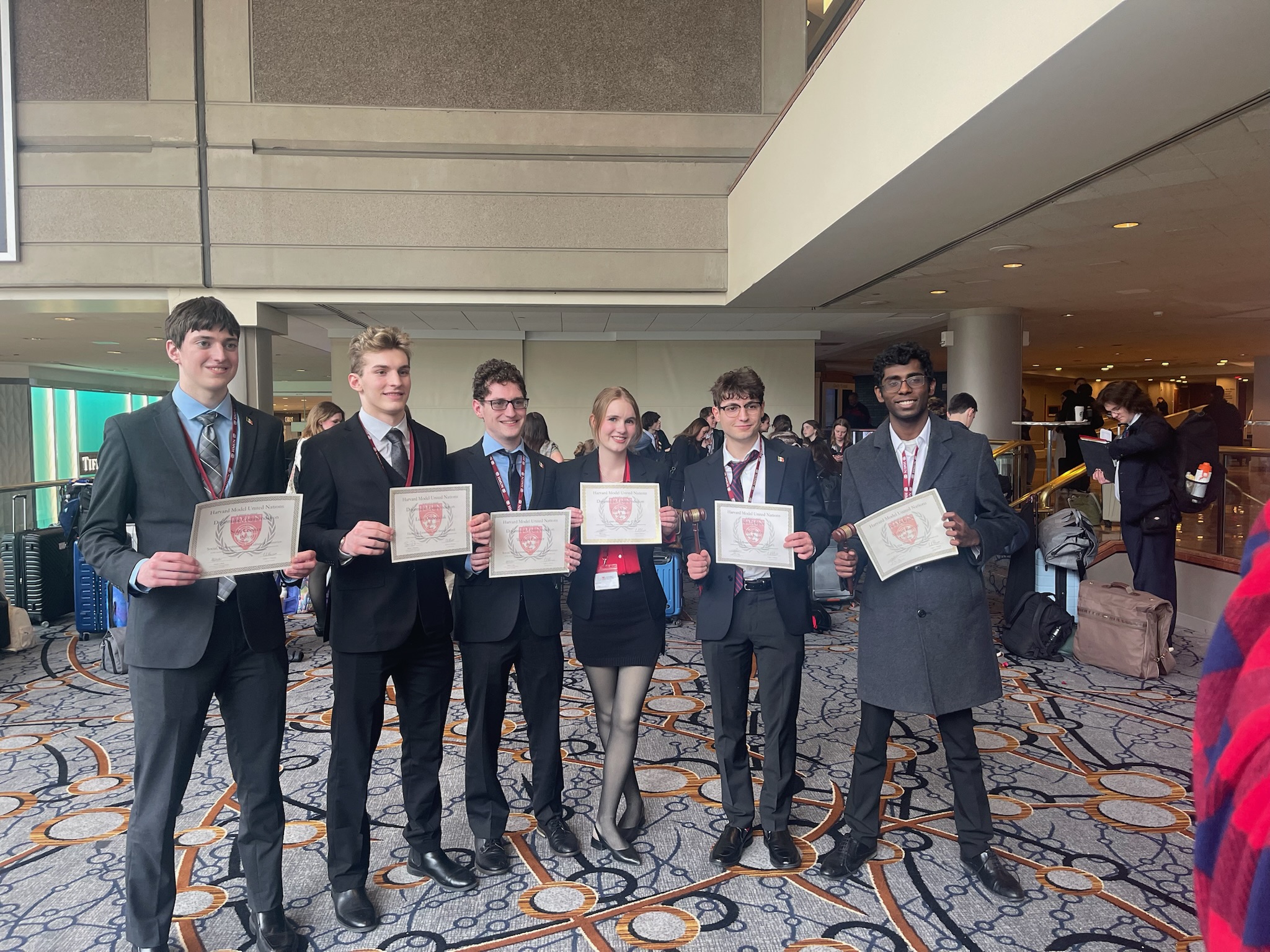
Overall, HMUN was a “smashing success,” added Sheridan. Six AHS students were honored with five awards at the conference: Tyler Buono for Best Delegate in the Disney Board of Directors; Mitran Kumar for Best Delegate in Ad Hoc Committee of Secretary-General; Tess Moglia for Diplomatic Commendation in The Court of Cleopatra; William Conner and Sean Conner for Diplomatic Commendation in SOCHUM (A): The Rights of Linguistic Minorities; and Luke Organisciak for Diplomatic Commendation in HECOSOC: The Medellin Cartel.
“It was definitely the most well-run conference I have ever been at,” said junior Tess Moglia, who participated in the HMUN Court of Cleopatra crisis committee for her first year. “There were so many different new people to meet and connections to make, and it was just a great experience inside of committee and out.”
Over the four days, AHS students immersed themselves in rigorous debate and collaboration. They were divided into various committees and topics, from the Social, Humanitarian & Cultural Committee to the Disarmament and International Security Council, and specialized crisis committees.
“The cool part about the [crisis] committee… is that I [didn’t] know the topic until I [got] there,” said Moglia. “So it’s all improv and you just use the resources you have and what you know and what they give you on the spot.”
Regular committees, however, require students to prepare a position paper, in which students research where their respective country stands on the issue that they are addressing in their committee.
“We [were representing] Mexico, and my committee [was] the Disarmament and International Security Council,” said sophomore Meryl Chen, a first-year participant in HMUN. “It’s basically this security council, and our topic [was] the issue behind transnational gangs, as well as intervening in civil wars.”
Attending HMUN for his third year in 2025, senior William Conner was in the Social Humanitarian and Cultural Committee, which debates women’s rights in prison and the decline in Indigenous languages. “My brother and I found [the topic] very interesting, we’ve both read literature about unjust treatment in the judicial process, so I think we want to take a deeper dive into that,” said Connor.
However, the rigor of HMUN exhausted many students, who found themselves in committees until or past midnight on some days. “I was in one of the few committees that had a midnight crisis,” added Moglia. “So I had another committee session from 1 a.m. to 3 a.m. Friday night.” With a busy schedule and lunch breaks filled with networking and research, many participants took a day to rest after returning from the conference.
“It was four very, very tough days,” commented Sheridan, “[But] everyone persevered well… These kids are working all day. I have to commend them, it’s incredible. They have conferences from 9 a.m. all the way to midnight. It’s a lot of time, but these kids are dedicated. They’re really, really into this. They have a passion for it, so it makes it go by a lot easier.”
For the four days and three nights, AHS students, along with others, stayed at the Boston Marriott Copley Hotel near the Prudential Center in Boston.
The cost for the HMUN trip was around $475, including costs for the conference fee and the hotel. Students were responsible for other expenses, such as food and their train and subway tickets to and from Boston Marriott Copley. Due to the large number of students at the conference, there was strict supervision and restrictions on where students were able to go during the four days. Everything students needed was easily accessible on the premises, and students did not have to leave the Copley area unless they were going out with their school for an excursion.