Vending Machine Thefts Decrease
Jacqueline Zhu
COPY EDITOR
The introduction of personal identification numbers (PINs) for the vending machines has triggered a rash of PIN thefts, prompting administrators to issue warnings against vending machine theft.
The issue of students stealing others’ PINs began in early fall, after the vending machines were put online. Offending students would take pictures or videos of other students putting their PINs in, and then use the PINs for themselves and their friends. Students who have had their PINs compromised would have to obtain a new PIN, a 30- to 40-minute process that involves the administration and cafeteria workers transferring the student’s funds to a new account.
Gail Koutroubas, Director of Food Services at Andover High School, explained that despite having PINs consisting of a five-digit number and a four-digit number to maximize security, some students are still able to copy down others’ PINs. “We didn’t think that kids would be videotaping other students putting their numbers in and then sharing it,” she said.
Andover High School has had the vending machines with codes for four years, said Koutroubas, but vending machine theft has never been an issue until this year. “We very rarely had an issue: kids were very respectful of each other,” she stated. “But, for whatever reason, this group of kids didn’t realize the severity of what they were doing. They’re stealing money, and a lot of money in some cases.”
The general consensus among students is that stealing others’ PINs is unacceptable. “You should not be using other people’s PINs to buy stuff,” said junior Nathan Chu. “That’s like using someone else’s credit card to make your own payments. If you really want something from the machine but either don’t have enough money or don’t have a PIN, then all you need to do is ask your friend to buy something for you.”

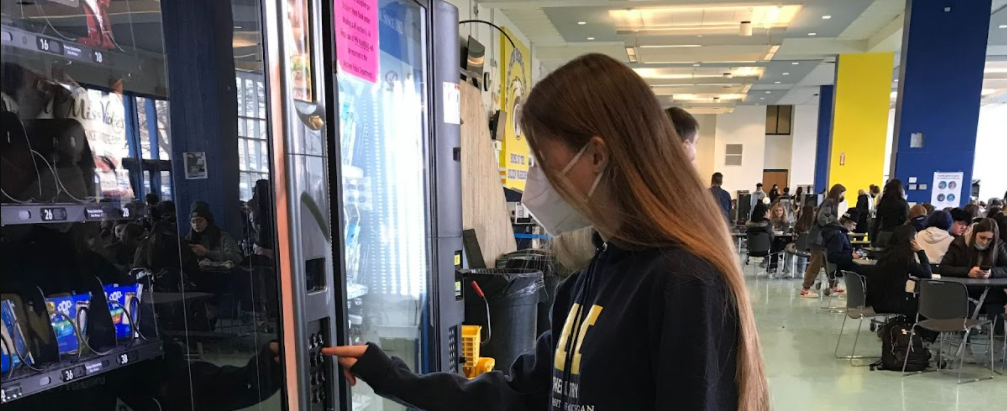
Juliet Herrick, a junior, enters her PIN into one of the vending machines
Some students are not sure if sharing PINs amongst friends is as significant an issue. “I think that while sharing your PIN so your friend can get a snack is considerate, lots of people are abusing this power and causing problems in the long run,” said Madelyn Blanchette, a junior.
“In my mind, sharing PINs is okay as long as it’s mutual,” stated freshman Gavin Cleary, “but if it is not or if it’s stealing PINs, then it is not okay.”
Koutroubas explained that students sharing their PINs with friends is also inappropriate. “When we assign you the PIN, there’s a letter that says ‘Do not share your PIN’. That’s like your mom or dad sharing their PIN to their bank account.”
Several students suggest that offending students’ PINs be deactivated as a countermeasure against PIN theft. “I think if sharing a PIN is becoming an issue, a suspension of the PIN could work,” said Blanchette.
Sophomore Megan Zhang agrees. “I think appropriate consequences for those who share their PIN numbers is to have their PIN deactivated for a certain amount of time, such as two or three weeks,” she said.
Zhang believes a possible solution would be to use biometric technology instead of codes. “Having everyone’s finger (of their choice) to be used for scanners marked/identified and then using those for the ‘codes’ would make sure that it is the correct person using the account,” she explained.
Koutroubas’ idea is similar, only students’ ID cards would be scanned instead of their fingers. “We really would love for students to carry their IDs and be able to scan everything,” she said. “It would eliminate lines, and it would eliminate theft. I think that it would be a little more secure, unless you lose your ID or something. Until there’s enforcement from the administration on carrying IDs, we’re just left with the PINs.”
Since holiday break, there has been a decrease in vending machine theft. “There was a decrease right after the students that compromised the numbers were punished,” stated Koutroubas. “As soon as we found out who they were through the cameras, it stopped.”
Koutroubas’ ultimate advice to students is to not share their PINs. “Be conscious of who’s around you when you’re putting your PIN in. Make sure there’s no kids videotaping you,” she said.