The DECA team changed their district from Boston to Lawrence over the summer.
The change in districts for DECA has received mixed reactions from both students and teachers. They now go against harder opponents and attend competitions in different locations than in previous years.
“I don’t know how much the district change has benefited, but it also hasn’t had a negative impact,” noted Kari Belson, a junior and three-year member of DECA. Belson said that facing strong teams, like Westford Academy, has encouraged members to work harder and perform better in competitions.
The advisor of DECA, Business teacher Ashley Kinsman said, “The people in charge of DECA made district changes based upon enrollment for each district to make the sizes of each district closer.” She said they want all of the districts to have about the same amount of people competing.
DECA is a program that is designed for high school students who are passionate about business. It is a competition in which students prepare for one of three categories: role-plays and case studies, prepared events, or online simulations. DECA has many categories which include marketing, finance, hospitality, management, entrepreneurship, and personal money skills.
Kinsman believes that the change has had minimal impact on students. “You’re still getting the same level of competition,” she said. She views the change as potentially beneficial for students. District 5 (Lawrence) is slightly smaller than District 4 (Boston), so there’s just slightly less competition.
Since each district decides when they compete, this year’s competition was held a month later than usual, which gave them more time to prepare. The extra time allowed leaders to work individually with more participants and provide guidance that some of the newer members hadn’t gotten the chance to receive before.
Marina Ten, a senior and co-president of DECA, shared her perspective from a leadership role. Her initial reaction to the district change was one of surprise, primarily due to the change in competition location. “The biggest thing about the district change is that you’re going up against schools that you’ve only really seen at states,” Ten explained. “We were able to hold more meetings and provide more information to the members.”
According to DECA members, the new competition venue at UMass Lowell was nice too, having been described as less confined than previous venues. The new setup, which Ten described as having an “airplane hangar vibe,” provided a refreshing change and more freedom for participants. Ten stated that she was also pleased with the club’s success in the new district, saying that many members placed well in their competitions.
There’s a new phone policy at AHS, and you’ve probably noticed it. Our phones go into what one might call a “phone jail”—those numbered slots where our devices are locked up during class, sometimes with an actual lock and key. The rationale is clear: no phones in class, no distractions. But let’s ask the question: why have we gone to such extremes?
We at ANDOVERVIEW strongly believe that class time is for learning, and phones can be and have been a major distraction. The administration has had enough of our glowing faces, aglow not from intellectual enlightenment, but from under brightly lit phone screens. Our teachers are concerned about our development; it is not that it gives them pleasure to deprive us of our hypnotic devices. But does locking up our phones, as if they’re dangerous contraband, teach us the right lesson?
This is high school. We’re constantly being told to act maturely and take responsibility for our actions. Some of us are already 18—legally adults—yet we’re treated as though we can’t be trusted with even the smallest responsibility. By removing the temptation completely, the administration is not teaching us how to manage it. It is just kicking the can down the road. Very soon, many of us will be heading off to college or entering the workforce. In those environments, policies like this one don’t exist. There won’t be phone jails. No one will force us to lock up our devices. It is up to us to learn to make responsible choices.
The phone policy creates a false sense of order. It’s easy for students to follow the rules because we don’t have a choice. But the moment the structure is gone, those who never learned self-discipline may be the first to revert to bad habits. What if, instead, we were trusted with our phones? If someone is caught using their phone during class, they face immediate consequences, as well as potentially being singled out for phone jail—with no parole—for the rest of the year. This is about accountability. We learn by making mistakes and facing consequences. If we’re shielded from making mistakes in the first place, we’ll never learn.
The new phone policy does enforce compliance with rules, but one should remember that we are expected to follow rules, even without heavy-handed enforcement. We need to be treated like the almost-adults that we are. It’s time to trust us to learn from our choices, not lock them away.
Harry Guo, Brandon Nguyen, and Eva Liss Layout Editors and Copy Editor
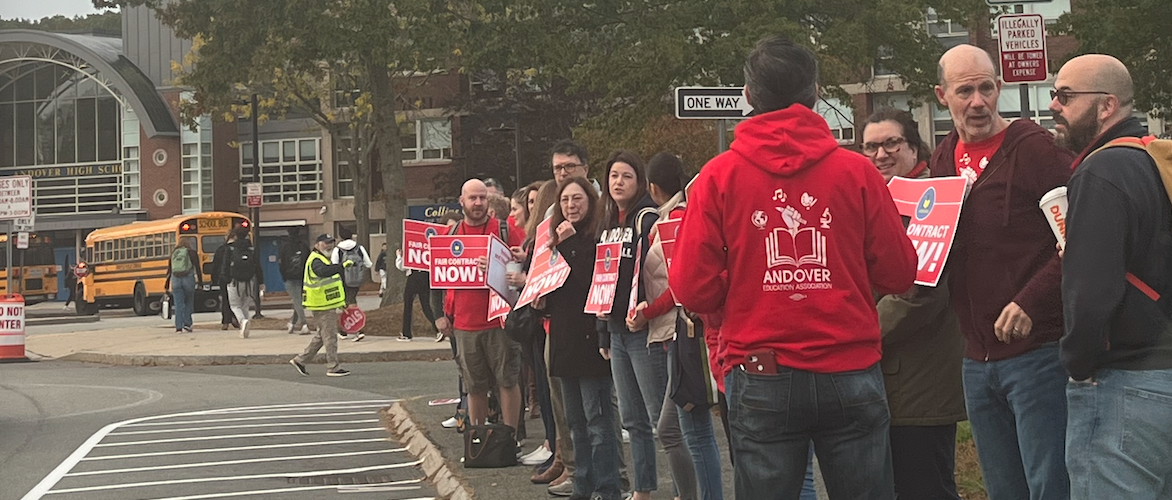
Students bustle into school as an early autumn breeze flows through the clear morning air. The large oaks out in front bear hues of orange and yellow, signaling that a new school year is well underway. And yet, there is an unfamiliar sight donning the entrance of Andover High School: the teachers and staff, dressed in red. As AHS enters the full swing of the new academic year, the Andover Education Association has begun demonstrations and a new Work-to-Rule policy every Friday in response to continuing contract negotiations with the School Committee.
In late January 2022, the Andover Education Association (AEA) began negotiating a new contract with the Andover School Committee. These negotiations have tackled issues on planning time, faculty meetings, parental leave, sick days, and personal days. Currently, all APS staff are working without a contract, as the previous one expired on August 31 of this year. The AEA represents about 850 educators in the district and the majority of Andover Public Schools staff.
According to Matthew Bach, the chair of the AEA and a history teacher at AHS, the “work-to-rule” policy was adopted for several reasons. These include raising awareness among the public, fostering community concern for the issue, and showing “that the school committee is not taking the teachers seriously,” said Bach. Throughout the week, teachers involved with the union at each school have chosen one day to strictly adhere to state-mandated contract hours. For AHS, this means the teachers have worked from 8:15 to 2:51 every Friday, so they were not available for before-school or after-school help.
Bach pointed to one of the largest issues that have yet to be settled— the salaries for instructional assistants, who work closely with the students who are most in need. “[Instructional assistants] make poverty wages,” said Bach. “They are [diverse and] should be given a boost in this time of historic inflation.” The instructional assistant’s previous contract states that they are paid $19.26 to $28.60 an hour based on a 184-day work year. According to Bach, this previous contract and the school committee’s current proposals only moderately boost their roughly $25,000-a-year salary, which may not adequately keep up with inflation.
With teachers, the AEA says it’s not as much about avoiding poverty wages, as AEA’s main goal with their contract negotiation is to keep up with comparable schools and districts.
STAFF PHOTO / Eva Liss AEA members gather outside.
According to Tracey Spruce, the chair of the Andover School Committee, the School Committee has not been able to accept the AEA’s proposal as they are restricted by the town’s budget. The AEA’s initial proposal on January 17, when negotiations started, was a tuition reimbursement and a wage increase of 16% over 3 years. The total financial impact of that proposal over 3 years would be over 10 million dollars. The town’s budget, which comes from taxpayers, allows only a 3.75% increase to the school department’s yearly budget. That increase must fund staff salaries plus every other need within the district, such as transportation, curriculum, school athletics, fine arts, and more.
“Our annual budget is close to $100 million,” said Spruce. “So you can see how accepting the union’s salary proposal would make it nearly impossible to pay for anything else.”
During the planned session on October 11, negotiations were paused due to disagreements on the negotiation space and the number of representatives the AEA and School Committee were allowed. The law states that both the teachers and school committee can constitute their bargaining team and that both can’t interfere with who the other party brings to the table. At the time of the meeting, the AEA advocated for the use of the Doherty Middle School auditorium to negotiate with the school committee to allow more member support. However, the school committee said they would only meet in the school committee room, which has a much smaller capacity.
According to Spruce, “The school committee is not required by law to engage in open bargaining, nor is it required to agree to negotiate directly with hundreds of union members, and the committee does not believe that would be an efficient or productive way to reach an agreement.” To the AEA, it felt like the school committee was trying to modify their bargaining team and restrict who was going to be on it. “For us, it’s really important [to have] transparency and democracy [where] everybody sees what happens,” said Bach.
According to their October 11 update on their website, the School Committee is currently offering “a 9.65% pay increase over three years of the contract… and a one-time $2,000 increase for [teachers with] the top [level of education]. For approximately 25% to 30% of APS teachers at [this top level], their salary in year one of the contract will be $112,058, and [they will have] a 9.5% increase to stipends.” The AEA’s bargaining team presented its proposal to increase salaries by 16% over 3 years and payment of a $2500 bonus, reduced from its previous proposal of 16% plus payment of two $2500 bonuses.
“I would not have expected the union to accept the School Committee’s initial set of proposals without negotiation,” said Spruce. “I would be surprised if the union expected the School Committee to accept its initial set of proposals without negotiation.” Both the School Committee and the AEA have said they would like to reach an agreement soon in order to return the school year back to normal. “It’s an inconvenience to [teachers] as much as it is an inconvenience to students or parents,” said Bach.
As for when the two sides may reach an agreement, a date for resolution is yet to be seen. However, the School Committee’s next proposal will be released today, November 8, with the next negotiations meeting anticipated for a week later on November 14.
Further commentary from AHS staff and AEA members was requested but denied.