The Issue of Gender: New Legislation Bans Transgender Women from Participating in Sports
  • May 6, 2025

Jillian Slotnick || SPORTS EDITOR

The whistle blows, cleats pound against the turf, and sweat drips as athletes compete under the stadium lights. For many students, the field is a place of competition, teamwork, and passion. But for transgender athletes, it can also be a battleground for identity and acceptance. With new legislation from President Donald Trump restricting transgender women from competing in women’s sports at the collegiate and secondary level, the stakes have never been higher. 

In a move that has reignited the ongoing debate over transgender athletes in sports, President Trump has introduced an order restricting transgender women from competing in women’s sports. On February 5, Trump signed an executive order, titled “Keeping Men Out of Women’s Sports,” which states that Title IX requires that women’s and girls’ sports should be limited to individuals who were biologically female at birth, and threatens federal funding for institutions allowing transgender women and girls to compete in women’s sports. Title IX is a federal law that prohibits sex-based discrimination in any education program receiving federal financial assistance. Over half of U.S. states have already enacted laws or regulations restricting the banning of transgender athletes from participating in sports based on their gender identity in K-12 and collegiate levels. A congressional bill seeking to enforce similar restrictions failed to pass the Senate on March 3, and the executive order and state-level actions continue to face legal challenges.

This policy, echoing a wave of similar conservative legislation across the U.S., has drawn strong reactions from both advocates and critics, with many arguing that it oversimplifies a complex issue involving science, fairness, and inclusion. These policies apply not only to athletes in the National College Athletic Association (NCAA) but also to those at the high school level, including those at Andover High School. 

According to the Pew Research Center, political polarization in America is at an all-time high, with deep divides across parties on key issues like immigration, healthcare, and social justice. Social media and partisan news fuel differences between parties, which leads to distrust in the government and institutions. Additionally, this division has grown with the election of President Trump, causing strains on political discourse and dampening efforts to find common ground.

As debates continue, both Elbasiony and Long agree that education is key to fostering a more inclusive society. “If schools can’t allow trans athletes to compete on the teams they prefer, they should at least work to make them as comfortable as possible,” Long said. “Even small things like using the right pronouns and being flexible with language can make a big difference.”

For many schools, the issue is out of their hands. Kerry Cashman, Assistant Athletic Director at Andover High School, noted that schools must follow regulations set by governing bodies like the Massachusetts Interscholastic Athletic Association (MIAA). “Obviously we always want what’s best for our students, but it’s so difficult…we have to follow MIAA guidelines,” she said. ADs from across the state (including in the Merrimack Valley) have struggled with how to implement this new policy.

Currently, according to the MIAA’s “Gender and Participation” guidelines, “a student shall not be excluded from participation on a gender-specific sports team that is consistent with the student’s bona fide gender identity,” a policy in line with Massachusetts state law (M.G.L. c. 76, sec. 5), which prohibits discrimination in public schools based on gender identity. The U.S. Department of Education has since launched an investigation into the MIAA for “potential Title IX violations.” In response, the MIAA released a statement that said it, “has historically complied with all applicable federal and state laws” and that it is “currently seeking guidance from the Office of the Attorney General and [its] own legal counsel on [its] next step.” 

Khaled Elbasiony, a student researching gender identity for his Capstone project, believes that misconceptions about transgender individuals play a significant role in shaping policy. “So many people are uninformed about gender identity,” he said. “If people actually understood the science, this wouldn’t be a big deal legislatively.” He emphasized that transgender women, even before transitioning, often do not have the same physical advantages as cisgender men. “There’s a common misconception that trans women have an overwhelming advantage, but a lot of trans people actually have hormonal imbalances that can put them at a disadvantage.” This is supported by research performed at the University of California San Francisco.

Many people believe the new policies are less about science and more about political control with house members such as U.S. Representative Alexandria Ocasio-Cortez and other democrats agreeing with these sentiments. Additionally, the new executive order doesn’t consider any of the scientific complexities of gender identity in justifying the limitations on transgender athletes, with no mention of a scientific or biological backing for their claims.

For transgender athletes, these policies have real-life consequences. Florian Long, a transgender student who previously played soccer on the girl’s team, shared his struggles with acceptance in sports. “It would have been better to play on the boys’ team because I felt more at home there, and they treated me better.” Long has since quit soccer and is now focused on music.

Long and many others fear that the new legislation will force transgender athletes into an impossible choice: either participate in a sport where they feel unwelcome or quit altogether. “It’s going to make trans kids feel trapped,” said Long. “They’re either going to have to quit or deal with being in an environment where they aren’t accepted. Seeing people like you in sports is an amazing experience. It’s important for kids who are figuring out who they are to know that they belong.”

The question of fairness remains at the heart of the debate. While some argue that transgender women may have competitive advantages, others advocate for policies that support inclusion while ensuring a level playing field. Elbiasony was quick to point out that although it’s not fair to expect people to be comfortable in a team that doesn’t align with their gender, it might be best for athletes to transition before they play on a team different from their sex at birth.

Beyond athletics, the conversation about transgender athletes reflects larger societal debates about gender, identity, and rights. Elbasiony pointed out that the polarization surrounding transgender issues stems from the way society categorizes people. “Labels create division,” he explained. “When you put people into strict categories, it objectifies them. That’s part of why America is so politically divided right now.”

Long believes that, ultimately, policymakers should focus on creating a more accepting environment rather than restricting opportunities. “Trump and others pushing these policies should stay out of other people’s business,” Long said. “This [order] makes trans kids feel invalid and stuck in places where they aren’t happy.”
Continue reading
Andover High’s DECA Transition
  • March 17, 2025

Arshiaa Prem || STAFF WRITER

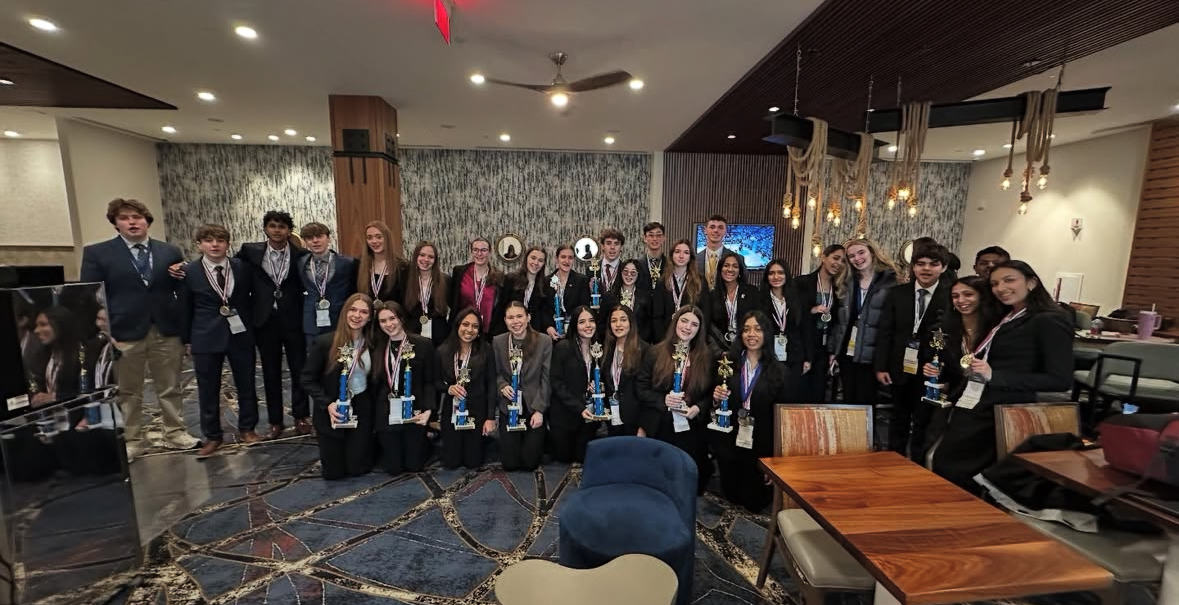
The DECA team changed their district from Boston to Lawrence over the summer.

The change in districts for DECA has received mixed reactions from both students and teachers. They now go against harder opponents and attend competitions in different locations than in previous years.

“I don’t know how much the district change has benefited, but it also hasn’t had a negative impact,” noted Kari Belson, a junior and three-year member of DECA. Belson said that facing strong teams, like Westford Academy, has encouraged members to work harder and perform better in competitions. 

The advisor of DECA, Business teacher Ashley Kinsman said, “The people in charge of DECA made district changes based upon enrollment for each district to make the sizes of each district closer.” She said they want all of the districts to have about the same amount of people competing.

DECA is a program that is designed for high school students who are passionate about business. It is a competition in which students prepare for one of three categories: role-plays and case studies, prepared events, or online simulations. DECA has many categories which include marketing, finance, hospitality, management, entrepreneurship, and personal money skills.

Kinsman believes that the change has had minimal impact on students. “You’re still getting the same level of competition,” she said. She views the change as potentially beneficial for students. District 5 (Lawrence) is slightly smaller than District 4 (Boston), so there’s just slightly less competition. 

Since each district decides when they compete, this year’s competition was held a month later than usual, which gave them more time to prepare. The extra time allowed leaders to work individually with more participants and provide guidance that some of the newer members hadn’t gotten the chance to receive before.

Marina Ten, a senior and co-president of DECA, shared her perspective from a leadership role. Her initial reaction to the district change was one of surprise, primarily due to the change in competition location. “The biggest thing about the district change is that you’re going up against schools that you’ve only really seen at states,”  Ten explained. “We were able to hold more meetings and provide more information to the members.”

According to DECA members, the new competition venue at UMass Lowell was nice too, having been described as less confined than previous venues. The new setup, which Ten described as having an “airplane hangar vibe,” provided a refreshing change and more freedom for participants. Ten stated that she was also pleased with the club’s success in the new district, saying that many members placed well in their competitions.

Continue reading
A Setback for Educational Progress
  • March 17, 2025

Tommy Kruecker-Green || Opinion Editor

President Trump has launched an initiative to dismantle the US Department of Education (ED). Such a move requires an act of Congress, which may be unlikely to occur. Nonetheless, recent calls by Trump to abolish the ED have ignited a debate that raises questions about equity, access, and the role of government in ensuring that every student, regardless of background, has a fair shot at success.

Contrary to what some believe, the ED was not created to dictate what is taught in classrooms—curriculum decisions remain the purview of states and local school boards—but to serve as a guardian of equity. Since its inception under former President Carter, the federal agency has played a role in ensuring that no student is denied an education because of sex, ethnicity, income, disability, or other factors. By administering programs like Title I funding and the Individuals with Disabilities Education Act (IDEA), ED has helped level the playing field for schools serving low-income communities and students with special needs. Moreover, federal funding is tied to schools meeting non-discrimination requirements. Removing this layer of support would risk undoing decades of progress in educational equity. 

Local and state governments provide the bulk of K-12 funding, and federal contributions make up only roughly 10 percent of public school budgets. For a school like AHS, dismantling the ED might not be felt very much at all. However, for underprivileged districts, the loss of federal aid would be devastating. When there is a system in which the amount of funding for schools is tied to property taxes, and hence, property values, one can understand why it is so important for an entity like the ED to step in and do what it can with a flawed system, to balance the scales and give all students, regardless of their zip code, a fair shot.

Andover High School Principal Jimmy D’Andrea provided insight into how federal education funding is allocated. “If the [ED] were to be abolished, that doesn’t automatically mean that the funding is abolished,” he explained. Federal funds pass through state agencies before reaching school districts, but their removal would significantly impact schools that rely on them the most. He pointed out that for Fiscal Year 2025, Andover Public Schools received approximately $3.7 million in federal funding out of a total $103.6 million budget. Perhaps Andover may not feel the effect, but he acknowledged that “if you were to look at, for example, Lawrence Public Schools next door or other city school systems in Boston public schools, you would likely see a much greater percentage of resources coming from the federal government.” The reality is that these underprivileged districts could suffer if federal education funding disappeared.

D’Andrea also addressed IDEA and Title I funds, which benefit students with disabilities and those from low-income families, respectively. “When they were initially talking about a funding freeze, they specifically said that Title I and IDEA money was exempted from that,” he noted.

I was wondering what is motivating conservatives intent on abolishing the ED. Many are socially conservative and say they want “woke” out of the schools. However, the federal ED is not in the business of developing curricula, and consequently, it is not “promoting” any social agenda in public schools. States set the rules and curriculum standards, while local school districts set policies and actual curricula. Nevertheless, in threatening to dismantle the ED, President Trump persists in claiming that it is time to return schools to state and local control. History teacher Fred Hopkins suggested that politicians who attack the ED are perhaps not being honest about their intentions. Although they say they want to return control of public schools to the local level, it’s just a fact—and they are well aware—that K-12 public schools are already, for the most part, controlled at the local level. He suspects that those attacking the ED are actually more interested in privatizing all education, in particular at the postsecondary level; they want to reduce spending on higher education. 

Indeed, in addition to K-12 funding, the ED administers Pell Grants and student loans, making higher education attainable for low-income students. These programs, which distribute approximately $30 billion annually, help millions afford college. Without federal oversight, these essential funding mechanisms could be dismantled or privatized, making higher education even more inaccessible to working-class Americans. Importantly, these grants and loans towards higher education make up more than half of the ED’s budget.

If the ED is eliminated, its functions could be folded into other departments and agencies. In fact, some legislated programs, like Title I or IDEA predate the creation of ED and would likely continue to be administered in some way. This is nonetheless not ideal; the idea behind the creation of the cabinet-level ED was to elevate the issues of education. Still, one could imagine something worse: that the responsibilities are not just shifted to other agencies but the ED’s role is abolished, and many programs eliminated. Then one would hope that the states would be able to take over the role that the ED had in promoting equity. I’m confident it would happen in Massachusetts. But I’m not sure about some other states. Above all, I believe that the ED is needed so that students seeking postsecondary education are not deterred by their financial situations. We need to have public colleges/universities. The cost of private postsecondary education in the US is obscene. I don’t say that lightly. So what are our priorities? If we are to be a nation that offers “opportunity to all,” dismantling the ED sounds like a bad idea, any way you measure it.

Continue reading
Murray and Diffenbach Win Close Election for School Committee
  • May 6, 2024

By Molly Borenstein
STAFF WRITER

In a closely contested election for the School Committee, Shauna Murry emerged victorious alongside candidate Lauren Diffenbach.

The election results showed Murray with 2,391 votes, her counterpart Diffenbach with 1,977, and McCready, a former school committee only around 100 votes below at 1,812.

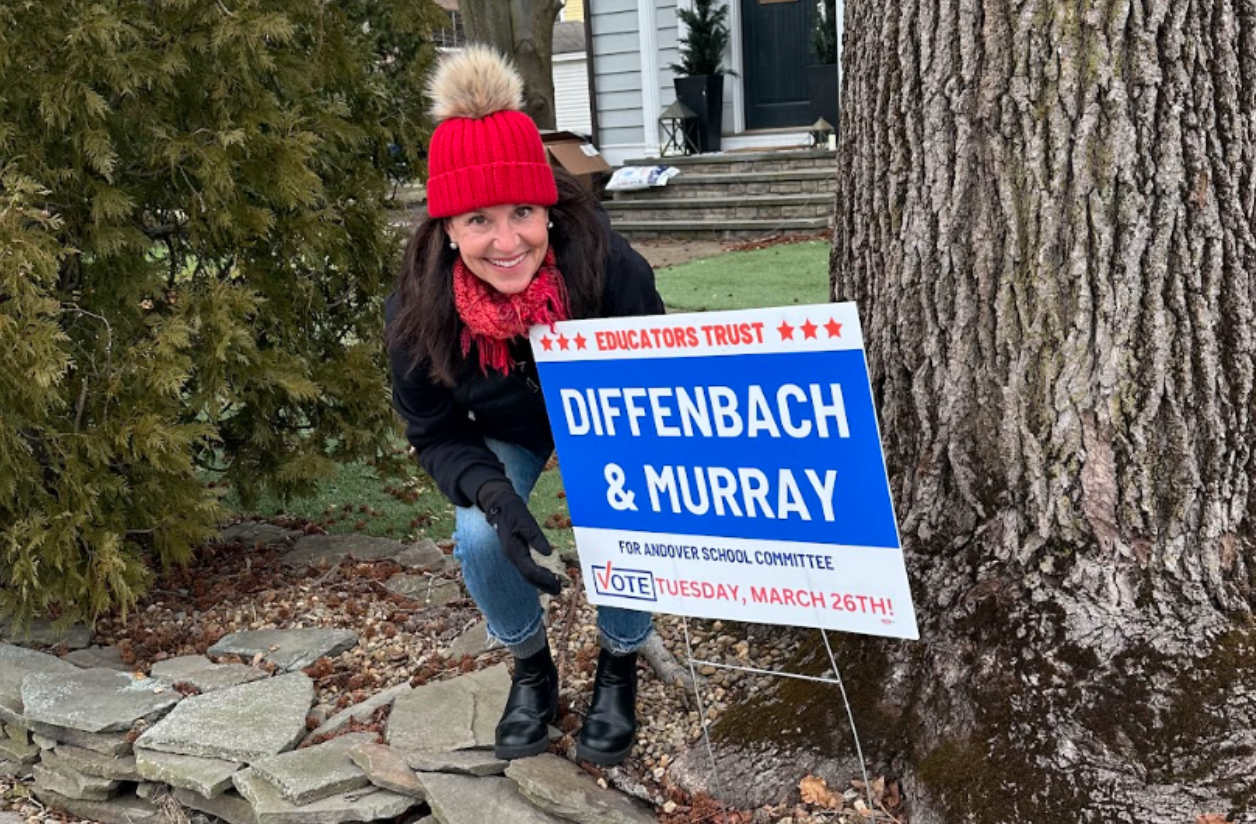
STAFF PHOTO / Molly Borenstein
A woman poses with a “Diffenbach & Murray” poster.

Murray and Diffenbach are both experienced educators. In an interview with ANDOVERVIEW, Murray specifically mentioned her two decades of service in public schools and believed her background set her apart from other candidates. “Residents recognized the value of having an educator’s perspective on the committee,” Murray said. Diffenbach, also highlighted similar ideas to Murray, believing that her background in education and help from the AEA pushed her toward victory. 

Reflecting on her campaign strategy, Murray emphasized the importance of positivity and outreach. “We focused on highlighting my strengths as a candidate and addressing the concerns of our public education system,” she said. 

Diffenbach, echoed Murray’s sentiments, expressing gratitude for unexpected community support during the campaign process. “Word of mouth goes a long way, and I will be forever grateful for the outpouring of support that led me here,” she said.

As she steps into her new role, Murray plans to prioritize listening to the community and reflecting on past initiatives. “I want to rebuild the bridge between the School Committee, teachers, and staff,” Murray states, emphasizing her commitment to representing all constituents.

Acknowledging the divides in the community, Murray and Diffenbach express a desire to collaborate with all voices. “As a district, there is a need for intentional work around repairing fractured relationships,” Diffenbach states. “I’m hopeful to increase collaboration and bridge the divides.”

Looking ahead, Murray sees healing as a primary challenge facing Andover’s education system. “We cannot move forward until we address recent tensions,” Murray emphasized. “In my experience working in education, the challenges seen by the public are often indicative of more complicated and deep-rooted challenges that exist within an education system. Up until now, I have only known the surface-level challenges as seen by the rest of the public. My first step is to learn more about those hidden systemic challenges in order to formulate a path to addressing them.”

Continue reading
New School Committee Members Set Goals for APS
  • May 23, 2022

Eva Liss
STAFF WRITER

Two new Andover School Committee members, Emily DiCesaro and Sandis Wright, were elected on March 22. Both members aim to aid communication between the Andover community and the district, with a hopeful outlook on their impact. 

COURTESY PHOTO / Judge DiCesaro
New school committee member Emily DiCesaro

Emily DiCesaro

DiCesaro has experience listening to, advocating for, and asking questions of the community she serves as a user experience designer at IBM, which may be helpful in meeting her goal of improving interpersonal connections in Andover. She said she decided to run for School Committee after she participated in the search for the new Andover superintendent through a town subcommittee; she was attracted by the optimistic and mutually beneficial relationship between the School Committee and the superintendent. She expressed a strong desire to support Superintendent Magda Parvey and the Andover community to her best ability. 

“[The School Committee members] have a common goal. We all want what’s best for the kids of Andover and the teachers,” said DiCesaro. “Starting to remember that and bringing us back to respectful disagreements is important.”

While DiCesaro has only been in office for a few months, she has already set her sights on helping the Andover community in a few specific ways: mending the damage done on mental health by the COVID-19 pandemic, finding new strategies for helping Andover get back on its feet, and creating a better dynamic between the school committee and the citizens of Andover.

“I think there’s relationships that need to be repaired,” said DiCesaro. “We have to figure out ways to show people we’re listening to them.”

She put forward ideas as to how she can bring about this change, such as reaching out to PTO groups or school events and using the district’s budget in creative ways to enhance community spaces like the Cormier Youth Center. Another idea is to research what other towns have done in the past to improve communication and cope with damage. DiCesaro said she knows there will be challenges to her goals, sometimes even from inside the community itself, but she still has hope. 

DiCesaro also said she loves Andover itself, and often goes for walks on the AVIS trails with her dog and family. She enjoys gardening and traveling and has even been in a crowd used for sound effects in movies. She said she is excited to help Andover and its community in any way possible. 

Sandis Wright

COURTESY PHOTO / Sara Hinchey
New school committee member Sandis Wright

Wright said he knows how to communicate effectively and understand people’s needs, as that is a large part of the various Andover subcommittees he has participated in and the School Committee itself. He’s been involved in many public service groups in Andover, such as the Diversity Equity and Inclusion Committee (DEI), Andover Parent to Parent, and the board of the A Better Chance (ABC) program. Wright went on to say that he believes in public education and looks forward to continuing his “ability to impact and shape our community” through his term as a School Committee member. 

“Sometimes people want to shy away from having difficult discussions if there’s something that’s not understood or perceived to be controversial or a taboo topic to discuss,” said Wright. “I hope I can help fill an opportunity with the community where maybe folks don’t feel like they’ve been heard.”

Hearing people’s thoughts and their values is one of Wright’s main goals, along with “minimizing abrasion and frustration” between the School Committee and the community of Andover, whether they be parents, teachers, or students. He said he was motivated to find a greater positive impact in the school committee position through his participation in DEI and ABC, and will look forward to continuing to help Andover.

Wright works as Managing Director of Information Management at Blue Cross Blue Shield Association, a healthcare provider. He said he thinks this will help him to be a better school committee member because he already has experience searching for innovative opportunities. He also said he knows that both his day job and the responsibilities of the School Committee are aimed to achieve the best possible outcomes for personal and widespread groups of people, and that he is confident in his ability to handle whatever challenges may come. 

Upon seeing Superintendent Magda Parvey’s results from the feedback survey she sent out to the district’s community, Wright said he was impressed by the importance, thoughtfulness, and prominence of Andover students’ thoughts and needs. “I’m excited to amplify the student voice,” said Wright. “[and] I am reenergized when I hear from our young generation.”

 In his free time, Wright enjoys gardening, traveling, and cooking or trying new foods.

Continue reading
OPINION: Russian Invasion of Ukraine Affects AHS Students
  • April 7, 2022

Harry Guo
GUEST COLUMNIST

In a nation full of loud voices, it’s easy to overlook the quieter ones. Even though people pound their fists and scream on television about the war and how teenagers only care about social media and TikTok, that’s not the case for all of us. My friends and I have discussed and debated Russia’s invasion of Ukraine, so it’s frustrating when our worries are misunderstood and discarded. In addition, with the easy access to phones and internet, we get an inside look at what’s going on in Ukraine right at our fingertips. This accessibility also comes with a lot of stress. School shootings, the COVID-19 pandemic, and now this invasion – we’ve got a lot to take in.

Many teachers have offered a safe space for students to talk about the war in Ukraine, especially when some students have families in the conflict zone. This led to healthy discussions and explanations of why we need to understand and engage with other parts of the world. One teacher says that many students have the same feelings now as the teachers did when they were in high school during the Cold War. Other teachers try to show Russia’s side of the story, but my friends and I can’t justify the images we are seeing in Ukraine. To make this whole situation even more complicated, teachers have to help students navigate through misinformation. One question that keeps popping up in classrooms is this: Am I going to get drafted into the war? Many teachers thought that these students, who live thousands of miles away from the conflict, were joking. Misinformation aside, many people said that teachers shouldn’t veer off too much from the curriculum. 

However, the current invasion isn’t as far off from the history curriculum as people think. Talking about this invasion opened my eyes to the similarities between the Middle Ages and Renaissance, which is something we’ve been learning. During the ninth century, Russia grew out of a blending of Slavic and Byzantine cultures. They also adopted Eastern Orthodox traditions, which separated them from the West, leading to a difference in culture that still exists today. From my teachers, I’ve learned that the invasion of Ukraine is nothing new and that history will continue to repeat itself. I believe that it’s important for students to understand the consequences of war and the parallels of today’s events with World War II and the Cold War.

Outside of the classroom, there has been an array of opinions on the topic. Some students have been team Putin, while others think they’re absolutely crazy. When the argument happens face-to-face during lunch, things can get vehement, but it never gets to the point where two people never talk to each other again. Once that bell rings for the end of lunch, everyone forgets everything and heads back to class as if nothing happened. This is a different story compared to last year as I spent all of it remote. When everything is online, it’s difficult to get to know others. Slow Wi-Fi speeds, crunchy mics, and awkward lags also don’t help. All of this combined is especially worse while discussing a sensitive topic. One message can spark a fiery debate among a whole group.

Overall, there’s a mixture of fear, anger, confusion, empathy, and helplessness among the student body because of the Russian invasion of Ukraine. Some were ashamed that they were praying for this to not happen to their own country instead of praying for the people of Ukraine. Others thought that people were overreacting until they saw the images of the damage done by the Russians. This war has not only affected our high school but everyone all over the world. Let’s hope that the invasion is stopped soon, before this escalates into something worse.

Harry Guo is a current freshman at AHS.

Continue reading