Senior Boat Cruise Returns; Senior Board’s First Steps for Fun Senior Year
  • October 7, 2024

Brandon Nguyen
EXECUTIVE EDITOR

The event was held on September 29 from 4:00 to 7:00 pm, departing from 60 Rowes Wharf in Boston. Activities included a picnic dinner, a DJ, dancing, and views of the sunset. The decision to renew the event was made by the Senior Board advisors, health teacher Holly Breen, and math teacher Scott Armstrong. 

Previously a longstanding tradition for seniors at AHS, the boat cruise was last held in 2019 before being canceled due to the pandemic. “When I was the Senior Board Advisor in prior years, we always had the boat cruise, which was always a phenomenal event,” said Breen. Another reason for bringing the boat cruise back was in order to spread senior events throughout the school year. “We don’t want to just have senior activities at the end of the year,” said Breen, “we want to get seniors really starting to hang out together and to be a group and community at the beginning [of the year].” 

According to senior Shreya Desai, a member of the Senior Board, a large school issue the Senior Board is focusing on tackling is the lack of school spirit. “We all felt like we had no fun senior events until the end of the year with Senior Week. And with the beginning of the year so stressful for seniors with [college applications], we wanted to give seniors a little more fun.” 

320 tickets were sold, according to Breen, out of 410 seniors at AHS. “A big part of that success has been the students on the Senior Board,” said Armstrong. “Their biggest part was getting the word out and getting people to come, which they clearly have been successful at.” Senior Aidan Loucks, another member of the Senior Board, stated, “Our goal is to make this a super fun year for everyone, and get as many people attending and engaging in community events like this.” 

STAFF PHOTO / Brandon Nguyen
Seniors look out at the Tobin Bridge in Boston Harbor from the cruise

The boat cruise isn’t the only event the Senior Board has planned this year. “We have Homecoming on October 19, and the charity football game will be the Monday before Thanksgiving,” said Breen. “We’ll also do the Halloween Costume Contest, and we want to do another event in February or March that’s open to all seniors.”

Loucks and Desai both agreed that their main goal with upcoming events is to increase the turnout. “Attendance wasn’t quite as we wanted [last year] for Homecoming while I was on Junior Board, but this year we’re hoping to turn that around,” said Loucks. “We’re going to work with the Junior Board this year,” said Desai, “to try and bring some new ideas to Homecoming and other future events.” 

Overall, the Senior board is working towards brightening up the school and creating a closer community for AHS seniors. “I hope more students just get involved and participate in what we’re planning,” said Armstrong. “I think it’s really going to enhance the culture, but more importantly, it’s going to be fun for everyone.”
Continue reading
AHS Introduces New H-Block Numbering
  • October 7, 2024

Isabella Yan
ARTS EDITOR

In the winter of 2023, the H-Block Planning Team surveyed students and faculty to gather opinions regarding the H-Block schedule and offerings. Following the feedback received from the survey, H-Blocks have been renumbered, aligning with the days on the 8-day rotation. The previous H-Blocks followed a consecutive order where H2 was the second H-Block in the schedule, H3 was the third H-Block in the schedule, and so forth. After the change, H2 became H3 because it occurs on Day 3, and H3 became H4 because it occurs on Day 4. Altogether, H-Blocks will now consist of H3, H4, H6, and H8 rather than the previous H2 through 5.

The H-Block Planning Team—currently in its third year running—is responsible for overseeing these changes. The team includes faculty members across various departments at AHS who meet monthly to discuss and plan the advisory curriculum and H-Block offerings. Reflecting on the student and faculty feedback received from the survey, Assistant Principal Alicia Linsey, the administrative facilitator of the H-Block Planning Team, shared that the previous schedule was confusing and needed a change.

STAFF PHOTO / Isabella Yan
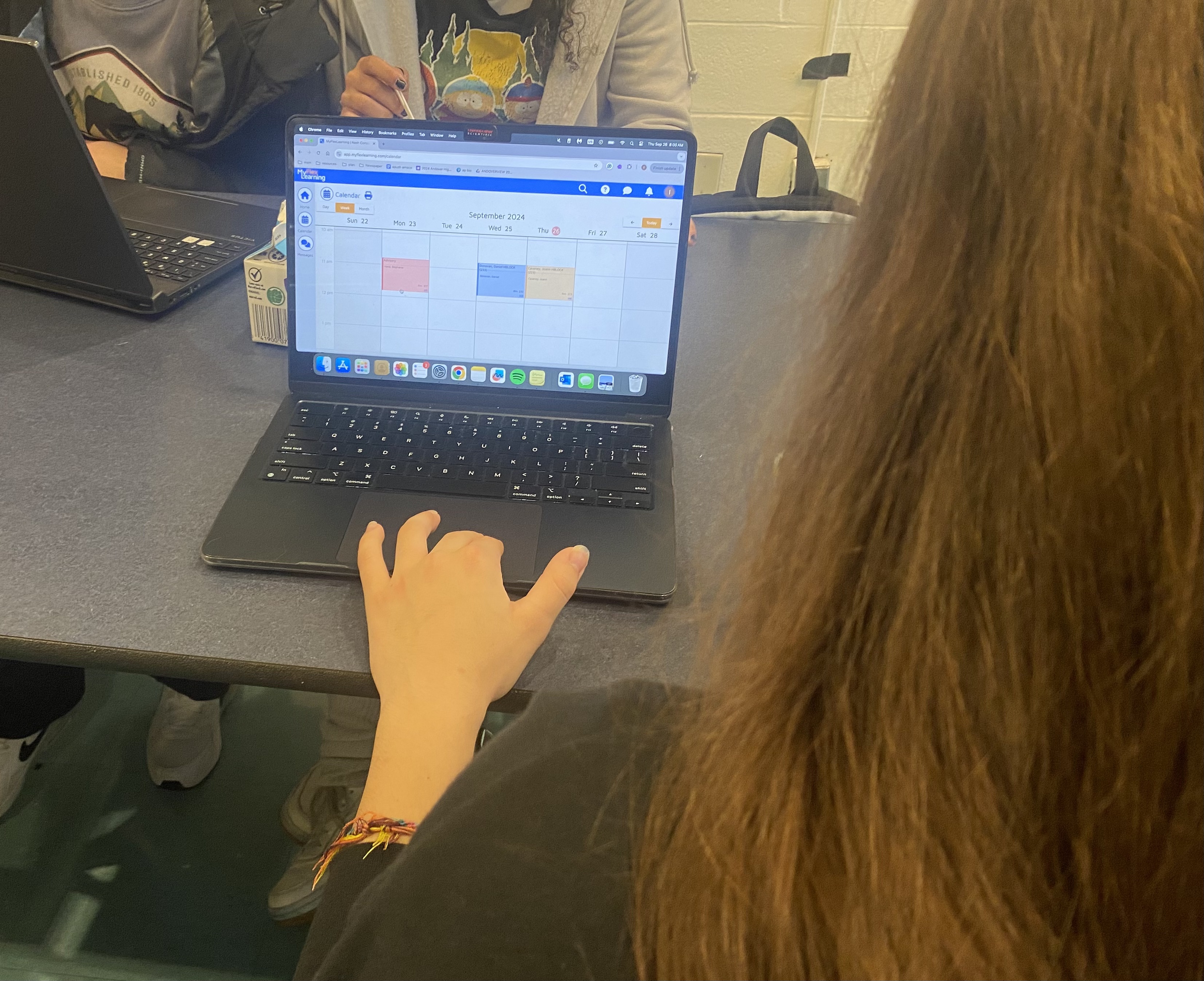
Student chooses H Blocks.

In the previous school year, the H-Block Planning Team began implementing the change of renaming H1 to Advisory. “It was important to clarify… [that] H1 has a distinct purpose [more so] than other H-Blocks,” according to Linsey.

The change of renumbering the H-Blocks has posed a challenge for students adapted to the old H-Block schedule. “I think it’s more confusing now,” said senior Sharayu Josh. She points out a communication hurdle, “You have to clarify whether you mean H4 meaning Day 4 or H4 meaning the fourth H-Block.”

However, students like junior Pranav Yadla have appreciate the new change, finding that the previous schedule was difficult to follow. “It’s more simple than last year,” he said. With the new schedule, Yadla offers a perspective that the new change has created clarity in navigating the schedule. “It’s way easier to know H4 is on Day 4 and not on Day 6,” he said. “You also know what day is coming up. So, it’s not just using the H-Block name just for H-Block, but also to find out what schedule that day is.”

While this change may take some time to get adjusted to as people settle in for the new school year, Josh acknowledged, “People will get used to it. It’s not really impactful on anything other than H blocks.”

Continue reading
First Year Mentor Program Aims to Cultivate Community 
  • October 7, 2024

By Samantha Sun
SOCIAL MEDIA EDITOR

Health teacher Holly Breen and Assistant Principal Alicia Linsey devised the program as a way to smooth the transition into the AHS community. Each advisory has two or three mentors who visit once every six to eight weeks to help out ninth grade students throughout their entire freshmen year. The mentors include sophomores, juniors, and seniors. The pairs are in different grades to resolve conflict with any grade specific activities done in their advisories, such as class meetings. 

”It is a school priority to continue to cultivate a community that fosters a culture of belonging and collaboration,” Linsey said. Breen added that she feels responsible to support relationships between students.  “I want [freshmen] to feel that this is home for them and… welcomed,” she explained. 

Not every freshman has siblings or friends who already attend AHS, Linsey noted. These are the kids the program intends to reach, in order to provide an upperclassmen support system to incoming students. Mentors and freshmen first meet during freshmen orientation so that they are familiar with each other throughout the entire school year. 

COURTESY PHOTO / Alicia Linsey
Alan Hibino and Allison Peters’ freshmen advisory class poses for a photo.

“I think [it gives] perspective for some of the mentors,” said Linsey. “You forget what it’s like to be a ninth grader [and how] it’s really big when you get to high school.” 

“I really like being a role model for others,” Lana Huynh, a junior and mentor, said. “The freshmen were very unsure and scared of what to do next, so [mentoring is] like being there as their older sibling in the school and [helping] them with things I’ve already experienced.” 

Junior Daphne Hatzigiannis has also enjoyed her experience being a mentor. “It’s a relatively simple job,” she said. “So far, the most memorable part has been the initial tour we gave our group, [and] it honestly got me pretty excited for school to start.”

“When I was a freshman I thought that upperclassmen were helpful when figuring things out,” Huynh said. “It made my transition a lot easier.” 

The leadership training, called Student Empowered Leadership (SEL), was designed by a group called Ignite Nation and funded by the Andover Coalition for Education. Ignite Nation collaborates with schools to help students feel connected and inspire students to lead and mentor their peers. There was a one day training session in January 2024 and a two day training session in June 2024, after the school year ended, to help prepare mentors for the following year.

The mentors learned how to facilitate conversations, how to be a great leader, how to act with integrity, and how to help with the transition process, Breen said. They also did trust-building exercises, skits, and fun games, such as a rock paper scissors tournament.

“It’s important [to] have this be a community to people, and the first step in that is building relationships,” said Breen. The First Year Mentor Program has been getting a lot of positive feedback from freshmen, mentors, and advisors. ”[The program] has really helped build connections across the AHS community,” Linsey concluded.

Continue reading
AHS Team to Conduct Particle Physics Experiment at DESY
  • October 7, 2024

By Tommy Kruecker-Green
Opinions Editor

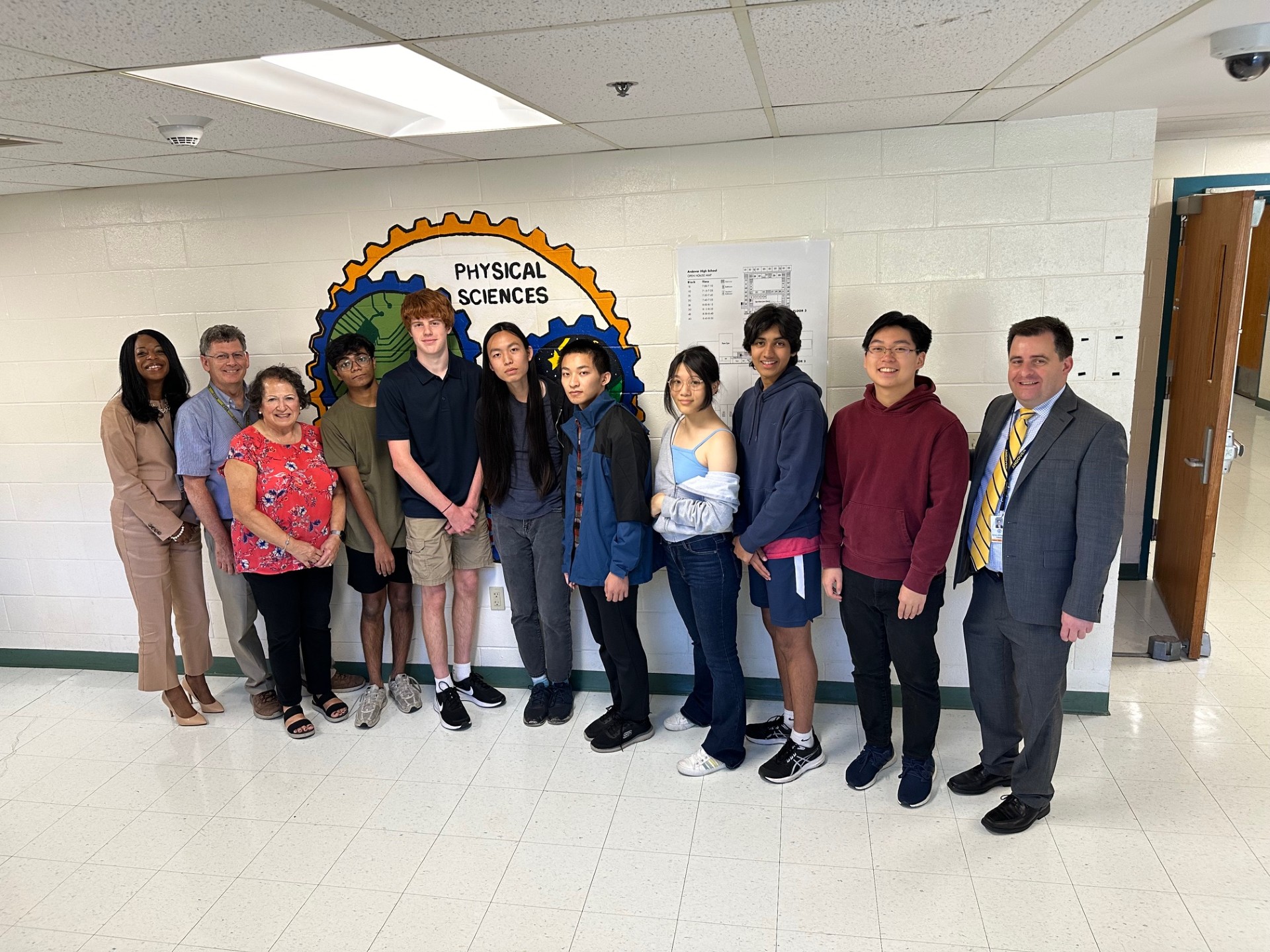
It all began when senior Richard Chen, discovered the competition at the end of the 2022-2023 school year. He attempted to recruit classmates but initially found little interest. Richard then approached Daniel Donovan, a physics teacher and the Physics Club advisor, and later, the team of eight’s mentor. Donovan’s initial response was skeptical. “He was like, this is an absolutely crazy idea, and it’s never going to happen,” joked senior Jaiden Li.

But the team – Theo Buckridge, Richard Chen, Samyak Jain, Jaiden Li, Daniel Lin, Zach Medjamia, Hari Palaniyappan, Robert Zhu – known as the SPEEDers (Smith-Purcell Effect Emission Determination) persevered. They began working on their proposal at the start of the following school year, brainstorming a number of ideas before settling on Smith-Purcell radiation. This lesser-known phenomenon, first discovered in the 1950s by Smith and Purcell, occurs when a beam of electrons passes over a metal grating, causing the emission of light.

The team’s proposal focuses on the unique properties of Smith-Purcell radiation. “It’s a non-intrusive method of diagnosing a beamline,” explained Li. A beamline is a line in a particle accelerator along which particles travel, and “diagnosing” means measuring its properties. “Essentially, that means that it’s very safe to conduct, and there’s also potential applications in healthcare with regards to X-rays.”

STAFF PHOTO / Tommy Kruecker-Green
Winners of “Beamline for Schools” competition, along with AHS physics teachers Mr. Donovan, Ms. Givens, and Principal D’Andrea and Superintendent Dr. Parvey

The non-intrusive nature of Smith-Purcell radiation in measuring an electron beam is a key advantage. “When you run the electron [beam], you don’t actually run the electrons through the grating; you run it over [the grating], and so the beam continues on,” Zhu clarified. This means scientists can measure the beam’s properties without disrupting it, keeping the beam intact for other uses like medical treatments. To develop their proposal, the team gained access to a library of physics papers through the school librarian, John Bérubé. They also used Onshape, a cloud-based CAD (computer-aided design) software, to create 3D models of their experimental setup. Li got involved just a week before the submission deadline to create this computer simulation.

Remarkably, the team completed their final proposal in just one week. “It was a very last-minute thing,” admitted Zhu.

At DESY, the team, accompanied by  Donovan, and physics teacher,  Cynthia Givens, had plans to run an electron beam over their designed grating and observe the resulting Smith-Purcell radiation. “We’re pretty much just gonna be running the beam and trying to observe the Smith-Purcell radiation,” said Zhu before they left for Germany. “And we’re gonna be tweaking things and trying to see if it matches our predictions for how much we’ll see, what we’ll see, what frequency, and so on.”

The students have ambitious goals after observing the radiation. They hope to code a simulation for GEANT4, a toolkit used by CERN for simulating particle interactions. “The thing with the Smith-Purcell effect is that there isn’t a module for it in GEANT4,” said junior Buckridge. “So we would be the first to code that.”

The team sees this once-in-a-lifetime trip as an opportunity to experience the international scientific community firsthand. “It’s just really great to have experience working with these tools that actual scientists use in the actual field,” said Zhu. “We definitely want to learn more about what the scientific community is like outside of just Andover or outside of just the U.S,” Li added.

Continue reading
AP Econ Debuts at AHS
  • October 7, 2024

By Carissa Dessin
EXECUTIVE EDITOR

This course, taught by Digital Learning and Business teacher Ashley Kinsman, marks a significant shift from the school’s previous elective business courses.

Kinsman, who has previously taught electives such as Intro to Business Finance and Social Media Marketing, now teaches two sections of AP Econ. On top of this, Kinsman continues to teach one section of a class she taught years prior, Intro to Business. AP Econ covers both Microeconomics and Macroeconomics, offering students a challenging education in economic theory. 

Despite making the huge transition from unleveled classes to teaching an AP, Kinsman said she’s “really enjoying it.” One challenge she described is “staying on top of the students and going over the units beforehand, to make sure [she has] everything ready for them.”

STAFF PHOTO / Carissa Dessin
AHS has added an Advanced Placement (AP) Economics course to its business curriculum this year, providing students with a deeper understanding of economic principles.

AP Econ introduces students to complex concepts like the production possibilities curve and marginal analysis, which Kinsman integrates with real-world applications. She conducts classes in a way that maximizes engagement, spending the first part of class lecturing and then transitioning to “hands-on engagement experiences in class time, so students can see how it [relates] to different scenarios in their day-to-day life.”

Senior Gavin Mottley described the class as going really well so far. “Economics is new for me,” he continued, “but it’s a lot easier to internalize information even though it started out as a totally foreign language.” 

Mottley initially found interpreting two-way tables that demonstrate comparative advantage between countries challenging but gained clarification from Kinsman’s teaching method. “[She] had us work together in groups in a game that had us practicing exactly that. It helped me a lot because I got to work with my classmates; asking them questions helped [reduce] the confusion I had, and helping them when they needed it reinforced the ideas I was more comfortable with.”

Senior Arushi Biswas also reflected on the challenges and rewards of the class. She initially found the production possibilities curve and related graphs confusing but credited the summer work with helping her stay on track.

When it came to registering for the class last spring, Biswas was first drawn to the class because she was interested in pursuing a degree in business and wanted to get a feel for her future classes. “I think students should get educated in economics because it teaches you how the economy works, when to save and when to invest, how to make informed decisions,” she said. “It gives you a good understanding of society and policy.”

Looking ahead, Kinsman is eager to dive into more advanced topics and continue making the material of the course relevant to the students’ lives. She hopes for them to see how truly applicable all of the information that they are learning is in their lives. “I think it’s just really applicable to your day-to-day life like…we do a lot of economic theory, without really realizing that’s what it’s called.”

Continue reading
Andover Responds to EEE, Implements Mosquito Control Measures
  • October 7, 2024

By Harry Guo
Executive Editor

EEE has become more common in the areas near Andover over the past 10 to 15 years. The town’s Arbovirus Response Plan, initially created in response to the West Nile virus, is adaptable to EEE and guides their current strategies. Their efforts start every April when they review data from the previous year and develop work plans for mosquito control.

“This year, we saw EEE appear at the end of July in Haverhill and Amesbury, where we usually don’t see it,” said Thomas Carbone, Andover’s Director of Public Health. “We anticipated its spread… and chose to have the mosquito control district treat the brush along athletic fields in August, prior to the start of fall sports.” The early mosquito spraying has so far allowed AHS to maintain its regular schedule of sports practices and games.

In response to EEE, teachers have become more cautious during outdoor activities for their classes. “I make sure that [bug] spray is available to students when we go outside,” said Melanie Cutler, a science teacher and advisor of both the Garden and Environmental clubs. Despite these precautions, she has observed that there hasn’t been a significant shift in student attitudes regarding outdoor activities this school year, contrasting previous years when EEE was more prevalent. 

STAFF PHOTO / Harry Guo
Seniors Tyler Buono and Collin Souza doing fieldwork outside for Melanie Cutler’s C Block AP Environmental Science class amidst EEE season.

Even though safety against EEE remains a priority, the approach to protecting student-athletes from the disease is largely individualized and not the responsibility of the coaches. “Everybody is aware of what the implications are if this disease is contracted,” said Wayne Puglisi, the Athletic Director for Andover Public Schools. These implications include headache, fever, chills, and vomiting. More severe cases of EEE may progress into disorientation, seizures, encephalitis (brain inflammation), and coma.

According to Carbone, residents should use mosquito repellent, wear long sleeved shirts and pants, and regularly check their yards for standing water to reduce mosquito breeding sites. “Untreated swimming pools are a prime breeding ground,” said Carbone. “As is standing water in roof gutters, children’s pools, bird baths, and abandoned tires.” However, there are no additional school-wide measures beyond general awareness and these personal precautions.

While the impact of EEE has been stifled by preventative measures, climate change continues to drive the increase of tick- and mosquito-borne viruses, according to Cutler. “When we have cold winters and hard frosts… a big percentage of their population tends to die off each year,” she explained. “That helps to keep the mosquito and tick population in check.” However, as climate change raises average winter temperatures, more of these pests survive the season, increasing the risk of virus transmission.

“Bird migrations inform… the 10 year EEE cycle,” said Carbone. “When we get more intense rainstorms and hotter weather, it invites the proliferation of mosquitoes.” Additionally, Andover is also monitoring other exotic mosquito borne illnesses moving northward, such as the Zika virus. 

Continue reading
OPINION: Freedom vs. Control in the Digital Era: Balancing Privacy and Security
  • October 7, 2024

Anushka Dole
STAFF WRITER

Pavel Durov, the founder of Telegram, a secure messaging app, was arrested on August 24 in France under allegations of allowing terrorist activities and other abuses to take place on the platform. The arrest has had a ripple effect across the globe, as Durov was an openly pro-privacy figure who is being penalized for it like many before him. 

Privacy was a cornerstone of Telegram, which protects user’s privacy by not sharing user data to third parties and enabling end-to-end encryption for certain chats. Durov’s arrest has led to collective anxiety about what can be shared online—even in a simple phone call or text to a friend—and has opened up conversations at AHS about online freedom. To protect our freedoms, we must completely reform the legal system to accommodate for the digital era and encourage companies to moderate content with algorithms rather than immediately handing data over to the government.

Digital freedom and privacy of data is especially important for teenagers, as we live much of our lives online. Since we are free to communicate in person without fear of the government listening in and regulating our conversations, then it shouldn’t be any different online. However, government surveillance of the internet has been prevalent since its inception—this is not necessarily a bad thing, because government intervention is necessary in criminal activity, but there is a line between protecting user safety and infringing on their privacy. 

Junior Milena Tiernan said she thinks, “It is our liberty to be able to communicate privately with each other, but [the government] should be able to see if people are trying to hurt other people in the real world.” 

Senior Aaryan Deshwal expressed similar views. “There should be a balance between free speech and using speech to incite violence and crime,” he said. “Free speech should not be regulated at all unless there are clear indications of bad intention.” 

 In Massachusetts, and the overall United States, COPPA (Children’s Online Privacy Protection Act) is set in place to protect children’s data from being exploited online, but the act only protects people 13 and under. High schoolers—even adults—are still vulnerable and impressionable, and if they make a mistake or fall in with the wrong digital crowd, their digital footprint will condemn them for the rest of their life. Making a mistake online directly escalates to law enforcement, something that has not been seen in the past.

In the past, even for adults who had their own home and privacy, the reliance on others in order to be able to send communications provided checks and balances on misdeeds. The mailman noticing a questionable package or neighbors noticing suspicious activity from the house next door served as informal obstructions to those who would attempt to perform illegal activity. 

Today, parents find it difficult to police their children’s content due to the sheer volume of production. And for the community surrounding the perpetrator? It’s very difficult to find signs of unlawful activity when there is no access to physical records or patterns of behavior to examine. 

Law enforcement has simply not caught up to the leaps that technology has made. The systems that are currently in place to safeguard us are built on a shaky foundation and are far too outdated. Algorithmic analysis of content could be a necessary intermediary—like neighbors or mailmen—to keep the balance between total anarchy and total surveillance.

Sophomore Arnav Josh had similar thoughts. “Tech companies should have basic, non-invasive filters meant to accurately recognize obvious illegal activity… it would be a huge breach of privacy for companies to be able to look at every conversation between people,” he said.

“You would need some sort of think tank, philosophers, people across the political spectrum, privacy experts, legal experts… You need a whole 360-degree view of people who can talk this through,” Bezaire added. “You need people from different walks of life, different education, different backgrounds to be able to put together a new ‘tech bill of rights’ that protects people but also helps keep us safe.”

Durov’s arrest may leave more questions than answers. And that’s okay—these are deep, complex issues that strike at the very core of humanity. Resolving them will require much more thought, countless conversations, and inevitably, even more questions. The tension between privacy and security will always be challenging to navigate, but it’s a balance we must find. The future of our society depends on it.

Continue reading
EDITORIAL: AHS Phone Policy Teaches Compliance, Not Responsibility
  • October 7, 2024

There’s a new phone policy at AHS, and you’ve probably noticed it. Our phones go into what one might call a “phone jail”—those numbered slots where our devices are locked up during class, sometimes with an actual lock and key. The rationale is clear: no phones in class, no distractions. But let’s ask the question: why have we gone to such extremes? 

We at ANDOVERVIEW strongly believe that class time is for learning, and phones can be and have been a major distraction. The administration has had enough of our glowing faces, aglow not from intellectual enlightenment, but from under brightly lit phone screens. Our teachers are concerned about our development; it is not that it gives them pleasure to deprive us of our hypnotic devices. But does locking up our phones, as if they’re dangerous contraband, teach us the right lesson?

This is high school. We’re constantly being told to act maturely and take responsibility for our actions. Some of us are already 18—legally adults—yet we’re treated as though we can’t be trusted with even the smallest responsibility. By removing the temptation completely, the administration is not teaching us how to manage it. It is just kicking the can down the road. Very soon, many of us will be heading off to college or entering the workforce. In those environments, policies like this one don’t exist. There won’t be phone jails. No one will force us to lock up our devices. It is up to us to learn to make responsible choices.

The phone policy creates a false sense of order. It’s easy for students to follow the rules because we don’t have a choice. But the moment the structure is gone, those who never learned self-discipline may be the first to revert to bad habits. What if, instead, we were trusted with our phones? If someone is caught using their phone during class, they face immediate consequences, as well as potentially being singled out for phone jail—with no parole—for the rest of the year. This is about accountability. We learn by making mistakes and facing consequences. If we’re shielded from making mistakes in the first place, we’ll never learn.

The new phone policy does enforce compliance with rules, but one should remember that we are expected to follow rules, even without heavy-handed enforcement. We need to be treated like the almost-adults that we are. It’s time to trust us to learn from our choices, not lock them away.

Continue reading
Hopeful New Addition to AHS Administration
  • October 4, 2024

By Abby Chachus
STAFF WRITER

Hall previously worked at Lowell Catholic High School as an assistant principal for three years, and as a history teacher there nine years before becoming assistant principal. The excitement of working at AHS really began to build for him when he started noticing aspects of the community that were exceptionally different from his old job. 

One event that sparked his interest was the annual Club Fair on September 23. “Lowell Catholic doesn’t have anywhere near that many clubs,” he marveled. He also expressed being impressed at the variety of topics students were interested in, pointing out the Jewish Student Union and Robotics.

When asked, new principal James “Jimmy” D’Andrea expressed hopefulness regarding Hall’s ability to help him improve the school spirit and community outside of students’ niche interests. D’Andrea acknowledged the students’ enjoyment of individual topics but hoped the entire student body could come together and support topics outside of their main interests. 

The decision of choosing the new administrator was not easy, D’Andrea expressed that Hall is a good fit, specifically stating that Hall has experiences in multiple departments at the high school level.  

“He’s had the opportunity to work with a lot of departments and a lot of different activities, because he was the only assistant principal [at Lowell Catholic],” D’Andrea said. 

“AHS is starkly different, not just in the structure and size of the building, but the clubs and activities students are involved in. That inspires me,” said Hall.

Continue reading
“Can U Do Me a Favor?”: Hacker Pirates AHS Instagrams
  • October 4, 2024

By Ella Hu
STAFF WRITER

All hacked accounts are managed by the hacker, who turned accounts into baits for money and places to post art content. Many AHS students mentioned receiving DMs on Instagram from hacked accounts asking for $50 or to use their profile picture. 

Junior Ana Murray first received a DM from a friend on her Instagram account asking for help, for Murray’s phone number and for her to answer a link sent to her number. Everything happened quickly, and Murray offered her help without suspecting anything. With a hold of Murray’s phone number, the hacker had full access to her information, including access to her passwords and accounts. 

STAFF PHOTO / Ella Hu
Sophomore Anya Gorovits receives text message from compromised Instagram account asking for a favor.

“The text sounded normal coming from my friend,” Murray said. “The timing and the tone really sounded like her and something she would say.” Murray followed the hacker’s instructions, which ended up compromising her Instagram account. 

Later, she discovered her friend’s Instagram account was hacked, and now her account was too. “After I provided my phone number, I lost access to my account and couldn’t open it,” she said. “The whole thing disappeared, and I started getting weird texts… when I blocked them, I would get another message from a new email or phone number asking for money.”

Principal James D’Andrea was made aware of the hacking phenomenon, which has also been affecting students’ access to their school email accounts. “If students’ Instagram accounts are hacked with their email logged on, they will be locked out of their emails as a protection management,” he said. “A lot of things in the school system are designed to ensure that systems in the school district remain safe from potential cyber-attacks or threats.”

It is difficult for apps to keep up with all the ways hackers can compromise user accounts using unsuspecting messages. However, D’Andrea said, “We know new technologies are developing and evolving so we have to constantly monitor what is happening behind the scenes… it is our priority that beyond academics, students are physically safe… emotionally safe, and ultimately, technologically safe.” 

Continue reading