Andover High School recently announced two new courses being offered next fall, AP Seminar and AP Government. AP Seminar will take the place of the combined sophomore English and history class.
Both of the new classes are open to sophomores, making them some of the first APs for underclassmen. AP Government will be open to juniors and seniors as well, whereas AP Seminar is being implemented exclusively for sophomores. It will replace Modern World Studies, which combines the Modern World History and English 10 curricula into one larger joint class. Students and staff alike have expressed confusion as to how AP Seminar will be managed.
Though the name is being used to describe the new collective class, AP Seminar is formally the title of the English class and Modern World Studies is the name of the History class, though the latter is colloquially used to refer to the current combined course as a whole. While AP Seminar will be taken as an Advanced Placement class, students have the choice to take Modern World Studies for an Honors or College Prep credit.
It’s important to note that AP Seminar, which is an English course, is not exactly the same as English 10. Fundamentally rooted in developing research skills, the curriculum follows a slightly different path than its sister English course while still covering similar topics. According to the College Board’s description, “in AP Seminar, you choose real-world or academic topics to investigate. AP Seminar teaches you how to find and use evidence from experts, and how to present the case from your own perspective effectively, both through writing and multimedia presentations.”
“AP Seminar is a course designed to develop students’ skills in research, analysis, and communication,” Sara Sympson, a representative from College Board, said. “It encourages critical thinking and collaboration, preparing students for college-level work. The course can be organized in a variety of ways to best address student interests, state and/or country and district goals and requirements, and local school traditions and culture.”
Despite the new title, AP Seminar will not be changing much when compared to Modern World Studies. Michael McCarthy, advisor of the Social Studies program in Andover Public Schools, explained that the class will remain nearly identical to its predecessor. Stacy Giggie, program advisor for the English program for grades 6-12, agreed. There will be little change in the overall curriculum, but some of the learning material and assessments will be altered to match the newfound AP-level difficulty of the class.
Modern World Studies and AP Seminar cover important and sensitive topics, and it’s important to ensure they are both prioritized equally. When asked if he was concerned about one subject being emphasized over the other, McCarthy said, “Yes, a little bit, but I’m very confident that the teacher who is teaching it will ensure that the skills we value will be taught.”
AP Government will be offered as a full-year elective like many other APs at AHS. Given the importance of understanding the government as an American citizen, McCarthy suggested that it would be a valuable addition to the course offerings for students.
“We want students to be active citizens, to understand the local government, their state government, their federal government, and to see the government as agents of change,” McCarthy said.
Test-optional college applications sound like a dream. Applying to your first-choice school without having to submit an SAT or ACT score is enticing. It feels nice not to worry about taking a test for your application. Realistically, though, students everywhere fall victim to the negative effects of this newly developed procedure.
Test-optional applications gained popularity during the COVID-19 pandemic. They were introduced as an option for students who were unable to take standardized tests due to the global restrictions at the time. Although test-optional policies were expected to be a temporary solution, they have since remained as an alternative for applicants who feel less confident in their test-taking abilities and wish not to declare their scores. What some students fail to recognize, though, is that in many cases it is more harmful than beneficial to withhold their scores when applying. In fact, it is often helpful to include an ACT or SAT score in situations where the applicant is uncertain.
The primary issue with test-optional applications is that their academics are more heavily scrutinized than those with a test score attached. William Hutchins, a guidance counselor at AHS, said, “What I usually say to my students is that if a school is test-optional, then other aspects of your application, such as your college essay, become more important.” The lack of a score gives admissions officers one less area of focus and increases the importance of a student’s transcript, admissions essay, and supplemental essays. Applicants are told that applying without standardized test scores will not affect their application results, and while it may be true that officers will not base their opinion on whether or not a student submits their results, their overall interpretation of the application will change if a score is not sent in and the weight of other aspects increases.
Applicants on a global scale face drawbacks from test-optional policies. Since 2020, some schools that implemented and maintained test-optional applications have seen a sizable rise in average scores for the SAT and ACT among their students. This is the result of selective submissions, only including scores that match or exceed the school’s average. As students begin neglecting to report lower scores, there is a steady increase in test result averages. This trend occurs when students stop including their standardized tests in their college applications out of fear that they do not measure up to the rest of the applicant pool. While some colleges avoid this by collecting test scores post-admission, many neglect to do so. Allowing students to apply with undeclared test results catalyzes this problem which, if it continues in this manner, will eventually render standardized test results as utterly meaningless numbers in a sea of schools boasting perfect 1600 average SAT scores.
Test scores function as an equalizer for college applications. Hutchins mentioned, “It can be tough sometimes to compare states against states, or schools against schools… If you have a 4.2 GPA at Andover, that’s not necessarily the same as a 4.2 GPA at North Andover.” He elaborated that standardized test scores do exactly what their title suggests by standardizing an aspect of the application process. The SAT and ACT exams are designed in such a way that they measure students’ capacity to take one similar exam and bypass factors such as teaching policies, available resources, or academic rigor that vary by school, and provide a simple, unchanging criterion for a college application.
I find that these combined effects of test-optional applications hinder the success of students and justify the eradication of the policy as a whole. Disallowing students from withholding standardized test scores would lead college admissions officers to view all applicants through the same lens. It would lower average scores at schools across the country and universally benefit students by increasing the likelihood of their results exceeding the school’s benchmark.
I am guilty of refusing to provide my test results on some of my college applications, but each time I have chosen not to submit them, I have wished they were a required element. Test score mandates would not only reduce the stress of deciding whether or not to submit but would also create more opportunities for applicants of different strengths to be admitted to the college of their choice. I feel as though this obligatory report would diversify the applicant pool and greatly improve students’ acceptance probability, easing the process for people of varying academic success.
High school seniors from AHS and beyond are now applying to more colleges than ever.
The class of 2024 has just wrapped up college application season, and according to Director of Guidance Aixa de Kelley, this year students applied to 9-10 schools on average. “We also had 28 students who applied to between 20-28 colleges, and two who applied to 30 colleges,” she said. According to a November 2023 article in Forbes, these staggering numbers are in tune with many graduating students applying to colleges all over the country, whose application numbers have been significantly increasing in the past years.
Edward Abbott, one of the guidance counselors, says that counselors recommend “a balanced list of 6-9 colleges,” yet very few students end up sticking to that number. “Students should see themselves attending each school on their list,” said de Kelley.
Abbott said this change can be attributed to several factors, one being the addition of over 100 new colleges to the Common Application this year. Seniors also appear to apply to more colleges out of fear of not getting accepted into any of them. “There are some schools popular with a decent amount of our students that have become more competitive over the years,” says Abbott.
Colleges allowing test-optional admissions, as well as AHS’s policy of not charging students for sending transcript packages, may also contribute to this cause, de Kelley provided. Some students also tend to apply to schools out of pressure either from parents or peers, lengthening their college list and consequently increasing their stress.
An interesting point of contrast could be the number of schools to which our faculty members applied during their senior year. Most teachers contacted for this article said they applied to three or four schools, which they found adequate at the time, considering the competition and the application fee. As de Kelley mentioned, application fees can add up quickly the more schools a student adds on. It can also take a toll on a student’s mental health to handle so many applications and deadlines when “at the end of the day, students can attend only one college.”
Abbott advises juniors to visit and research schools with an open mind and create “a balanced list of schools” in terms of selectivity, competitiveness, and financial fit. He also suggests that students keep in mind the other activities they will be involved in as they begin their senior year, such as clubs, new classes, sports, jobs, etc. Students should prioritize their mental health by having their college lists and personal statement drafts ready over the summer. This can alleviate a large amount of anxiety and distress around college application season.
When the current seniors started their time at AHS on August 29, 2018, the four years to come — 1,367 days, 32,808 hours, 1,968,480 minutes, 118,108,800 seconds — felt like they would last an eternity. However, by May of 2022, it felt like it went by way too fast.
Coming into AHS from middle school was like going to college. An overwhelming amount of exploration came with this step. I could join any clubs, had an option on what classes I wanted to take, could pick any sport to try out for, and make a bunch of new friends. On top of just living through that, it was the time for a lot of firsts. First time going to a high school sports game (before Triple EEE hit Andover), first time staying after school, first high school dance, first party, and it seemed like a dream. It was the preview season for the next three years.
Sophomore year only got better. While freshman year came with trying new things, sophomore year gave me my first real taste of freedom: my driving permit. Additionally, with everyone turning 16, the fun continued, as sweet-sixteen invitations were traveling around the school. However, that stopped when the news of COVID started being carried around instead. Then, came the fire alarms for a whole week. By the time we finished making bets on who the culprit was, the announcement was delivered: School is canceled for the next two weeks due to COVID. At first it was exciting, the endless facetimes, family walks, disinfecting groceries, and sitting behind the computer with the cameras off because for some reason it was uncomfortable to turn them on. And before you knew it, school was officially over.
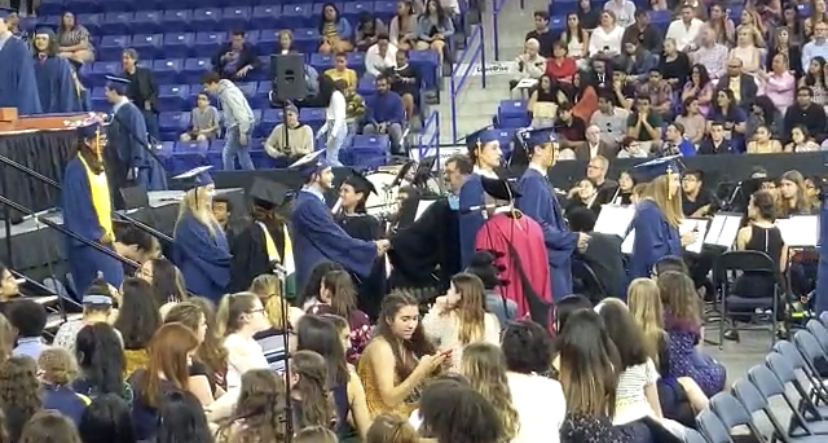
STAFF PHOTO / Shravya Sathi Seniors walk down the path at graduation after getting their diplomas
By the time we returned to junior year, whether you picked hybrid or online, it was an unexpected situation. We never thought we would have to wipe our desks at the end of class with cleaning spray, eat six feet away from friends in the Dunn Gym, have classes under large tents, have assigned seats for the whole year, and hope for no “close contact” emails from the school nurse. However, a little bit of normalcy continued in our lives when it was time to get our licenses (unless you got caught in the North Andover Auto School scandal). With this freedom, however, came the realization that we need a job in order to pay for gas, and soon enough we were all working our first jobs.
Senior year thus far has been a mixture of all the previous years: exploration of freshman year, freedom of sophomore year, and responsibility of junior year. The college process at the beginning of the year was a type of stress I would not wish on my greatest enemy. However, the time between submitting college applications and decisions coming out hardly exists— it goes by so fast. Then, it’s April and it’s time for all the senior events. By the time the AHS Grads Instagram starts rolling with commitments, it really hits that this is goodbye. Soon enough, prom will be over, and it will be senior events week, graduation, senior safari, and our last goodbyes. By May 27, 2022, we’d have gone through our last high school sports game, last time walking through the school doors, last high school dance, last party, and the dream is over.
In the end, it truly goes by faster than you think. The same kids that you went to elementary school with, drew on shaving cream covered desks with, made Valentine’s Day cards with, are all going to be spread apart across the state, country, continent, and some, even the world. Take a moment to enjoy where you are and take it all in because it will be over before you know it.
High school seniors across the world are currently having to grapple with a major decision that will play an important role in their further education. For some students, deciding where to go to college is simple; they have known their whole lives they are destined to go to this place, or they toured a specific school junior year and knew it was the one. Yet, for others, the choice can be quite stressful to map out.
Due to the COVID-19 pandemic, there has been significant changes to the admissions process — specifically, the removal of the requirement for students to submit standardized testing scores. Since students did not have to submit scores, many decided to apply to more schools that might have originally been out of reach. As a result, universities this year have received record numbers in terms of applicants.
In addition, many universities over-accepted the Class of 2021 last year, therefore they are having to accept less students this year in order to restore their undergrad population.
All of these contributing factors have led to a stress overload for seniors. Students this year are facing unexpected rejections more often than before.
As it is expected the next few years will be impacted by the pandemic, there will continue to be a need for resources for the rising seniors. In the future, we hope to be able to find more accessible ways to connect with guidance counselors and access helpful, basic resources
that will outline exactly what rising seniors need to fill out with specific information. For example, seniors and their parents did not know what the CSS profile or FAFSA is or how to fill them out. Many students do not know what things we should be doing since freshman year to help make applying to colleges easier in the future.
We believe that having more time and meetings with guidance counselors since freshman year. These meetings can consist of figuring out what the student wants after high school and making sure they are on the right track for that. In addition, having a platform that students can access as early as ninth grade, with all the college information and checklists could truly help.
Editorials represent the opinion of the ANDOVERVIEW staff as a whole.
Last year, Andover High School switched its college readiness program from Naviance to Scoir, an overall welcome change. The change to Scoir gave students an efficient and convenient medium for their college search.
Jayne Jones, an AHS guidance counselor who has helped hundreds of students throughout their college selection processes, stated that the overall response to Scoir has been friendly thus far. “The site is super user-friendly and allows students to research and link to colleges… and review the scattergrams as compared to other AHS graduates,” she said. The access to graphs that help visualize where one stands in relation to the expectations of a college makes finding attainable reach schools much easier, according to Jones.
“Scoir is also more contemporary and visually more pleasing,” Jones continued. “Students can also follow colleges’ links to Facebook, Twitter, or Youtube, something that Naviance did not offer. Parents and caregivers also use SCOIR, and most of the parents and caregivers have found SCOIR to be helpful during the college process.” This was a much-needed change from Naviance, according to Jones.
Scoir has not improved efficiency in the college process for students alone, according to Jones. “SCOIR has also been easier for our teachers,” she said. “With Naviance, teachers were required to submit their letters of recommendation for their students. If a student added a college to their list, the student had to notify the teacher so that the teacher could send their letter. On SCOIR, it is the guidance counselors’ job to send the teacher recommendations in addition to other credentials. As much as this is another step for guidance, it makes more sense and streamlines the process.”
Since the switch to Scoir took place last year, AHS senior Georgia Allen has already gone through her search for colleges. She described her experience with Scoir as very positive overall. “It was very easy to figure out how to use Scoir and it became easier to find out more information on specific colleges,” Allen said. “Before using Scoir, some worries that I had about finding colleges were that I would not be able to figure out the specific necessary information about each college, but Scoir actually made it way easier to organize my list and to figure out what I wanted from a college.”
The time to begin college applications will begin soon for AHS juniors, the class of 2023, and many students have voiced both excitement and trepidation about their upcoming pressure-filled senior year. AHS junior Amanda Lichtenberg expressed her anticipation about using Scoir to apply to colleges. “I feel nervous because I have no clue what school I want to go to and don’t know what I want to study,” she said, “I know I want to go to a kind of big school, so hopefully, I’ll have some sort of way to filter down my options so I can see what is available to me.” According to both Jones and Allen, Scoir may provide the perfect outlet for students like Lichtenberg to make their journey through college applications a little more comfortable.
As seniors wait apprehensively to receive their college decisions, many colleges have announced an extension for the no-standardized-test-requirement policy.
High school classes of 2022 were not required to submit standardized test scores when applying to most colleges. Recently, many schools have been releasing announcements extending this policy for the upcoming years.
Found on some colleges’ websites, such as Harvard University’s, a statement has been posted that this change is because of the COVID-19 pandemic. Meanwhile, Columbia University has announced in a new update on their website that they have extended it “to consider systemic shifts in access to educational opportunities.”
In fall of 2020 and 2021, nearly every college went test-optional, with most colleges continuing the policy in fall of 2022. With this change, guidance counselor Anne-Marie Fortier noticed that the number of students who went test-optional has increased. This brings to light the possible disadvantage that some students face when taking standardized tests. “When the SATs were first put together, it was supposed to be an equalizer,” stated Fortier. “It’s not an equalizer, because what happened is the people [who did well were the ones] who had resources for studying [and] taking prep classes… Kids who didn’t have access to that did not do well, and it had nothing to do with their inherent or innate ability.”
According to Fortier, the test-optional change prompted “a lot of kids [to apply to]… more competitive schools. [As a result,] super competitive schools, like the Ivy League schools, saw their application numbers just shoot to the sky.”
Senior Isabel Rodenberger, who applied for and got into Tulane University with the test-optional policy, stated that all twelve schools she applied to followed a test-optional policy, and she is “very happy with [her] decision.”
“Most schools are starting to value other qualities in an application over test scores,” Rodenberger remarked. “A test score will not determine the outcome of your college decision. Test scores may look very impressive, but an absence of scores will not hurt an application.”
Former AHS Grads on the Campus Experience in the Pandemic
By Erin Li
STAFF WRITER
We remember saying goodbyes to the seniors who graduated last year and the years before that, but do you ever wonder how they’re doing in college now? As this crazy school year is coming to an end for the high school class of 2021 and the college students, have you ever just wondered how the pandemic has affected them? What does college even look like now and what struggles do they need to face? ANDOVERVIEW interviewed past AHS graduates to check in on their college experience under the pandemic and to see if they had any tips for the upcoming freshman students going into college.
This year, most colleges went remote with a choice of hybrid classes and living on campus. Even though it was expected that the pandemic would change the whole on-campus life experience, Rebecca Song, a 2020 AHS grad and a freshman at UMass Art, told ANDOVERVIEW that she still chose hybrid over remote: “The experience is obviously not the same, but I feel like if I were in person I think I will be more focused and attentive.”
According to Song, in her school, most of the upperclassmen chose remote classes but a lot of freshmen chose hybrid to fill their first-year class requirements. Her only hybrid class this year is figure drawing, which is a freshman year required class for art students where they bring their art materials into a room and draw different models every two weeks. You can take this class online too; however, when it involves nude models, the teacher won’t be able to host a zoom meeting.
When asked about what she dislikes the most about college during the pandemic, for her it’s the absence of engagement in class, and lack of motivation. Song said, “Sometimes I felt like I didn’t have access to help, or like I couldn’t ask for help.” With online classes, students tend to find it awkward to stay after class to ask questions. Since the teachers can’t help the students physically face to face, it became an effort to reach out and email the professors or social workers for help.
This struggle to connect is also true with making friends especially for the class of 2020 going into a brand new environment. Usually, you would make friends through in-person classes, school clubs, and activities, etc. But this year everything shifted online, changing the main source of creating friendship to school Discord servers, Instagram direct messages, and other social media platforms. Even though you can’t hang out with a huge group of friends to grab food or study together in the library, people are trying to make it work. “In Discord channel, people will coordinate little things like going to the Blick store to get art materials, running errands together… a few people go and that sparks conversations,” Song added.
Along with all the struggles of finding motivations or making new friends, oddly enough, there are also perks to the pandemic college life, such as being able to attend online classes more easily or having bigger dorm rooms all to themselves. Sherry Wang, a 2018 AHS grad and a junior at Bentley University, said, “To be honest, I haven’t missed a single class this semester because they were online classes. Before when they were offline it was easier to not go to classes when all your friends didn’t want to go.”
Of course, another big part of the college experience is residential life. Because of the pandemic though, there are strict restrictions on college dorms and visitors. Students from outside the school are not allowed to enter dorms, they are required to take COVID tests every week and show an indication of the negative result when entering any buildings on campus. The public facilities on campus changed too: libraries are often not open now but only available for curbside pickup, the study rooms are limited to fewer than four people, and these restrictions differ for each school. For the students studying in Boston, some of their social activities during the week are running errands, grabbing food and drinks, or just hanging out with friends around Newbury Street or at the Boston Common Park.
According to Wang, “It feels more like living your own life and surprisingly grocery shopping became my favorite activity.” As an upperclassman living in a suite with her own individual kitchen, Wang started cooking more during the school year. Grocery shopping became the number one activity she looks forward to because it’s a reason for her to leave her room and breathe in some fresh air from the outside.
To provide a better experience for the students, colleges have also been trying their best to create student bonding activities to relieve stress, make opportunities for friendships, or just create some kind of normalcy during this abnormal year. Some of the common activities are online bingo, movie nights, or even arts and crafts nights. According to Wang, Bentley University continued its annual Spring Day event, which this year was April 16-18. Usually, they would have an in-person concert where all the students come together but this year they had a virtual concert featuring Tinashe, 24kGoldn, and Jeremy Zucker. During the three event days, there were different free food trucks every day on campus serving ice cream sandwiches, burgers, fries, tacos, fried chicken, whoopie pies, etc. These are some great activities to bring students together in a safer way during this special time as well as providing some late-night snacks to fuel up their motivation again.
STAFF PHOTO / Erin LI Former AHS 2018 grad Sherry Wang holding a whole plate of food she received during Bentley’s Spring Day Event on April 17th, 2021.STAFF PHOTO / Erin Li An example of the variety of food Bentley provided during their 2021 Spring Day Event to help students to bond together and relieve stress.
The past AHS grads sure have had a very special college year under the pandemic, there are lots of struggles they had to face and resolve but there are also little surprises they found on the way to make isolation a bit better. What will the college class of 2025, this year’s high school seniors, experience next year? Who knows, but it may not be a bad idea to start reaching out to make new friends on the internet, go grocery shopping, or try to cook (without burning your kitchen down)!
Tips From AHS Grads
“Bring your spices, bring your salt, bring your pepper, bring your chili bean sauce, sriracha, because they don’t have that in college.”
Rebecca Song (2020 grad)
“If you’re struggling, others probably are too. Reach out to your peers even if it seems intimidating.”
Henry Chen (2020 Grad)
“Don’t miss any of your classes.”
Sherry Wang (2018 grad)
“Form study groups. Learning on your own is going to get harder from here on out.”
Henry Chen (2020 Grad)
“Find your roommate ASAP or rent a house ASAP.”
Christina Zhou (2020 grad)
“Random roommates are pretty, well, random. Learn to get along with people that frustrate you, at least to be able to amicably resolve conflicts.”
Henry Chen (2020 Grad)
“Be prepared to feel overwhelmed but also know that you are never alone.”
SCOIR, the new college search and preparation platform brought to the Andover High School sophomores and juniors during the 2020-2021 school year and the seniors the year prior, is a platform for students to make their college searching experience much easier. SCOIR allows you to do anything from keep track of applications to request a teacher’s letter of recommendation.
Anne-Marie Fortier, one of the AHS guidance counselors, talked about this program during an interview stating that “it’s far more user friendly” (SCOIR is the predecessor of Naviance) Juniors can use SCOIR for their college searching process and see what is out there for colleges and universities. “There’s a search function that allows students to select a number of fields that are important to them… size, location, major, any specific activities, athletics,” and more.
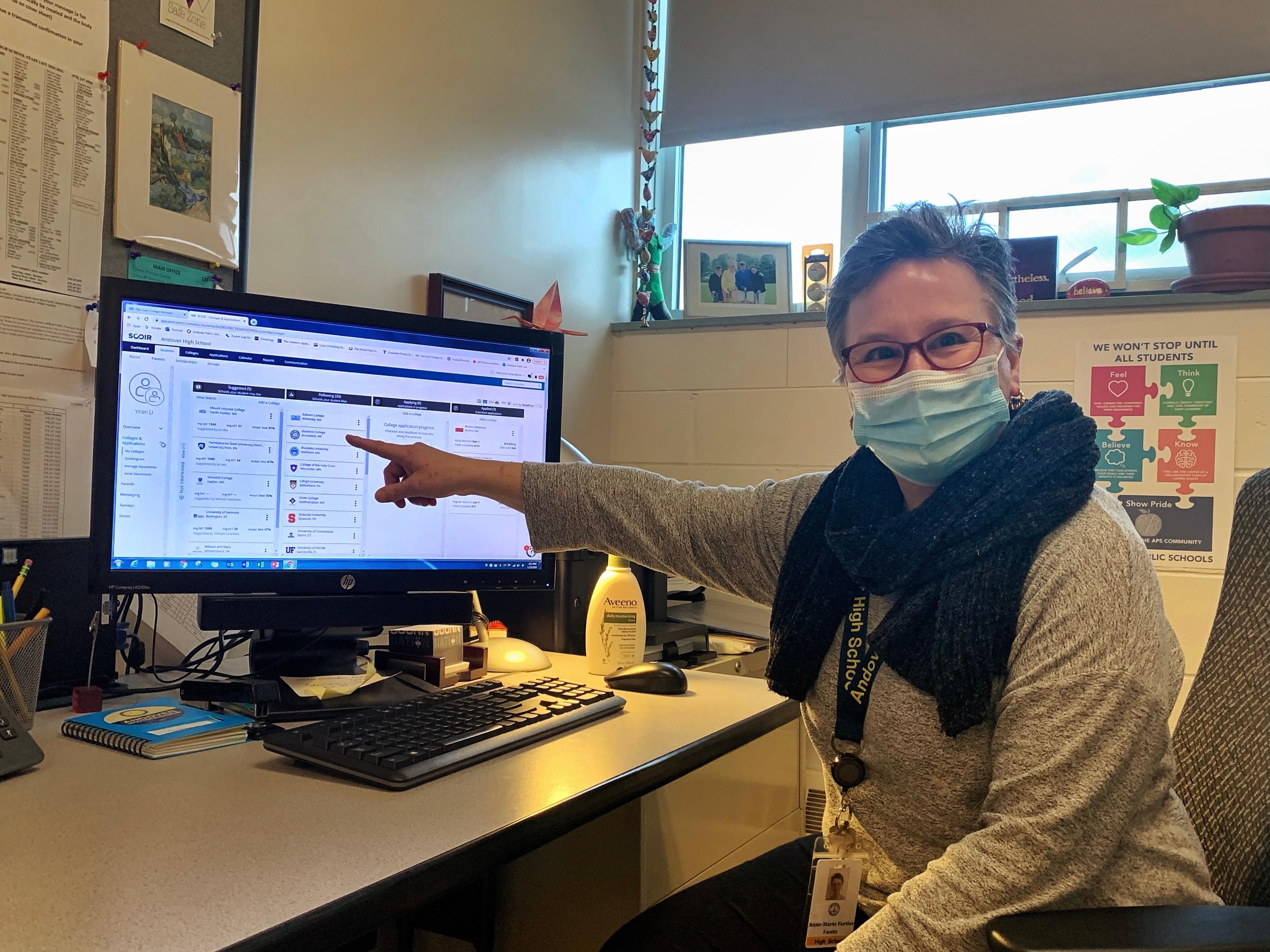
STAFF PHOTO/ Erin Li Ms. Fortier pointing and demonstrating how to use the SCOIR college search page.
Another great feature the juniors can use is the populated information part of this program. “Once you find a college in SCOIR, we have populated information about other Andover students that have applied and who have either been admitted or denied based on the variable of test scores or GPA,” said Fortier. This allows students to see if their test scores and GPA qualify for the college they are looking for and helps them narrow down their choices for colleges. This makes the selection process (hopefully) a bit easier.
This program is also great for sophomores. Sophomores can use this to look at what they could possibly be interested in before going more in-depth in their junior and senior years. “There is a program acclimated with SCOIR that is related to career development… we are still putting some finishing touches on how we want to present that material,” said Fortier.
If you are still nervous about searching for college and don’t know where to start, here are some tips and tricks from our seniors to help you in this experience.
The college search can become very stressful when you don’t know where to start. “Recently, college searching has been making me really nervous,” said Mishaal Khan. She is a junior and started looking at colleges the summer before her junior year. “I’m excited, I know it is a new chapter in our lives and it is a chance for us to study and learn about something we are interested in as individuals.” Her enthusiasm is a great start. But let’s give some tips and tricks from two of our very own seniors, Sophia Yannalfo and Charles Hoffman!
COURTSEY PHOTO Sophia Yannalfo wearing her Northeastern University sweatshirt.
Sophia Yannalfo was recently accepted into Northeastern University in Boston and Charles Hoffman has finished his college application process. Both Hoffman and Yannolfo were both very excited about the academic side of things which is very important. If a college doesn’t have what you are wishing to study, this can help narrow this list down.
“Utilize your guidance counselors, utilize your peers, especially if you are a sophomore or a junior that is starting to look at school,” Yannolfo said. People who have already been through the process can be a huge help, such as your older peers or even older siblings. Your guidance counselors also know a lot about you, so they can help you find the places that could match your interests.
An open mind is also incredibly important. “We didn’t know we were going to be in a global pandemic and that we would have to apply to colleges in the middle of [this],” she said. “Keep your options open because you might be set on one thing your freshman and sophomore year and then you end up changing your mind completely.”
COURTSEY PHOTO Charles Hoffman finishes his college application process.
Both Yannolfo and Fortier recommend communicating with your parents. “I think a conversation with your parents is probably the first thing to do. Even if you aren’t initially on the exact same page,” Fortier said, adding that keeping your parents informed is important for the topics of expectations for each other. Financial aid might also be discussed and scholarships as well.
And the last general tip is good organization. “Start as early as the beginning of your junior year,” Yannolfo said. “Just kind of look at what you’ve done throughout high school so far… the whole organization factor is so so important.”
Hoffman agrees with this as well. “I definitely wish I worked on this more in the summer, because the time crunch right now is no joke!” he said.