ESIC Students Bring Youth Sustainability Fair to life
  • May 20, 2025

Janaesa Macasaet || STAFF WRITER

The second annual Youth Sustainability Fair was held at the Cormier Youth Center on Saturday, April 26. Organized by seniors Lincoln Pekock and Sarah Waters, the fair aimed to promote youth work in climate activism.

With around 200 attendees, the two-hour fair included a sports gear swap, toy swap, clothing swap, and interactive booths. Pekock and Waters organized the fair through the Environmental Sustainability Internship Course (ESIC), partnering with Andover WECAN. Science teacher and ESIC advisor Melanie Cutler found the experience to be hopeful.

“Often when we hear about climate change, we hear about the bad news,” said Cutler. “The point of this fair is to share all the good news. There are a lot of great things happening right here in our community that I think a lot of people don’t know about.”

Apart from ESIC students, members of the Environmental Club, Garden Club, Fashion Club and AP Environmental Science students attended. Those from organizations and surrounding schools such as Phillips Academy and Greater Lawrence Technical School also came, offering new insights to AHS students. 

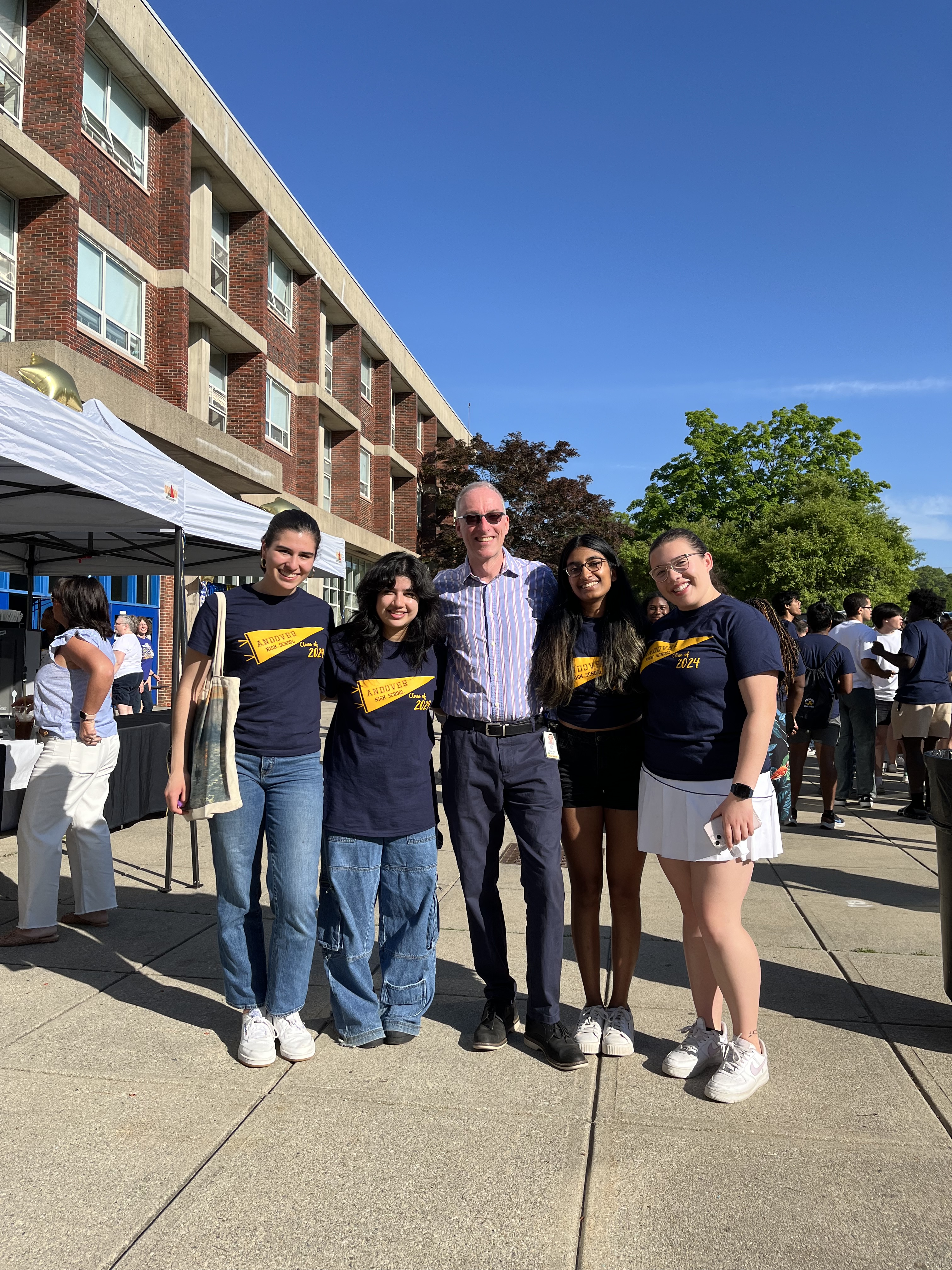
High school, middle school, and elementary school students at the fair

“It was impactful…it’s great to see new ideas, new perspectives. There were ways for us to improve that were mentioned,” Grant Gaden, a sophomore and Environmental Club booth volunteer said. “It was great to meet people who had similar interests, who brought new ideas to the table that I hadn’t considered when it comes to sustainability.”

Sharing a similar sentiment, Pekock said, “It was really great to get to see into the middle school and elementary school education system [and] how they teach about climate change and things such as that.”

The fair opened the floor to people of all backgrounds to discuss sustainability—among them was Massachusetts State Representative Tram Nguyen, who presented to attendees. 

Cutler said, “She came and gave a nice moving speech…and was really encouraging…she’s now working [at a] state government level on a lot of sustainability initiatives.” 

For students interested in climate activism, ESIC offers a range of opportunities, whether it be planning the Sustainability Fair or writing articles for a non-profit. The course encourages students to use their skills to make a real-world impact. Waters aims for her and Pekock’s project (the fair) to have created a positive impact in the community, and reduce worries. 

“I’m sure there’s a lot of climate anxiety, especially being in Massachusetts where there is a lot of recognition for it, but I would hope that people gain some hope just to see how many initiatives there are,” said Waters.


Continue reading
Environmental Initiatives Take Hold in Andover, at AHS
  • March 17, 2025

Anushka Dole || ONLINE EDITOR

The Andover Green Advisory Board has taken on several initiatives to increase the overall sustainability of AHS and the town of Andover as a whole.

The advisory board was created around 2008 by the then-Director of Planning and Land Use, Paul Materazzo. According to the town of Andover’s website, the intent of the board was to “provide support and advice, which contribute to practical environmental solutions, to various town boards and town departments in Andover”. Members on the board are appointed by the Town Manager. 

Environmental Science teacher Melanie Cutler is one of six members serving on the board currently, and she articulated the goals of the board in more detail.

“The main role [of the board] is to advise [the] town government in improving the environmental sustainability of our town,” she said. “That includes things like energy reduction, pollution reduction, and decreasing water use.”

One of the board’s most significant efforts in recent times has been supporting the construction of the new, green West Elementary school building.

“For the new West Elementary School, the [board] was involved early in the planning process,” Cutler said. “Some [board] members attended public planning meetings with the architects to encourage environmental sustainability features in the design.”

Designed by Cambridge architectural firm SSMA, the new school building underwent a 36.7% carbon reduction compared to the original building. The building is also 100% electric and ready to be net zero. 

Thanks to the board’s efforts, Andover has been designated as a “green community” by the state, which has opened up opportunities for grants that have been used to reduce energy consumption in schools and town buildings. These grants have enabled the replacement of traditional street lights with energy-efficient LED lights.

In addition to the grants earned by the green community designation, the board works with Dr. Losick Yang, Director of Sustainability, and the Energy Director Janet Nicosia, to apply for new grants.

“We do what we can to support [Yang] and help her in her efforts,” Cutler said. “She’s the official town employee, and we are the volunteer group that talks with the different town departments to see how we can help them do things more sustainably.” 

The board’s initiatives also focus on enhancing environmental education and improving indoor air quality.

Because of the availability of environmental education, clubs such as the Environmental club and the Garden club have flourished at AHS (see sidebar). 

Students in AHS courses, such as ESIC, also help contribute to the goals of the board. ESIC is the Environmental Sustainability Internship Course, and it is a course for seniors who would like to conduct an environmental project over the course of the year. A particularly interesting project from ESIC, from 2015, involved students studying indoor air quality at the high school. They investigated volatile organic compounds (VOCs).

“There are a whole bunch of things that can reduce air quality in schools… VOCs are one,” Cutler said. VOC stands for volatile organic compounds, and they are chemical fumes that you can smell coming from things like paint, furniture, or flooring. The study conducted at AHS revealed that there are no VOCs at AHS, which is a major step towards indoor air quality improvement.

Continue reading
Climate Change: An Opinion
  • February 13, 2023

By Anushka Dole
STAFF WRITER

Climate. Change. On their own, these words are as common as any others; something not worth a second thought in the busy commotion of our daily lives. Yet, when these unassuming words are put together, they create a bombshell of a phrase that threatens to destroy the very fabric of our society. The topic itself is shrouded in controversy, and discussions often end poorly. However, it doesn’t have to be this way. We must open up the conversation if we are to solve this issue. 

“Biodiversity is in crisis, the climate is in crisis, there’s going to be big, big changes in the 21st century, and I think it’s really important that people know and understand,” said Alexis Valenti, who teaches environmental science at Andover High School.

In order to truly understand climate change, asking questions is essential, and one of the key questions in many of our minds is, “Why is it so hard to get rid of climate change?” 

Melanie Cutler, who teaches AP Environmental Science and the Environmental Sustainability Internship Course (ESIC) has the answer. “The biggest challenge,” she said, “has been that, for whatever reason, fighting climate change has become a more political issue than it needs to be.” Indeed, as per Truthout News, in the US Senate, one in every four senators holds investments in the fossil fuel business. The giant industry has generated nearly $2 trillion in profits since 1990, making it very lucrative to invest in. 

Besides the political snags, there are also scientific issues to contend with. The problem lies at the heart of modern living: almost all the contemporary comforts we enjoy are fueled by fossil fuels. Everything, from our TV to home heating to transportation, relies on fossil fuels—even things we wouldn’t normally consider, like concrete (the world’s third largest emitter of CO2, according to the BBC.) 

One may argue, “Why don’t we just shut down the production of oil as soon as possible?” Though it may seem like the obvious solution, implementing it is not as simple as it seems. The renewable energy technology we have right now is just not up to the mark. Scientific advancements, along with political coordination, must be made if we are to use entirely renewable energy.

Fortunately for us, there is no shortage of ideas in searching for solutions. Valenti and Cutler both have insightful thoughts on ways that society as a whole could tackle this problem. “Environment shapes behavior, so if you want people to behave in a certain way you have to set up the environment… to make it easier to do the right thing,” said Valenti. An excellent example she gave was that in New York City, “many people… don’t own cars because of the high costs and big hassle of owning and driving a car there; it’s much easier to walk and take public transportation.” 

For Cutler, the biggest thing that American society can change in order to contribute to solving climate change is “wean ourselves off of fossil fuels and switch towards renewable.” In addition, she said “we need to improve our whole electricity grid and develop a lot more battery technology to store wind and solar power.” In this aspect, there is good news: according to a recent article from the Boston Globe, carbon emissions from the national electric grid have fallen—a sign that innovations are being made thanks to the coordination of science and politics. If political leaders give science the funding it needs, it is possible to revolutionize renewable energy technologies. 

Climate change is a wide-reaching problem with dire impacts, but that doesn’t mean we should lose hope. “The most important thing is to help people understand we need to be more conscious of how we live,” Valenti said. Spreading awareness and taking action are things that we can all do together, whether it be through participating in our school’s Environmental Club, using a carbon footprint calculator to find and eliminate our personal emissions, reducing our meat consumption, or even bringing a zero waste lunch. We can also lobby our local and state governments to act for climate change. Our involvement and enthusiasm is what will propel us forward. 

The pursuit of science and politics will be essential in tackling global warming, and our school has opportunities for education here as well, including the Intro to Environmental Science course, Advanced Placement Environmental Science, and ESIC. There are a number of ways we can contribute to combating climate change in our own town, and perhaps use the same skills to improve larger communities.

As Cutler eloquently phrased it, “For every problem we talk about, we talk about lots of solutions, and there’s lots of good news on the horizon.”

STOCK PHOTO / Climate change

Continue reading