Spanish Department to Host Day of the Dead Fair
  • November 12, 2025

Areeta Faiz || Social Media Editor

A cultural fair celebrating the Day of the Dead will take place during H Block this Thursday in the cafeteria.

The fair will include a variety of hands-on activities, music, and food, allowing students to explore several popular Mexican traditions. The event has been organized by students from the Spanish Conversation Club led by teacher Sylvia Danos and AP Language and Culture classes taught by Indira Garcia. This will be Andover High School’s first year hosting this celebration.

“Students from all world language classes will have the chance to experience one of Mexico’s most meaningful and beautiful traditions,” said Danos.

Stations will include the traditional ofrenda (altar), calaverita (mini skull) painting, papel picado (colorful, decoratively cut paper), the classic Mexican game Lotería, and a chance to try traditional Mexican sweet treats.

Students can participate by signing up for the H3 block with their world language teacher, who will then bring them to the cafeteria where the fair will take place.

“This celebration reflects the values of love, memory, and cultural identity that are central to many Latin American traditions,” said Danos. She added that experiences like this help students appreciate the richness and diversity of the Spanish-speaking world while fostering empathy and global awareness.

Traditionally celebrated in Mexico and other Latin American countries on November first and second, Día de los Muertos honors deceased loved ones through family, music, food, and art. A key tradition is the creation of an ofrenda, or altar, decorated with photos, candles, and offerings to remember loved ones who have passed.

AHS has showcased the student-made ofrendas for the last seven years as a part of the World Language Department curriculum. This year, Danos and Garcia decided to go all out, believing that it is essential for students from other language programs to learn about this celebration.

Danos is excited to see students from diverse language backgrounds come together to celebrate culture, creativity, and diversity: “Enjoy music, crafts, food, and culture, all in one H Block!”

Continue reading
Funding the Future of Science: Proposed NIH Funding Cuts Throw US Biomedical Research Into Uncertainty
  • November 4, 2025

Anushka Dole || Online Editor 

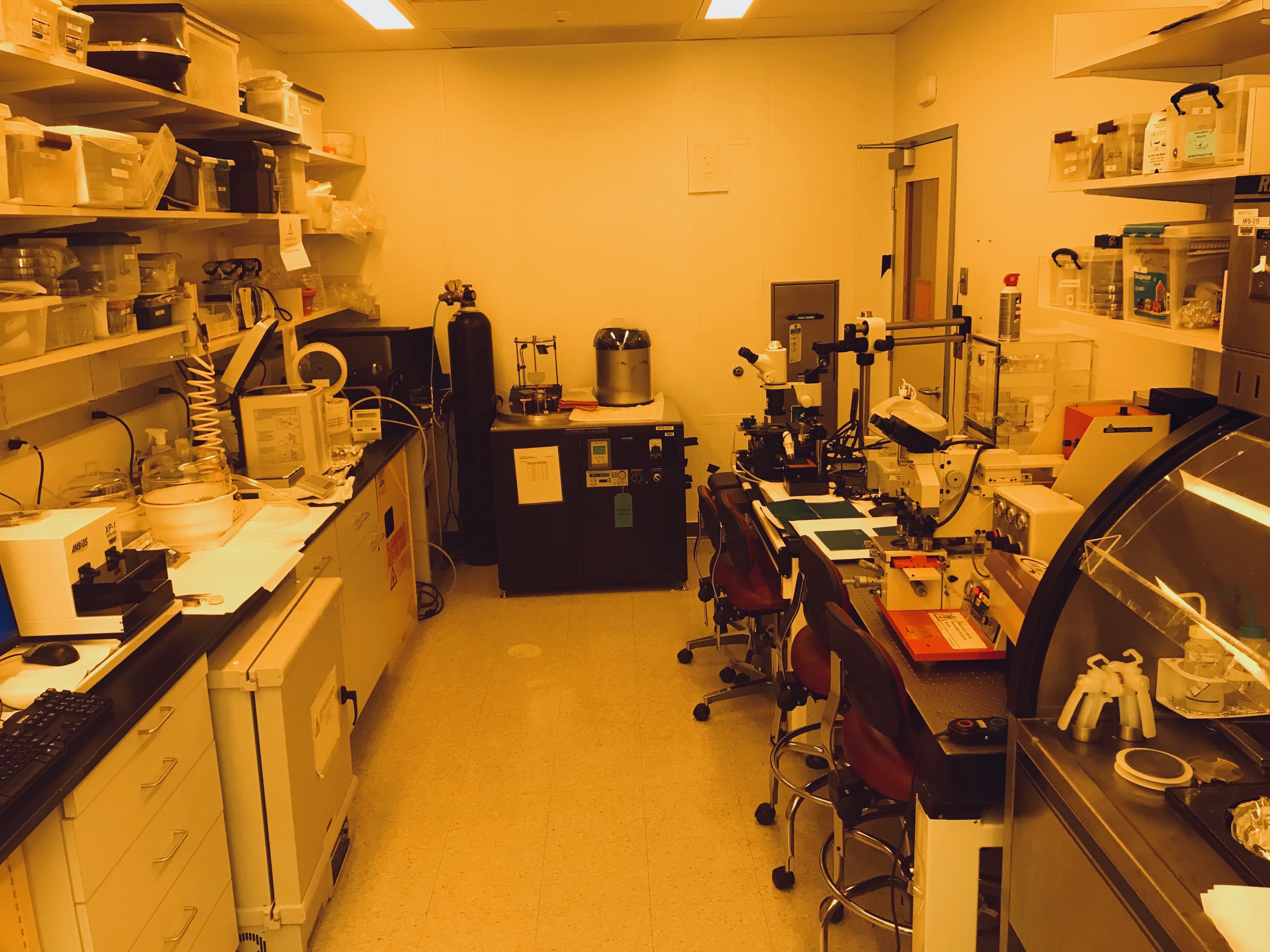
In the sunlit Orkin Lab at Harvard Medical School, lab technicians diligently carry out their experiments, pipetting meticulously into Eppendorf tubes. Next door, in a darkened room, a team of researchers are  huddled around a fluorescence microscope, tracking how gene‑editing tools can restore crescent-shaped red blood cells into their healthy state—a pathway the Orkin team helped pioneer.

Like the Orkin Lab, countless biomedical research labs across the United States engage in lifesaving research every single day. Their research is now in jeopardy. Funding inconsistencies in the National Institutes of Health (NIH), including proposed cuts to indirect costs and the halt in federal funding due to the current government shutdown, threaten to stall progress and could have lasting detrimental effects on both the ongoing research and the communities that rely on it, including Andover.

In April, the NIH cancelled $800 million in grants that it had already approved because the projects didn’t align with the Trump administration’s policies. In July, a federal judge then ruled that the cuts were unlawful, which restored research funding. According to the Boston NPR station WBUR, the US Supreme Court ruled that the NIH can withhold the grants in August.

In addition to withholding the grants, the Trump administration is proposing to significantly reduce funding for “indirect” costs of research, supported by the narrative that the funds “were largely administrative bloat, unrelated to the costs of research.” According to the Harvard Crimson, these indirect funds include costs such as lab construction, research equipment, hazardous waste removal and “countless other very real and necessary costs of research.” For institutions in our own backyard, the impact is tangible: Harvard University stands to lose hundreds of millions of dollars, a blow that could ripple across its affiliated hospitals—including Boston Children’s Hospital, Brigham and Women’s hospital, Dana-Farber Cancer Institute, Massachusetts General Hospital, and many more. Across the country, other US institutions stand to lose billions more.

To fully understand the effects of the funding cuts, it’s important to start at the source: with the research itself. Research is a long, iterative process, full of ideas that start small and experiments that may or may not work. Unlike labs and experiments in school, where the outcome is clearly defined and predetermined, research can be filled with dead ends and uncertainties.

It often begins with something as simple as an idea. Dr. Nathan Crook, an associate professor in the Department of Chemical and Biomolecular Engineering at North Carolina State University, described a project’s start as the moment you first think of a concept, and the end as the moment you stop actively working or thinking about it

“Normally, you or someone in your lab has a flash of insight… at these early stages, you usually don’t have dedicated funding for it,” he said. Early experiments are often small-scale pilot tests that can be supported by seed-funding (typically around $10,000) from the university, or a research foundation. More senior researchers may have access to discretionary funds – “rainy day” funds to use on early projects that aren’t bound by any specific research question.

Dr. Sara Smaga, an AAAS Congressional Science and Engineering Fellow and former Executive Director at the NSF Center for Genetically Encoded Materials, added that this initial stage is the beginning of a longer iterative process.

“In academia, faculty choose what topics they want to study…often a student will collaborate to design their project within their advisor’s topic area,” she explained. “The results of each experiment generate new questions, leading to further hypotheses, even if the initial result is ‘nothing happens!’”

Each experiment can quickly expand into multiple interconnected projects. Each project requires more resources, which are obtained by funding, typically in the form of research grants.

“Let’s say the pilot test goes well, and you get some interesting data,” Crook said. “You will then likely apply for a ‘normal’ research grant using those results as preliminary data. Usually the cool projects are kind of crazy, and the grant reviewers won’t believe that you will be able to do what you are proposing unless you have some sort of proof-of-concept that it is working.”

These grants can come from a variety of sources, including private foundations (such as the Gates foundation or the Chan Zuckerberg Institute), federal funding, internal university funding, state grants, or industry funding. 

“Generally, a Principal Investigator (usually the senior faculty member overseeing the lab), will craft a proposal describing what they’d like to study and why, and submit to a funder,” Smaga said. “After submission, proposals are reviewed by a panel of experts in the field, who evaluate each proposal for feasibility and impact. Not every proposal is funded, and sometimes it takes multiple tries to write a proposal that gets chosen for funding.”

If a proposal isn’t funded right away, researchers often continue the project on the side, refining their ideas and re-applying for grants until they can secure official funding. Once secured, labs can expand, hire more researchers, and pursue the project in earnest. Ultimately, the most significant source of funding for research projects—especially in academia—comes from federal funding, typically the NIH.

“Most of the funding in every lab I’ve ever been a part of has come from federal funding,” Smaga said. Crook agreed, stating that “the most important [source of funding] by dollar amount, are federal grants,” and that “federal grants have funded 77 percent of the research in [his] lab.”

This reliance on federal support means that any disruptions in the grant cycle—whether from delays, government shutdowns, or the proposed cuts to indirect costs at agencies like the NIH—can ripple far beyond the walls of a single lab, outpouring from academia to industry, and eventually, impacting the lives of citizens. The money from NIH funding is a key part of funding early-stage projects, like projects being worked on by Smaga and Crook, laying the foundations for industry to develop novel therapeutics. 

“Just one example: NIH-funded research on bacterial immune systems gave us gene editing, which is now being used to cure sickle cell and rare genetic diseases,” Smaga said.

Jackie Thompson, who works on targeted cancer treatments at Takeda Pharmaceuticals in Cambridge, agreed. “My current work involves developing cell and gene therapies for cancer,” Thompson said. “These treatments rely on decades of foundational research…that was often NIH-funded.”

For communities like Andover, where students and educators are deeply connected to Massachusetts’ vibrant research ecosystem, those losses hit especially close to home. Sarepta Therapeutics, a biotechnology company with an office in Andover, develops gene therapies that depend on the same fundamental research NIH grants have long supported. 

At AHS, the BioBuilder club gives students hands-on experience with synthetic biology research, and the opportunity to work on projects that can be published in a student research journal. While BioBuilder opens doors for aspiring scientists, those doors exist within a larger research ecosystem that relies on consistent federal funding.

“It’s not something that you can just reinstate the funding and think that things are going to pick up as normal,” said Dr. Lindsey L’Ecuyer, the advisor of Andover High School’s BioBuilder club. “When people set up a lab somewhere else, they’re not coming back… it’s going to make it really hard for us to come back from that.”

L’Ecuyer sees the loss trickling down to high school classrooms, mentorship programs, and the students who might have been inspired to pursue science in the first place. “It feels like we’re losing a whole generation of people that would be coming to do research in the U.S.,” she said. “America has been a leading country in scientific research, and it’s going to make it really hard for us to come back from that.”

Crook agreed. “Other countries certainly aren’t reducing research funding, and guess where top scientists—even US citizens—will go? It really hurts our country’s economic…and actual…security to reduce research funding.”

Smaga also worries that America could lose a generation of scientists, and she’s already seen the early signs. “This past cycle, we saw graduate programs responding to funding freezes and future funding uncertainty by admitting fewer students,” Smaga said. 

Biomedical research supports far more than scientific discoveries and the university labs that make them: according to the nonprofit United for Medical Research, every dollar of NIH funding generates about $2.56 in economic activity. The stakes of losing consistent funding are clear in places like the federally funded Orkin Lab at Harvard, where gene-editing research is already transforming lives. The lab is a clear example of how federal support fuels the discoveries that save lives, and it continues to inspire students and scientists to pursue the next breakthroughs. 

“It’s a challenging time to be in biomedical research, but I’m still optimistic about the field,” Thompson said.

“For students who want to get into science, the advice is simple: start early, get involved, and follow the questions that excite you,” she said. “Even sending an email to a professor whose work interests you can open doors. Despite the obstacles, the next generation of scientists has a real shot at making a difference—and it could be your curiosity that drives the next big breakthrough.”

Continue reading
Student-Hosted Video Game Hackathon Scheduled for Late September
  • September 22, 2025

Anushka Dole || Online Editor

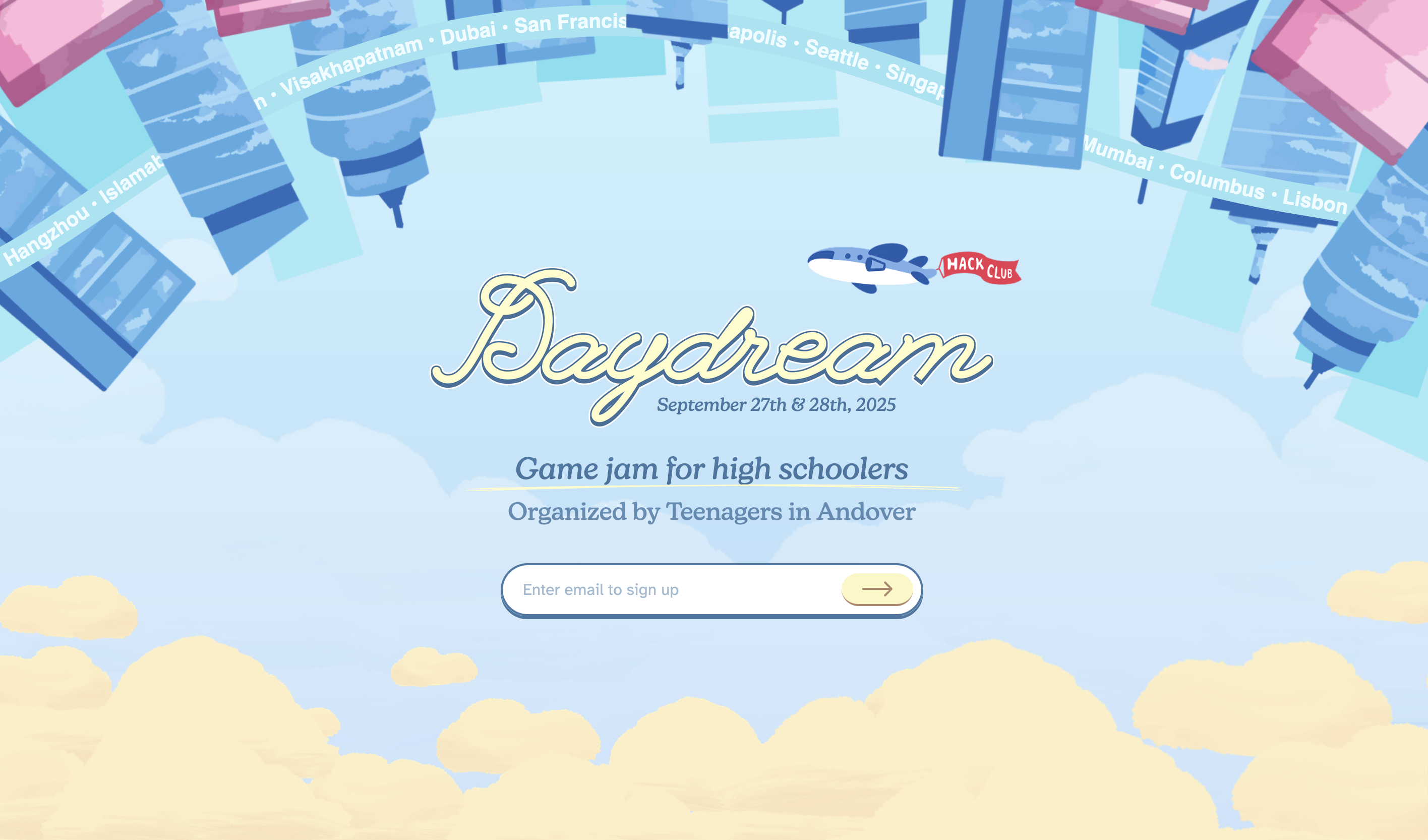
Daydream Andover is a two-day hackathon for high school students that will be held at Merrimack College on September 27 and 28, with prizes available for the winning teams. 

At a hackathon, students come together to code a project over a short period of time. Daydream is a game-jam, which is a subcategory of a hackathon, where students will collaborate to create a video game during the event.

The hackathon is being organized by a team of three students, AHS seniors David Shi and Jessie Wang, as well as Emily Fang, a senior from Phillips Academy. Designed to be beginner friendly, Wang, Shi, and Fang are hosting workshops for beginners during the event to give them the tools they need to build their projects.

“We’ll teach them how to make a project on Godot, one of the simplest languages to make a game… we run workshops, and then we let them code,” Wang said. She added that artists and musicians are also encouraged to come to Daydream, as their contributions are essential to designing a game.

The first day of Daydream runs from 10am to 8pm, and students are encouraged to start their games the moment they arrive. Teams of up to four people are allowed, and team selection can happen at any time during the event. Each game will follow a set theme which will be announced on the day of the event.

“We get to pick one out of the ten themes that are sent to the organizers, but those haven’t been released [to the public] yet…basically, it’s a mystery,” Wang said.

Amenities will also be provided for coders during the events, including lunch and dinner on both days. There will also be prizes for the top three teams after being judged by the organizers. 

Wang, Fang, and Shi all came together to host the event out of a shared passion for hackathons, bringing Daydream to Andover by working through the California-based nonprofit Hack Club. 

“We had the best time ever [at Shipwrecked, a hackathon held at Cathleen Stone Island]. I met friends that I never thought I would meet… [hackathons] opened my mind to new ideas, it’s a very valuable experience,” Wang said. 

Shi agreed, adding that “you get to learn how to build a lot of cool things, and make lasting connections.”

When asked what they hope students will gain from the event, Fang stated that she simply hoped that they would “gain a new friend,” as well as get their foot into the “doorway into programming.”

Daydream is accepting sign-ups until the day of the event, at this link.

Continue reading
World Languages Coordinator Reflects On Career, Retirement
  • June 9, 2025

Avery Slaughter || STAFF WRITER

Peter Hall, program coordinator of World Languages at Andover Public Schools, is retiring this coming September. Hall has been working in the district for 35 years.

Hall’s career at APS commenced in 1995. Over the span of 27 years, he taught both French and Spanish at levels ranging from beginner to Advanced Placement before transitioning into the role of program coordinator in 2022.

Overall, his experience at APS has been a positive one.

“I am fortunate to say that I have enjoyed my years here,” said Hall. “I have had a lot of wonderful students who make each year a little different. […] It’s been a lifetime of memories and experiences.”

Over the years, Hall has worked with students in and out of the classroom in an effort to inspire interest in other cultures. His passion for foreign languages began in middle school, and he has since strived to share that enthusiasm with others. Hall traveled with students to France seven times as part of the French Exchange Program and led the Spanish Exchange Program trip once. Additionally, he chaperoned numerous other international trips offered by APS.

“As a language teacher it has been my passion to share my love for travel and learning about other cultures with students,” Hall said. “It provides an opportunity to get to know students outside of the classroom and broaden their perspectives on the world.”

Watching students grow as people throughout trips abroad has been one of his favorite parts of his job, Hall said. 

Moreover, his years of teaching have defined who he is as a person. Much of who he is has been shaped by his career in teaching, explained Hall. He plans on taking that educational mindset with him into the future.

Hall’s positive impact on the World Language Program hasn’t gone unnoticed by teachers who know him. Between his contributions to the various programs offered by the department, years of teaching multiple languages, and guidance as program coordinator, he will be missed in retirement.

“I think he’s a great person,” Spanish teacher Teresa Peralta said. “It’s hard for us to let him go, but I think each person has a mission and I think he’s ready [to retire]. We want to say thank you for all the work that he has done, and for teaching us as well.”

Continue reading
CollegeBoard Scores 1/5 on AP Testing Administration
  • June 9, 2025

“Once you enter the start code, you may begin.” With these words, hundreds of AP Psychology students at AHS expected to start their AP exam. Instead, they were greeted by a laggy, glitchy BlueBook testing app that refused to cooperate. For the students who were unable to coax the app into functioning, the exam was delayed to May 21—a poor solution for students who spent a whole year preparing for that moment. 

We at ANDOVERVIEW believe that the fragile testing infrastructure of CollegeBoard is absolutely unacceptable. One would assume that a nonprofit organization that claims to be “paving the path for college success” would ensure that its testing platform relies upon servers that are able to handle the increased traffic on testing day. CollegeBoard provided very little consolation to the adrenaline-crashing students. “Most students have had a successful testing experience, with more than 5 million exams being successfully submitted thus far,” the organization defended. The statement was tellingly short—PR representatives at CollegeBoard couldn’t be bothered to devote any longer than a five-minute coffee break to drafting this “apology.” 

Unfortunately, technical glitches are not the only issues that CollegeBoard has encountered this AP season. After a slew of hate comments were slung in author Namwali Serpell’s direction, she discovered that the vitriol was directed towards one particular passage in one of her books. The infamous “Look at Me” passage was recognized by this year’s AP Lang students as an indecipherable jumble of content followed by some seriously difficult multiple-choice questions (MCQs). After learning this, Serpell revealed that CollegeBoard had included the passage in the test without her permission and distorted its meaning in the MCQs that followed. Adding insult to injury, Serpell also clearly stated that she was against standardized testing as a concept. As of late May, CollegeBoard had yet to address these comments.

The negligence of CollegeBoard has created a sorrowful state of affairs for those looking to take advantage of the benefits of AP courses and exams. To no one’s surprise, the corporatization of education has introduced far more harm than benefit to all involved. We can only hope that CollegeBoard will hear and fix some students’ criticisms.

Continue reading
Grounds for Concern: Caffeine addictions that plague the community are keeping students up at night
  • March 8, 2025

Areeta Faiz || STAFF WRITER

AHS sophomore Jiya Jotwani has perfected her beloved Starbucks order: a grande iced sugar cookie almond milk latte, or perhaps a peach iced green tea. She says they keep her chronic procrastination in check, in addition to being a sweet treat to enjoy after a long day.

The sun has barely risen when sophomore Adelaide McLean stops by Dunkin’ before school for her daily 20-ounce mocha latte. She had managed a good rest the night before, but the threat of a midday headache keeps her routine alive morning after morning.

Junior Lex Malsky, with a soft spot for energy drinks, reflects on his former addiction that led to a whopping four hours of sleep each night during his formative years. The 2020 “alternative” culture that was in reality quite popular featured Monster Energy, bearer of an infamous 160 milligrams of caffeine per can.

No matter who you are, the typical Andover High student is no stranger to late nights, heavy eyelids, and promises to oneself to “lock in” on sleep, only to get pushed back week by week. According to the Centers for Disease Control and Prevention (CDC), caffeine seems like the holy grail that would keep 73% of U.S. adolescents from slipping into despair. 

Billions of people around the globe are drinking coffee each day, and dangerous doses of caffeine are hardly ever consumed in one sitting. Still, the world’s most popular drug is far from harmless, and AHS feels its effects every day.

“One cup in the morning can help give you some energy throughout the day, but that’s really not what’s happening,” said health teacher Candice McVeigh. “That’s not how adolescents tend to use it.”

“I probably see a handful of students buying the same drinks every day, which isn’t many considering the population of the school,” said AHS cashier Pamela Anderson. “Overall, these drinks are very popular.”

According to Anderson, AHS began selling coffee to get students to class on time. “They were often tardy since they would go to Dunkin’ or Starbucks to get their coffee before school.” Taylor Pirog, the Andover Public Schools Assistant Director of Food Services, is concerned, however, that students may be buying too much in a day and it is not being regulated.

It’s no debate that often, caffeine is the only realistic way students can maximize the little time and energy they have. Of course, students aren’t drinking caffeine just for fun. Between study sessions, concerts, tech weeks, and early morning practices, coffee and energy drinks feel like survival tools more than anything. 

It’s a vicious cycle: when people become reliant on caffeine, it becomes part of their routine, and consistent use is exactly when it becomes harmful. “You’re going to sleep later, so you want to wake up later, yet you really can’t because you have priorities,” said McVeigh. “And the cycle keeps going because you use the caffeine to stay up the next night.”

Getting addicted doesn’t even always involve academic pressure or the caffeine itself; sometimes it just tastes good. The CDC reports that the growing popularity of energy drinks may be increasing caffeine intake among children and adolescents. Consumption of sweetened coffee drinks has also increased.“Especially with some of the larger drinks that people order, people don’t know how much caffeine is in there,” said McVeigh.

“I’m not sure how many milligrams there are,” confirmed McLean when describing her daily order. “It’s a 20-ounce drink, but there’s other stuff in there.”

On top of this are the mimickers of caffeine. Many energy drinks have products in them that do equally as much as, if not more than, what caffeine does. “Whether it’s taurine or guarana or other additives. Even just sugar,” added McVeigh. 

But perhaps one of the most costly consequences of the drug is simply how detrimental it is to your wallet. The school offers a few choices, ranging from a dollar-fifty iced coffee to a three-dollar Uptime. Some of the more intricate Starbucks drinks can end up being upwards of seven or even ten dollars. 

“In the last five to ten years, more and more of these refreshers have been popping up. They’re expensive, first of all, which is a waste of money. And it becomes a habit,’’ said McVeigh. Often, three dollars a day quickly turns into a sum much greater than necessary.

Headaches, moodiness, and fatigue are all well-known side effects of caffeine withdrawal. McLean, for example, gets eight hours of sleep every night. Even so, “if I don’t have coffee in the morning, my head starts to hurt later in the day,” she said.

“When I started drinking [Monster Energy] very often, it caused me to sleep even less, and I was very irritable at the time,” recalled Malski, demonstrating how the drug ultimately creates a routine that does the opposite of what it’s supposed to.

So, how do we become more cognizant of our intake and break the cycle? McVeigh suggests herbal teas, water with fruit, and things that are hydrating to help keep you more alert. Exercise and putting screens away before bed are both things that can help get into a better sleep pattern.

Lattes, refreshers, and energy drinks are undeniably delicious. More importantly, they feel like the easiest solution to remain motivated on days it’s hard to stay awake. These beloved beverages are the reasons so many of us take trips to coffee shops in the mornings and vending machines between classes. But as coffee culture continues to grow, students may want to ask themselves: Are they really in control of their caffeine habits, or is caffeine in control of them?

Continue reading
Swim captain reflects on value of sports as final season approaches
  • December 13, 2024

By Avery Slaughter
STAFF WRITER

Luke Suh, a senior at Andover High School, is entering his final year on the boy’s swim team as a newly-appointed captain.

While he won’t be continuing to swim competitively in college, the sport has played a vital role in his relationships and identity as a person.

Though he had been swimming competitively since first grade, joining the school’s team in his freshman year was a big adjustment. The focus on community was very different from what he was used to on his various club teams, but the change was an overall positive one. While club swim had a more individualistic approach with an emphasis on personal skills and abilities, the AHS team focused on how they made each other better.

“On the high school team, I definitely feel like I’m doing something more than just for myself,” Suh said.

The emphasis on being a cohesive team assisted Suh in finding many friends at AHS through swimming. This was especially true when he was an underclassman. The shift up to high school was made significantly easier by his position on the team.

In addition to gaining a sense of community, competitive swimming has also helped him build character and leadership skills. As someone new to AHS, the sport assisted him in finding his place in the school. Alternatively, as a sophomore and junior, it allowed him to develop perseverance and discipline in an environment removed from academics. As a captain, that responsibility will be emphasized, but he plans to meet the new challenge head-on.

“I’m supposed to be a good example and all that does definitely build character,” Suh said.

Like many of the sports at AHS, the boy’s swim team is a large commitment. During the season, they meet every weekday for around an hour and frequently meet on weekends as well. Despite the long hours on the weekdays and the occasional meetings during Winter Break, Suh has kept a firmly optimistic attitude regarding the crowded schedule.

 Suh said a student should do clubs and sports because they enjoy them, not because they feel obligated to do them. In addition to swimming, Suh also participates in DECA and the Quiz Team. Because of these three activities, he doesn’t have a surplus of free time. His mindset has helped him balance all of his responsibilities. 

“It’s a commitment that you make,” Suh said, “and so I just tell myself that I’ve decided to do this, and I’m going to do my best with whatever I’m assigned to do.”

While he still loves swimming, Suh won’t be continuing his competitive career in college. Regardless, he will continue to swim as a recreational activity. It helps him maintain his physical health, but, more importantly, there is another major benefit he gains from it.

“I’m doing [swim] because I enjoy it,” Suh said. “So I don’t care how much time I have to spend or how much sleep I lose. I don’t care. It’s just about doing well.”

Continue reading
How Much Pep Could a Pep Rally Rally, If A Pep Rally Could Rally Pep
  • December 13, 2024

By Jillian Slotnick
SPORTS EDITOR

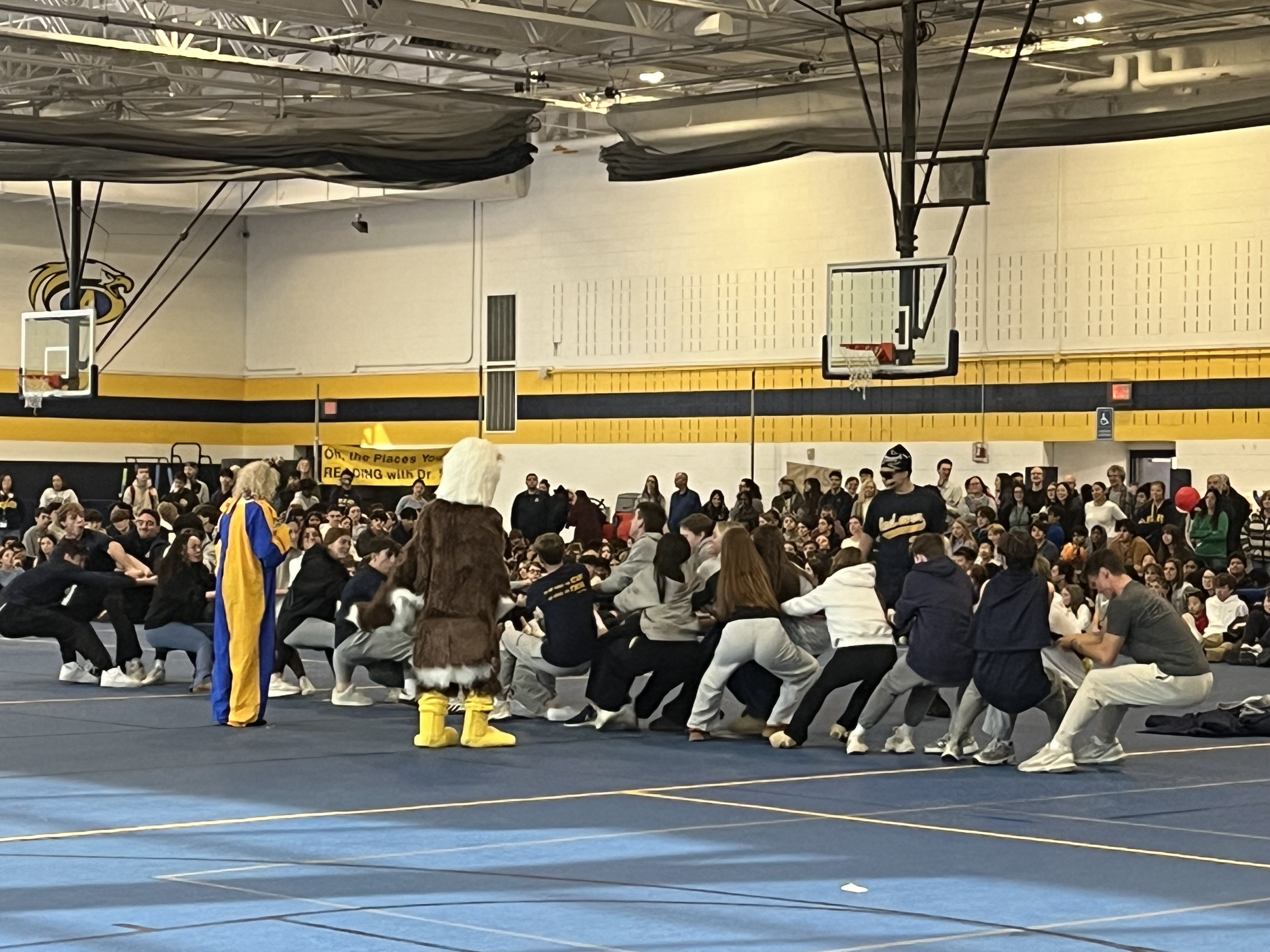
Student Government and the Jungle organized the celebration, which consisted of pie-eating contests, tug-of-war, and team competitions. This year, students took a major role in planning, as opposed to last year’s rally, which was mainly coordinated by Interim Principal Betty Taylor. The rally was attended by the entire school and had participation from students, teachers, and even Principal Jimmy D’Andrea. 

The pep rally is a tangible example of all the work student organizations, such as Student Government and the Jungle, do. Senior Salma Ali, a member of Student Government and one of the main pep rally organizers, said, “We want to get more people excited. A lot of people want to skip the last day or skip the pep rally, so we want to get people more excited, which is why we’re having the Jungle leaders as MCs. [Hopefully] they’ll get people hyped and push them to get involved and be a part of it for the next [few] years.”

Student participation is the heart of any successful pep rally, and at AHS, the energy students bring is unmatched. From chanting school cheers to yelling for their friends, the enthusiasm from the students sets the tone for the event. This year, a number of fall sports, from girl’s swimming and diving to golf, participated in the pep rally. The event planners hoped that competing in events like tug-of-war will serve as bonding experiences and demonstrate team unity. 

Unlike in past pep rallies, there was no teacher dance or speech from football coach Ernest Perry. Additional activities are the balloon relay, band performances, and Jungle Leaders also acting as MCs. These changes will hopefully allow for greater student engagement.

STAFF PHOTO/ Jillian Slotnick
Students collide during relay game.

The planning and care put into the pep rally is obvious, and reflected by the palpable excitement shown by the students during the event. Connor Acheson, a captain of the football team, said, “I love [the pep rally]. I think we should have more [of them]. I think the team and everybody in the school get super excited, and it’s a lot of fun: super high energy. And it definitely helps before the big game.”

Perry expressed a similar opinion. “The school really likes it and the players seem to like it [as well],” he said. ”Everybody’s really into it. The energy is great, especially so close to the game. I think it really gets us into that mindset of the Thanksgiving [game] and needing to give it our all because it’s the last time we’ll step on that field this season.”

According to Ali, the annual pep rally does not only increase excitement for the Thanksgiving Day football game, but also elevates overall school pride. By bringing the whole community together, it forms a stronger bond between AHS students. Even administrators have noticed the positive change pep rallies and the presence of the Jungle has on school spirit.

Athletic Director Wayne Puglisi said, “I think that the Jungle has had some great turnouts for our home football games. They’re very supportive of other sports [as well,] which is great to see since that’s not been the case in the past. I feel like school spirit is slowly coming back [after COVID and our changing leadership]. Just the way that students act in the Jungle, how they cheer, and what they do for the different teams and different programs; it’s pretty cool.”

Continue reading
Germs Gone Viral
  • December 13, 2024

By Samantha Sun
SOCIAL MEDIA EDITOR

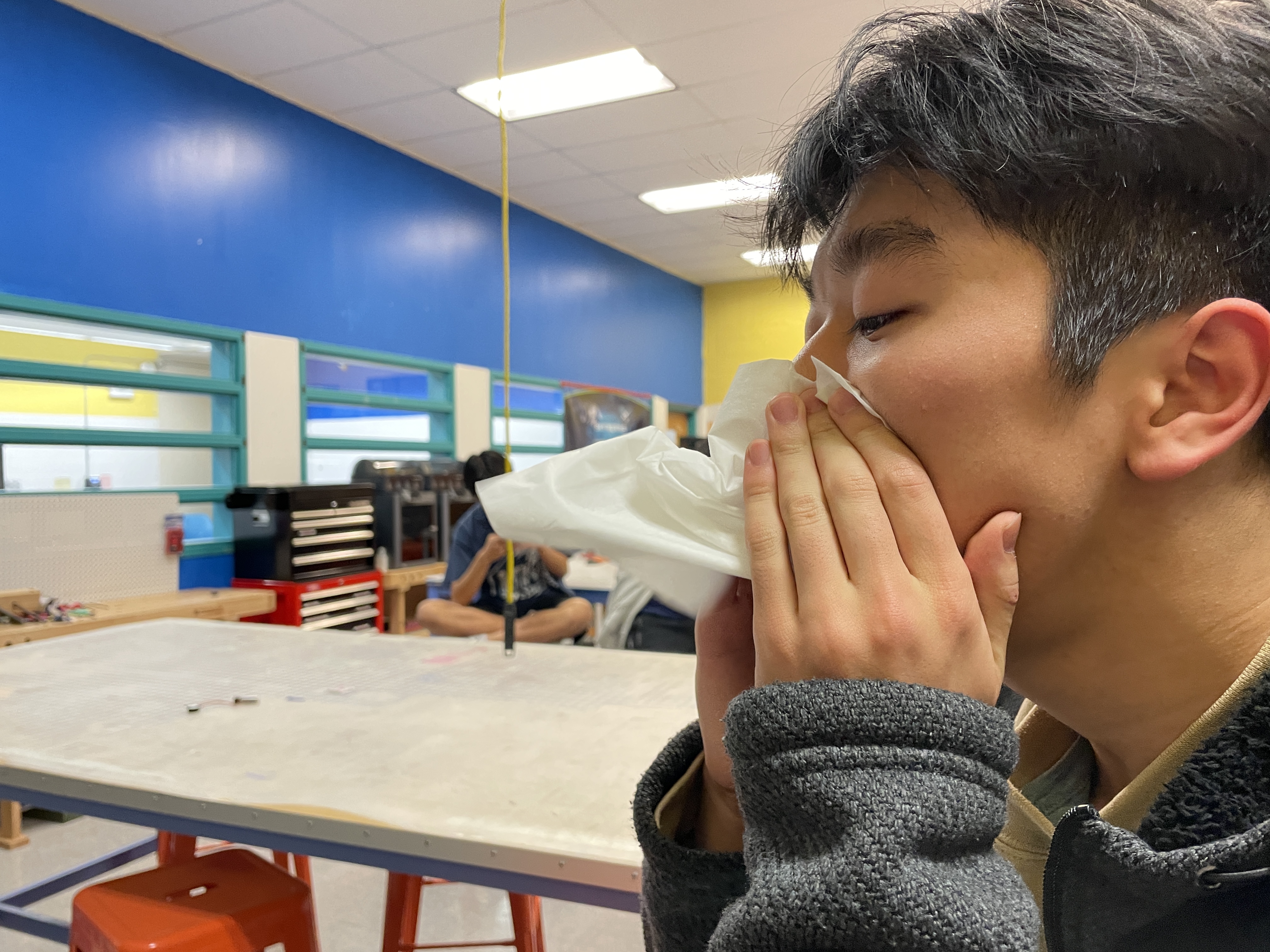
As the crisp autumn air gives way to the chill of winter, the familiar sounds of sniffles and coughs fill the hallways of Andover High School. Inside, classrooms are sprinkled with empty tissue boxes, weary faces, and feverish temperatures. 

For many students, this is a yearly struggle: balancing rigorous schoolwork while battling illnesses that leave them drained and struggling to keep up.

Junior Aki French knows the struggle all too well. On a recent chilly Sunday, a dull headache settled in, followed by dizziness. “I noticed my head [started to] hurt [and] I got super cold,” French said. Outside, she bundled up in six layers, trying to fight it off despite the weather. Already, she suspected that the illness might be more serious than the average cold.

The confirmation came swiftly—through a COVID test, she discovered the coronavirus had struck for the second time, the first time being in 2021 over quarantine. French wasn’t surprised; a friend of hers had recently tested positive for COVID. French theorized she caught the virus from her friend. French’s first and second experiences were similar; her days were filled with fevers, headaches, and resting to recover quickly. However this time, the sickness felt more daunting as a junior in high school.

Finally returning after a week of recovery, she found herself with a mountain of work. “I missed three quizzes and two essays because I got COVID,” French said with a sigh. As a hardworking student taking two AP courses, she had to put in extra effort to catch up with the rest of her classmates. This meant staying after school for tutoring from her physics teacher, finishing quizzes during H-Block, and getting through homework as quickly as possible. 

“It was very hard to manage… I think I managed it,” French laughed, reflecting upon her efforts to catch up. “But a lot of teachers and my guidance counselor helped me to arrange the schedule of testing and homework.” This was something French gratefully advised all students to do: ask for help from counselors, teachers, and parents. 

Health teacher Candice McVeigh expressed a similar opinion. “It’s important to advocate for yourself if you are feeling overwhelmed,” said McVeigh. Oftentimes, getting support helps lessen the stress and burden of getting back into school and making up work. 

Cases like French’s are all too common. Students often find themselves buried under work after just a few days away due to illness. Due to less sunshine and being indoors more, it’s easier to contract an illness, McVeigh explained.

“Schedules tend to get busier with the change of seasons,” said school nurse Heidi Katz. “People get run down and self-care is often not high on the priority list.” 

The most common illness? The common cold, which prompts the most visits to the nurse’s office. The flu is the second most common contender at AHS.

The flu and common cold are contracted through coughing, sneezing, or touching contaminated surfaces. The best ways to prevent them is by washing your hands thoroughly, getting lots of rest, and drinking enough fluids. There are also annual flu and COVID vaccinations, which can help lower the chances of catching them. 

“Everyone is so busy and anxious about missing school, clubs, sports, they don’t allow themselves to fully recover,” said school nurse Melissa Sucharewicz. 

While it can be nerve-wracking to miss a lot of school from being sick, if illnesses are not properly treated, they can potentially increase the length and severity of the sickness. It is best to let the body heal on its own before tackling school work, extracurriculars, or sports.

McVeigh observed that a lot of upperclassmen, especially those taking harder classes, often prioritize school work over their health. “First and foremost, I believe—maybe it’s because I’m a health teacher—that you have to take care of yourself to make sure that there is a balance [in your schedule],” she said. 

She emphasized that finding a balance includes taking care of homework assignments, having downtime, and taking care of the body properly. 

Finding time for each of these factors is the hardest part, as time management is not an easy task. Too much or too little of either of these can create a dysfunctional schedule. While schoolwork is a priority as a student, so is taking care of our health. It’s important for all students at AHS to remember that self-care is equally crucial as keeping up to date with homework and tests.

Continue reading
TEDxAndover Uplifts AHS Voices
  • December 13, 2024

By Janaesa Macasaet & Ariana Teasdale
STAFF WRITERS

A room full of people. A stage, bathed in light. The spotlight on Graham Igo. Murmurs spread throughout the crowd as the unexpected 15-year-old confidently strides out onto the stage. As cameras face him, he takes his spot in the middle. Clad in a professional blue velvet suit and tie, Igo captivates the audience’s interest. 

Igo spoke at the inaugural TEDxAndover event held at the Andover Country Club this past October. As he stepped on stage, Igo posed the question “how many of you have ever heard the term ‘be yourself’?” His speech, “The Cost of Fitting In,” featured personal anecdotes and skillful commentary on the societal pressures to conform, and the emotional effects of those pressures.

“I focused on others instead of myself, and when I did experience short-term satisfaction, I felt unfulfilled,” Igo said. “I was [just] doing what others were doing, which built up a lot of emotions.” 

TEDx events, different from TED conferences, are local and independently organized events. TEDxAndover is a newly established platform, organized by Andover resident Menka Hariani, that provides people with an opportunity to share meaningful ideas. Hariani was determined to create a platform in which she could empower diverse voices. Driven by a strong sense of purpose, she started working on the event application last year, and obtained the license for it in August. 

“As an organizer I was responsible for everything:” Hariani said, “finding the right speakers… pitching them… refining their scripts, finding the venue, all of the marketing… [in addition to] developing and designing the entire website.”

In just eight weeks, Hariani organized the first event, featuring five speakers and one performer. With overwhelming support from the Eagle Tribune and the AndoverMums Facebook page, the event was quickly assembled, and sold out with 100 people attending.

STAFF PHOTO/ Janaesa Macasaet
Organizer Menka Hariani introducing the first speaker.

“With very little time, and not having enough background in event management, there were a lot of challenges…,” said Hariani. “I feel very fortunate and lucky that I got to work with people who delivered very high quality…work and made it…successful.”

 Featured speakers presented on a range of topics, from health and well-being to life strategies. In the lineup was AHS sophomore Graham Igo. Sharing the stage with highly accomplished individuals—an Olympic gold medalist, a Harvard professor, two CEOs, and an NBA dancer—Igo was surrounded by those with far more experience. As a high schooler, he provided a unique, younger perspective. Drawing from his middle school days, he discussed his own struggles with identity and how he was pressured by peers to fit in. 

Even as a first-time formal public speaker, Igo was confident in his abilities to deliver a talk. In order to prepare, speakers work with volunteer coaches to completely memorize their speeches. After intense practice, Igo presented with ease.  

“I read my speech a million times,” Igo said. “Just went over it line by line, trying to remember each part.”

Igo was not the only AHS student on stage, however. Hariani’s daughter, sophomore Jiya Jotwani, was the host. Hariani proposed the idea, though Jotwani was still required to go through the application process, with the chance of being rejected. With note cards in hand, she warmly introduced the speakers, supported by friends in the audience. 

“At first it made me really nervous. I felt a lot of pressure to not mess up,” Jotwani said. “But then, when we took a break… all of my friends told me I did super good and so I felt a lot more confident.”

Though initially attending the event to support host Jiya Jotwani, sophomores Grace and Hannah Arnold were quite impressed with Igo’s courage. 

Grace Arnold said, “[Igo’s speech] was really interesting…because he’s speaking to a room of primarily adults, by himself, and…giving a speech on something that a lot of people might…not accept him for. I think that was a really good example to set.”

The journey to uplift Andover voices has yet to end, however. A full-day TEDxAndover event is scheduled for June 2025, with hopes for ten speakers and two performers regarding the topic of invisible threats, which are problems people often disregard as harmful.

Hannah Arnold, approached by Hariani, has newfound inspiration to deliver her own speech after seeing well-established speakers and fellow classmates gain the chance in a lifetime. From her own experiences, she’s interested in speaking on learning strategies as well as how to handle chronic pain as a longtime soccer player. 

Hariani encourages people of all kinds to speak. “When I am looking for a speaker, I am only looking for great ideas. I don’t care what the background of the person is, I don’t care where they’re coming from; I’m only looking for diverse voices and great ideas that are worth spreading,” she said. All she hopes for is to “strike conversation in the community”.  

Interested in being a TEDxAndover speaker? Applications open January 2025. Refer to tedxandover.com for more information. 

Continue reading