Five AP Exams to Go Online This Spring
  • January 25, 2024

Jill Slotnick and Brandon Nguyen
CORRESPONDENT EDITOR AND LAYOUT EDITOR

The AP exams for AP European History, AP Computer Science, AP English Language Composition, AP English Literature, and AP United States History classes are to go online this spring. 

According to the College Board, all Advanced Placement Tests available in the digital format will be completely online by 2025. The option for these digital tests became available during the 2022-2023 school year. AP Coordinator and Head of Guidance, Aixa de Kelley, said the AHS administration had been discussing this change for the last few years but had ultimately decided they should wait until it was proven the tests could be administered online successfully. The choice to go digital this year was approved by de Kelley.

AHS Administration decided to go through with the switch after feedback they received nationally and locally. “From our experience last fall with the digital PSATs, offering the exam in the digital format streamlined the process. We received only positive feedback from students at AHS who took the digital PSAT exams,” said Dr. Magda Parvey, the Andover Public Schools superintendent. The administration also took into account feedback collected by the College Board, which stated that “students nationwide who participated in the digital exams [preferred the digital] format, especially when it comes to the long essays. Typing the responses was much easier and more familiar for them than handwriting the responses.” 

In regards to the actual content of the tests, the digital exam itself has the same number of sections, the same amount of questions, and has a parallel format for writing as well, said de Kelley. Students will also be using school-provided laptops which takes away the stress of having to remember a computer and charger, and downloading a lockdown browser in addition to an already nerve-racking exam.

With the decision coming out only a week before Thanksgiving break, many teachers were caught off guard by the decision. For the better part of three months, teachers had been preparing their classes for a paper exam. Michelle Chachus, an AP US History (APUSH) teacher for over ten years, expressed her discontent with the switch. “I’m not a huge fan of digital testing because it’s really hard to interact with documents. In my class we focus on annotating documents and highlighting key ideas, and I think that becomes a lot more challenging [with] a digital test. I know there are digital highlighting tools, but I feel like I need to really process what’s in the document.”  

Some teachers also had concerns regarding College Board’s previous digital AP Exams. Jennifer Percival, an AP English Language Composition (AP Lang) teacher, brought up the AP digital exam during the pandemic. “The platform that College Board is going to use should be more user-friendly than it was in the past to accommodate COVID. During the test, people had trouble with multiple choice questions and going back to questions they’ve already answered, so I hope problems like that don’t happen with this exam.” Percival also questioned the equitability of the digital exam. “I think it would be better if [the exam] was on paper,” she explained. “This switch affects not only our community of learners but also many other communities where digital learning isn’t as prevalent or easily accessible.”

The school seems divided on the issue of online testing, de Kelly admitted. “Some teachers were a little nervous; some teachers were happy about it,” she said. “They realize that computers are what kids are used to writing on, instead of with paper and pencil. There’s [also] a lot of resources on the College Board, and teachers can use AP Classroom.” AP Classroom is a nationwide website used to register students for their AP exams at the end of the year. It also provides resources for studying.

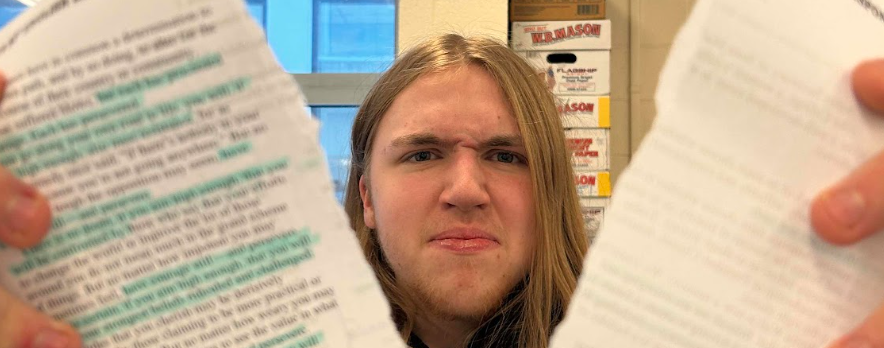
STAFF PHOTO ILLUSTRATION / Brandon Nguyen
Junior Ewan McCrimmon angrily tears a paper APUSH test.

For students, the announcement seems to have also caused disagreement, leaving some excited for a modern upgrade and others scrambling to adjust. Ewan McCrimmon, a junior taking APUSH, welcomed the move. “It’s a lot less paper, and it’s accommodating to the new way the world works online. Not that many people write stuff down on paper anymore,” he said. He appreciated the convenience and speed of typing, and stated that he will “be more focused on comprehending the question than focusing on spacing out [his] writing.” But McCrimmon also had some concerns about the school’s technological readiness: “Last year’s MCAS was a shame… [the school’s wifi] was struggling to keep up with everyone logging in all at once.”

Magdalena Phelps, a junior taking AP Lang and APUSH,  was more opposed to the change: “I’m just more of a visual person, so being able to really interact with the text helps me a lot.” Worried about the late announcement and lack of resources, she added, “In APUSH and AP Lang, there isn’t much digital work. It’s very much on paper, so [it’s hard to know] how they’re going to transition.” Both Phelps and McCrimmon agreed that students should be able to choose whether or not to have their exams be paper or digital. “It’s unfair that we don’t have those types of accommodations for AP testing,” Phelps said.

Continue reading
Time Management and Study Strategies: Students Tackle Stressful Midterm Season
  • January 15, 2024

By Samantha Sun and Melody Tang
STAFF WRITER AND ONLINE EDITOR

AHS students are preparing for midterms, a series of academic tests that mark the first half of the year, falling in a four-day period between January 16 to 19.

Midterm exams are meant to be a tool for teachers to better examine the progress of students during their time in class, but many students find it stressful to prepare for so many tests at once. 

Freshmen this year are taking midterms for the first time, and there is some nervousness arising from it as a new concept entering high school.

Freshman Kiera D’Angelo added her thoughts on how intimidating midterms seem. “I have never had any sort of test like this before and I don’t quite know what to expect,” said D’Angelo. It is different from the middle school experience, which may contribute to the pressure freshmen feel. 

One of the struggles freshmen like D’Angelo had was where to begin. “I had no idea how to effectively study and learn how to have long-term memorization,” said DAngelo, and she wishes underclassmen could receive advice from upperclassmen or counselors.

Luckily, seniors have already completed the midterms process three times, and have plenty of advice to give to underclassmen. Senior Ellen Chou assures that there are plenty of options to help you get started studying for midterms if you’re having trouble. She suggested, “If your teacher has made a study guide, then definitely study everything on that. For other topics like science and math, watching videos to review, like The Organic Chemistry Tutor, Khan Academy, and Amoeba Sisters, are helpful if you feel like you need to re-teach yourself something.” Chou also recommended keeping an organized binder or folder so that students can look at in-class material while studying.”

Chou additionally finds the Pomodoro method helpful while studying, a technique that breaks your studying session into 25-minute intervals of continuous work and 5-minute breaks in-between. “I used this method a lot during AP exams and I found it really helpful,” said Chou. 

Because midterms encompass testing for every class, it requires a lot of time management, study material, and concepts. This causes a lot of stress for those who do not know how to study for multiple tests at once.

“Last year…I wasn’t used to it and it was something new for me,” said Razan Hawat, a sophomore who was also nervous [about] taking it for the first time last year. “But I realize[d] if you have the time to study for it, it’s not too bad.”

One of the mistakes Hawat made as a freshman was not managing her time well. “I think I learned from last year that I shouldn’t wait for the last minute,” Hawat noted. Stressing out the night before and cramming information last-minute is a mistake many people make. 

“I do find that my phone can be a real distraction when I study,” said D’Angelo, as she described the occasional obstacles. Procrastination is also another factor that students struggle to deal with, not just freshmen. D’Angelo agreed that it is difficult to overcome the temptations of social media, and talking to friends is also a distractor. 

Chou agrees to “time yourself well and don’t procrastinate.” She recommends the Notion app to organize and plan for midterms. “I find it helpful to be able to visually see the work that needs to be done so I would recommend making a checklist of assignments,” stated Chou. Chou also believes that everyone learns best in their own ways and suggests testing multiple methods—like watching videos, re-reading textbooks, or self-testing—to see what works best.

Many students believe midterms are not a measure of success or intelligence. Although the results do contribute to a percentage of a grade, it isn’t necessarily an accurate representation of a student’s learning capabilities.  Sophomore Zoe Roberts stated that “determining whether this learning was done in class, over a reasonable period, or independently crammed in days before the test, is where a midterm falls short.” Chou added that, because there is such a large amount of information to study, it is “an okay reflection of [a student’s] progress.”

Roberts finds that putting excessive stress on midterms isn’t worth it and that as long as students try their best. It’s difficult to get A’s on everything, which may be why so many freshmen are worried about the midterm exams.

Continue reading
EDITORIAL: You Choose: Pen and Paper or Touchpad and Keyboard?
  • December 5, 2023

The SAT—the most widely standardized test for college admissions in the Northeast—is going digital. This overhaul aims to make the SAT easier, shorter, and more accessible. However, paper testing remains our preferred option.

Standardized tests take multiple hours. When staring at a screen for so long, reading dense passages in minuscule font, it is inevitable that the words will blend together. As our eyes are flooded with blue light, our ability to concentrate deteriorates due to eye strain and fatigue. Being tired and distracted is not the ideal state to take an exam. 

We will lose the ability to annotate with a pencil. Navigating an exam with a touchpad is not the same as graphite grinding on a test booklet. Ferris Jabr, in the Scientific American, notes that digital formats fail to replicate the tactility of reading on paper—a physicality that aids with retention and absorption. When we read e-texts, we tend to move on to the next page without reflection, a process key to ensuring we understand the presented material. There is a reason your teachers hound you to take notes on paper—you’ll forget much of the material otherwise.

During any math exam, doing work out on paper is essential. Many of us choose to do work right in the booklet to see the answers, questions, and our scratch work simultaneously. Even if the digital SAT provides test-takers with three to four sheets of printer paper—and more on request—it is impossible to look at the question and answer choices without tilting your head up at the screen. Losing your train of thought or accidentally selecting the incorrect answer just became much easier.

Despite all the drawbacks, we can all agree that a shorter test is always for the better. The new digital SAT combines the Reading and Writing sections into one while cutting down the duration of the test from over three hours to two hours and 14 minutes. It will adapt to your performance—the questions you receive for Module Two (each section is split into two modules) will be generated based on how you do in Module One. The length of reading passages has significantly shrunk, and each text corresponds with one question, thus removing the need to flip back and forth between the text and the question. We all know the wait for scores can feel like years, but with the switch to digital, scores will be sent out in a few days instead of weeks. 

Unlike the SAT, the ACT will keep a paper option available when it goes digital. With many of us preferring the paper test, while others are comfortable taking it digitally, this is the way to go.

Continue reading
Midterms are Back in Session!
  • January 13, 2022

Philippa Konow

STAFF WRITER

For the classes of 2022 and 2023, midterms are almost a memory. Having not taken the tests since winter of the 2019-2020 school year (pre-COVID), these seniors and juniors may find it almost strange that it’s happening again this year. 

Midterms will be held in January. With a month to go in the first semester, midterms are getting extremely close. Many students are experiencing heightened stress around the tests, especially after a whole year of missing these exams. 

“I don’t like the school’s decision to bring back the midterms,” stated junior Zoe Isbell. “It leaves most of us unprepared and not knowing what to expect, and we also missed a lot of information last year that we could need on the test.” 

Junior Madelyn Blanchette shared that she doesn’t really see a benefit to midterms because of the increase in stress and anxiety: “I don’t like midterms because I don’t like tests. I value my time off from school and would rather spend it doing a hobby rather than spend it studying.”

Isbell added, “Personally, the midterms are extremely stressful and the teachers spend about a week just preparing you for it. This takes time away from valuable learning time where we could be learning new information that we could use during the finals or other exams.”

PHOTO ILLUSTRATION / Avi Shapira
Sophomore Aisosa Oviasogie studying for midterms

Some students don’t mind bringing back midterms. “Sure, it’s one extra test that has a decent amount of weight to it,” said Andrew Magner, junior, “but it has benefits too, like those breaks between tests and just getting out from school early.”

While many students dislike tests, there are some students that believe there are benefits to these midterm exams. Magner said, “It helps create a long-term memory of the thing you’ve been learning about, as well as giving students practice before finals and allowing freshmen to get comfortable with these big tests.”

“I enjoy getting to spend the 30-minute breaks wherever we want between midterms,” said Audrey Hetherington-Young, a senior at AHS, referring to the open campus policy between each exam.

Isbell believes it’s a good thing that these tests are graded; the exams provide a way for teachers to understand what level of understanding their students have in their classes. This can help them either adjust something that may be confusing as well as figure out what to remove or add to their lesson plans or methods. 

Many of the juniors and seniors also need to remember that freshmen and sophomores will be experiencing midterms for the first time this year. Sophomore Sergey Bielecki is quite nervous about the tests. “It’s a lot of studying and I’m not sure how much weight it has for my grades,” he said.

Many may be asking what the purpose of midterm tests even is. Math teacher Scott Armstrong explained that midterms are used as a midway point for courses in order to prepare students for the larger assessments ahead in college. “We give departmental midterms so that the final does not cover all the material from August to June,” added Armstrong.

Continue reading
Bach and Meagher Voice Opposition to MCAS
  • November 19, 2021

By Jacqueline Zhu

STAFF WRITER

 Discussions about whether MCAS exams should continue to be administered have been reinvigorated after the COVID-19 pandemic caused MCAS scores across Massachusetts to plummet. 

Statewide MCAS test results from the spring 2021 exam show that fewer students scored Meeting Expectations or higher for math and English compared to students in the same grades before the pandemic, according to the Department of Elementary and Secondary Education (DESE). DESE issues accountability determinations for school districts based on how well students perform on MCAS exams. These determinations categorize districts as Districts Requiring Assistance or Districts Not Requiring Assistance, and they help the state decide how to allocate resources. 

Many teachers are calling for an end to MCAS testing, arguing that it is unnecessary and detrimental to both students and teachers. Jennifer Meagher, who teaches English at Andover High School, said that the high stakes of MCAS testing further narrow methodology. “Students have to pass MCAS to graduate, and districts are punished if their students aren’t performing according to the state’s mandates,” explained Meagher. “So it drives everything, it drives the curriculum, and it creates pressure that I don’t think is healthy for students or teachers.”

The loss of class time is another one of the many grievances some teachers have with MCAS. Meagher stated that her work emphasizes critical thinking, creativity, and authentic dialogue between teachers and students, and spending time for MCAS exam preparation shifts the focus away from those things. 

“No matter the discipline, MCAS takes away valuable instruction time from teachers and students during the school day,” said Matthew Bach, social studies teacher and president of the Andover Education Association, the teachers’ union.

Many also point to standardized testing’s deep-rooted history in racism and inequity and its inability to accurately measure students’ performance and success. “Standardized tests were invented by the Eugenics movement to serve as pseudo-scientific devices to support racist theories and marginalize vulnerable members of the working poor,” explained Bach. 

Junior Diya Ganesh believes that MCAS is a flawed method for assessing students’ abilities. “I think that the idea behind MCAS is well-intentioned,” said Ganesh. “The state uses it as a metric to see how effectively students are being educated, but it fails to take into account outstanding circumstances. Lower income districts with a greater immigrant population tend to do more poorly on these tests through no fault of their own, due to English not being their first language, or their primary focus being to survive.” 

Bach and Meagher note the impact of MCAS on lower income districts. “Schools with a higher percentage of students who are struggling in those ways are taken over by the state,” said Meagher. “Their school committees and school leaders are rendered powerless.”

“[MCAS] is used to disenfranchise communities like Lawrence and expropriate them from democratic governance of their school systems,” stated Bach.

“Standardized tests treat students as data,” stated Meagher. “To think that you can quantify the way somebody interprets the world in a number on a page, I think it’s unrealistic and harmful.”   

These sentiments have been exacerbated by the pandemic. “MCAS has changed the way we teach and interact, and I think we really saw it last year with COVID,” said Meagher. “For me, the whole experience with MCAS last year reinforced just how dehumanizing standardized tests can be.” She expressed her frustration with the state’s insistence on implementing MCAS despite the loss of class time and the pandemic.

Many students feel that the pandemic has made it more difficult for them to prepare for MCAS. “I would say [the pandemic has affected my MCAS scores],” said an anonymous student, a sophomore. “I learn better in a classroom setting and it’s sometimes harder getting in contact with teachers online to ask questions.”

A possible alternative to MCAS testing is being developed. “The [AEA] has started a process with UMASS professor Jack Schnieder to work on developing authentic and community-based school quality measurements that would take the place of MCAS,” stated Bach. “Potential alternative measurements could entail community curriculum priorities, extracurricular opportunities, educator turnover rates, [and] enrollment rates.”

Continue reading
Quizzes and Tests are not the Best
  • February 7, 2021

By Andoverview

We know that the majority of the student population dislikes taking tests or quizzes. But during a global pandemic they’re even worse. From keeping your camera on your paper to loading hybrid students up with tests on the in-school days so they can be supervised in person, we’ve seen all of the methods of “cheatproof” testing. While preventing students from cheating on tests and quizzes seems like a good thing, it’s not the best idea during times like these. First of all, the camera-on-paper plan doesn’t work for students who don’t have working cameras or those who don’t have access to a printer to print out the test. There are also some students who can’t move their computer’s camera, which provides more difficulty with this kind of test. Additionally, the mental and physical health of many students are in a decline due to these difficult times, and that should be taken into consideration: Many of us who are hybrid students find that we get loaded up on tests on the in-school days, which is extremely stressful. And those of us who are remote students have had to stick with all of the… creative ways that teachers are trying to administer tests. Because of all these reasons, we feel that grades should be based more on classwork, projects, or other homework assignments, rather than test and quiz scores. Teachers should put the effort they put into preventing cheating on tests into giving assignments that will still assess students’ understanding, or giving work that requires us to use what we learned in class.

Continue reading