EDITORIAL: You Choose: Pen and Paper or Touchpad and Keyboard?
  • December 5, 2023

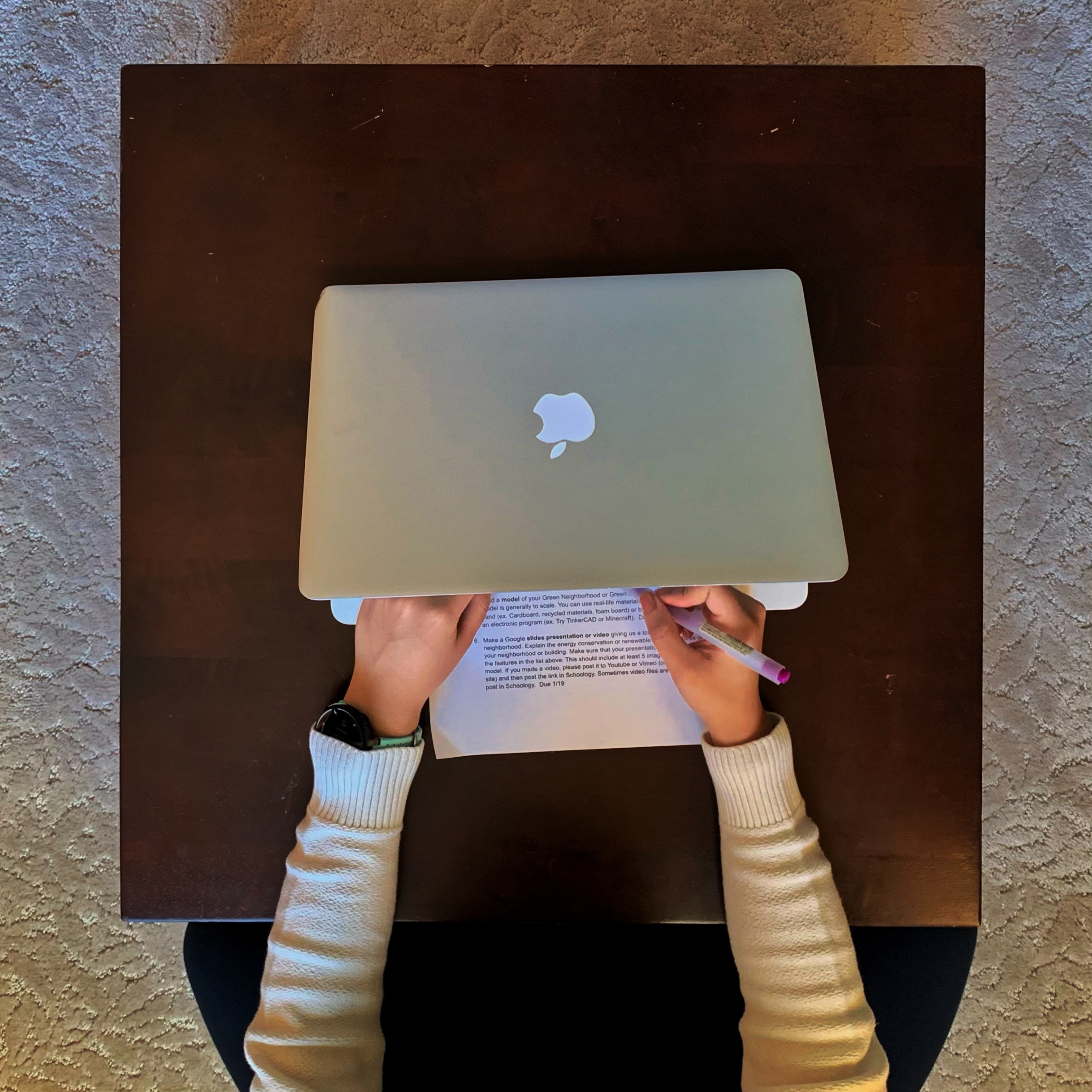
The SAT—the most widely standardized test for college admissions in the Northeast—is going digital. This overhaul aims to make the SAT easier, shorter, and more accessible. However, paper testing remains our preferred option.

Standardized tests take multiple hours. When staring at a screen for so long, reading dense passages in minuscule font, it is inevitable that the words will blend together. As our eyes are flooded with blue light, our ability to concentrate deteriorates due to eye strain and fatigue. Being tired and distracted is not the ideal state to take an exam. 

We will lose the ability to annotate with a pencil. Navigating an exam with a touchpad is not the same as graphite grinding on a test booklet. Ferris Jabr, in the Scientific American, notes that digital formats fail to replicate the tactility of reading on paper—a physicality that aids with retention and absorption. When we read e-texts, we tend to move on to the next page without reflection, a process key to ensuring we understand the presented material. There is a reason your teachers hound you to take notes on paper—you’ll forget much of the material otherwise.

During any math exam, doing work out on paper is essential. Many of us choose to do work right in the booklet to see the answers, questions, and our scratch work simultaneously. Even if the digital SAT provides test-takers with three to four sheets of printer paper—and more on request—it is impossible to look at the question and answer choices without tilting your head up at the screen. Losing your train of thought or accidentally selecting the incorrect answer just became much easier.

Despite all the drawbacks, we can all agree that a shorter test is always for the better. The new digital SAT combines the Reading and Writing sections into one while cutting down the duration of the test from over three hours to two hours and 14 minutes. It will adapt to your performance—the questions you receive for Module Two (each section is split into two modules) will be generated based on how you do in Module One. The length of reading passages has significantly shrunk, and each text corresponds with one question, thus removing the need to flip back and forth between the text and the question. We all know the wait for scores can feel like years, but with the switch to digital, scores will be sent out in a few days instead of weeks. 

Unlike the SAT, the ACT will keep a paper option available when it goes digital. With many of us preferring the paper test, while others are comfortable taking it digitally, this is the way to go.
Continue reading
Standardized Testing + COVID = Unnecessary
  • March 26, 2021

With all of the chaos of this school year, standardized tests such as AP exams and MCAS are just another hurdle to overcome. However, the fact that many of these tests are being crammed into the same month is unnecessary; students are already burnt out after all of the challenges of hybrid and remote learning, and having to take multiple tests within mere days of one another is excessive.

It was initially proposed that MCAS requirements ought to be waived for this year, on account of the abnormal circumstances. Since this decision was rescinded, AP tests have been rescheduled in order to accommodate MCAS testing; in simpler terms, tests are being moved to make way for more tests. If MCAS was able to be forgiven for this year in the first place, then there is no reason that this decision should not hold. 

Trying to force this many exams on students within the same time frame has the potential to be disastrous on many fronts, which is why we believe one test should be addressed at a time. Deal with the AP exams first, subtract out this year’s MCAS from the equation and try again next year.

Continue reading
Teachers Navigate Online Testing
  • January 2, 2021

Teachers Modify Online Testing in Many Different Ways

By Jacqueline Zhu

STAFF WRITER

The switch to remote learning has prompted many AHS teachers to use creative methods for monitoring their students during online assessments.

Administering tests and quizzes online has proved to be a great difficulty. Technical issues, time constraints, and the increased possibility of cheating are only some of the challenges teachers face with online testing. Now more questions are arising regarding whether monitoring students is a necessary step or detrimental to the trust between students and teachers.

One of the most common ways teachers track their students is by instructing them to leave their cameras on or tilt their cameras down. “[W]hen [students] start to take the quiz/test, they need to lower the camera to make sure the teacher can see their paper and both hands,” said Chinese teacher, Lin Wu. 

Sophomore Louis Morrison told ANDOVERVIEW one of his teachers has students keep their cameras on during tests to watch for suspicious behavior. He thought this method was effective because of “the scare tactic factor that could lead to some students … deciding not to cheat because they don’t understand how the teacher is using their webcam to identify their cheating.”

STAFF PHOTO/ Erin Li
Example of a set up where the camera is facing the hands and test in order to prevent cheating.

Some teachers also use more unconventional methods. 

“[My teachers] create [breakout rooms] in Google Meet or Schoology for each student,” said sophomore Vivian Tang. “Once inside each breakout room, each student will then present their screen and the teacher can then monitor each [students’ screens] for any signs of cheating.”

“I have students use their phone as the camera for the conference – and it is supposed to be directed toward their computer screen and their hands,” said Minda Reidy, who teaches programming and geometry. She uses this method to see if her students’ computer screens move away from the test and to see if their hands move towards notes or near the camera to look things up.

STAFF PHOTO/ Erin Li
Example of a set-up for an online test where the phone faces the computer and their hands.

Others rely on the honor system. “Before we take tests, our teachers tell us not to use our notes, search up answers on [G]oogle, not to use lecture notes, etc.,” said sophomore Dhriti Motwani. “There are directions provided to us before we take our tests.”

But Math teacher Stephanie Ragucci told ANDOVERVIEW that relying on the honor system may be a little naive. “I think what [teachers] really need is some sort of a lockdown browser that would allow students to only be in the assessment they are working on,” she said.

Many students feel the measures their teachers take to prevent cheating are necessary and effective. “[These] methods are necessary because even though tests are online, students can tend to search up answers and get them right,” Motwani said. “But in the end, students are not learning and just creating bad habit[s] for themselves.”

“I think it is necessary to implement this rule since it would mean that everyone is taking the test equally and without outside resources,” said Tang, adding that she believes the methods are efficient in ensuring there’s no cheating.

Many teachers have stated the frequency and length of assessments given has reduced since the switch to remote learning. “In the past, there [would] be one quiz every two weeks in general, while now, it [is] one per month,” Wu said. “For Chinese, students usually have a vocabulary quiz and a general quiz, while now, it will be one or in other formats as assessment.”

Ragucci is moving to smaller assessments since the larger ones take too long to grade. She has been giving out fewer assessments in general that would be considered a quiz or a test. “These crazy times have forced us to learn to assess differently than we are used to,” she said.

Continue reading