Long-Time Teacher Retiring After Two Decades at AHS
  • December 5, 2023

By Ella Hu
STAFF WRITER

STAFF PHOTO / Sanjith Kalpat
Mrs. Reidy poses for a photo at her desk.

Minda Reidy, a math and computer science teacher, will retire this school year after 20 years at AHS. 

Reidy teaches Enriched and Honors Geometry, as well as the elective Intro to Computer Science class for all grade levels. After school, she supervises the Robotics club that has been running for 16 years. Reidy’s impact on AHS can be seen in her accomplishments of developing the engineering program at AHS and founding the Robotics Club. 

Reidy had already retired from computing before becoming a teacher at AHS. After a friend suggested she come as a substitute teacher, she agreed and tried it out. “I loved interacting with the students…helping them think about what they were going to do and what these things involved,” Reidy said. It was an experience that she could not forget, leading her to become a teacher. 

Reidy’s Geometry classes and Computer Science classes have proven to be rigorous. Past students from her Geometry classes describe it as demanding, unexpected,  and self-ameliorating. One student commented that it took a lot of “chutzpah,” a Hebrew word that means backbone, to go through with the class. However, they all enjoyed the effort they put into class and found the course to be difficult but rewarding. Past students, now facing their last years at AHS, agreed that the class brought everyone together. They worked together to help each other on their projects and, outside of class, became great friends. 

AHS senior Aneesh Ratnala recounts his freshman year in Enriched Geometry class. He enjoyed Flatland discussions the most. Flatland was a book read by students in Reidy’s Enriched Geometry class. Ratnala said the discussions were very specific. “We talk[ed] about stuff that we really don’t talk about in other math classes,” he said. “It was very intellectually provoking.”

Many aspects of Reidy’s classes set them apart from other classes. Not only did students agree that Reidy was good at knowing her students well, but her classes also taught them to be confident in themselves. Sasha Dicovitsky, now a senior, says, “[Her class] taught me how to fend for myself.” These small details about Reidy’s class turn out to not only be able to help students learn in class but also in their future. 

The same goes for the Robotics Club, where students mentioned that Reidy goes out of her way to try to help and challenge them for greater things. Josephine Pan, vice-president of the Robotics Club, said, “The people here are very dynamic, very passionate…Part of that is [because] Mrs. Reidy is able to help push us to use our passion to create those great robots.” These challenges also will come in handy in their future careers for those pursuing a similar field of study. President of the Robotics Club, Raj Kontham stated, “For me definitely, I am looking to major in computer engineering, so a lot of the skills I learned…[in] the past couple of years, for sure.” 

With 20 years of teaching experience, Reidy said her focus has been mainly on helping students develop the ability to understand the new challenges presented instead of just the learning portion. She hopes that students will not only “want to know [the] why” to answers but also be able to grasp the concept behind it. 

For current and future students, Reidy shared, “You can find the answers. We’ve all seen you can Google the answer, but knowing the why helps you find your own answers. Instead of just looking for the answer, understand how things work and why they work, and you will come up with new answers.”

Looking forward to retirement, Reidy plans to travel and make delicious food. She is hoping to travel to Hawaii when the whales are migrating and later to the Antarctic region following their movement. 

When asked what is one word to describe her experience as a teacher at AHS, Reidy said, “Learning. Even though I’m teaching, I’m learning as well and I love that. Learning is awesome besides…Proofs are fun!”

Continue reading
A New Face in APUSH
  • December 5, 2023

By Vismay Ravikumar
STAFF WRITER

As the demand for AP U.S. History (APUSH) soared at Andover High, the need for a new faculty member to join the APUSH staff has grown more apparent. ANDOVERVIEW sat down with veteran social studies teacher Fred Hopkins to discuss his yearning to teach U.S. history and the preparation that his transition required.

What prompted you to start teaching APUSH?

I was a US history major in college, yet I’ve never, ever taught U.S. history despite asking to do it every year. I’ve had a series of bosses tell me, “Yeah, we’d like to get you into a U.S. History class. How about next year?” Sometimes, I will just give up and just stop asking [to teach U.S. History] . When the people who have been teaching APUSH here said, “We’re open to someone else stepping in and helping that person navigate the course,” I was just standing there, ready to jump into the system. I just wanted the change of pace.

Has U.S. history been an interest of yours since high school?

When I was a high school student, I knew it wasn’t required. I studied different worlds, cultures, and histories in college, but I focused on U.S. history.

How many APUSH students do you teach? 

18. Just one section.

What are your opinions on AP classes?

The community and the management of the schools look at AP as a standard type of course. And it’s gotten to the point where this monopoly that the College Board has – they could tell you how to do. I don’t know if they would allow such a thing. They are a nonprofit, but they’re a business – people making money. I would rather see us abandon APs and just teach content courses and then force the AP world to accept ourselves. I taught AP European history in New Jersey for three years. My students and I didn’t have to deal with AP tests, and I wasn’t in any way encouraged to teach the test. I felt like a liberated teacher. It’s counterintuitive to teach to a test. A good test is something that reveals to students what they’ve learned. Teaching to a test, we all know, is pedagogically not sound. What we’re doing, it’s a mess.

What is the hardest part of starting to teach a new course? 

The things that I know best are the things I’ve taught up to then. So, when you don’t have this information stacked up in your memory banks, it makes it a little bit frustrating. The hardest thing about APUSH is stress. I wonder if people are interested in learning, or are they just interested in the measurement and what it does with college applications? Pure learning would be ideal if that’s happening.

What is the process of preparing to teach a course you haven’t taught before?

Over the summer, I worked with both the other teachers. And I read, and I read, and I read history, and analysis of history and opinions on history. Then, I went through an institute that I attended the prior summer and took in all the information that they shared.

Could you speak more about collaboration with [fellow APUSH teachers] Dr. Michaud and Ms. Chachus?

They showed me how they divide the AP course into units and lessons and showed me how they approach the show, and how they do assessments. They try to vary their lessons and activities and how they review. We talked about how you grade students, and everybody grades differently. So we’ll have to adopt. approaches to what works for you. By the way, that process is still ongoing.

They’re both willing to answer every one of my questions as soon as they come up. 

Are they a resource for you?

I wouldn’t be standing without them.

What is your favorite part of American history in general? Are you looking forward to teaching that in APUSH?

My favorite part of American history is the analysis of foreign policy that drives America’s official and unofficial interactions with the world.

Are you planning to continue teaching APUSH?

My reluctance to hop in was pretty strong, and now that I’m in it, I will stay.

STAFF PHOTO / Sanjith Kalpat
Mr. Hopkins helps Freshman Caroline Arnold with her work.

Continue reading
New Faculty Profiles
  • November 5, 2022

ANDOVERVIEW staff members interviewed the new faculty members in Andover High School this year. Here are short profiles.

Ellen Gaudiano, World Languages
By Anika Nagle, STAFF WRITER

Ellen Gaudiano has returned to Andover High School this year after a short retirement period. Having taught Spanish for 25 years, she has adopted the role of introducing students to French culture and language through the class of French 1.

Throughout her life, Gaudiano held a love for teaching and a deep admiration of world languages and cultures. Having majored in two languages, Russian and French, during college, she always knew what career she wished to pursue. There are similarities in teaching a language regardless of which tongue it is, and it was these aspects that appealed to Gaudiano. “I love the idea of teaching culture and language to students [so] that they can travel someday and use it,” she said. 

Gaudiano’s passion for teaching students the unique culture behind a language can be seen in her favorite memories of teaching: foreign language week. “One of the things that we used to do is we used to celebrate foreign language week in March,” she said. “We would have a big cabaret…another day we did food, the cafeteria would serve meals from all different parts of the world, another day we would switch teachers…and [students] who come from different cultures, they would present their culture to different classes..I loved that”. 

Gaudiano retired due to a strenuous workload stemming from teaching 5 different classes. However, throughout her two-year long retirement, she never once stopped helping others. As COVID-19 swept throughout the country, Gaudiano was often found in vaccination clinics, an environment where she “loved being out there with people, and..realized that maybe [she] had left too early.” When the pandemic died down, Gaudiano wasted no time in returning to AHS. She now presides over one classroom instead of the five she had previously: a perfect balance between the career she loves and the relaxation she deserves. “`Teaching this one class is ‘parfait pour moi (perfect for me), ’” she said. 

There are stark differences as well as similarities between Spanish and French. French in particular is “ just gorgeous, it’s pretty and it’s musical,” remarked Gaudiano. Of course, being tasked with teaching such an elegant language brings about its own difficulties. “French pronunciation is very difficult…I like working on that with students,” she said. And as she overcomes such challenges in her class, she indulges in one of her favorite aspects of teaching: developing a relationship with her students, which in turn results in a positive learning experience for them as well.

Vivian McNeeley, ESL
By Samantha Sun, STAFF WRITER

Vivian McNeeley joined the English as a Second Language (ESL) department this year at Andover High School with hopes to bring more awareness and inclusivity in the ESL community.

McNeeley has 15 years of teaching experience, 10 in the Andover Public Schools district, six at Bancroft Elementary, and three at High Plain Elementary. She has also worked at High Plain as an art teacher. As a professional portrait painter and an owner of a photography business (Evergreen Photography), she is busy enough without the addition of her own 4 kids.

Being a second language learner inspired McNeeley to teach ESL. “I know what it feels like to just be plopped into a place where you have no idea what’s happening or going on,” she said. One thing unique to McNeeley is her use of her own artwork in her teaching. “You can really connect with kids through art, and then from there you can use it as a jumping point for language learning,” stated McNeeley.

Mackenzie Comeau, Social Work
By Julie Mahoney, STAFF WRITER

Mackenzie Comeau, the new social worker at Andover High School, is currently filling in for Ms. Abbott who is on leave.

Previously, Comeau was an intern at AHS for about a year for her Masters of Social Work (MSW). She studied at Plymouth State University in New Hampshire and did her MSW at Salem State University. 

Comeau loves Andover and its community. “I want to create a space where students feel safe, included, accepted and supported,” she said. She loves her job and wants students to know that “if students ever need any support, please feel free to reach out to the social work team or the guidance team.” 

Comeau has visited over 20 countries. She has traveled to places such as Switzerland, Scotland, and Turkey. India was her favorite because she found the culture to be very beautiful.  Despite being to so many countries and seeing the world, watching students progress and seeing the impact of connecting with others was what made her passionate to continue her career and settle down in Andover.

Noella Kandjanga, Mathematics
By Saarvi Deshwal, STAFF WRITER

Noella Kandjanga has been teaching math for 8 years, and this year she joins the Andover High community.

Kandjanga went to UMass Lowell for her undergraduate and is currently working on her PhD. Before she got into teaching mathematics, according to Kandjanga, she started with psychology. Kandjanda had taken advice from a professor to reconsider her choice, which is when she decided to go into mathematics.

Outside of her career, Kandjanga has two kids and a wonderful life. When she is given the opportunity to have spare time, she enjoys listening to music, reading, and spending time with her family. “We went to watch tennis at the U.S. Open, that was pretty cool,” Kandjanga said. She also loves to travel with her family. Almost every year with her family, Kandjanga goes to Canada. She has also gone to France, Belgium, and England.

Noella Kandjanga was born on Christmas day, hence her name “Noella,” which translates to “Christmas” in French. Kandjanga would like to try teaching another subject, such as French, since she is fluent in it. Something helpful to keep in mind next time you need help with your French homework!

Allison Peters, Mathematics
By Carissa Dessin, STAFF WRITER

Allison Peters, a new addition to the math department, has her obvious desire of teaching. What is not very obvious is that she used to dream of being a professional poker player.

While Peters’ dream may seem bizarre, her reasoning as a math teacher makes sense. She stated the fact that it “deals with a lot of numbers” and handling that much money “just seemed exciting.”

Peters started her college career as a computer programming major, so teaching math was not in her original plan. However, programming did not go the way she wanted it to, according to Peters. She got her first opportunity to teach while waiting in line at the math lab in her college. The line was so long that Peters began tutoring the people in front of her in order to get farther ahead. This ignited her excitement for teaching math, and she was offered a job in the math lab. From seeing her students understand and “finally get rid of that frustration,” she fell deeper in love with teaching.

Continue reading
Ralph Bledsoe Remembers Time at High School, College
  • May 23, 2022

Angela Mac
STAFF WRITER

Science teacher Ralph Bledsoe is well known and loved by students and faculty members at Andover High School. 

Prior to high school, Bledsoe went to Southern California Military Academy (SCMA), a junior high boarding school. He then attended Northfield Mount Hermon (NMH), a boarding school in Massachusetts. After high school, he went to the University of Southern California (USC). Bledsoe noted that his experience was out of the norm: boarding in high school and commuting to college when most students did the opposite. 

When Bledsoe made the switch from SCMA to NMH, he recalled that “all of a sudden, I was getting C’s and D’s, from A’s and B’s, because the work was at an upper level. It was no freaking joke.” 

Compared to AHS students, Bledsoe had a lot more freedom and time off from classes. At NMH, students would only have classes three or four days a week. On some days, there would be free periods where Bledsoe “could go anywhere [he] wanted. You know [at AHS] every second is regulated.” Private schools like NMH would load up on schoolwork and then have days off for the students to complete it. Bledsoe admires AHS students for their constant work and compared it to a workday: “A lot of kids here will have 14-hour day jobs, where the job has to get done. Doesn’t matter the hours. You work through Saturday and you work through Sunday.”

With the free time Bledsoe had, he didn’t spend it thoughtlessly. As a work-oriented person, he studied in the library and prepared for the next class. At USC he made sure to study at all 11 libraries on campus. Bledsoe’s favorite subject in college was organic chemistry. Though organic chemistry may be regarded as one of the hardest classes, for Bledsoe, it came naturally. However, he reflected that his mind developed over time. “Don’t think your mental capabilities are going to stay static. Throughout your life, you’re still developing, and your mind is going to be clearer and clearer and clearer,” he stated. 

Physical chemistry was the subject that challenged Bledsoe the most: “It was just, like, beyond my reach. A little bit. You know? So I blunted my drive, which was a mistake.” He explained that taking classes to get them out of the way is the wrong way to go about school. The right attitude was to take classes to learn a skill and to remember it, that way it could be used later on in life. To high school students, Bledsoe said, “You got to fight everybody. Got to fight yourself. You got to fight for what you need to do.”

In NMH, Bledsoe enjoyed being a part of the Afro-AM, a club for African Americans. The club located in the basement of the Cutler Science Center was called Harambee Umoja. Members of the club would go to socialize and throw parties in between classes, and even go to Phillips Academy to beat the students there in basketball. 

Now in his 8th year at AHS, Bledsoe is proud of the students at AHS. In the mornings that he comes in tired, seeing the students energizes him and it gets him ready to start the lesson. As much as teachers love their students, each has their own pet peeves about them. However, Bledsoe’s pet peeve wasn’t about the students, but himself. He asked, “Why am I such a school person. It’s absurd. Why do I enjoy faculty meetings? No teacher enjoys faculty meetings.” After a pause, he asked himself again, “Why do I cry every single graduation and miss the kids?”

Continue reading
Krista Hibino Offers Students Advice
  • May 23, 2022

Melody Tang
STAFF WRITER

Krista Hibino, a mathematics teacher at Andover High, experienced high school as the “quiet student.” 

COURTESY PHOTO / Krista Hibino
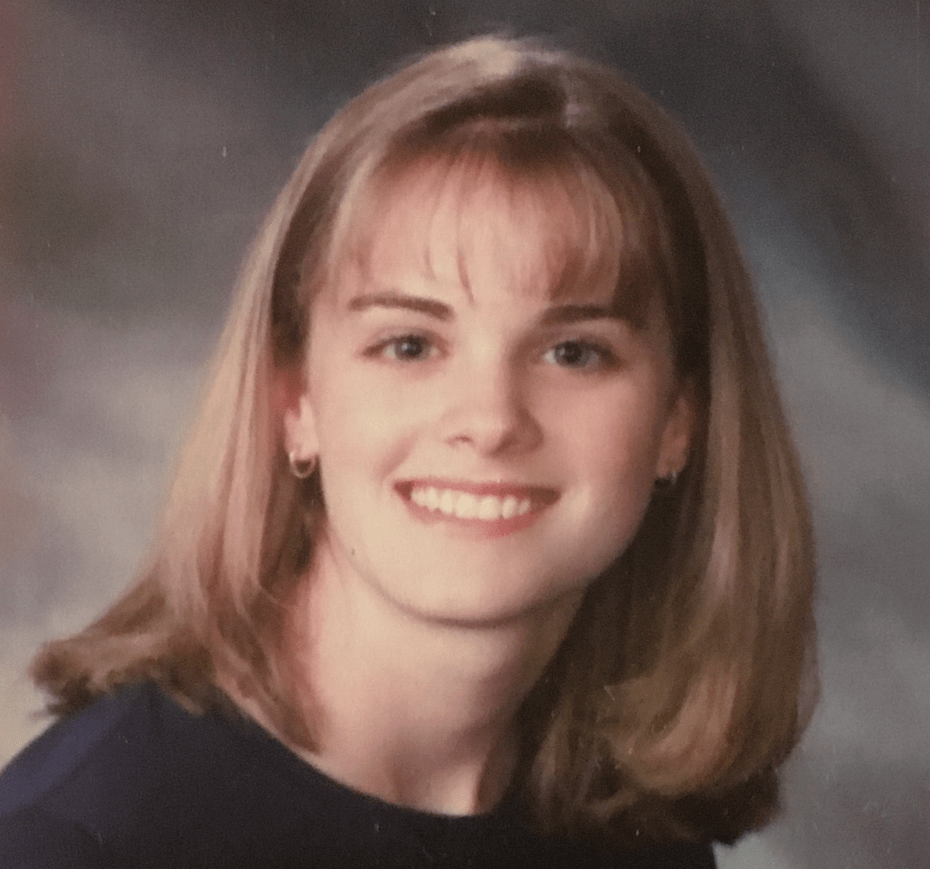
Hibino’s photo from when she was in high school

While Hibino went to high school at Lowell High School, being located in Massachusetts gives it many similar qualities to life at AHS. She also remembers preferring STEM classes more than humanities classes, and pursued her interest in mathematics and education at Merrimack College. This led Hibino to teaching at AHS as a student teacher, and she has since decided to stay permanently in the AHS
mathematics department.

Hibino encourages students to try at least one activity that is out of their comfort zone. “If there’s some type of activity that the school’s putting on… and it’s really not something you think you’d like, if you just grab a friend and go, it might be something you end up liking,” says Hibino. “I wish I had done something like that.”

When asked about any pet peeves she experiences as a teacher, Hibino brought up a nuance in words that many students use. Specifically, the nuisance is when students ask if they “missed anything” after an absence from class. At first, some may be confused, but Hibino explains her point of view clearly. “You clearly missed a whole class; we didn’t sit here and do nothing,” she jokes. Instead, Hibino suggests students use the phrase “what did I miss?” as an alternative.

Continue reading
Señora Deschenes Reflects on Her AHS Memories
  • May 23, 2022

Jocelyn Barton
STAFF WRITER

Traditions have been the glue that holds together communities such as our own. Jennifer Deschenes, alumnus of Andover High School, recalls what life was like back in the day for herself and other students. 

The most common traditions, as found in many other high schools, were the football games and school dances. Deschenes said, “It was the highlight of Friday nights: Going to a football game and then going to a dance was something that we all looked forward to.”

House parties in high school were a major event for students as well. Surprisingly, hanging out at McDonald’s “was the biggest thing to do back then,” she said. 

As most high school students are, Deschenes was sometimes a rebellious student. She explained that “telling [her] parents that [she] was going to a friend’s house to sleep over but really was going to a party” was something that she found to be extremely juvenile but fun.

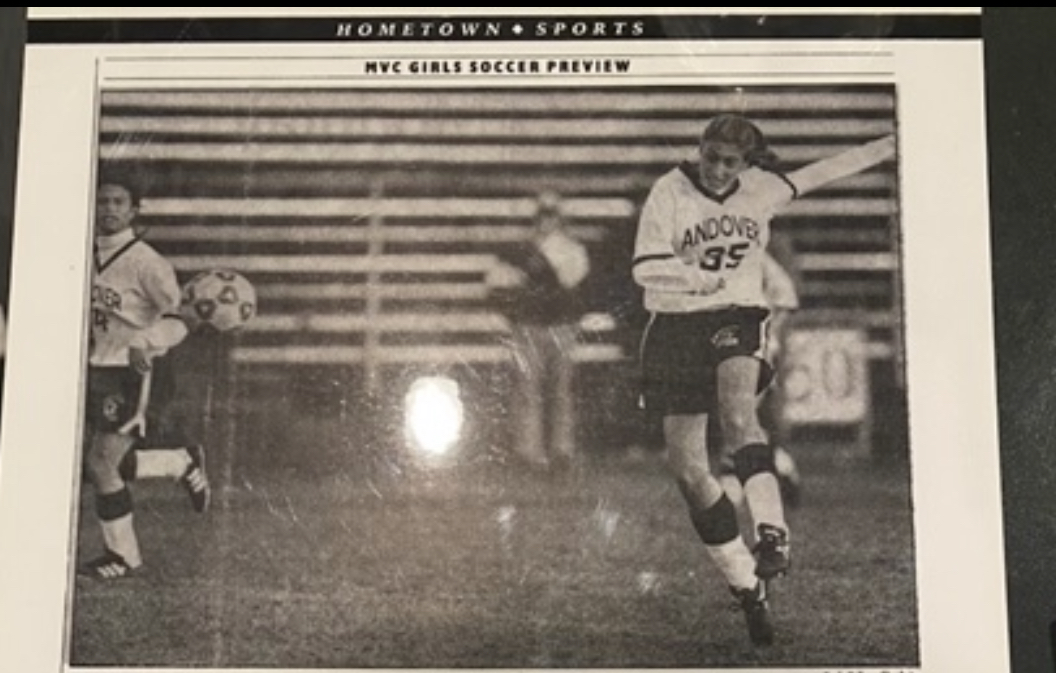
COURTESY PHOTO / Jennifer Deschenes
Deschenes (right) as an AHS senior playing for the school’s soccer team in the MVC’s

Additionally, sports were something that students commonly took part in. Deschenes herself was a three-sport athlete in soccer, tennis, and basketball throughout her years at AHS. Although it did not leave her much time to relax, she enjoyed the structure and organization of her schedule.

Another popular piece of AHS’s reputation was the exhilarating school spirit it carried. At pep rallies, the student body was found to be extremely energetic and proud to attend AHS. Compared to AHS today, the excitement for pep rallies is nothing as it was back in the day.

However, the importance of these traditions seems to have disappeared over time. Technology and social media’s advancements potentially could have impacted the evolution of these memorable traditions. “I feel like there would be more pressure today to think about what would be posted on social media, which we didn’t have back in the day,” Deschenes said. 

Deschenes thinks that the main reason why our traditions have faded out is because of these influences. “I think things seemed simpler than they are today. Like, that dance was a simple fun event and then today I just feel like people are thinking too much about what they look like or how they feel in front of other people because of social media.” 

Continue reading
AHS Alumnus Alan Hibino Shares Experience
  • May 23, 2022

Grace Wang
STAFF WRITER

Alan Hibino is a math teacher, basketball coach, and tennis coach at Andover High School. He is also an AHS alumni. Hibino shared how AHS has shaped him and mentioned his favorite high school event. 

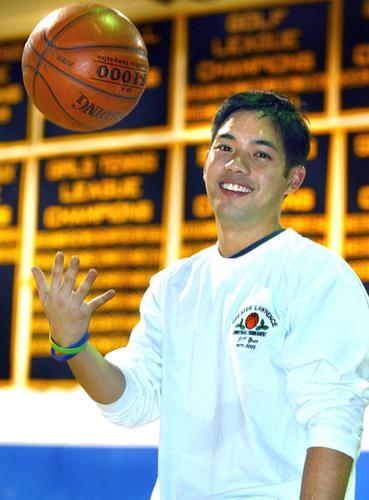
COURTESY PHOTO / Eagle Tribune

In highschool, Hibino described himself as “a pretty hard worker at school… who wanted to get good grades and played a lot of sports.” In his four years at AHS, Hibino played basketball, tennis, soccer, and ran cross country. Additionally, he took a “pretty rigorous course load in school.” Hibino said he was in National Honor Society and “pretty close” to being a straight A student. Now, he’s back at AHS.

Hibino said his friends and teachers were the biggest things he took away from AHS. The people he became friends with in high school continue to be relevant in his life today. He explained, “I have a good, strong group of friends… that I still talk to from high school and they’ll be my friends for life.” Sometimes when they’re together, they reminisce about high school days. 

Hibino mentioned that compared to AHS in his days, the atmosphere never changed among the student body. Even some of the teachers were the same. When Hibino was a student, Coach Faz was his basketball coach. Mike Wartman, the current AHS boys tennis coach, was Hibino’s tennis coach. Peter Hall, who still works in AHS, is a memorable teacher for him. Hibino said, “I speak fondly… about having Señor Hall for Spanish. When I was a senior in high school I got recommended for [AP] Spanish, and I said no. I’m taking whatever class Señor Hall is teaching because I know I’m going to get more and that he’s a really great teacher.” He ended up taking Spanish 5 with Hall instead of AP Spanish, which helped improve his Spanish a lot. Ultimately, these teachers helped shape Hibino’s own teaching, coaching, and parenting. These teachers helped shape him as a person. 

In addition to teachers and friends being memorable, Hibino vividly remembered Senior Safari, an all-night graduation party that takes place in the field house. It started at 10 p.m. and went until 5 a.m. At the party, there were all sorts of games and activities, even hypnotists. Hibino loved Senior Safari. He said it was his favorite and most memorable event. “Senior safari, look forward to it… That’s the best thing, tell everyone that’s the best thing,“ emphasized Hibino. 

Besides the academics at AHS, Hibino urged students to try the things they want to do and go out of their comfort zone. “Everybody should try to go to as many high school events as they can… clubs, sports, drama.” Before students graduate, he thought the most important thing to do is trying something they’ve never done before. Hibino also encourages students to talk to new people. “Find someone in one of your classes that you want to [talk to],” he said jokingly. “Well, they might think you’re weird and wonder why you’re talking to them, but try to find someone outside of your friend group.” 

For students, Hibino said that another important trait for success is recognizing your capabilities. “There’s no shame in saying, ‘That’s not the right fit for me; I gotta find something else to do.’ Some people call that quitting. I say no, that’s having the ability to recognize what you can or can’t do, which is an important trait to have.”

Continue reading
Beloved Teacher Retires to Make Room for Nature
  • May 26, 2021

By Sonja Kruecker Green

CORRESPONDENT

One might say Nancy Walke’s first cherished book of poetry, A Child’s Garden of Verses, by Robert Louis Stevenson, foreshadowed two of her great passions—gardening and teaching literature.   

However, Walke, a beloved and recently retired AHS English teacher who had been teaching in the district for more than 30 years, did not always know she wanted to teach. As an English major in college, there was an implicit assumption that teaching would be her most likely career move. But Walke wasn’t so sure. 

“I didn’t necessarily see myself as a teacher, and in a way, I almost thought, ‘I am not going to be a teacher because it is what everyone thinks I will be,’” she said. 

Given Walke’s desire to march to her own tune, it is not surprising that as a child she was attracted to books featuring heroines with strong independent spirits; book series like Little House on the Prairie and Nancy Drew mysteries. Later, reading Jane Austen’s Emma—again a heroine who is no shrinking violet—was a turning point for Walke, upon the revelation this was not a book about women getting married, but rather an astute social commentary.  Walke described her understanding of both Emma and Virginia Woolf’s essay, “A Room of One’s Own” as personally transformational. 

After college, Walke started a job as an advertising copywriter at the Harvard Coop. It was not until after a “series of unfortunate events and happy accidents” that she was led to teaching. She first came across an opportunity to substitute in North Andover. She anticipated this being a temporary position but gradually found that she had an affinity for teaching and was eventually given a permanent substitute position at the high school in North Andover. Later, there was an opening at a small private school where she taught math, science, and reading, and it was then that she came to the full realization that she wanted to pursue a teaching career. 

In time, she got her certification and master’s degree and was hired at Andover High School. She moved to the middle school level for 25 years until eventually returning to the high school. Over the course of her career, she helped scores of fledgling readers and writers take flight. 

When not nurturing her students,  Walke lovingly tends to her flower garden. In gardening, one must prepare the soil and sow the seeds, water, and weed, the same way a teacher must prepare a fertile environment for learning. Teachers plant the seeds in the form of ideas and nourish students with books.

She found that keeping rabbits away from her garden, though, is not always simple, and they must ultimately learn to coexist. In the same way, we must learn to coexist with modern technology; Walke believes it is vital that teachers help students develop a lifelong love for reading in the age of the internet. She suggested that what is important is that students understand reading itself is so very empowering regardless of the medium; it is transformational and, in  Walke’s words, it is “transportational.”  

“What is important is to, right out of the gate, get students to think about their identities as readers and the role that reading can play in their lives,” she said.  

She mentioned an activity she had her students do at the start of the school year, where they created a list of books that were significant to them; this helped the students to realize who they were as readers.  Walke also added, “You want to be giving students a variety of experiences in the classroom” in order to ensure students are engaged. 

 Walke will miss teaching but is looking forward to tackling the pile of “books in waiting” on her nightstand and having more time for gardening. She would love to do more traveling and mentioned that Ireland is definitely top on her list. 

As the Roman scholar and consul Cicero noted, “If you have a garden and a library, you have everything you need.”

Three Questions with Ms. Walke
What books are currently on your nightstand?

 “Gardening books, some Barbara Pym books, and ‘a lot of books in waiting.’”

If you could have a picnic with 4 writers, dead or alive, who would they be? 

     “Jane Austen, Barbara Pym, Rachel Carson, and Harper Lee.”

Is there one piece of literature that you particularly enjoyed discussing with students?

“The Giver, To Kill a Mockingbird, Lord of the Flies, 1984, Night, and Frankenstein all sparked very insightful discussions among students.”

Continue reading
Teachers Navigate Online Testing
  • January 2, 2021

Teachers Modify Online Testing in Many Different Ways

By Jacqueline Zhu

STAFF WRITER

The switch to remote learning has prompted many AHS teachers to use creative methods for monitoring their students during online assessments.

Administering tests and quizzes online has proved to be a great difficulty. Technical issues, time constraints, and the increased possibility of cheating are only some of the challenges teachers face with online testing. Now more questions are arising regarding whether monitoring students is a necessary step or detrimental to the trust between students and teachers.

One of the most common ways teachers track their students is by instructing them to leave their cameras on or tilt their cameras down. “[W]hen [students] start to take the quiz/test, they need to lower the camera to make sure the teacher can see their paper and both hands,” said Chinese teacher, Lin Wu. 

Sophomore Louis Morrison told ANDOVERVIEW one of his teachers has students keep their cameras on during tests to watch for suspicious behavior. He thought this method was effective because of “the scare tactic factor that could lead to some students … deciding not to cheat because they don’t understand how the teacher is using their webcam to identify their cheating.”

STAFF PHOTO/ Erin Li
Example of a set up where the camera is facing the hands and test in order to prevent cheating.

Some teachers also use more unconventional methods. 

“[My teachers] create [breakout rooms] in Google Meet or Schoology for each student,” said sophomore Vivian Tang. “Once inside each breakout room, each student will then present their screen and the teacher can then monitor each [students’ screens] for any signs of cheating.”

“I have students use their phone as the camera for the conference – and it is supposed to be directed toward their computer screen and their hands,” said Minda Reidy, who teaches programming and geometry. She uses this method to see if her students’ computer screens move away from the test and to see if their hands move towards notes or near the camera to look things up.

STAFF PHOTO/ Erin Li
Example of a set-up for an online test where the phone faces the computer and their hands.

Others rely on the honor system. “Before we take tests, our teachers tell us not to use our notes, search up answers on [G]oogle, not to use lecture notes, etc.,” said sophomore Dhriti Motwani. “There are directions provided to us before we take our tests.”

But Math teacher Stephanie Ragucci told ANDOVERVIEW that relying on the honor system may be a little naive. “I think what [teachers] really need is some sort of a lockdown browser that would allow students to only be in the assessment they are working on,” she said.

Many students feel the measures their teachers take to prevent cheating are necessary and effective. “[These] methods are necessary because even though tests are online, students can tend to search up answers and get them right,” Motwani said. “But in the end, students are not learning and just creating bad habit[s] for themselves.”

“I think it is necessary to implement this rule since it would mean that everyone is taking the test equally and without outside resources,” said Tang, adding that she believes the methods are efficient in ensuring there’s no cheating.

Many teachers have stated the frequency and length of assessments given has reduced since the switch to remote learning. “In the past, there [would] be one quiz every two weeks in general, while now, it [is] one per month,” Wu said. “For Chinese, students usually have a vocabulary quiz and a general quiz, while now, it will be one or in other formats as assessment.”

Ragucci is moving to smaller assessments since the larger ones take too long to grade. She has been giving out fewer assessments in general that would be considered a quiz or a test. “These crazy times have forced us to learn to assess differently than we are used to,” she said.

Continue reading