AHS Setting for 8th-Grade Career Fair
  • April 29, 2025

Isabella Yan, Saarvi Deshwal, and Tommy Kruecker-Green || ARTS, LAYOUT, AND OPINIONS EDITORS

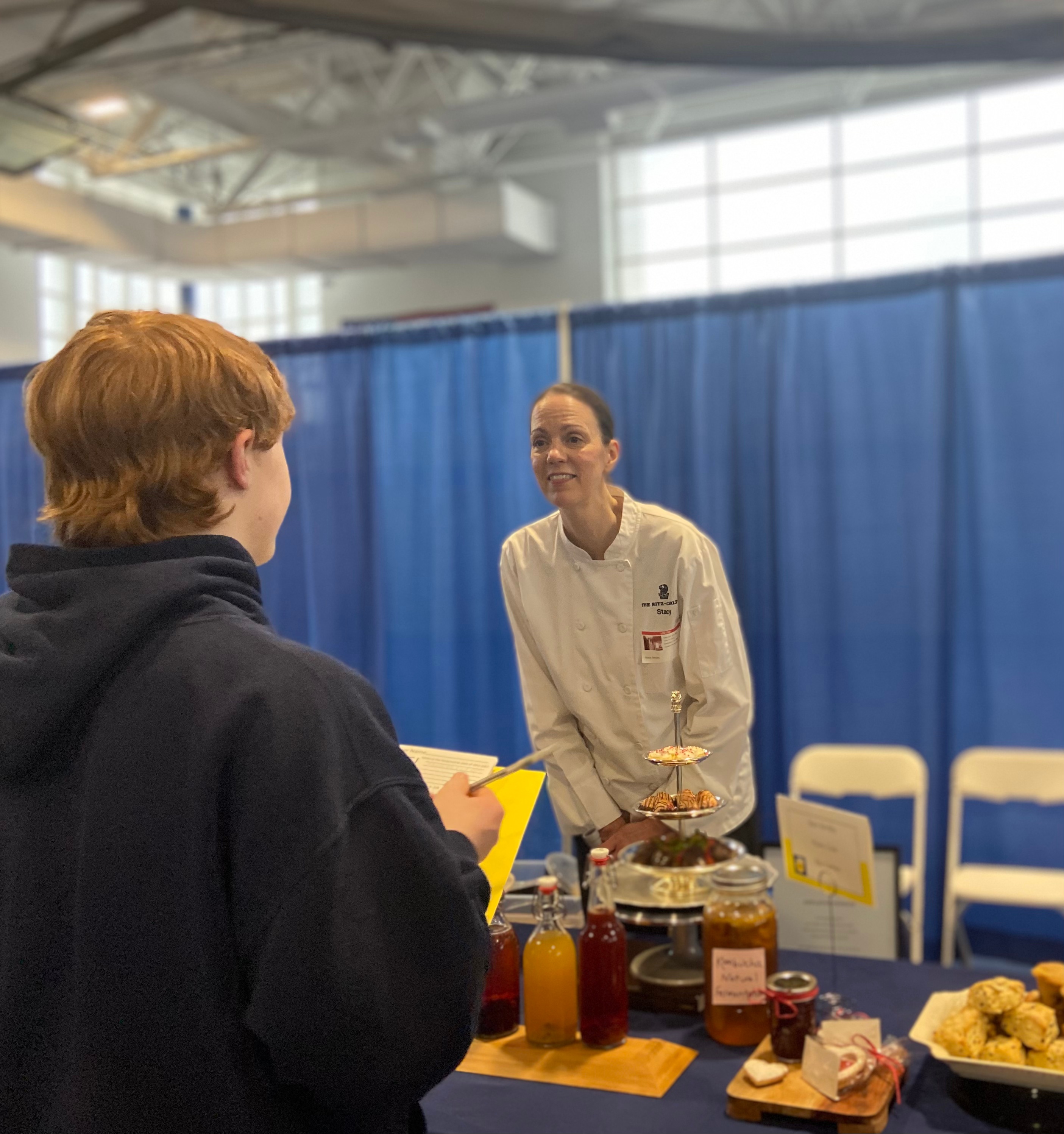
Andover High School hosted a My Career Academic Plan Fair (MyCAP) on April 15 for eighth-graders to explore career options before they enter high school. 

Eighth-grade students gathered in the Field House at AHS for the first-ever joint Career Day with all APS middle schools, organized through the MyCAP initiative, a Department of Education grant program. AHS collaborated with middle school and high school counselors, a team of educators, and volunteers to plan the career day. Prior to the fair, students were encouraged to do their own research on jobs that they are interested in. During MyCAP, students walked around with “passports” in which they could take notes of their discussions.

The purpose of the fair was to help rising freshmen gain insight into possible professions and career paths before they enter high school, so that they have a stronger idea of the courses they would like to take.

“[Students compiled] a list of careers that they’re interested in,” said Aixa de Kelley, Director of Guidance, and event coordinator. “Then they come here and find the careers for which they have questions to ask, and then they get a stamp.”

There were over 50 adult volunteers who shared their experiences from their various professions. Although smaller career days have been hosted at the middle schools in past years, this marked the first year that all three middle schools came together at the high school for a unified event. Volunteers answered questions students had and shared the proper education and experience requirements for their professions. 

Timothy Burgess, an electrician and a volunteer at MyCAP, shared, “[I hope to] inspire [students] that it’s not uncommon in a town like Andover to go to a trade school, because I went to West Middle, [and] it felt like there was a big stigma against going to a trade school.”

Another volunteer, Yissy Perez, a civil engineer and founder of construction company YCP Northeast, shared her motivation for sharing her career experience. “I would love to start a conversation early on. When [kids] hear engineering, they might think, well, that’s so difficult. And it is. But when something is fun, when you enjoy it, it’s worth it,” Perez said.

While studying at Tufts University, Perez enrolled in academically challenging courses, discovering her passion for engineering. She wants to share this experience with students and encourage more young women to pursue STEM professions. 

“I would love to see more women [pursue STEM]. In my view, especially when I’m working for another company, you don’t see this many women. It would be great,” Perez added.

Continue reading
AHS Seaperch competes at regional contest
  • May 6, 2024

By Anya Gorovits
STAFF WRITER 

Seaperch, an AHS club, sent their two teams to a regional competition in Cambridge on April 10th. The Jellyfish, one of the teams, won 5th place, while the other team, the Orcas,  tied for 2nd. Unfortunately, neither team qualified for nationals this year. 

  Seaperch is a robotics competition where high school teams’ robots from around the world are put through complex obstacle courses and are judged on time and completion of difficult tasks. Students use PBC pipes, wires, and motors to create a remotely controlled vehicle. This may sound similar to many other robotics competitions, such as the AHS Robotics Club (ARC), but there’s a catch: the entire competition is underwater. 

The team has always scored well and is “pretty exceptional”,  according to AHS Seaperch’s founder and advisor, Daniel Donovan.

Seaperch competitions consist of two parts, an obstacle course and a challenge course. For the obstacle course, the robots must maneuver themselves through 5 hoops and back as fast as they can. The path totals around 20 feet. The challenge course, however, is much more complicated.

“This competition, the challenge is modeled after collecting samples using a remotely operated vehicle like a deep submersible,” said Donovan. He chose to start the club after receiving an email from a US Navy representative. The Seaperch program, run by Robo Nation, is entitled to promote students’ interest in marine design. 

This year’s challenge course requires the robots to pick up rocks and sensors, open a door, and place the objects inside a small space. They earn points from different tasks and are given 10 minutes to gain as many points as possible. During the competition, students stand on the side of a pool and control their robots as they find their way through the water. There are two competitions each year. Teams first compete regionally, and if they qualify, they compete again at nationals.

Though Seaperch robotics may still sound similar to normal robotics, Seaperch robots don’t require any programming at all. According to Donovan, “Robotics is more complicated. These are simpler devices, but they’re working in a more complicated setting.” Though no programming is needed, students must learn about buoyancy, waterproofing, and how to operate underwater to create a successful robot. They learn a lot about the marine environment as well as engineering. 

Most Seaperch members are also in robotics. Junior Canyu Li said Seaperch is “way less time-intensive, and way less material-intensive than normal robotics.” She explained that the more relaxed setting makes Seaperch a very fun club.

Senior Luke Stump describes Seaperch as a “mini robotics,” saying it leaves a lot of room for creativity. 

AHS has had a Seaperch team for about 10 years and has placed 1st or 2nd at regionals and gone to nationals almost every year. Nationals typically take place at the University of Maryland. Last year, the team rented a van and drove down to compete. A couple of years ago, the team won 3rd place in the country.

Continue reading
Club of the Month: Women in STEM
  • January 13, 2022

Anusha Sambangi

STAFF WRITER

Women in Science, Technology, Engineering, and Math is run by Eunchai Kang, Baishali Chaudhari, Emily Packer, and Rishika Agarwal. Women in STEM aims to inspire and empower women and non-binary students in STEM fields, and offers resources to support them. Club activities range from inviting guest speakers to running fundraisers and drives. Members also discuss summer programs and STEM opportunities for high school students.

“I love that I get to meet new people and make new connections,” said Packer. The club encourages members to interact and learn from each other, as well as share ideas and have fun.

All AHS students are welcome to join and participate.
WIS meets every other Thursday at 3 p.m. in room 205. For more information about the Women in STEM club, visit ahswis.weebly.com.

Continue reading
STEM & Humanities: The Battle Continues
  • May 25, 2021

By Katie Budinger

EDITOR IN CHIEF

Andover High School offers nearly twice the number of STEM AP classes as it does AP classes that fall under the umbrella of English and history. Do me a favor and think about that for a moment.

The ratio is 5:9, with English and history APs making up the lower figure and a combination of math and science contributing to the other. The science department alone offers six different AP classes, which is more than English and history combined. Unless you are an upperclassman who has a passion for the humanities, you might not have even noticed this disparity; I had to go through next year’s course catalogue in order to obtain the numbers to support such a statement. 

One of the things that makes AHS great is that we have so many classes available to us; there is something for everyone! This becomes especially apparent when it comes time for course selections, especially to rising juniors and seniors who are delving into the world of APs and other upperclassmen courses that open up as requirements loosen their hold. 

“There are all sorts of interesting courses that we offer,” said guidance counselor Heather Dwyer. “You don’t necessarily have to have an AP designation for the course to be rigorous and really interesting.”

The real problem arises when you find what you love and want to completely submerge yourself in one particular field.

“I’ve always been a reader, and I’ve always been a writer, and that’s just where my interests lie. I just find history and language a lot more interesting than equations and numbers and atoms,” said one junior, who is currently going through the process of selecting courses for their Senior year. They have an interest in taking AP Literature & Composition, Senior Capstone, and Multiple Identities in Text, all of which are classes with English credits attached, thus meaning that they would receive three English credits towards their graduation requirements. “I’m fulfilling all my requirements, so I feel like that shouldn’t be a problem. I feel like I should be able to pursue that if that is an available option…. There’s no such thing as too many humanities!”

Meanwhile, Senior Erin Currie is living a very similar route by taking three, full-year classes in the sciences. Much more comfortable with the S in STEM—“TEM kind of scares me,” she admits—Currie opted to take Marine Biology, Anatomy and Physiology, and Forensic Science her senior year. 

When asked about the process of fitting all three courses into her schedule, Currie said, “I was talking to my guidance counselor about this and she was telling me, ‘Don’t expect to get them all. List alternatives. There’s like an 80% chance,’ she said, ‘of getting two, a very low chance of getting all three,’ so she told me to prepare to not get all three.” Currie knew her chances were slim, but decided to try her luck with the system, which her guidance counselor had no issue with. “I did get all three…. It was a funky process.”

However, the Junior currently deep in the selection process has had a very different experience. “[My guidance counselor] literally said that I might not be able to take that many English classes,” they said. 

Now, perhaps my own judgement is a bit clouded, since I had the exact same experience as this Junior. When I tried to take three English courses, I was told that it was, without a doubt, impossible. Why is it, then, that in a different department Currie is able to take the same amount of science courses? Perhaps her guidance counselor was more open to the idea than some, or less worried about what college might think. 

“Over my years of being a guidance counselor– which is going on seventeen– we have a lot of communication with college admissions officers and representatives… and really the consistent message is that they don’t want a student really ‘majoring’ in a particular subject in high school,” Dwyer said. She encourages students who want to pursue an academic niche to find ways outside of the classroom, such as clubs.

Senior Olivia Ventre, who plans to major in English in college, has found a different way to further explore her love of English. Her Senior Capstone project focuses on women and diversity in literature, but she hasn’t taken nearly as many humanities classes as she might have liked. “I’ve never really had room on my schedule,” Ventre admitted. “It never really seemed like an option for me. It wasn’t that my guidance counselor was like, ‘No!’” 

You might be wondering what any of this has to do with the numbers I threw out early on, but it all boils down to the same problem. It’s the elephant that no one seems willing to acknowledge, and yet it’s in the room. It’s the reason that we have more STEM APs than humanities, and that one student can take three classes while the other’s request is refused. The superiority of STEM in our society has bled over into the AHS system, leaving the Humanities at a disadvantage.

When asked if students tended toward one discipline or the other, Dwyer observed, “Year to year we have a bit of everything, but within my last five to six years I’ve seen a lot of students focusing on STEM.”

This disparity is evident in the fact that the College Board only offers two English APs (both of which AHS offers). However, there are a total of nine history APs available, only three of which will be available next year, compared to the twelve math and science APs, of which we offer nine. If enough students came forwards and vehemently expressed interest in these courses, Dwyer seemed to believe that it would be possible to add more APs as long as they did not overburden teachers. She also emphasized that AP courses are not the be all and end all, but they do very clearly show how our society tends toward STEM and leaves the humanities in the lurch.

If you disagree, then chalk up this column as the rant of a bitter Senior who wanted to spend her senior year writing and reading as much as possible before going to college to do the same thing: write and read. All I ask is that you don’t dismiss me as a complete conspiracy theorist and go forth into the academic world with your eyes wide open.

Continue reading