AHS Team to Conduct Particle Physics Experiment at DESY
  • October 7, 2024

By Tommy Kruecker-Green
Opinions Editor

It all began when senior Richard Chen, discovered the competition at the end of the 2022-2023 school year. He attempted to recruit classmates but initially found little interest. Richard then approached Daniel Donovan, a physics teacher and the Physics Club advisor, and later, the team of eight’s mentor. Donovan’s initial response was skeptical. “He was like, this is an absolutely crazy idea, and it’s never going to happen,” joked senior Jaiden Li.

But the team – Theo Buckridge, Richard Chen, Samyak Jain, Jaiden Li, Daniel Lin, Zach Medjamia, Hari Palaniyappan, Robert Zhu – known as the SPEEDers (Smith-Purcell Effect Emission Determination) persevered. They began working on their proposal at the start of the following school year, brainstorming a number of ideas before settling on Smith-Purcell radiation. This lesser-known phenomenon, first discovered in the 1950s by Smith and Purcell, occurs when a beam of electrons passes over a metal grating, causing the emission of light.

The team’s proposal focuses on the unique properties of Smith-Purcell radiation. “It’s a non-intrusive method of diagnosing a beamline,” explained Li. A beamline is a line in a particle accelerator along which particles travel, and “diagnosing” means measuring its properties. “Essentially, that means that it’s very safe to conduct, and there’s also potential applications in healthcare with regards to X-rays.”

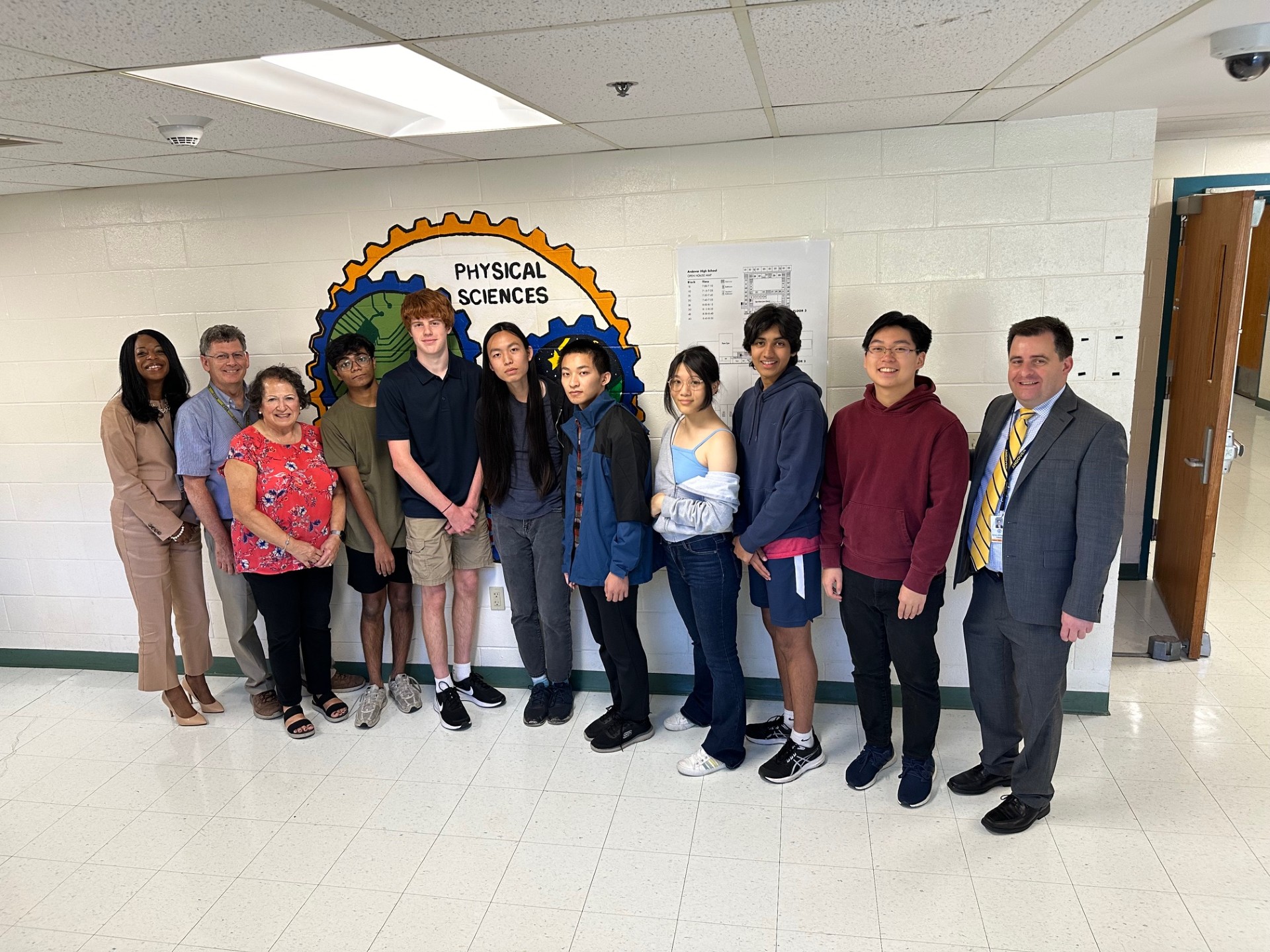
STAFF PHOTO / Tommy Kruecker-Green
Winners of “Beamline for Schools” competition, along with AHS physics teachers Mr. Donovan, Ms. Givens, and Principal D’Andrea and Superintendent Dr. Parvey

The non-intrusive nature of Smith-Purcell radiation in measuring an electron beam is a key advantage. “When you run the electron [beam], you don’t actually run the electrons through the grating; you run it over [the grating], and so the beam continues on,” Zhu clarified. This means scientists can measure the beam’s properties without disrupting it, keeping the beam intact for other uses like medical treatments. To develop their proposal, the team gained access to a library of physics papers through the school librarian, John Bérubé. They also used Onshape, a cloud-based CAD (computer-aided design) software, to create 3D models of their experimental setup. Li got involved just a week before the submission deadline to create this computer simulation.

Remarkably, the team completed their final proposal in just one week. “It was a very last-minute thing,” admitted Zhu.

At DESY, the team, accompanied by  Donovan, and physics teacher,  Cynthia Givens, had plans to run an electron beam over their designed grating and observe the resulting Smith-Purcell radiation. “We’re pretty much just gonna be running the beam and trying to observe the Smith-Purcell radiation,” said Zhu before they left for Germany. “And we’re gonna be tweaking things and trying to see if it matches our predictions for how much we’ll see, what we’ll see, what frequency, and so on.”

The students have ambitious goals after observing the radiation. They hope to code a simulation for GEANT4, a toolkit used by CERN for simulating particle interactions. “The thing with the Smith-Purcell effect is that there isn’t a module for it in GEANT4,” said junior Buckridge. “So we would be the first to code that.”

The team sees this once-in-a-lifetime trip as an opportunity to experience the international scientific community firsthand. “It’s just really great to have experience working with these tools that actual scientists use in the actual field,” said Zhu. “We definitely want to learn more about what the scientific community is like outside of just Andover or outside of just the U.S,” Li added.

Continue reading
Andover High School Students & Staff Share Mixed Opinions on Animal Dissections
  • March 20, 2023

By Harry Guo and Brandon Nguyen
STAFF WRITERS

Students in sophomore Biology classes dissected fetal pigs to study the body systems of living organisms. According to science teacher Lindsey L’Ecuyer, classes were able to perform dissections earlier this January for the first time since 2017. Dissections had been taken out of the school curriculum over time and money concerns. Since then, various classes have made plans to dissect pigs, cats, squids, and sharks, although other classes have dissected flowers as an alternative to animals. 

According to Jennifer Rodier, another science teacher at AHS, the pig fetuses used in the sophomore classes’ dissections are sourced from a local slaughterhouse, where their mothers are used for meat and other products. These fetuses, which would not have survived without their mothers, are given to schools like AHS to be dissected instead of being thrown out. The cats usually had been living on the street before being dissected. Many of the marine animals, like the squids, are sourced from supermarkets. 

Ella Baldwin and Kaila Bloom, two sophomores at AHS, are firmly against the dissection of any animal. They also run Animal Action Club at West Middle School, a club devoted to teaching kids how to help the animals and wildlife of Andover. According to Baldwin, “dissections shouldn’t be done anymore. It doesn’t make sense. If it’s for learning opportunities, you could do the exact same thing on a computer.” As advocates for ending animal testing, they bring up the concerning amount of waste produced by animal dissections, which, according to the Humane Society of the United States, can result in up to 12 million animals killed per year. 

Bloom believes there should be more effort in educating students on how the animals are sourced, so people can be more informed about their choice to participate in dissections. “We need to be educated before we choose to do these things… these beings’ lives are being taken for our gain,” she said. Bloom proposed that everyone should use online options, such as looking at simulations or videos of others doing dissections, which would only take the life of one animal to educate an entire class. 

Even the teachers had mixed opinions about animal dissections. According to L’Ecuyer, “having an opportunity to do something that’s more real-world and less taking notes… to get in and see [what] those [organs] look like is a more meaningful experience.” She claimed that these hands-on activities can help students envision what they want to do in the future.

Alan Kalf, a Biology and Chemistry teacher at AHS, had a unique perspective on dissections in high school. “Biology is a mandatory course… not everybody will want to do a dissection so that makes me hesitant to do it,” said Kalf. “If it was an elective course like anatomy, then it’s easier because everybody has the choice to take it.”

Rodier believes dissections are worthwhile as long as students are willing to make learning experiences out of them. “Dissections in my past completely helped me understand and visualize what I was being taught out of my textbook,” said Rodier. “After I got over my own fears on the first dissection, I warmed up to the idea, and [dissections] became valuable learning experiences.”  She pointed out that there aren’t many drawbacks to performing dissections: students who are comfortable have the opportunity for a firsthand experience, and students who’d prefer not to dissect have online alternatives available. 

Despite some debate, most teachers do agree that the downsides to dissections are worth it if students can spend enough time and effort on the dissection. “When we think about ethics, we think about whether the benefits outweigh the concerns,” said L’Ecuyer. “By taking a careful, methodical teaching approach in classes and helping students get as much out of it as they can, then the benefits outweigh the concerns.”

STAFF PHOTO / Harry Guo
Aniketh Sherigar, a sophomore in L’Ecuyer’s Biology class, participates in a pig dissection.

Continue reading