The graphs show the number of new cases reported by day, week, month, and overall in Andover High School andthe Andover Public School district since the return to school after winter break on January 3, 2022.
After winter break, there was a surge in COVID-19 cases, but the numbers are gradually decreasing. According to the Andover Public Schools COVID-19 Dashboard, shown on the Weekly Cases graph, the number of cases in the school has tended to spike after the weekends, then go down over the week. This pattern has been repeating each week since the break, but the spikes have been becoming smaller.
The Dashboard resets on Saturdays, but as of February 7th, as shown in the Total Cases graph, over 317 students at Andover High School and nearly 100 students and staff in the district had tested positive for COVID since after winter break. This is about 17.6% and 14.7%, respectively, of students and staff. While the number of cases is at a steady decline, it is still important to follow the COVID-19 guidelines and be careful to not catch it.
For the classes of 2022 and 2023, midterms are almost a memory. Having not taken the tests since winter of the 2019-2020 school year (pre-COVID), these seniors and juniors may find it almost strange that it’s happening again this year.
Midterms will be held in January. With a month to go in the first semester, midterms are getting extremely close. Many students are experiencing heightened stress around the tests, especially after a whole year of missing these exams.
“I don’t like the school’s decision to bring back the midterms,” stated junior Zoe Isbell. “It leaves most of us unprepared and not knowing what to expect, and we also missed a lot of information last year that we could need on the test.”
Junior Madelyn Blanchette shared that she doesn’t really see a benefit to midterms because of the increase in stress and anxiety: “I don’t like midterms because I don’t like tests. I value my time off from school and would rather spend it doing a hobby rather than spend it studying.”
Isbell added, “Personally, the midterms are extremely stressful and the teachers spend about a week just preparing you for it. This takes time away from valuable learning time where we could be learning new information that we could use during the finals or other exams.”
PHOTO ILLUSTRATION / Avi Shapira Sophomore Aisosa Oviasogie studying for midterms
Some students don’t mind bringing back midterms. “Sure, it’s one extra test that has a decent amount of weight to it,” said Andrew Magner, junior, “but it has benefits too, like those breaks between tests and just getting out from school early.”
While many students dislike tests, there are some students that believe there are benefits to these midterm exams. Magner said, “It helps create a long-term memory of the thing you’ve been learning about, as well as giving students practice before finals and allowing freshmen to get comfortable with these big tests.”
“I enjoy getting to spend the 30-minute breaks wherever we want between midterms,” said Audrey Hetherington-Young, a senior at AHS, referring to the open campus policy between each exam.
Isbell believes it’s a good thing that these tests are graded; the exams provide a way for teachers to understand what level of understanding their students have in their classes. This can help them either adjust something that may be confusing as well as figure out what to remove or add to their lesson plans or methods.
Many of the juniors and seniors also need to remember that freshmen and sophomores will be experiencing midterms for the first time this year. Sophomore Sergey Bielecki is quite nervous about the tests. “It’s a lot of studying and I’m not sure how much weight it has for my grades,” he said.
Many may be asking what the purpose of midterm tests even is. Math teacher Scott Armstrong explained that midterms are used as a midway point for courses in order to prepare students for the larger assessments ahead in college. “We give departmental midterms so that the final does not cover all the material from August to June,” added Armstrong.
Drop-Out Rate in 2021-2022 School Year Brings Light to Difficulty of AP Classes
With many students dropping out of Advanced Placement and Enriched classes, a pressing question persists: How has the COVID-19 pandemic impacted the student drop rate in these classes?
AP classes, which are college freshman level courses taught in high school, are known to be both quick-paced and work-intensive. Throughout the year, some students will request level changes down to honors, bringing a bit of light to the difficulty of some of these classes. According to some AP teachers, Andover High School has experienced more students moving down from AP levels this year than ever before.
When one thinks of an AP course, there are a few infamously difficult ones that come to mind: AP U.S. History (often abbreviated to APUSH) and AP Calculus are among the few. But what do actual students and teachers of these classes have to say about them?
APUSH is a class that is known to be extremely difficult. The pace, depth of content, delivery, and assessments of APUSH are more challenging than what students are used to. “For juniors who are first taking an AP class, it’s quite an adjustment. If you think about it, it’s literally skipping two grades,” said Mary Robb, who taught APUSH up until this year.
STAFF PHOTO / Melody Tang AP students Larissa Cardine (left), Julia Kole (middle), and Julia Benjamin (right) study in the morning before class.
Andover High School junior Bori Kim said, “APUSH is definitely a challenge, but it’s not always hard. The pop quizzes are hard to study for, though, and projects are a lot of work. The key to APUSH is time management.”
AP Calculus, which is one of the most notoriously difficult AP classes, is split into two levels: AB, which teaches half a year of college calculus in one school year, and BC, which teaches one full year of college calculus in one school year. “AP Calculus specifically is also, for some students, the first time that they struggle with math,” said Megan Mulert, who teaches both Honors Calculus and AP Calculus AB. “For a lot of students, it’s the first time that they actually have to put in the work and learn how to study.”
While there are usually only one to two students who drop down from BC to AB, Mulert said she has had around 10 this year. Mulert remarked, “The main skills you need for AP Calculus are algebra II and precalculus, and… most of that for them was during COVID. So, I’ve seen the effects of the pandemic much more this year even than I did last year.”
AP Calculus BC teacher Karen Waters also brought up an important point: although there were many students who moved down this year, there were also many students who were taking courses in a level higher than they were recommended for. This might have played a role in the increased number of students moving down, since they were not well prepared for the rigor of the class.
Shawna Chu, a senior at AHS, said that AP Calculus BC is especially rigorous because there are no “homework grades or participation grades, so your grade is just however well you do on tests.”
A couple students interviewed mentioned that APs weren’t as difficult as they thought. Several say that most of the difficulty is self-inflicted. AHS junior Yash Kalwani, who is taking four APs, explained, “Honestly it’s not really a lot of work, it’s just poor time management that leads juniors to struggle with APs.”
Procrastinating can become an AP student’s worst enemy. AHS junior Annie Song, who is in AP Chemistry, also gave a piece of her advice. She jokingly warned, “Don’t be like me and play nine hours of games before you start homework.” Altogether, the general consensus is that APs definitely require more work and effort than a college prep or honors course. However, as long as you don’t procrastinate, the work shouldn’t become crushingly overwhelming. Unfortunately, many students are tempted by procrastination and it snowballs into being behind on lots of classwork and homework, which often results in doing poorly on tests.
AP Tips and Tricks
Although AP classes are infamously difficult, there are many tips and tricks on how to get through these courses while maintaining a good grade.
Interviewed teachers stressed to always ask for help, to be at every class present and participating, and to do homework every night so as to not fall behind. AP Calculus BC teacher Karen Waters mentioned that summer work is important as well, observing that students who really put in the effort to thoroughly do their summer work did better when classes began.
Mary Robb, an AP U.S. History teacher up until this year, also noted the importance of reaching out for help when needed, mentioning that the students who came to see her during H-block were the ones who showed the most growth throughout the year.
“If you pay attention in class, you should be pretty set for the tests anyways. I say to not go in over your head because if you end up taking too many APs, that can take up a lot of your time,” junior Annie Song added, “Depending on the person, it can stress you out a lot, so know your boundaries… [and] always make time for yourself.”
AHS Junior Bori Kim also commented, saying, “Think about which ones may help you in college or [in] the major that you’re thinking of [pursuing].” Being proactive, attentive, and staying on top of your course load is really the secret behind surviving AP courses.
Andover High School students express their dislike towards H-1 H-Block, which encourages faculty to make changes.
Some students wish they could have more time to do homework. They also want the freedom to choose what teachers and people could meet in the same H-Block. This would allow students to meet with teachers and peers, as well as hold club meetings.
AHS junior Ryan Swenson expressed his frustration with the block. “The H1 teachers always have some weird assignment for us that no one actually does,” he said.
Many others agree that the bonding activities are a waste of time.
However, what students don’t know is that changes to H-1 are already happening. There is a small H-Block planning team that asked a few students what they wanted most for future H-Blocks.
Some students have offered some ideas for changes that could be made. Rajswami Kontham, a sophomore at AHS, said that he wishes students “had more time to complete work in H-1 alongside classroom activities.” This was the most common theme throughout the student body.
During H-1 on Tuesday, November 2, instead of the normal curriculum, students were given time to get last-minute assignments done before the end of term one. This independent period goes by the name Bee You, inspired by worker bees.
“Some people might want to work on homework and just do a lot of work. Where others may want to give themselves some time to reflect,” said Assistant Principal Kwesi Moody. The H-Block planning team plans to implement Bee You in future H-1 H-Blocks.
As AHS neared the end of the first term, students went over their grades and concerns with their H-1 teachers before the term ended. H-1 teachers helped students get in touch with the teachers they needed to see.
Currently, a goal of H-1 H-Blocks is to meet the needs of each student. For example, H-1 aims to help freshmen familiarize themselves with the faculty members and the school, especially after transitioning from middle school. They will have their H-1 teacher for all four years at AHS, giving them an opportunity to connect with that teacher. H-1 gives all students a time and place to get themselves organized for the next cycle. There are also learning activities that take place during H1, such as ALICE training, fire drills, and more. During this time, H-1 teachers may go over important events and announcements.
In addition, H-1 is a place where students can discuss recent issues and other important lessons. Some students have come to their H-1 teacher for both mental and academic support. For many, it is a safe space.
Social worker Abby Levins stated that students “have to think about the overall school environment and community, and the school’s need to have a sense of community and spirit so that everyone gets along well.”
Since in-person school resumed during the COVID-19 pandemic, wearing masks has been mandated. This was put in place in order to keep each student and staff member as safe as possible from the virus. The mandate within the Andover Public Schools system was going to last until at least November, but after a school committee meeting on October 21, the schools sent out an email regarding the extension of the mandate. Especially because the holidays are just around the corner and many students and staff have family members who had not been old enough to get vaccinated, it’s great that the mandate was extended until at least January 15.
The email also explained that the extended mandate would allow more time for parents to have their younger children vaccinated, if they choose to, as the vaccine was to be approved shortly after the email was sent—It was approved on November third.
Despite the administration’s efforts, many students still do not adhere to the rules about wearing masks, and teachers and other students are struggling to deal with them.
Several students interviewed observed how many students were not wearing their masks correctly in school. Andrew Magner, a junior at AHS, said that in his classes, only about 60-90% of students wear their masks correctly. Senior Audrey HetheringtonYoung said that in her classes, however, only half of the students wear them correctly. Junior Rachel Chen said that there are at least three people in each of her classes that wear their masks under the nose or mouth, and Junior Ohad Mamet said that only about 80% of students have them on right.
I took note of students in each of my classes, and by my count, an average of 19.6% of them were wearing their masks incorrectly. This is nearly one fifth of students, which is unsafe, to say the least, and rather disappointing. If not all students wear their masks correctly, then it ruins the whole point of wearing masks in the first place, and will prolong the spread of COVID. To stop wearing masks, you have to wear them first. Additionally, I found that an average of 1.3 students kept their masks below their mouths in each class, which is even more unsafe.
STAFF ILLUSTRATION / Naomi Bloom
Teachers have been struggling to have students keep their masks on. Even when reminded to put their masks back up, many students simply tug them back down once their teacher looks away.
“There isn’t a teacher in this building who has time to constantly remind the same students to wear their masks properly,” said Mary Robb, a Social Studies teacher at AHS, “and, quite honestly, they shouldn’t have to.”
Chen noted that most of her teachers have to keep asking the same students over and over again to keep their masks up, to no avail. Those students still return to class each time, masks hanging under their noses. Magner said that because of these students that continue to wear their masks improperly, some teachers seemed to have given up on enforcing mask-wearing as the year went on. “I still would say that the majority of my teachers do enforce it when they see a student not properly wearing a mask, even if they may not be paying as much attention to students’ masks as they did before,” he added.
“I don’t really understand what the big deal is about masks,” said Elias Pantazi, a junior. “It has been proven that they help control the spread of COVID and they aren’t uncomfortable or hard to breathe in… I’m not really in the mood to be sent home because people feel too much pride to be a team player.”
Additionally, Junior Avanthika Suryadevara also said that there are several people in her classes, especially in the hallways, who wear their masks incorrectly. “It mostly shocks me when I see people wearing them completely down, because that’s not effective in any way,” she said. It’s extremely disappointing that so many people don’t mind putting others at risk for such a small personal benefit.
Wearing your mask is for the good of the community, and it doesn’t hurt to keep it up–there are mask breaks for a reason. Keep your mask up, not just for the safety of everyone else, but also yourself.
“I know it is an inconvenience,” said Michelle Chachus, an AHS teacher, “but if wearing masks keeps us safe until more people are vaccinated and the variants are under control, then I think it is a small price to pay for health, safety, and peace of mind.”
Around one hundred fifty students sign up for a new course, Advanced Placement Psychology, at Andover High School.
While AP Psychology was offered through Virtual High School previously, this is the first time it is being physically offered at AHS. The teachers for this course include Micheal McCarthy, Michelle Chachus, and Kathryn Vives, all of whom teach the half-year elective Psychology and Mental Health, offered in honors and CP-levels.
The idea of a psychology class mixed with the challenge of an AP course make it very appealing to students. “I don’t know if everybody wants to go into psychology,” said Vives, “but I think that there’s at least a nugget of interest that everybody holds, learning about the human brain psyche and why we behave the way that we do.”
The half year elective itself, was a popular choice, which could have lead to the large number of signups for the AP version. “I took the psychology elective sophomore year, and I had a great time with it, so I decided to take the AP version of the class,” reflected senior Aahana Tiku.
Many students are also interested in the subject itself. “I have a big fascination with how the brain and mind work,” said senior Mimi Cung, “I decided to take the AP course because I think it has more opportunities and will allow me to go more in depth.”
In this course, students are encouraged to take a hands-on approach to learning and participate in a lot of activities. There have been simulations, as well as different types of projects surrounding zombies, restaurants, the brain, and theme parks so far. “I like it a lot,” said senior Saima Rahman, “the work and activities we do in this class kind of connect to my other classes so I’m happy with the way it is structured.”
Through this approach, students are understanding and forming unique connections between the class, themselves, and beyond. “We are able to look at different perspectives and compare and contrast with our own experiences,” said Cung. “It is evident how we are able to apply these concepts to the outside world.”
While the course has been going well overall, the teachers have already seen some challenges with lesson plans and pacing.
“It’s so early,” said Vives, “I already see things from every unit, every lesson I’ve taught, that I’d like to change a bit for next year.”
Additionally, since the AP exam will be held during the first week of May, there is great pressure on the teachers to finish the course by that date. “It’s just very hard to judge how fast we have to move through the content,” reflected Vives.
The Andover High School library was renovated this past summer to improve the learning environment for students.
The library was last renovated in 1997 before the current updates this year; and after about 20 years without improvements, the library is finally getting the updates it deserves. John Berube, a librarian at AHS, stated that the carpet in the library was “starting to split,” one of the many reasons the library needed renovations. This split was a safety hazard to students, who could potentially trip on the carpet. The renovations were initially just supposed to replace the carpet, but as the process started the school decided to paint the walls, update lighting, as well as fix sound issues.
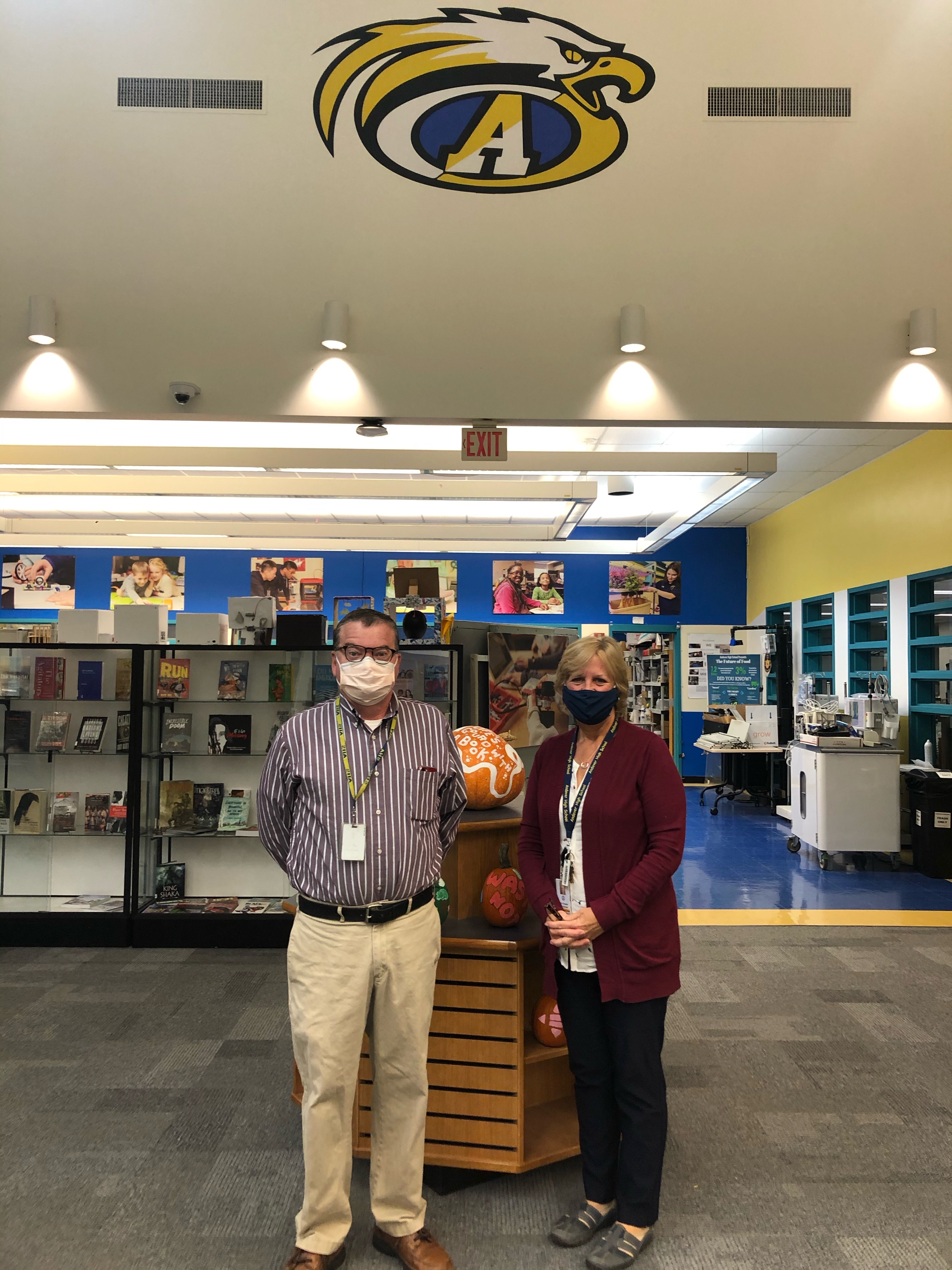
STAFF PHOTO / Caitlin Connell John Berube (left) and Mary Coombs (right) in front of the new library design
Berube said they had been “talking about [the renovation] for years,” and over the summer the project finally started up. So far, the brick and concrete has been painted over white, blue, and yellow—the colors of the Andover Warriors—and our school’s logo has been added on one of the walls.
Mary Coombs, who is also a librarian at AHS said, “The new paint made it feel brighter and more engaging.”
The school has also hired an acoustical engineer to help plan out how to make the library less echoey, and more suitable for classroom use. Berube said the library “echoes something wicked,” so for sound regulating, acoustical panels will be installed along the walls which will absorb some of the noise. Along with the noise panels, a new wall is going to be put in the library surrounding the open classroom on the left by the entrance. This wall will help control sound to minimize the noise produced during classes.
The renovation will continue through the year and consist of updating the light fixtures in the entrance of the library and changing the lights to LEDs for a brighter working space. New light fixtures will be added to the front of the library brightening up the space even more. The bookshelves in the library were also spaced out further to create room for two new classroom spaces in the library, providing even more space for learning.
The bathrooms in the library may also be getting renovated in the future. The plan is to modernize them by making the bathrooms touch-free. The bathrooms in the library will also be gender-neutral, making them available for all students to use.
Coombs said, “I love the changes.” Her part in organizing the renovations was vital and she is more than happy with how the library ended up looking. Years ago, the library that we know today was once just a small room with a hallway in between and an auditorium on the other side that faced the foyer. Now the library is a combination of the hallway, library, and auditorium. The space has grown dramatically in size since 1997 and continues to be used as a student-centered space. The new renovations have only made the library more inviting for students and teachers, creating a better learning environment.
GUEST PHOTO / John Berube What the current library space looked like in 1997
The return to the 8-day schedule and the lifting of social distancing restrictions this year have prompted a variety of responses from students.
Concerns over safety have arisen over the removal of social distancing restrictions, such as one-way hallways and spaced seating in classrooms. Some students feel that the lifting of these restrictions has made them feel more unsafe.
“Lifting the social distancing [restrictions] and one-way hallways is definitely more convenient for students but not necessarily the safest thing,” said sophomore William Tutwiler. “I understand Andover’s vaccination percentage is very high, but I believe it is safest to continue social distancing especially with the new Delta Variant.”
Jack Klock, a junior, feels the same way. He said it’s definitely going to impact safety at the school, and acknowledged that although most people at AHS are vaccinated, it’s important to stay cautious.
Others feel that the removal of some restrictions won’t have much of an effect on safety. “I think as more people get vaccinated and COVID-19 rates start to decline, lifting some restrictions will be okay,” stated junior Elisabeth Shin, “as long as people still maintain some hygiene and make sure to get vaccinated, [it] shouldn’t impact the safety of most students.”
A blank template of the 7+H schedule
The return to the 8-day schedule is another of the many changes to AHS this year. The 8-day schedule has long been a contentious topic, and many are divided on whether its reinstatement has been beneficial or detrimental.
Senior Janice Lee is among those who do not prefer the 8-day schedule. “During the 4 block schedule we had during the hybrid model, it was easier to manage my work because the classes would be every other day. So if I had class one day I would have at least the day I had class and the next day to work on [homework].”
Others, such as Shin, enjoy the 8-day schedule. Shin likes the 8-day schedule because it allows her to sign up for teachers for H-blocks and helps keep the days interesting. “While there is no predictable pattern, I think it kind of symbolizes how life is not set in stone,” she said.
Despite these mixed opinions, students are overall happy that they can be in-person. “I think it’s just a blessing to be back in school learning in classrooms rather than behind a screen and I am looking forward to a really great school year,” said Tutwiler.
Students Express Pros and Cons of Hybrid and Remote Academy Changes at AHS
By Naomi Bloom
STAFF WRITER
Some AHS students have switched between remote and hybrid learning for a myriad of reasons, and the majority of those interviewed (aka, the Switchers) were happy with their choices. However, getting students switched is a complicated process that not everyone can work with.
“The process of switching instructional modes is very complex from a scheduling perspective,” said Assistant Principal Scott Darlington, adding that many students requested a switch, but with a limited amount of space in the classroom, it was difficult to process everyone’s requests.
For example, senior Alana Miller didn’t get to switch from hybrid to remote. She was concerned about school safety in regards to COVID-19 and because of stress as well. She also mentioned the transitions between in-class and at-home days within hybrid have been “extremely hard on students and teachers.”
Miller told ANDOVERVIEW that in order to switch, one has to be “extremely proactive and fight to get switched.” She even thinks the school was making the process a difficult one in an attempt to dissuade students from trying to switch from one type of instruction to another.
However, Darlington explained the process itself has been much more difficult than expected. This is because in the fall, many more requests to switch were accepted, so as a result, there is very little room for new people to switch now.
“We are following a district process in determining who can switch instructional modes,” he said. “[In] many cases, it just depends if there is space in the same type of class as in the other instructional mode.”
Aside from Miller, the other four Switchers interviewed by ANDOVERVIEW were able to make changes at the end of term two. They all had rather smooth transitions and were all happy with their new learning model. Sophomore Angela McNeely said that during her switch to remote, she only had to change one of her electives and that everything else went as planned. Her switch to remote from hybrid “feels really refreshing” so far.
Santiago Montez, a freshman who switched to the remote learning, said that while there are the pros and cons of each instructional mode, both are still good. For example, he missed hybrid because you get to be around people in class, but he liked remote because it’s safer and he added his teachers in remote are better with technology, as they have had to use it more.
For those of you who are looking to switch if there is an upcoming opportunity, here are some tips for switching:
Sophomore Alison Dalton, who switched to remote, said the experience of switching can vary from person to person, but students should try to switch to the option that allows them to stay more motivated.
Senior Isabella Gervais, who switched to hybrid, said that while “school is school” and there will always be times that get stressful, it’s important to “make sure that you are doing the best for your mental and physical safety.” She also said students will have support from their teachers and friends, so there’s no reason to be afraid to try to switch.
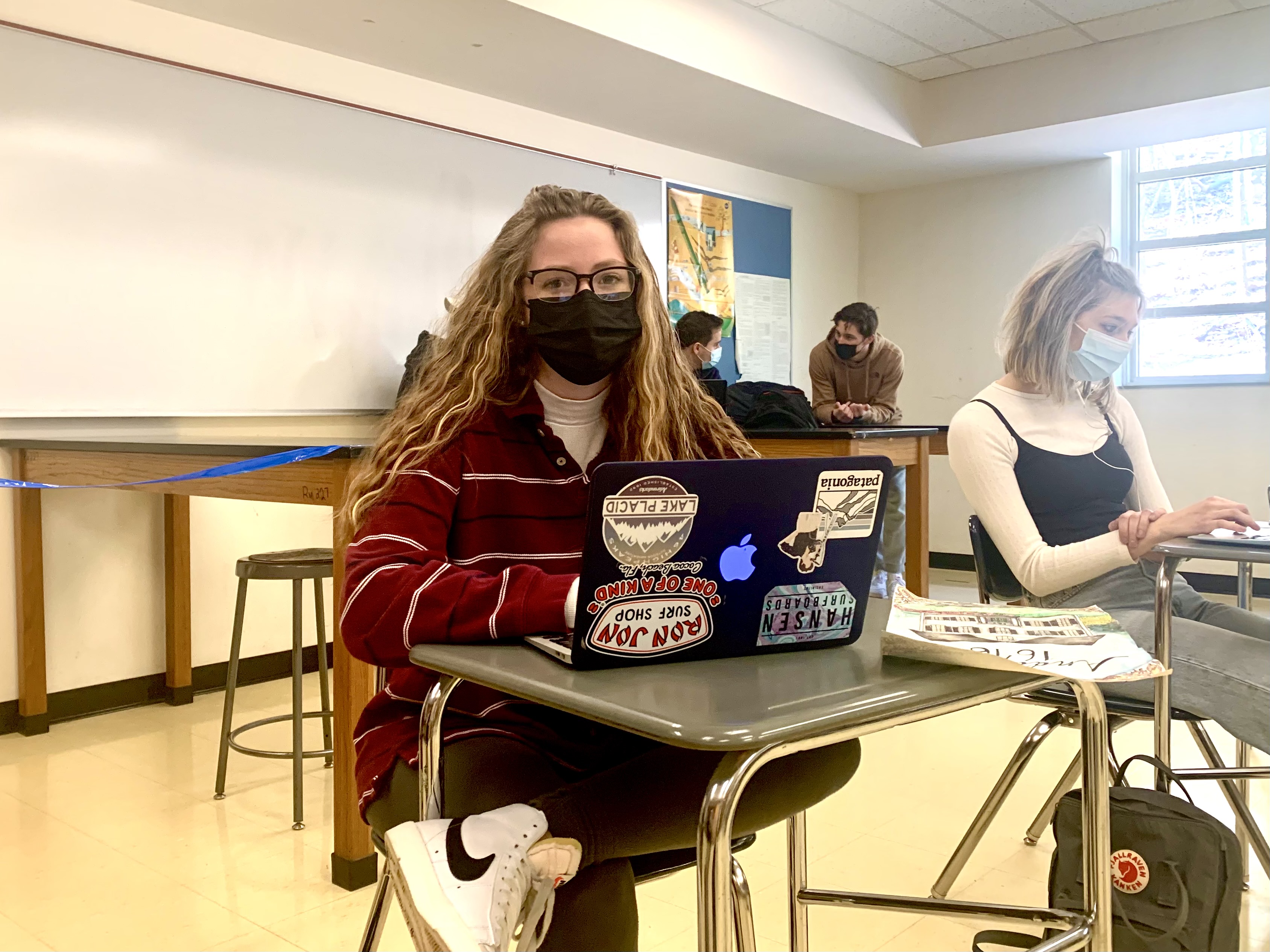
STAFF PHOTO/ Erin Li Senior Isabella Gervais studying on her computer during in person H-Block.
In addition, Darlington told ANDOVERVIEW that students who are switching will need to use a support team of their guidance counselor, teachers, parents, and their assistant principal, if needed, to help with the switch. “Learning remotely full time is very different from in-person hybrid learning,” he said. “[They] may require different strategies for students to organize their school work and time.”
This last year has been a mess for everyone. From government workers to grocery workers, everyone has had to deal with the pandemic. Schools were closed, and businesses closed. With all of this going on, many people struggled to stay on top of schoolwork, bills, and other issues. In school, many students were having trouble in school, and I was one of them. Dealing with remote learning is extremely difficult, and it adds more stress to a busy day. Personally, I think AHS has had a poor performance catering to the remote students. They should consider a reassessment of the situation, and provide more resources to the cause. To start, the district gives remote students VHS classes for courses “not offered” through the high school. This is supposedly because of a lack of staff to teach all the classes. They resorted to a third party system, The Virtual High School (VHS). VHS offers a wide variety of courses, but the difficulty of the year long courses is ridiculous. As a senior this year, I enrolled in a Physics class, supposedly for high school students. It was the difficulty of a third-year college course. There was a lab, lab report, problem set, and quiz every week! The extreme rigor of this course caused me to fall behind in other classes, and use other class time to try and catch up in this VHS class. It was extremely frustrating, and I was extremely stressed in order to try to get my grade up. I spent all of my time after school trying to work on this course, and it is a poor reflection on how the class was run. Not to mention, the “instructor” was located in Nepal, which is a day behind us. I was not able to access for extra help. I was extremely disappointed in the set up of this course. Not only was VHS a significant issue. For world languages, AHS gives remote students the program, Idiomas, to learn their language of choice. However, to call it a course was a stretch. There was no teacher to student communication, and it took forever for the teacher to respond to emails. Assignments were given with poor instructions, and there were many assignments which weren’t graded properly. I am still waiting to hear about several grades for my course which were submitted before winter break! I don’t understand how the district thinks this program is good for remote students. I understand that COVID-19 is a widespread issue, and that everyone is going through a difficult time. However, I feel Andover should have grasped the situation much better than this mess of a program. AHS had an entire summer to figure out if they needed to hire extra staff, or if they needed to add extra programs to ensure the proper education of students. I find this experience as a remote student to be extremely disappointing, and this is a poor example of what AHS “stands for.” I hope the district learns from these mistakes and helps other students who are having issues.
Yay
Remote school seems like a walk in the park, but it does come with its own difficulties. I chose to participate in Remote Academy because I felt that going to school would be too risky during the COVID-19 pandemic. I had taken some classes online over the summer, so I felt I was well equipped to succeed. Remote school has presented issues that I did not anticipate. When I was in class last year, there was a fine line between school time and personal time. Remote learning has fractured this boundary. With no solid differentiation between home and school, I quickly found school work and academic pressures to be invading my personal space. Consequently, I needed to find ways to feel comfortable in both worlds. I managed to accomplish this by making time to do things I love, like artistic activities, reading, and playing games with my family. Virtual High School (VHS) is also a hot topic among many students. Some enjoy the classes, while others feel they are not worthwhile. I was introduced to VHS when I took geometry last summer. I found that learning a complex subject, such as math, is difficult within this program. The classes have no lectures, and there is no structured communication between the student and teacher. Therefore, it was up to me to learn the material on my own, with very little assistance. As a sophomore this year, I am enjoying my cybersecurity course through VHS. I have been doing well because I am interested in the material. Also, I have an instructor who has made herself accessible, so if I have a question, I receive a quick response. I feel I have learned more in this course in four months than what I absorbed in the geometry class I took last year. There have been many times when I have lost enthusiasm and motivation to learn remotely. I found the best way to tackle these issues is to take care of myself. When I feel worn out, I take time to decompress by reading a book or taking a quick walk in the neighborhood. I do miss seeing my friends in class. Seeing my friends over the internet isn’t the same as interacting with them in class. We don’t get to meet during lunch, chat in the hallway, or share a laugh during a class discussion. Though my friends and I meet over FaceTime to keep in touch, it’s not a fulfilling substitute for in-person socializing. Overall, I doubt that I will switch to hybrid this year. Although school is extremely important to me, the health and safety of my friends and family is my first priority. Remote learning has its drawbacks, but I am able to maintain peace of mind by staying home. I am hoping I will see everyone at school in September!