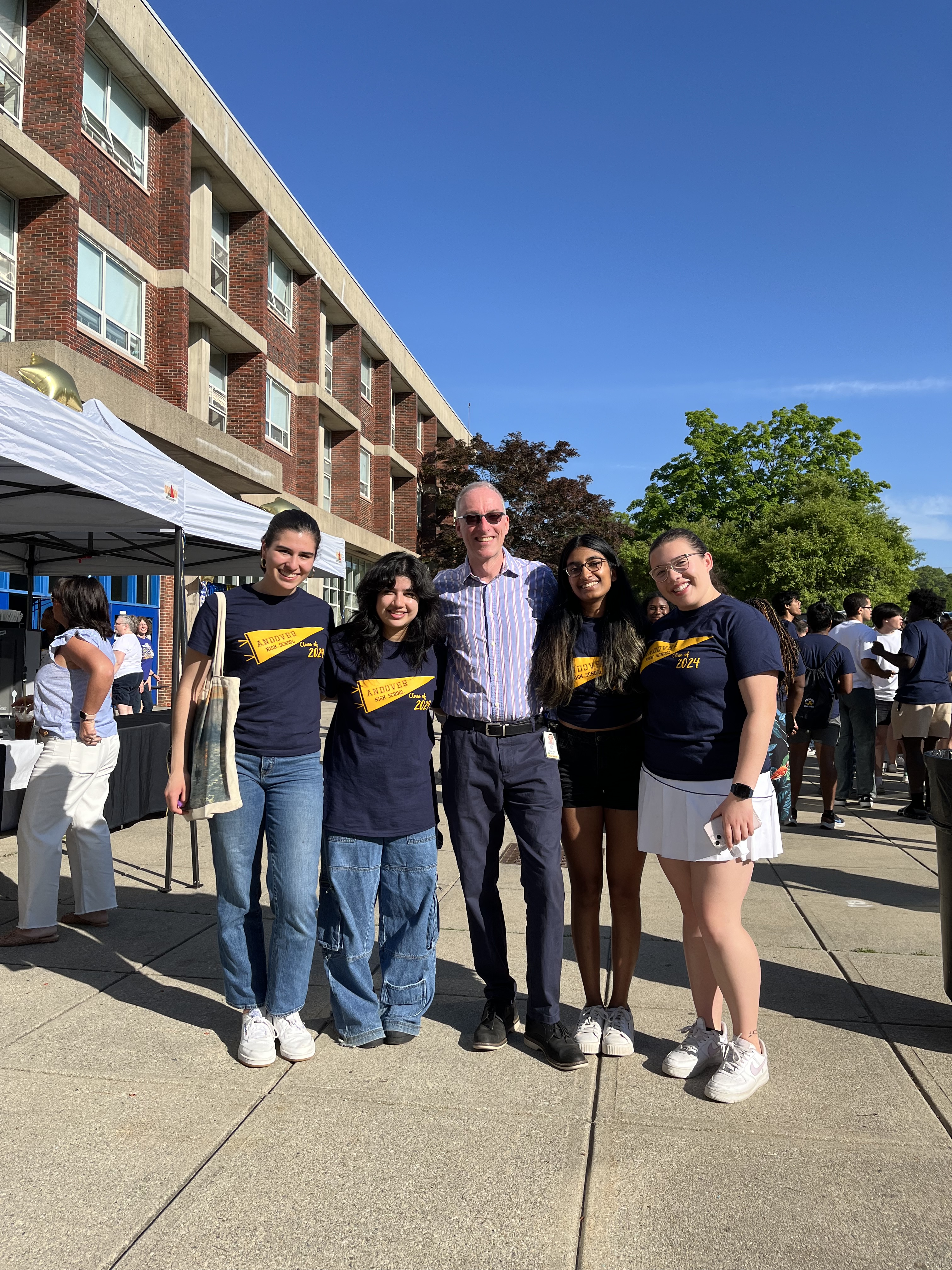
As the demand for AP U.S. History (APUSH) soared at Andover High, the need for a new faculty member to join the APUSH staff has grown more apparent. ANDOVERVIEW sat down with veteran social studies teacher Fred Hopkins to discuss his yearning to teach U.S. history and the preparation that his transition required.
What prompted you to start teaching APUSH?
I was a US history major in college, yet I’ve never, ever taught U.S. history despite asking to do it every year. I’ve had a series of bosses tell me, “Yeah, we’d like to get you into a U.S. History class. How about next year?” Sometimes, I will just give up and just stop asking [to teach U.S. History] . When the people who have been teaching APUSH here said, “We’re open to someone else stepping in and helping that person navigate the course,” I was just standing there, ready to jump into the system. I just wanted the change of pace.
Has U.S. history been an interest of yours since high school?
When I was a high school student, I knew it wasn’t required. I studied different worlds, cultures, and histories in college, but I focused on U.S. history.
How many APUSH students do you teach?
18. Just one section.
What are your opinions on AP classes?
The community and the management of the schools look at AP as a standard type of course. And it’s gotten to the point where this monopoly that the College Board has – they could tell you how to do. I don’t know if they would allow such a thing. They are a nonprofit, but they’re a business – people making money. I would rather see us abandon APs and just teach content courses and then force the AP world to accept ourselves. I taught AP European history in New Jersey for three years. My students and I didn’t have to deal with AP tests, and I wasn’t in any way encouraged to teach the test. I felt like a liberated teacher. It’s counterintuitive to teach to a test. A good test is something that reveals to students what they’ve learned. Teaching to a test, we all know, is pedagogically not sound. What we’re doing, it’s a mess.
What is the hardest part of starting to teach a new course?
The things that I know best are the things I’ve taught up to then. So, when you don’t have this information stacked up in your memory banks, it makes it a little bit frustrating. The hardest thing about APUSH is stress. I wonder if people are interested in learning, or are they just interested in the measurement and what it does with college applications? Pure learning would be ideal if that’s happening.
What is the process of preparing to teach a course you haven’t taught before?
Over the summer, I worked with both the other teachers. And I read, and I read, and I read history, and analysis of history and opinions on history. Then, I went through an institute that I attended the prior summer and took in all the information that they shared.
Could you speak more about collaboration with [fellow APUSH teachers] Dr. Michaud and Ms. Chachus?
They showed me how they divide the AP course into units and lessons and showed me how they approach the show, and how they do assessments. They try to vary their lessons and activities and how they review. We talked about how you grade students, and everybody grades differently. So we’ll have to adopt. approaches to what works for you. By the way, that process is still ongoing.
They’re both willing to answer every one of my questions as soon as they come up.
Are they a resource for you?
I wouldn’t be standing without them.
What is your favorite part of American history in general? Are you looking forward to teaching that in APUSH?
My favorite part of American history is the analysis of foreign policy that drives America’s official and unofficial interactions with the world.
Are you planning to continue teaching APUSH?
My reluctance to hop in was pretty strong, and now that I’m in it, I will stay.
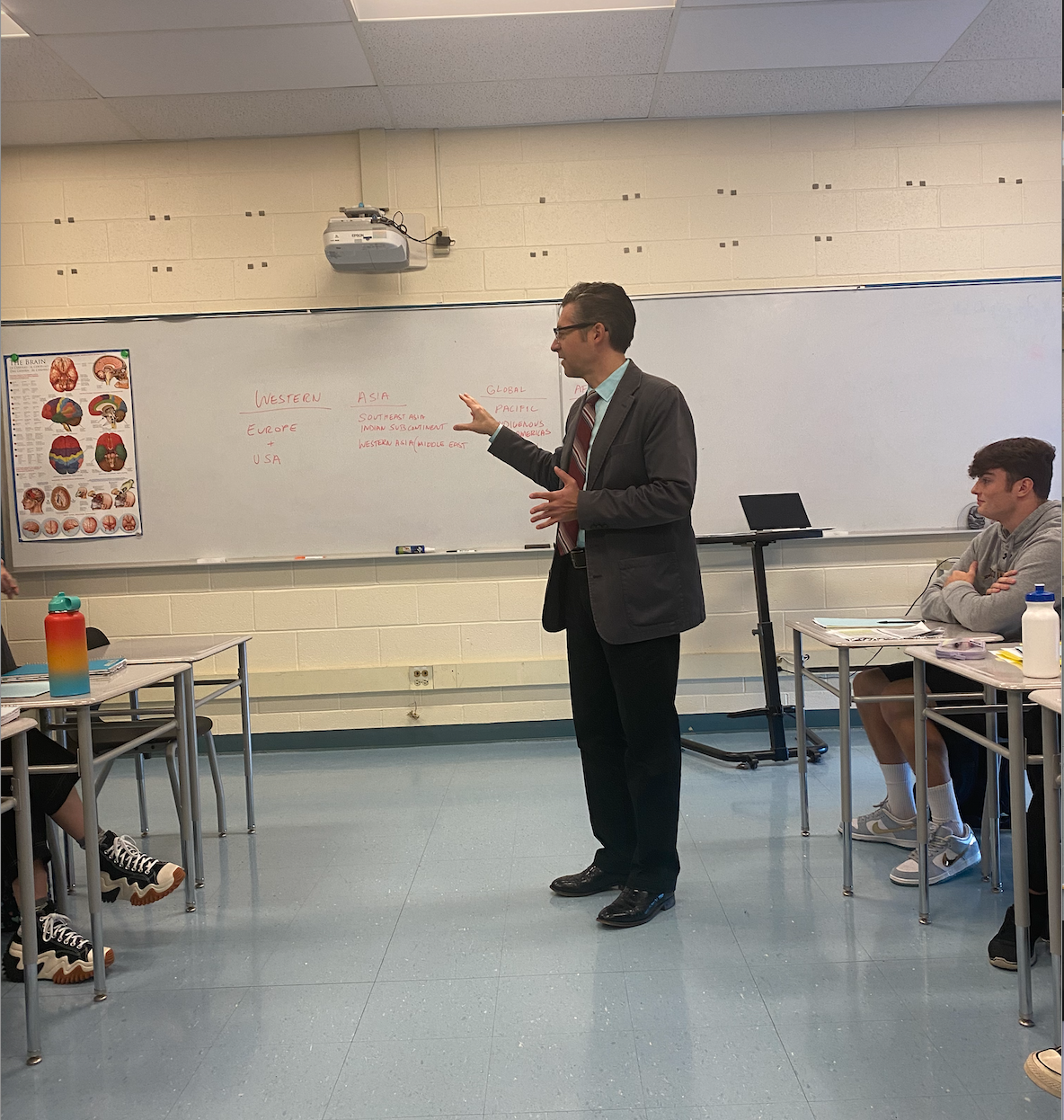
STAFF PHOTO / Sanjith Kalpat Mr. Hopkins helps Freshman Caroline Arnold with her work.
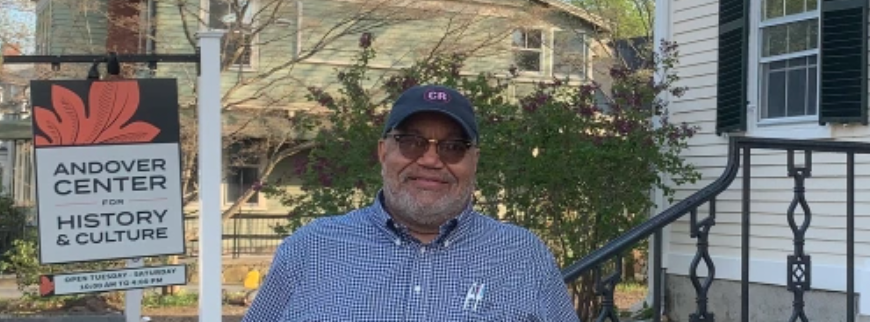
Ralph Bledsoe, a science teacher at Andover High School, was recently nominated to serve on the Board of Governance for the Andover Center for History and Culture. This role would entail helping manage the Center’s affairs and planning the steps that would be taken to further its missions.
The Andover Center for History and Culture (previously known as the Andover History Society) works to preserve the history of Andover. The center holds memorabilia dating back centuries, including an antique book collection containing books over 200 years old.
“They’ve basically tracked the history of this town… and are trying to be the center for the town to be able to, upon going in, appreciate what has happened here,” said Bledsoe.
“The History Center’s mission is to spark curiosity and inspire action by gathering and sharing stories that connect us to each other, our community, and the world,” added Elaine Clements, the executive director of the Andover Center for History and Culture.
In his newfound position, Bledsoe will have a say in how the Center is run. “As a Board member, Mr. Bledsoe will join a group of volunteers who focus on the future of the History Center and our shared vision of a world where people use history to create connections and take action,” said Clements. Board members work together in committees to consider what steps the History Center can take to bring Andover closer to that vision, as well as how they can use their resources, such as people, building, and funding, to accomplish said steps.
Bledsoe has been an active participant in the Andover community for years. In addition to being a beloved member of the AHS staff, he has been involved in the Fulbright Teaching Excellence and Achievement (TEA) program at UMass Lowell, where he works with international teachers to show them the U.S education system in Andover. He is also the chair of the Nominations and Elections Committee for the Andover Education Association teacher union and vice-chair of the Council on Aging Board for the Robb Center Andover Elder Services. Last, but not least, he has won the Black Excellence on the HillMassachusetts State House Award. He earned this after delivering Dr. Martin Luther King Jr’s “I Have a Dream”speech to the four corners of Massachusetts. It was this speech—among the many other community involvements—that drew the eye of the Andover Center for History and Culture.
“Mr. Bledsoe has also been an important part of a number of open mic nights that the History Center has co-hosted with the town’s DEI commission. We’ve talked about history and research projects,” said Clements. “Mr. Bledsoe’s passion for history is clear and we’re delighted that he will be bringing his passion and enthusiasm to the Board of the Directors and the History Center.”
“I love how things work and what you need to do to make something function, and essentially history is how we work now,” said Bledsoe. His fascination with history, combined with his attachment to Andover, culminated in his desire to join the Board of Governance for the Andover Center for History and Culture. “I love the town of Andover… I love history… [and] I love museums… so why not become involved with a museum for the town?” he said.
COURTESY PHOTO / Ralph Bledsoe Ralph Bledsoe, a science teacher at AHS, is enthusiastic about his new position on the Town’s Historical Board. Courtesy photo by Ralph Bledsoe
By Naomi Bloom, Avi Shapira, and Melody Tang MANAGING EDITOR, EDITOR IN CHIEF, ONLINE EDITOR
Some students have voiced concerns surrounding issues of misrepresentation and lack of diversity in the AHS history curriculum, and the social studies department has been working towards acknowledging student feedback while meeting the criteria put forth by Massachusetts law.
One highly-discussed issue has been the Eurocentric perspective of history courses. Abinaya Ganesh, a junior who is co-president of the Diversity, Equity and Inclusion Student Advisory Committee, said that Europe and America are a focus. “Usually, your history classes… are based on, ‘How did this thing affect Europe? How did this thing affect America?’” Ganesh said.
Additionally, some students have noticed that their freshman year history course covered a variety of world regions, but their sophomore year course mostly focused on Europe. “My freshman year World History teacher did a really good job of truly teaching ancient civilizations, especially in Asia,” said senior Diya Ganesh. “Modern World is more focused on the West.”
Several teachers interviewed echoed these concerns and are working to make their courses less Eurocentric.
There used to be only two required history courses at AHS, World Civilizations in freshman year and 20th Century Studies in sophomore year. Several years ago, the two required courses were expanded into three: World History (freshman year), Modern World History (sophomore year), and US History (junior year). These courses are taken by current AHS students.
“A lot [of content] was lost,” said US History and Race and Membership teacher, Kathryn Reusch. With only two years to cover the entire high school history curriculum, there was not enough time to cover as many topics as they felt they should. So, the classes were split up. She said that the intent of the department splitting up the courses over three years instead of two was to create a Modern World class that would “allow teachers and students to be able to explore more parts of the modern world and explore more diverse stories of the world,” which resulted in the restructuring of the classes.
Mary Robb, who teaches US History and Democracy and Media Literacy echoed this. “It’s allowed us to be far more… inclusive, because we have more time,” due to there being three required history courses instead of two.
PHOTO ILLUSTRATION / Naomi Bloom
A lot of the AHS history department’s curriculum is based on Massachusetts educational standards rather than teachers’ decisions. Massachusetts standards include topics that must be covered, most of which focus on European history.
The Massachusetts guidelines include instructions for two courses, World History I and World History II (similar to freshman and sophomore history at AHS). While World History I includes some global history, the vast majority of content required to be taught in World History II is European history, or how European imperialism impacted other world regions.
“The state gives us a general [curriculum] that’s a little bit broader than ours… [outlining] major themes you should talk about, and then we often add to that more than anything,” World History teacher Nicholas Rand said.
The curriculum also depends on department-wide standards that “spell out the most important topics that [current AHS social studies teachers] collectively, or past groups in our department, have decided over the years,” said Rand.
Despite the split in classes, it is a challenge to incorporate much outside of the set curriculum. “We have work to do, and one of the struggles of a history teacher is always, ‘How do we find the time to do all of the things that we think are important?’” said Reusch. “Because when we add one thing, we need to take something out. And, clearly, issues of identity and diversity are incredibly important, and figuring out how to incorporate those in an authentic way with the time that we have is always a challenge.”
Another issue aside from the required parts of the curriculum that can result in differing experiences for students with some topics is that different teachers cover different topics in their classes based on their expertise in the subject. “It’s mostly about how we learned about it [and] our connection to these topics,” said Rand. “I will say that, as I’ve grown as an educator, I continue to add where I find new interesting things.”
Even when the curriculum is expanded, the way the content is taught can affect the lessons students take away and the experiences of the students in the class.
“Sometimes students… feel like they have to represent [their] culture in a discussion,” said junior Ellen Chou.
Abinaya Ganesh recommended that teachers facilitate discussions about sensitive topics, and provide the class with resources so students of color don’t have to defend their culture to their classmates. “Make a space where your students of color can speak, but don’t make them the resource for the class,” said Abinaya Ganesh. “Part of it [is] being able to crack down and know when you have to step in and facilitate.” They also noted the importance of providing students with resources to hear the perspective of people of color outside of their classmates.
Some students described the way they were taught about their own cultures’ history in class as uncomfortable.
“When we were learning about the British Raj in India… the documents and videos we watched romanticized the imperialistic nature of Britain in India and didn’t take into account how people that were in India felt,” said Diya Ganesh.
Because of the limited exposure students get to cultures beyond Europe in their education, history classes sometimes give a stereotypical view of a certain culture to students.
“Every time I see Africa, in any context, in the AHS curriculum, [it] is always described as this destitute place that is actively being conquered by white colonizers,” said junior Aisosa Oviasogie. “It’s never been presented as a place with a society that has a complex government… It’s never presented that way… Because when I go to Nigeria, I’m not walking around barefoot and living in a hut. There are cities in Africa with amazing architecture, and that are sleek, teeming with all this new technology. And nobody ever gets to see that. Nobody ever gets to see what I see when I go to Nigeria.”
“I also think that we need to be more cognizant [that] yes, these events [such as colonialism and slavery] happened. But how does that affect students’ view of different cultures in the process?” said Oviasogie. “If you were constantly portraying cultures like they’re struggling, and they’re not free, then what does that make other people think?”
If you were constantly portraying cultures like they’re struggling, and they’re not free, then what does that make other people think?
However, Robb said that finding media that focuses on marginalized groups can be challenging because they have been marginalized in every aspect of US life, including media. “Marginalized groups have been treated horribly throughout US history,” she said. “They’ve also thrived, they’ve also created, and invented, and learned, and developed, and grown in spite of really poor treatment, and that’s what I hope to find.”
Diya Ganesh emphasized the importance of what kind of media is shown in class. “I really think it goes back to the materials and preparation on talking about these specific topics,” she said, recommending that teachers have class discussions on the perspective of certain sources and how complicated an issue is when there are no other options of sources to show, rather than“just watching the video, having an assessment, and pretending like it’s not a big deal, when it actually is.”
Rand described how he approaches covering difficult topics in class. “I tried to make it well known that this is important… I try to spend at least a couple of days really digging into sources, really trying to set a serious tone so that students, again, remember those connections, remember that’s part of world history, as well as this part of our history.”
Some students also expressed concern over a cater towards the white population of students. Oviasogie noted that the way she was taught about racism in her history class was often focused on getting through to white students rather than making students of color comfortable. “[People] felt a need to protect their actions or their ancestors’ actions… Then we have to make them not feel bad for their ancestors’ actions when the purpose of learning isn’t to make anybody feel bad. It’s learning so that we don’t ever have [the Holocaust] happen in the future.”
When interviewed, students continuously expressed interest in learning about different cultures they hadn’t learned about in social studies classes.
“It feels like year after year we continuously go over the same material,” said senior Rachel Irza. “Instead of re-learning the American Revolution again, I think it would be much more beneficial to learn about more countries that typically don’t get much representation in traditional history courses.”
Reusch said the history department is having conversations on adding elective courses on cultures not heavily covered in the core courses, such as Asian, Latin American, and Native American history. “There are so many other cultures that deserve attention,” said Reusch. Currently, the only social studies elective that focuses on a region other than Europe or the US is Modern Middle East.
“We can always do better, there’s always a striving to do better,” said Reusch. “And I think that’s a mark of a good teacher, that you do your best but always recognize the room for growth. And I think that we are, as a department, open to that.”
“Being always open to feedback is really important,” said Abinaya Ganesh. “You can teach sensitive topics and genuinely believe that you are doing everything you can… You wouldn’t be able to know that if students don’t feel comfortable sharing [their opinions on a lesson].” They also mentioned the importance of teachers making it clear to students that they welcome student feedback.
Rand also discussed the importance of student feedback, encouraging students to let him know if there is something that they disagree with or if they’ve heard something different because they’re closer to a certain piece of history.
Oviasogie encouraged students to speak up if they have an issue with the way a topic was presented in their class. “Go to any teacher, literally any teacher, and they’ll talk to another teacher, they’ll talk to their program head. And something will happen. Emails can be sent and meetings can be had, but not if you don’t say anything.”
Robb emphasized the importance of having these discussions and continuing to make pushes towards increased diversity and representation in history classes. “There are folks from every corner of the world living in the United States, be they residents, be they citizens, and people of every faith, every culture… and I think that’s something that makes the United States unique, I think that it’s something that makes the United States strong, and I also know that it’s something that creates a lot of challenges for us,” she said. “But we can’t understand where we are today, can’t work toward having a more compassionate and healthy future, if we don’t understand the past.”
Advanced Placement (AP) Art History students at Andover High School (AHS) had a unique summer homework this year exploring and analyzing a museum of their choice.
All AP courses at AHS have a mandatory summer assignment that prospective students must complete. In addition to the usual academic reading, AP Art History instructor Matthew Bach added an extra component to the course’s assignment that was unique to any other class offered at AHS: each student was to visit a museum of their choice and analyze the “amount of space… that is devoted to the display of western, Eurocentric objects versus how much is devoted to non-western cultural objects.” At the beginning of school, students got together and discussed what this meant about the world politically. Those who were unable to carry out the assignment were given online alternatives so that they were still able to take the course if desired.
STAFF PHOTO / Ethan Zabar Matthew Bach teaching the AP Art History class.
Manasvini Panguluri, a senior at AHS taking AP Art History, is taking the course mainly to explore this new perspective. “I felt like growing up, we were constantly taught about artists like Leonardo da Vinci, Frida Kahlo, [and] Picasso,” Panguluri said. “I feel like this class definitely broadens my point of view on art and will definitely improve my art work.”
Bach, who created the assignment, believes there are many benefits to this style of learning. In addition to student testimony, Bach noted that he was very impressed with the beginning-of-the-year discussion. “I think it really benefits students to be out in the world criticizing and deconstructing the institutions and power structures that we’ve built, not just sitting at home and reading a book,” Bach remarked. This style of learning in general, he believes, is much more effective than simply referencing online sources. Panguluri added, “I feel like it really pushes you to explore and experience on your own before even having any knowledge of the course.” She agreed that the summer work for AP Art History was indeed distinct from her other summer assignments.
Due to student demand for the class, AP Art History was added to the selection of courses after first being proposed several years ago. As described in the 2022-2023 AHS Course Catalog, AP Art History is a course that allows students to “experience, research, discuss, read, and write about art… through multi-variant contexts.” Bach believes that the course analyzes historical art pieces from more of a global perspective (as compared to other history courses) and that it dedicates “much more of a conscious effort to [study] non-western history.”
If one refers to the experimental labs performed in most science classes, they will observe that this type of education is not completely new to AHS. However, it is certainly less-commonly observed amongst humanities classes. AP Art History’s summer assignment not only broadens AHS’ styles of education, but also encourages likewise changes among similar classes.
Andover Public Schools hired Gregory Hurley as program coordinator for the social studies department on January 27, 2022, replacing Adrianne Bock.
Before coming to Andover, Hurley worked in the Malden Public Schools system for seventeen and a half years. He was a history teacher and the head of the social studies department at Malden High School, and for the last three years, he oversaw social studies, English language arts, world languages, art, music, ensembles, and libraries as the Director of Humanities.
When asked why he chose to work in Andover, Hurley said that there were many reasons. He stated that he’s able to work K through 12, and after he got to know students and teachers at the elementary schools, middle schools, and high school, he found that Andover deeply values education. “I was really excited about having the opportunity to go out here and help all of our students grow,” said Hurley.
STAFF PHOTO / Jacqueline Zhu Gregory Hurley, social studies program coordinator, working in his office
As a program coordinator, Hurley helps teachers assess what they are teaching in terms of curriculum as well as what’s working and what’s not in terms of instruction. “It’s a support role for teachers, to help them best help all of our students,” he explained.
Helping students and teachers navigate difficult topics and current events is one of the goals Hurley hopes to accomplish at Andover High School. “One of the things about teaching history and social studies in 2022 is that it’s fraught with lots of roadblocks, because the very nature of social studies is that we lean into controversial things,” said Hurley. “History is hard. History is ugly, it’s messy, and when you’re studying historical events and human interaction, it gets messy and ugly.”
Hurley emphasized that the goal of social studies teachers is not to train students to do a job but to guide others. “I really believe that social studies is leadership training,” he stated. “We want to be confident that after we work with students, we’re happy with them being leaders of our society, whether it’s Andover, Massachusetts, the United States, or the United Nations. We want to be confident that students have the analytical thinking, reading, writing, and communication skills at a level that they could lead us.”
Hurley’s experiences at AHS have so far been positive. “There are some amazing people here,” he commended. “Students are incredible. I really enjoy getting to know many of the students, and I think we have a very professional staff.”
Hurley’s favorite aspect of working at AHS is interacting with students in their social studies classes. “I love teaching, I love being in classrooms with kids and their teachers,” he stated. “Being able to be in social studies classes and learn with students has been so much fun, and it’s definitely the highlight of every day.”