SCROLL: Day in the Life of a High Schooler
  • March 17, 2025

Anya Gorovits and Diya Manikandan || STAFF WRITERS

I jolt out of sleep as my alarm blares into my ears. My hand moves before my brain does, reaching for my phone. I quickly snooze the alarm and instinctively click to watch some videos—just a few to start the day. 

“STOP SCROLLING, If you want to be more productive, you need a morning routine.”

I blink at the screen. That sounds…important. I watch as a girl lists out five steps to increase productivity. I instantly forget steps one through four, but I think step five is “stop wasting time.”

I nod. Good advice. I watch another video. Then another; 20 minutes later, I’m still in bed.

Scroll.

History, first period. The teacher is lecturing us about the Constitution, but it sounds fake. I open my phone under my desk.


Is the Constitution even real?”

First result, a guy’s voice blares through my AirPods: “WAKE UP PEOPLE, the government doesn’t want you to know this, but the Constitution was actually written by time travelers!”

I look up to see everyone staring at me. Shoot, my AirPods never connected. The teacher sighs and continues on with the lesson. I look back at my phone.

Scroll.

Math class. I don’t understand anything. The room is silent, except for the teacher’s monotone voice and the sound of someone cracking their knuckles. What if she calls on me?

I ask to go to the bathroom and leave. In line, I open my phone. 


I return to class 12 minutes later. The teacher glances over at me from her desk.

“You okay?” she asks. I nod and slide into my seat. 

Scroll.

Time for lunch. I sit with my friends. We smile at each other and pull out our phones. Overlapping sounds from our phones accompany the background noise of the cafeteria. 

Someone finally looks up. “Did you see that—”

“Yeah, I saw it on TikTok,” I say. They nod and go back to scrolling. I take a bite of my wrap.

Scroll.

Gym class. The teacher says we need to exercise. 

I check my phone. One video says walking 100 steps a day is enough. The next says running can be bad for you.

I decide to sit down. 

Scroll.

Finally, I’m home. I open up a blank doc. My English essay on phone usage is due tomorrow. Time to focus. I set my phone on the other side of my desk. 

I type my first two sentences, occasionally glancing over at the chipped screen that stares back at me, daring me to pick it up. I begin to write, “Phone addiction is a myth. I would be able to survive without my phone–”

BZZZ. BZZZ.

Ignore it. I need to focus. I write another sentence, but the words just don’t sound right, even though they came from a video by a wellness influencer. Somehow, everything sounds better when it’s online.

I’m about to finish the end of my next sentence—

BZZZ. BZZZ. BZZZ.

Maybe it’s something important. It couldn’t hurt to check. 

My phone screen lights up. Oh, someone new requested to follow me. I should see who they are, check out their posts, where they go to school—

Scroll.

Four hours later, the three sentences from my essay stand alone. Meanwhile, I’ve watched 73 videos. A few of them were on tips for better writing though, so it’s basically studying.

Scroll.

My eyes drag lazily across the screen of my phone to check the time. Midnight. I should sleep. 

Another video will help me fall asleep. Just one more. 

Scroll.

It’s 3:00 AM, and my phone is snug against the indentation it’s made on my pinky finger.  

A pop-up interrupts the dancing cat on my screen…

 “Time to take a break? You’ve been scrolling for a while!” 

Sigh… 

Scroll.
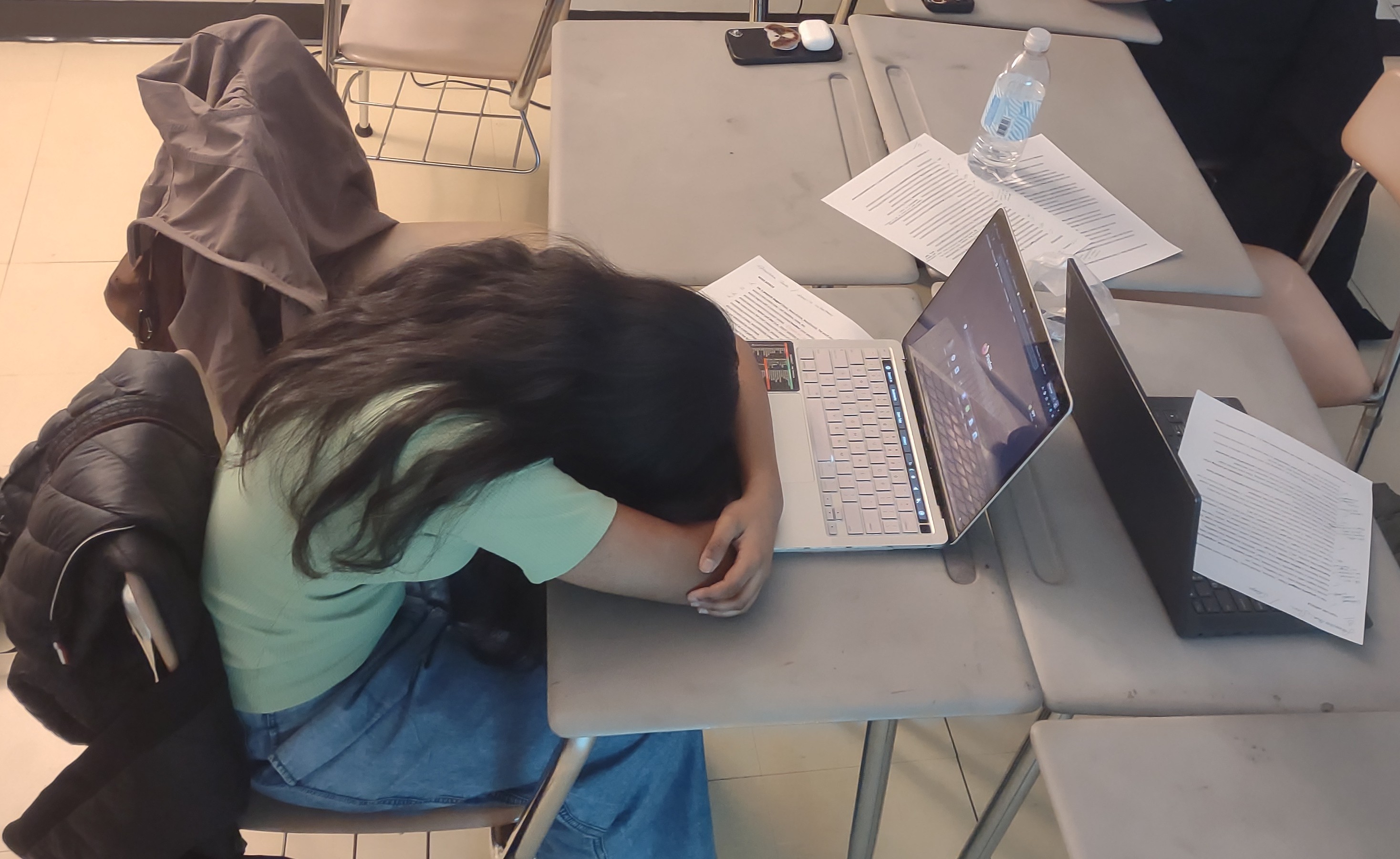
Continue reading
Zzzzzzz The All Nighter Epidemic zzzzzzZ
  • March 17, 2025

Importance of Prioritizing Sleep & Effects of Sleep Deprivation

 Samantha Sun || SOCIAL MEDIA EDITOR

The exhausting Monday morning starts with eye bags and eight ounces of coffee. Despite the waft of caffeine filling the air, everyone seems to be as awake as zombies. Walking through the halls at eight in the morning, murmuring about pulling all-nighters or late-night study sessions fill the air. First period is a chorus of yawns, and somewhere, someone is already dozing off at their desk. Rather than eight ounces of coffee, it’s eight hours of sleep that AHS students need. 

Every AHS student has been there—whether it’s staying up late to finish a project after procrastinating for the past week, studying for a test last minute because it was pushed back to prioritize the other homework, or doom scrolling through social media until the sun rises. 

Junior Meredith Cummings admitted to getting an average of four to six hours of sleep during school nights. “I think I got five hours of sleep today, or yesterday, or whatever. I don’t know anymore. The days are blurry,” she said with a shake of her head.

On Mondays, she has Orchestra and doesn’t get home until 8:15 p.m. Usually on Mondays, teachers will assign a bunch of work because it’s a new week, Cummings noted. “It’s too much,” she said. Sometimes it’s not just staying awake in class but being able to be alert to do even the simplest tasks. “[Once] I was so tired…I left my glasses in the fridge,” Cummings said, reminiscing and laughing about the memory.

“For me, when I wake up I’m awake but one to two hours later my brain just goes completely blank and it’s really hard for me to focus on my work and to understand topics,” senior Sana Godhani said, who is currently researching sleep deprivation for her Capstone project.

But what does sleep do? The simple answer is that it keeps us alert and ready for the day. “I think about it like filling your gas tank,” said health teacher Bestey Desfosse. Cells and muscles are repairing, rebuilding, and regenerating while resting. Sleep refreshes energy and ensures that students are equipped to deal with all the mental or emotional challenges in life, Desfosse said.

Beyond drowsiness, sleep deprivation can lead to higher chances of getting sick, more emotional reactions, or increased procrastination. In fact, many issues that students face during the day are rooted in the fact that they aren’t getting enough rest at night, Desfosse explained.

But why don’t students get enough sleep? Stress. According to the Cleveland Clinic, stress throws off the melatonin balance and the amount of Gamma-aminobutyric acid (GABA) in the body’s system decreases, making it harder to fall asleep. GABA is a neurotransmitter in the brain that regulates mood, relaxation, and sleep. However, when it’s not balanced, it causes a cycle where stress leads to poor sleep, and poor sleep increases stress. “It’s like a spiral,” Cummings said. 

“There’s also things that you can do during the day to help boost your system like going outside…[or] working in a space where natural light is able to come in,” advised Godhani.

Simple things like taking a walk, purposefully getting eight to ten hours of sleep, or meditating can help balance GABA levels and help with relieving stress. “Talking and, like, letting it out [helps],” Cummings said. For her, chatting with friends and family helped make the burden of stress lighter. 

However, after a long day of school, clubs, and other commitments, the easiest thing to do is unwind and check social media. But one hour of relaxing can turn into the infamous monster of doom scrolling. “Teenagers’ brains that aren’t fully developed are prone to getting sucked in,” said Desfosse. 

The blue light from phones tricks the brain into wakefulness, making it more difficult to fall asleep at night. “If you use blue light glasses [or] change the color on your phone to red, it could help decrease those effects,” Godhani advised. While it’s okay to use social media as a tool to relieve stress, it shouldn’t become an obstacle that prevents sleep.

Sleep deprivation isn’t normal—it’s an issue with real consequences. Sleep is not a luxury, it is a necessity. At the end of the day, the best way to stay awake isn’t a cup of coffee, it’s a good night’s sleep.

Continue reading
Andover Responds to EEE, Implements Mosquito Control Measures
  • October 7, 2024

By Harry Guo
Executive Editor

EEE has become more common in the areas near Andover over the past 10 to 15 years. The town’s Arbovirus Response Plan, initially created in response to the West Nile virus, is adaptable to EEE and guides their current strategies. Their efforts start every April when they review data from the previous year and develop work plans for mosquito control.

“This year, we saw EEE appear at the end of July in Haverhill and Amesbury, where we usually don’t see it,” said Thomas Carbone, Andover’s Director of Public Health. “We anticipated its spread… and chose to have the mosquito control district treat the brush along athletic fields in August, prior to the start of fall sports.” The early mosquito spraying has so far allowed AHS to maintain its regular schedule of sports practices and games.

In response to EEE, teachers have become more cautious during outdoor activities for their classes. “I make sure that [bug] spray is available to students when we go outside,” said Melanie Cutler, a science teacher and advisor of both the Garden and Environmental clubs. Despite these precautions, she has observed that there hasn’t been a significant shift in student attitudes regarding outdoor activities this school year, contrasting previous years when EEE was more prevalent. 

STAFF PHOTO / Harry Guo
Seniors Tyler Buono and Collin Souza doing fieldwork outside for Melanie Cutler’s C Block AP Environmental Science class amidst EEE season.

Even though safety against EEE remains a priority, the approach to protecting student-athletes from the disease is largely individualized and not the responsibility of the coaches. “Everybody is aware of what the implications are if this disease is contracted,” said Wayne Puglisi, the Athletic Director for Andover Public Schools. These implications include headache, fever, chills, and vomiting. More severe cases of EEE may progress into disorientation, seizures, encephalitis (brain inflammation), and coma.

According to Carbone, residents should use mosquito repellent, wear long sleeved shirts and pants, and regularly check their yards for standing water to reduce mosquito breeding sites. “Untreated swimming pools are a prime breeding ground,” said Carbone. “As is standing water in roof gutters, children’s pools, bird baths, and abandoned tires.” However, there are no additional school-wide measures beyond general awareness and these personal precautions.

While the impact of EEE has been stifled by preventative measures, climate change continues to drive the increase of tick- and mosquito-borne viruses, according to Cutler. “When we have cold winters and hard frosts… a big percentage of their population tends to die off each year,” she explained. “That helps to keep the mosquito and tick population in check.” However, as climate change raises average winter temperatures, more of these pests survive the season, increasing the risk of virus transmission.

“Bird migrations inform… the 10 year EEE cycle,” said Carbone. “When we get more intense rainstorms and hotter weather, it invites the proliferation of mosquitoes.” Additionally, Andover is also monitoring other exotic mosquito borne illnesses moving northward, such as the Zika virus. 

Continue reading
Health Teacher Mrs. Desfosse Talks About Her Health Career: Health Career Q&A
  • May 6, 2024

By Samiha Jaffar
STAFF WRITER

Betsey Desfosse is one of the health teachers at Andover High School. Mrs. Desfosse has taught health for 32 years. In her free time, she loves to go outside and enjoy nature and walking her dogs. “ I think I am a very responsible person, and I grew up helping people around me as I help my aging parents and my niece with special needs,” she said.

How did you become interested in becoming a Health Teacher?

I liked being a Sunday School teacher when I was in high school so I knew I liked to teach.  I just thought health was the most exciting and ever-changing topic.

How long have you been teaching health? 

I have been teaching health for around 32 years!

How has health changed over the years?

The reason I wanted to teach health is because it changes all the time.  Over the years, there have been new issues, inventions, diseases, and current health issues to contend with.

What do most people struggle with? 

 I think when I first started at AHS, I would say that kids were struggling with not being as happy as they could be.  That was the start of our mental health crisis.

Were the causes for adults and children the same or different, if different, why? 

 Maybe the root cause is the same but presents differently based on someone’s age.

Do you notice phones affecting people’s mental health? If so, how?  

Massively!  They are not helping.  It breaks my heart to watch how unhappy and disconnected people are. I wish teenagers could grow up without a phone. I had the best childhood memories that kids today will never have.

Have you ever struggled in terms of health? 

 Definitely with mental health and body image, but I have worked hard to be in a good place with both and [am] always happy to help anyone struggling!

What do you think is the most important topic in Health?

I would say building skills to help yourself and others and knowing resources.

Continue reading
Students learn how to “Stop The Bleed”
  • January 25, 2024

By Julia Rodenberger
STAFF WRITER

AHS students received certificates in stopping traumatic bleeding after training offered by emergency room professionals during H4 on December 5. 

Medical Opportunities Club, led by juniors Laksmhi Jayaprakash and Shriyaa Anandakumar,  partnered with the Lawrence General Hospital to host Stop the Bleed: a nationwide campaign sponsored by the American College of Surgeons to address death by blood loss. Abigail Wertz, the program general of the trauma program at Lawrence General Hospital, led the free instruction alongside two emergency room nurses.

Attendees were provided the opportunity to step away if sensitive to gore; however, no real images of blood were shown. Trainers utilized rubber tubes with faux flesh wounds to demonstrate how to administer tourniquets and gauze onto severe injuries including lacerations, impalements, and amputation.

STAFF PHOTO / Julia Rodenberger
Students listen intently to the Stop The Bleed presentation.

Jayaprakash and Anandakumar began volunteering in the Emergency Center at Lawrence General Hospital this past summer,  through which they were introduced to Stop the Bleed. “When I took the class at Lawrence General, there were people of various age groups,” Anandakumar elaborated. “It’s not just for students. Anybody can take it; it’s an important skill.”

The H-Block was open to all, drawing students and staff with varying interests beyond traditional medicine. Attendance numbers surpassed 20 participants. 

Junior Dylan Moses participated in Stop the Bleed with aspirations to work for the Coast Guard in Search and Rescue. “First aid plays a big role in those fields,” Mose stated.

Moses expanded on the importance of first aid experience for high school communities. 

“Unfortunately there’s been a number of school shootings, and individuals with gunshot wounds could be saved through treatment that is taught here,” Moses added. “I just want to be well vested in first aid in case I encounter problems in my life.”

Wertz repeatedly emphasized that traumatic bleeding is the number one preventable cause of death in the United States. Following a period of instruction, attendees were able to work firsthand with the faux medical supplies under supervision from Wertz and the two nurses. 

While at Lawrence General Hospital, Jayaprakash and Anandakumar also volunteered briefly in the maternity and pediatric centers, respectively. In creating the Modern Opportunities Club in Fall of 2023, they aimed to explore the diversity of careers in the medical field. “We wanted to really delve into that in the club and explore everything else other than just doctor and nurse,” Jayaprakash elaborated.

Medical Opportunities Club meets every Wednesday at 3:00 pm in room 220, with opportunities for members to engage in various research projects. “The first one—you’ll see it on the H block—is a research campaign to analyze vaping in the student body,” Jayaprakash explained. “We’re working with the principal and the school administration to tackle the vaping problem.”
Jayaprakash hopes that Stop the Bleed will become a recurring event for AHS through continued partnership between the Medical Opportunities Club, Lawrence General Hospital, and AHS administration. “That would be amazing,” Jayaprakash said.

Continue reading
Actress Julia Kole Pursues Public Health
  • January 13, 2022

Angela Mac

STAFF WRITER

Julia Kole, the lead from the recent play Mamma Mia, plans to major in the field of public health rather than performing arts. 

Kole is a senior and a widely known performer at Andover High School. Being a performer takes a lot of time and work, and Kole doesn’t know if that’s something she wants. She stated, “You have to know what you want and you have to go at it full force.” She may love theater, but she isn’t interested in that type of tough and intense environment. 

Kole takes interest in public health for a multitude of reasons. She has always been fascinated by different diseases and loves measuring and experimenting; however, what she loves most is helping people. Though she doesn’t plan on majoring in theater, she plans to continue it on the side. All the colleges Kole applied to have acapella and theater groups, as they are a “requirement for [her].” Another option she considered was either minoring or double majoring in music; however, it would be along the lines of music production or theory instead of performing arts. 

Kole’s love for theater started in second grade. She always enjoyed the feeling of being on stage. Though Kole’s been on stage countless times, she still gets nervous because she wants to give the audience a good show. The people in the Show Choir and the AHS Drama Guild have always been family for Kole. After rehearsals, she would hang out with her fellow cast members in the dressing room. “I talk to them a lot,” Kole said. “They were my people. I like to think I was kinda their person. But you gotta find your people.” 

To students that are interested in doing theater in high school, she said, “It never hurts to try.” Kole explained that theater is a great community and that in a tough environment like high school, it’s good to have that kind of support. It also opens up opportunities for students interested in theater, show choir, and performing arts. 

Besides acting and performing, Kole loves playing guitar, songwriting, and learning American Sign Language (ASL). She loves ASL because “you have to be so expressive when you’re signing to get the proper meaning across and I just love being expressive.” 

Being expressive is something Kole excels at and is one of the reasons why she loves theater and performing. Though Kole has plans in the field of public health, theater and performing arts will always be a part of her life.

Continue reading