Five AP Exams to Go Online This Spring
Jill Slotnick and Brandon Nguyen
CORRESPONDENT EDITOR AND LAYOUT EDITOR
The AP exams for AP European History, AP Computer Science, AP English Language Composition, AP English Literature, and AP United States History classes are to go online this spring.
According to the College Board, all Advanced Placement Tests available in the digital format will be completely online by 2025. The option for these digital tests became available during the 2022-2023 school year. AP Coordinator and Head of Guidance, Aixa de Kelley, said the AHS administration had been discussing this change for the last few years but had ultimately decided they should wait until it was proven the tests could be administered online successfully. The choice to go digital this year was approved by de Kelley.
AHS Administration decided to go through with the switch after feedback they received nationally and locally. “From our experience last fall with the digital PSATs, offering the exam in the digital format streamlined the process. We received only positive feedback from students at AHS who took the digital PSAT exams,” said Dr. Magda Parvey, the Andover Public Schools superintendent. The administration also took into account feedback collected by the College Board, which stated that “students nationwide who participated in the digital exams [preferred the digital] format, especially when it comes to the long essays. Typing the responses was much easier and more familiar for them than handwriting the responses.”
In regards to the actual content of the tests, the digital exam itself has the same number of sections, the same amount of questions, and has a parallel format for writing as well, said de Kelley. Students will also be using school-provided laptops which takes away the stress of having to remember a computer and charger, and downloading a lockdown browser in addition to an already nerve-racking exam.
With the decision coming out only a week before Thanksgiving break, many teachers were caught off guard by the decision. For the better part of three months, teachers had been preparing their classes for a paper exam. Michelle Chachus, an AP US History (APUSH) teacher for over ten years, expressed her discontent with the switch. “I’m not a huge fan of digital testing because it’s really hard to interact with documents. In my class we focus on annotating documents and highlighting key ideas, and I think that becomes a lot more challenging [with] a digital test. I know there are digital highlighting tools, but I feel like I need to really process what’s in the document.”
Some teachers also had concerns regarding College Board’s previous digital AP Exams. Jennifer Percival, an AP English Language Composition (AP Lang) teacher, brought up the AP digital exam during the pandemic. “The platform that College Board is going to use should be more user-friendly than it was in the past to accommodate COVID. During the test, people had trouble with multiple choice questions and going back to questions they’ve already answered, so I hope problems like that don’t happen with this exam.” Percival also questioned the equitability of the digital exam. “I think it would be better if [the exam] was on paper,” she explained. “This switch affects not only our community of learners but also many other communities where digital learning isn’t as prevalent or easily accessible.”
The school seems divided on the issue of online testing, de Kelly admitted. “Some teachers were a little nervous; some teachers were happy about it,” she said. “They realize that computers are what kids are used to writing on, instead of with paper and pencil. There’s [also] a lot of resources on the College Board, and teachers can use AP Classroom.” AP Classroom is a nationwide website used to register students for their AP exams at the end of the year. It also provides resources for studying.

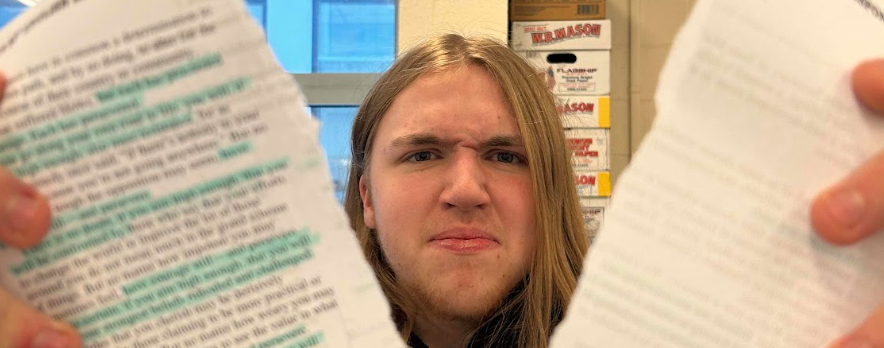
Junior Ewan McCrimmon angrily tears a paper APUSH test.
For students, the announcement seems to have also caused disagreement, leaving some excited for a modern upgrade and others scrambling to adjust. Ewan McCrimmon, a junior taking APUSH, welcomed the move. “It’s a lot less paper, and it’s accommodating to the new way the world works online. Not that many people write stuff down on paper anymore,” he said. He appreciated the convenience and speed of typing, and stated that he will “be more focused on comprehending the question than focusing on spacing out [his] writing.” But McCrimmon also had some concerns about the school’s technological readiness: “Last year’s MCAS was a shame… [the school’s wifi] was struggling to keep up with everyone logging in all at once.”
Magdalena Phelps, a junior taking AP Lang and APUSH, was more opposed to the change: “I’m just more of a visual person, so being able to really interact with the text helps me a lot.” Worried about the late announcement and lack of resources, she added, “In APUSH and AP Lang, there isn’t much digital work. It’s very much on paper, so [it’s hard to know] how they’re going to transition.” Both Phelps and McCrimmon agreed that students should be able to choose whether or not to have their exams be paper or digital. “It’s unfair that we don’t have those types of accommodations for AP testing,” Phelps said.