Andover Responds to EEE, Implements Mosquito Control Measures
  • October 7, 2024

By Harry Guo
Executive Editor

EEE has become more common in the areas near Andover over the past 10 to 15 years. The town’s Arbovirus Response Plan, initially created in response to the West Nile virus, is adaptable to EEE and guides their current strategies. Their efforts start every April when they review data from the previous year and develop work plans for mosquito control.

“This year, we saw EEE appear at the end of July in Haverhill and Amesbury, where we usually don’t see it,” said Thomas Carbone, Andover’s Director of Public Health. “We anticipated its spread… and chose to have the mosquito control district treat the brush along athletic fields in August, prior to the start of fall sports.” The early mosquito spraying has so far allowed AHS to maintain its regular schedule of sports practices and games.

In response to EEE, teachers have become more cautious during outdoor activities for their classes. “I make sure that [bug] spray is available to students when we go outside,” said Melanie Cutler, a science teacher and advisor of both the Garden and Environmental clubs. Despite these precautions, she has observed that there hasn’t been a significant shift in student attitudes regarding outdoor activities this school year, contrasting previous years when EEE was more prevalent. 

STAFF PHOTO / Harry Guo
Seniors Tyler Buono and Collin Souza doing fieldwork outside for Melanie Cutler’s C Block AP Environmental Science class amidst EEE season.

Even though safety against EEE remains a priority, the approach to protecting student-athletes from the disease is largely individualized and not the responsibility of the coaches. “Everybody is aware of what the implications are if this disease is contracted,” said Wayne Puglisi, the Athletic Director for Andover Public Schools. These implications include headache, fever, chills, and vomiting. More severe cases of EEE may progress into disorientation, seizures, encephalitis (brain inflammation), and coma.

According to Carbone, residents should use mosquito repellent, wear long sleeved shirts and pants, and regularly check their yards for standing water to reduce mosquito breeding sites. “Untreated swimming pools are a prime breeding ground,” said Carbone. “As is standing water in roof gutters, children’s pools, bird baths, and abandoned tires.” However, there are no additional school-wide measures beyond general awareness and these personal precautions.

While the impact of EEE has been stifled by preventative measures, climate change continues to drive the increase of tick- and mosquito-borne viruses, according to Cutler. “When we have cold winters and hard frosts… a big percentage of their population tends to die off each year,” she explained. “That helps to keep the mosquito and tick population in check.” However, as climate change raises average winter temperatures, more of these pests survive the season, increasing the risk of virus transmission.

“Bird migrations inform… the 10 year EEE cycle,” said Carbone. “When we get more intense rainstorms and hotter weather, it invites the proliferation of mosquitoes.” Additionally, Andover is also monitoring other exotic mosquito borne illnesses moving northward, such as the Zika virus. 

Continue reading
Students Miss Outdoor Breaks During Class
  • May 2, 2023

By Xander McKay-Kao
STAFF WRITER

With the frequency of breaks during class diminishing, Andover High School students have stated that taking a walk outside during class would help with productivity.

Originally introduced as mask breaks, institutionalized short breaks from class taken outside of the school began when the COVID protocol was initiated at AHS. Caitlin Brown, AHS’s principal, explained that the COVID system encouraged teachers, especially during long blocks, to allow times for students to remove their masks. Spacing issues meant that these mask breaks could not be done inside, so specific mask break locations outside the school were established. This was so that the school could keep track of where kids were for safety reasons. 

Now that AHS is no longer under COVID protocol, Brown says that the school just asks the teachers to inform the school if they are to go outside, but now that teachers are no longer told to take their kids outside, many teachers have stopped doing it altogether.

Enrico Panzica, a junior, said, “Trudging through a day with no breaks is hard work, school only really has one break, lunch.” He explained that a break helps him clear his head, a sentiment held by many others. In addition to Panzica, many students, such as juniors Mars Tasiopoulos, Arjun Chavan, Luke Stump, and Kyle Huang, adore these breaks. Many have expressed displeasure with the recent lack of them. Many teachers no longer take their students on walks, perhaps due to time constraints. One math teacher, Dorothy Power, said, “In general, I have not been taking them. I would love to go more regularly… but there is always so much to do.” Walks take on average 5-10 minutes if a class walks around the entire school, perhaps less if they choose to use the courtyard. A break of that length could take up a significant portion of class time. 

Brown explained a problem that arose during the lunch block, which is one of the two long blocks during which teachers would actually take breaks past COVID. When classes would walk past the exterior courtyard by the cafeteria, students would mix and begin to deviate by heading inside early. Not knowing where students were meant that the school couldn’t ensure their safety. As such, she has said that teachers have been told not to take laps around the school during lunch. Both Scott Darlington, an assistant principal, and Brown have said that the interior courtyard is a perfectly suitable place to take these breaks.

Some teachers agree with the general student sentiment. Katie Reusch, a social studies teacher who teaches U.S. History, Race & Membership, and Music & Society classes, is fond of walking breaks. “I find that people are better equipped to do whatever we’re doing after the breaks as opposed to just trying to stick it out and getting tired,” she said.

Continue reading
COVID-19’s Impact on Extracurriculars
  • February 28, 2022

Naomi Bloom
STAFF WRITER

The COVID-19 pandemic impacted many extracurricular activities throughout the year. However, due to the surge in cases after winter break, several extracurriculars have had to take extra precautions.

Since many families and friends gathered over winter break, COVID-19 cases spiked again, almost twice as many as the surge last winter. This is most likely due to the highly contagious Omicron variant. The rise in cases combined with the prior accommodations made for the pandemic forced many extracurriculars to do more to keep students safe.

The Athletic Director of the Andover Public Schools district, Bill Martin, spoke on the impact that the surge in cases had on the district’s sports teams and their fans. “We have had most of our teams affected by the number of athletes and coaches that have been out due to COVID,” he said. To ensure that their teams wouldn’t have to miss any competitions, a few games were postponed. 

Additionally, the number of fans allowed at games has decreased. However, Martin said that he was hoping that by the end of the winter season, there will be fewer COVID cases and that the regular amount of fans will be able to return to the games.

In some instances, extracurricular activities have had to withdraw from their programs. For example, the AHS Model United Nations club is no longer attending this year’s Harvard Model United Nations (HMUN) conference. The conference was set to take place in person near the end of January, so the school’s delegates withdrew. Out of the thirty to fifty students at AHS that attend the HMUN meetings, fifteen delegates would have gone to the conference. Other delegates would have been coming from all around the world. Michael McCarthy, the teacher advisor for the program at AHS, said that he was worried about the possible spread of COVID there. “I had a lot of concerns about the delegates’ safety, so we withdrew our participation,” he said. “I was concerned that students would contract [COVID] and would be absent from school and would miss out… it’s a very large organization, and so with some kids out, they would miss out on a fun extracurricular opportunity.” 

COURTESY PHOTO / Andover Robotics
What a normal in-person robotics meet in the AHS cafeteria looks like

The school’s robotics teams have also had to accommodate for the pandemic. Round one of the robotics tournament was going to be held in the AHS cafeteria in January, but because of the surge in cases, it was postponed. The competition in Canton was also postponed. “We’ll have ‘Practice Judging Days’ instead, which would be done remotely,” said Canyu Li, a freshman on team Thunder. Minda Reidy, the teacher advisor for the robotics program, said that was done “as a general cautionary.” She also noted that the schools of some other teams in the state were not allowed to travel, so several teams would have missed the meet. “We also put into consideration that we were asking a lot of people to be in tighter [quarters] than we should really with a big Omicron concern,” she added. Thankfully, though, the teams will still be able to take part in their Practice Judging Days and were able to host the tournament round in February.

In addition, the AHS math team was also impacted by the pandemic. While the school’s team was able to attend the meet that took place after winter break, some other teams were not able to. Dorothy Power, the teacher advisor for the team, was glad that the team could still make it to the competitions. “We were really fortunate that Mr. Darlington helped us find a way to travel beginning in January, and that all of our mathletes were healthy and could attend,” she said. These teachers and students are hoping that the pandemic will come to an end and their activities will be able to return to normal. “I’m hoping that this is the beginning of the end and that we can eventually—and probably soon—say goodbye to COVID in some way,” said McCarthy.

Continue reading
Graphs of COVID-19 Updates
  • February 14, 2022

Naomi Bloom

STAFF WRITER

Last updated Feb. 7, 2022

The graphs show the number of new cases reported by day, week, month, and overall in Andover High School and the Andover Public School district since the return to school after winter break on January 3, 2022.

After winter break, there was a surge in COVID-19 cases, but the numbers are gradually decreasing. According to the Andover Public Schools COVID-19 Dashboard, shown on the Weekly Cases graph, the number of cases in the school has tended to spike after the weekends, then go down over the week. This pattern has been repeating each week since the break, but the spikes have been becoming smaller. 

The Dashboard resets on Saturdays, but as of February 7th, as shown in the Total Cases graph, over 317 students at Andover High School and nearly 100 students and staff in the district had tested positive for COVID since after winter break. This is about 17.6% and 14.7%, respectively, of students and staff. While the number of cases is at a steady decline, it is still important to follow the COVID-19 guidelines and be careful to not catch it.

Continue reading
Freshmen Adjustment Into Post-COVID Learning
  • January 13, 2022

Dane Connor and Ethan Zabar

STAFF WRITERS

Andover High School’s current freshmen, the Class of 2025, is adjusting to the transition into a high school environment after the COVID-19 pandemic. 

After the COVID-19 outbreak in March 2020, the lives of many people changed drastically, for better or worse. School sessions were held in a hybrid or fully remote setting, and that was a huge adjustment for students everywhere. Now, Andover High School’s Class of 2025 must handle the transition back into fully in-person learning on top of the massive change to learning in a high school setting. 

Katherine Johnson, an English teacher at AHS, believes that despite the setbacks caused by the past year in online learning, the class of 2025 may be able to take valuable lessons away from that period and apply them to their freshman year. “In my opinion, though not ideal, the skills that students were able to gather and hone during remote learning could be a huge asset to draw from for their high school experience,” Johnson stated. “Remote learning forces a lot of students to look at themselves as learners, and understand what works for them as students in terms of organization and time management.”

Johnson is of the belief that from a teacher’s standpoint, expectations for students should not change, but should come with empathy after a long time struggling with the threat of COVID. “My standards have not changed,” Johnson said. “Students are people; we are all here to learn from each other and to do the best work we can do. We’re here to think, and read, and learn, and write, and laugh… I appreciate that for all students the past couple of years has been intense and challenging. We all need to be sensitive and approach one another from a place of compassion, understanding, and kindness.” 

She continued by saying that teachers had adjustments to make as well. “As a teacher, logistically, remote learning forced me to be incredibly clear about my expectations and pacing.” She then stated that she sees this year’s freshman class as highly engaged learners, and hopes that as a teacher, her class is a safe and productive learning environment for the new additions to AHS. 

Sahil Khosla, an AHS freshman, felt that the trajectory of his peers’ maturity dipped during the pandemic. “Overall, I feel as though the growth of most of the people around me has stagnated, and I find more and more of them beginning to approach education and school with carefreeness and listlessness,” he said. 

However, Khosla felt that COVID’s impacts are beginning to fade. “Overall, the effects of COVID only really affected my eighth-grade year, as that was when the experience was new to all of us,” he added. “We’ve been going through it for so long now that the memories of how we did things before seem less realistic with each passing day.”

Although their eighth-grade year during the heat of the pandemic is over and memories have started to fade, many freshmen still feel a great impact from their time with COVID. Brody Harris, another member of the freshman class, said that life, especially school, has still been difficult for him as a result of COVID’s impact. “My eighth-grade year was very bad grade-wise, and I am in classes that are a little lower than I would like to be in,” stated Harris. “For example, my eighth-grade math teacher did not let me do geometry this year and Algebra 1 is mostly repeat stuff I already know.” 

Harris also felt like communication with teachers was as difficult in his freshman year as it was in eighth grade with the pandemic present. However, he did credit the teachers, acknowledging that the school staff had just as difficult a time. 

Possibly the biggest worry about the pandemic impacting incoming freshmen was that they have matured slower during their time in isolation and that as a result, they’d have a more difficult time making responsible decisions. Conversely, in an unofficial survey run by ANDOVERVIEW staff, two-thirds of the interviewed students felt that socializing with their peers was as easy as it had always been, despite a possible dip in social maturity.

Ms. Reidy, an AHS math teacher, gave some comments about the freshmen’s transition into high school. During their last year of middle school, the class of 2025 was thrown into an online learning environment, and Reidy believes that the high school workload shocked inexperienced freshmen. “They didn’t have that year to ramp up work,” she said.

Reidy stated that the increase in workload from middle school to high school is a difficult transition for everyone, and the circumstances given to the freshmen have only made that transition more difficult.  She added that she felt the freshman being isolated for so long impacted their ability to socialize with peers and adults. “They weren’t with anybody,” she said. Reidy felt that the freshmen’s excitement to be back in person for introduction to high school would provide a boost in energy and morale, and in turn, motivate them to make up for the lost time.

Continue reading
APS District Receives Nearly 2 Million in Federal Education Grants
  • January 13, 2022

Naomi Bloom and Eva Liss

STAFF WRITERS

Through the Massachusetts Department of Elementary and Secondary Education (DESE), the federal government has provided just under $2 million to help support Andover Public Schools, where the COVID-19 pandemic has left a lasting impact on students. 

The Elementary and Secondary School Emergency Relief Funds (ESSER) are federal educational grants given to aid schools during the pandemic. The first part, ESSER I, granted the Andover Public School district just over $150,000 issued in March of 2020. It was geared towards helping schools adapt to the pandemic and the switch to remote learning. The second grant, ESSER II, was passed in December of 2020, giving over $550,000. This grant was given to support schools in their attempts to reopen buildings and keep people safe, as well as to fund professional development, social emotional training, and academic support for learning loss. Andover has applied for an additional $1.25 million through the ESSER III grant, which is targeted at fighting learning loss and supporting students’ mental health in these challenging times. As the status of the pandemic and school districts’ needs are constantly shifting, the aim of the ESSER funds is also changing to match what is needed at the time. Some of this money still continues to fund the daily needs of APS schools, Andover High School included. 

“We hand out over 100 masks every day to students coming in; [there are new] desks coming in,” said AHS principal Caitlin Brown, speaking on how some of the money has been allocated. “We’re also running some preemptive programs to help students who may need some support, like academic support… where we’re helping them catch up in their work so they don’t get behind.”

As the aim of ESSER I was to help schools adjust to the pandemic and reopen, much of the grant was spent on devices for remote school, more desks for socially distant classrooms, cleaning supplies, and personal protective equipment (PPE). ESSER I has mostly been spent, although some of it is still going to daily supplies, such as the masks distributed at the doors of AHS each day. 

The second grant, ESSER II, was meant for a combination of combatting learning loss and contributing to daily school needs. As the focus of APS shifted from remote learning to hybrid learning and keeping students and teachers safe in that environment, so did what the federal money was being used for. The deadline for ESSER II’s spending is 2023, and currently it is being spent on daily supplies for AHS, salaries for substitutes caused by teacher absences due to the pandemic, and making sure ventilation is up to code. It is also being used to fund supplementary learning programs, such as before-school programs and academic enrichment, or social emotional learning (SEL) training for teachers. 

“This is a true mental health crisis,” said APS superintendent Dr. Magda Parvey, speaking of the emotional and mental state the pandemic has left on school communities. 

Fortunately, the district is looking to the third grant, ESSER III, as a possible solution. APS has applied for the grant, which, if spent by the deadline in 2024, would deliver over $1 million to the district. Much of this money would go to training for teachers, such as SEL training and how to help students who are struggling due to the pandemic. Brown also added that a main priority of APS schools always has been, and should be, meeting the needs of their students. “Based on what the survey said,” Brown stated, in regards to a survey sent out to families about what the funds should be used for, “there was a lot of support for more mental and social emotional support training… we’re still in this space and we really just want to be prepared and make sure we’re ready to meet the needs of our students and staff.”

The APS district also plans to use the grant as a supplement for learning, such as funding summer school programs if necessary. The pandemic is not over yet, and the funding may not be, either. “I don’t think we’ve seen the end results of the funding,” Brown said, “but I’m hopeful that it will continue to help out students.”

Continue reading
Mask Rules in Cafeteria Raise Questions, Concerns
  • November 19, 2021

By Eva Liss

STAFF WRITER

Most Andover High School students are doing their best to follow the masking and social distancing rules in the AHS cafeteria this year. 

When in the cafeteria, social distancing isn’t required, and students are only required to wear their masks when walking around. These rules were created by Massachusetts’ Department of Elementary and Secondary Education (DESE) in accordance with the Center for Disease Control and Prevention’s guidelines. The mask mandates were extended through October 1, then November 1, and have since been extended through January 15 as of October 26. Although the vaccination rate in the high school is high, at 85 percent, it is still important for students to follow the guidelines to keep the school safe. 

“I’m very glad we have masks,” junior Juliet Herrick said. “But how can you eat food with a mask on? If we’re distanced it’s awkward. [The cafeteria rules are] like a compromise. It gives you a taste of normal.”

Freshman Carmina Merrill said that she believes it’s harder to enforce the masking rules in the cafeteria than in the classroom. Senior Tessa Barcelo said “Sometimes people don’t follow [the rules],” and that she feels the rules should be a little more enforced. 

With the amount of students and the large space, it’s hard for the monitors to keep track. Ron Ramsey, an AHS monitor, has a different opinion than Merrill and Barcelo. He said that kids are generally more willing to follow the rules, especially ones who were at AHS last year. 

STAFF PHOTO / Eva Liss
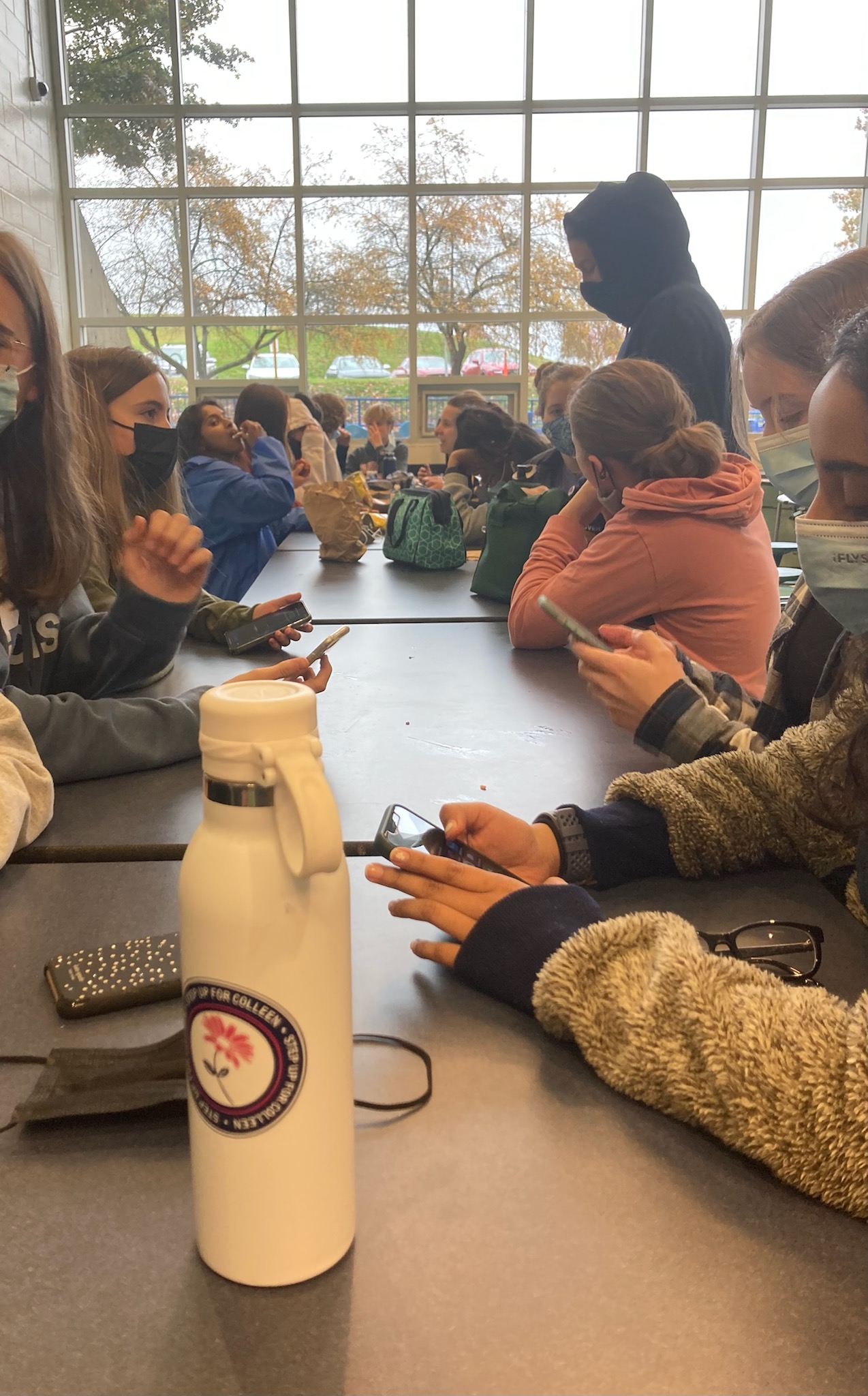
Masked and unmasked students sit in cafeteria during their lunch block

The rules for eating in the cafeteria last year were much more severe. There were two eating spaces—the cafeteria and the Dunn Gym—and students ate at desks spaced six feet apart. Sophomore Ingrid Cotta said, “[The masking rules] make it easier to hang out with your friends at lunch, and I think most of the people are following the rules. It works out pretty well.” Students seem to be willing to cooperate with the current rules if it means they don’t have to go back to the old ones. 

Scott Darlington, an assistant principal at AHS, said he believes that students need to focus a little more on following the rules and keeping themselves and others safe. He also said students are doing a good job so far. “It takes a certain amount of discipline to remember to [mask up],” said Darlington. “Sometimes people take off their masks, put them down, and then they stand up to get a glass of water and they’re halfway there, and we remind them, and they’re like, ‘Oh my gosh, I didn’t even realize that!’”

Darlington said he believes AHS is doing the best it can with the guidelines it has. “Everyone thinks ‘Oh, why do we still have to wear masks?’ Because you probably would have a hard time keeping your school open if you didn’t,” he added.

Continue reading
Bach and Meagher Voice Opposition to MCAS
  • November 19, 2021

By Jacqueline Zhu

STAFF WRITER

 Discussions about whether MCAS exams should continue to be administered have been reinvigorated after the COVID-19 pandemic caused MCAS scores across Massachusetts to plummet. 

Statewide MCAS test results from the spring 2021 exam show that fewer students scored Meeting Expectations or higher for math and English compared to students in the same grades before the pandemic, according to the Department of Elementary and Secondary Education (DESE). DESE issues accountability determinations for school districts based on how well students perform on MCAS exams. These determinations categorize districts as Districts Requiring Assistance or Districts Not Requiring Assistance, and they help the state decide how to allocate resources. 

Many teachers are calling for an end to MCAS testing, arguing that it is unnecessary and detrimental to both students and teachers. Jennifer Meagher, who teaches English at Andover High School, said that the high stakes of MCAS testing further narrow methodology. “Students have to pass MCAS to graduate, and districts are punished if their students aren’t performing according to the state’s mandates,” explained Meagher. “So it drives everything, it drives the curriculum, and it creates pressure that I don’t think is healthy for students or teachers.”

The loss of class time is another one of the many grievances some teachers have with MCAS. Meagher stated that her work emphasizes critical thinking, creativity, and authentic dialogue between teachers and students, and spending time for MCAS exam preparation shifts the focus away from those things. 

“No matter the discipline, MCAS takes away valuable instruction time from teachers and students during the school day,” said Matthew Bach, social studies teacher and president of the Andover Education Association, the teachers’ union.

Many also point to standardized testing’s deep-rooted history in racism and inequity and its inability to accurately measure students’ performance and success. “Standardized tests were invented by the Eugenics movement to serve as pseudo-scientific devices to support racist theories and marginalize vulnerable members of the working poor,” explained Bach. 

Junior Diya Ganesh believes that MCAS is a flawed method for assessing students’ abilities. “I think that the idea behind MCAS is well-intentioned,” said Ganesh. “The state uses it as a metric to see how effectively students are being educated, but it fails to take into account outstanding circumstances. Lower income districts with a greater immigrant population tend to do more poorly on these tests through no fault of their own, due to English not being their first language, or their primary focus being to survive.” 

Bach and Meagher note the impact of MCAS on lower income districts. “Schools with a higher percentage of students who are struggling in those ways are taken over by the state,” said Meagher. “Their school committees and school leaders are rendered powerless.”

“[MCAS] is used to disenfranchise communities like Lawrence and expropriate them from democratic governance of their school systems,” stated Bach.

“Standardized tests treat students as data,” stated Meagher. “To think that you can quantify the way somebody interprets the world in a number on a page, I think it’s unrealistic and harmful.”   

These sentiments have been exacerbated by the pandemic. “MCAS has changed the way we teach and interact, and I think we really saw it last year with COVID,” said Meagher. “For me, the whole experience with MCAS last year reinforced just how dehumanizing standardized tests can be.” She expressed her frustration with the state’s insistence on implementing MCAS despite the loss of class time and the pandemic.

Many students feel that the pandemic has made it more difficult for them to prepare for MCAS. “I would say [the pandemic has affected my MCAS scores],” said an anonymous student, a sophomore. “I learn better in a classroom setting and it’s sometimes harder getting in contact with teachers online to ask questions.”

A possible alternative to MCAS testing is being developed. “The [AEA] has started a process with UMASS professor Jack Schnieder to work on developing authentic and community-based school quality measurements that would take the place of MCAS,” stated Bach. “Potential alternative measurements could entail community curriculum priorities, extracurricular opportunities, educator turnover rates, [and] enrollment rates.”

Continue reading
Trouble Right Under Your Nose
  • November 19, 2021

By Naomi Bloom

STAFF WRITER

Since in-person school resumed during the COVID-19 pandemic, wearing masks has been mandated. This was put in place in order to keep each student and staff member as safe as possible from the virus. The mandate within the Andover Public Schools system was going to last until at least November, but after a school committee meeting on October 21, the schools sent out an email regarding the extension of the mandate. Especially because the holidays are just around the corner and many students and staff have family members who had not been old enough to get vaccinated, it’s great that the mandate was extended until at least January 15.

The email also explained that the extended mandate would allow more time for parents to have their younger children vaccinated, if they choose to, as the vaccine was to be approved shortly after the email was sent—It was approved on November third.

Despite the administration’s efforts, many students still do not adhere to the rules about wearing masks, and teachers and other students are struggling to deal with them.

Several students interviewed observed how many students were not wearing their masks correctly in school. Andrew Magner, a junior at AHS, said that in his classes, only about 60-90% of students wear their masks correctly. Senior Audrey HetheringtonYoung said that in her classes, however, only half of the students wear them correctly. Junior Rachel Chen said that there are at least three people in each of her classes that wear their masks under the nose or mouth, and Junior Ohad Mamet said that only about 80% of students have them on right.

I took note of students in each of my classes, and by my count, an average of 19.6% of them were wearing their masks incorrectly. This is nearly one fifth of students, which is unsafe, to say the least, and rather disappointing. If not all students wear their masks correctly, then it ruins the whole point of wearing masks in the first place, and will prolong the spread of COVID. To stop wearing masks, you have to wear them first. Additionally, I found that an average of 1.3 students kept their masks below their mouths in each class, which is even more unsafe.

STAFF ILLUSTRATION / Naomi Bloom

Teachers have been struggling to have students keep their masks on. Even when reminded to put their masks back up, many students simply tug them back down once their teacher looks away.  

“There isn’t a teacher in this building who has time to constantly remind the same students to wear their masks properly,” said Mary Robb, a Social Studies teacher at AHS, “and, quite honestly, they shouldn’t have to.”

Chen noted that most of her teachers have to keep asking the same students over and over again to keep their masks up, to no avail. Those students still return to class each time, masks hanging under their noses. Magner said that because of these students that continue to wear their masks improperly, some teachers seemed to have given up on enforcing mask-wearing as the year went on. “I still would say that the majority of my teachers do enforce it when they see a student not properly wearing a mask, even if they may not be paying as much attention to students’ masks as they did before,” he added.

“I don’t really understand what the big deal is about masks,” said Elias Pantazi, a junior. “It has been proven that they help control the spread of COVID and they aren’t uncomfortable or hard to breathe in… I’m not really in the mood to be sent home because people feel too much pride to be a team player.”

Additionally, Junior Avanthika Suryadevara also said that there are several people in her classes, especially in the hallways, who wear their masks incorrectly. “It mostly shocks me when I see people wearing them completely down, because that’s not effective in any way,” she said. It’s extremely disappointing that so many people don’t mind putting others at risk for such a small personal benefit.

Wearing your mask is for the good of the community, and it doesn’t hurt to keep it up–there are mask breaks for a reason. Keep your mask up, not just for the safety of everyone else, but also yourself.

“I know it is an inconvenience,” said Michelle Chachus, an AHS teacher, “but if wearing masks keeps us safe until more people are vaccinated and the variants are under control, then I think it is a small price to pay for health, safety, and peace of mind.”

Continue reading
Mamma Mia: Post-COVID Production Running Smooth
  • November 19, 2021

By Ethan Zabar

STAFF WRITER

Andover High School’s 2021 theater production, Mamma Mia!, is going great in a post-COVID-19 year as the November 18 debut grows closer. 

The cast and supporting crew of Mamma Mia! were more ready than ever to pick back up with shows as they were before the COVID-19 pandemic. Tessa Barcelo, a senior and lead role in the play explained that the acting crew had settled back into pre-COVID theatre well and was making notable progress towards a great production despite the setbacks last year. 

“We’ve learned to roll with the punches,” Barcelo said, “[The production] has gone right back to the Collins Center stage, so we feel at home again.”

The production this year is not without its difficulties, and according to Barcelo, wearing masks during the performance has an impact on the cast’s ability to sing. However, she and other cast members have found workarounds for the potential issues of wearing masks on stage that still ensure COVID safety. “Disposable masks, because they’re more flexible, let you open your mouth more and sing better than the cloth masks,” Barcelo noted, “They’re better for projecting.”

GUEST PHOTO / Anat Briskin
Tech crew member Jillian Boyer painting tiles for the Mamma Mia set

This year there have been a few notable additions to the production staff that according to the Director of Arts at AHS, Susan Choquette, have helped boost the potential for the show. “Typically Mr. Desjardins is the musical director of the play, but he recently just had a baby,” Choquette said, “…so I invited a colleague of mine,…Thom Smoker. He’s a great musician and singer, he works well with young voices, and also he’s now teaching music…at Berklee School of Music and Endicott College, so he’s really fitting us in.” 

Choquette also explained that Mamma Mia has a new choreographer, Stephanie Morris: the owner of the local dance studio Creative Arts Academy. “She’s working really hard because there’s a lot of dance in this show,” Choquette stated.

This year’s show has had a demanding regiment thus far, and according to Choquette, that was not likely to let up until the day of Mamma Mia’s debut. “Somebody’s rehearsing…six days a week, whether it’s me, or Thom, or Stephanie. Sometimes there are even two rehearsals in a day.” Choquette said, “We’re a busy group trying to get ready for this performance…it takes a village.”

Despite the strenuous schedule and minor COVID-related nuisances, Mamma Mia’s cast is keeping a positive mentality and has set the bar high for the production this year. Choquette described Mamma Mia as the perfect fit for production in a post-pandemic year: heartwarming, well known, and all-around fun.

 “What I’ve learned is that we can do anything,” Choquette said. “Bring on a global pandemic, we’re still going to make theater.”

Another major cast member of Mamma Mia, Sadie Rooney, matched Choquette’s praise of the production’s progress thus far. “It’s been a long journey, but we have overcome a lot of the roadblocks put in our path by COVID… The sets and lighting this year are truly gorgeous and I’m so glad to be back on the stage.” Rooney said, “Because of the lack of theatre in many places last year, the cast is even bigger than ever and so excited to be performing once again.”

Rooney spoke for the entire cast when she described her excitement for this year’s production. “From what [the production staff]  have said to me, they seem to be just as excited as we are. They all give up so much time and energy to this production and we are all so incredibly grateful.” Rooney continued, “ABBA is a fan favorite for many, so I think Mamma Mia is a perfect way to bring back theatre [to Andover].”

Barcelo, Choquette, Rooney, and the rest of Mamma Mia’s staff urge everyone available to check out the show and have exclaimed high expectations for this year’s production. “It’s such a fun show and not something you’ll want to miss!” Rooney concluded. 

Tickets will be sold at the door or online at the Andover Theatre Arts website. Be sure to check out Mamma Mia’s debut at the AHS Collins Center:

Thursday, November 18 – 7:30 p.m.

Friday, November 19 – 7:30 p.m.

Saturday, November 20 – 7:30 p.m.

Sunday, November 21 – 2:00 p.m.

Tuesday, November 23 – 7:30 p.m.

Continue reading