Students, Teachers Deal with Consequences of Missed School Days
Grace Wang
STAFF WRITER
This January, colds and COVID left students at Andover High School stuck quarantined at home. “Every class one to two students are out,” mentioned Andover High School science teacher Lindsey L’Ecuyer.
After returning to school, they’re slammed into a whirlwind of test make-ups and overdue homework. How do students catch up from missing numerous 78 minute classes? Likewise, what is the impact on their grades? How are the teachers dealing with this epidemic of winter absences?
First, let’s look at school through the eyes of a returning student. Every single day, they’re missing around 5 classes, and if you’ve ever been sick before, you’ll know that it doesn’t usually only last a day. Additionally, because of COVID, any cold symptoms lead to an awkward exchange of nervous glances. After waiting for the worst of fevers and coughs to disappear, students will have missed multiple days of class.
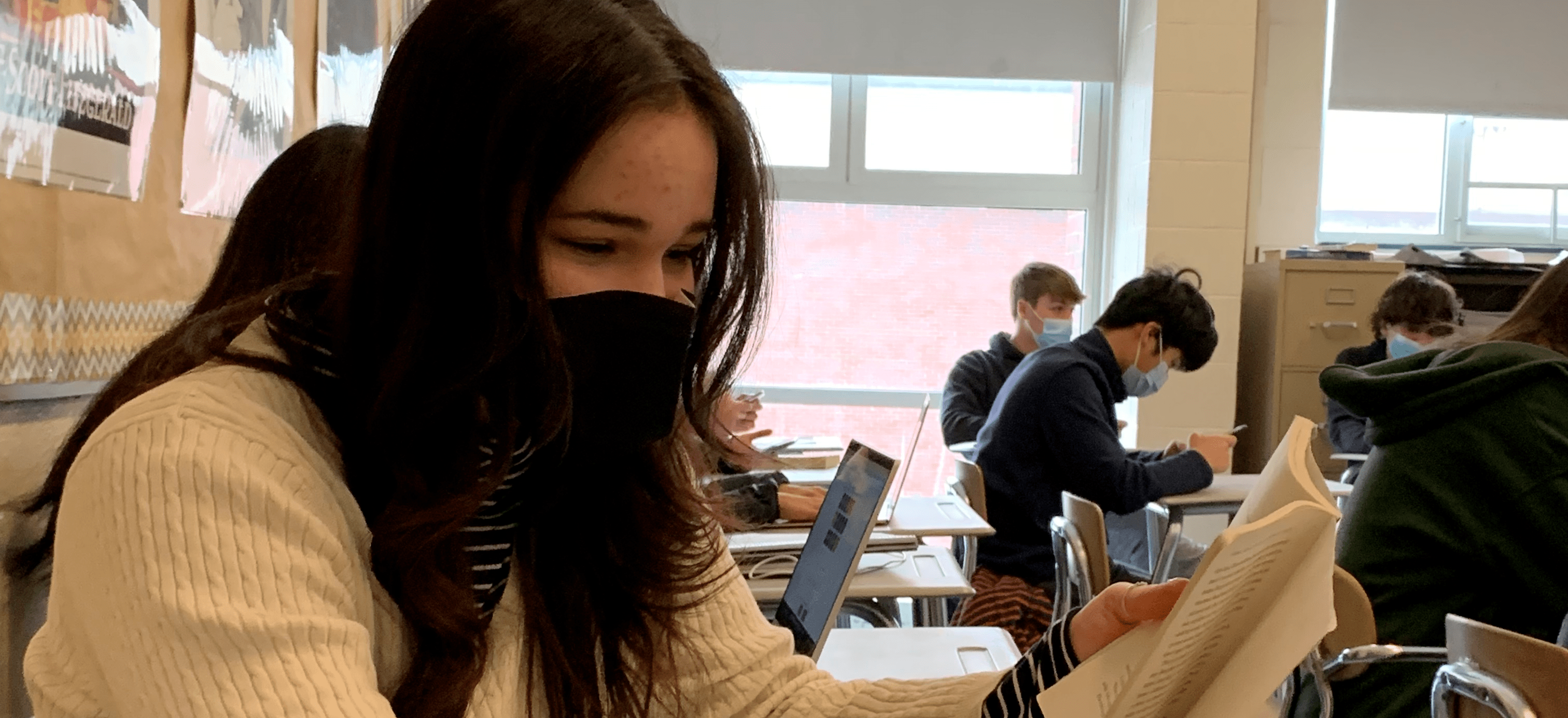
STAFF PHOTO / Grace Wang Sophomore Julie Mahoney struggling to catch up with work after being absent
“Once you get back, it’s hard to get into the flow of things,” remarked AHS sophomore Sydney Call, who has missed many days of school. “On top of all the homework and classwork you’ve missed, you also have to keep up with the present class content. Since you’ve missed previous class stuff, the current stuff might not even make sense…like I had a unit test on the first class back in biology.”
More importantly, because of the pandemic, COVID will leave students having to catch up on weeks of missed school. After hearing from a student who has missed class time, it makes us wonder: how do students successfully catch up?
“Being in touch with the teacher and working on a plan to get their work made up [should be the first thing to do]…The key thing is communication,” emphasized AHS geometry teacher Minda Reidy. It’s better that students explain what’s going on so that teachers can work with them, rather than leaving assignments missing with no explanation. H-blocks are a great way to catch up on class content with a teacher. Most teachers stay after school for a bit before leaving in case students need help as well.
“My rule of thumb is always to lighten the load and make the reentry easier,” said AHS history teacher Mathew Perry. Similarly, L’Ecuyer reaffirmed, “I try to work with them knowing that they have, you know, pressure from six other classes too.” In many cases, teachers are very understanding of student’s situations. Extensions are given when needed, and teachers try their best to integrate the student back into class, which can be difficult due to the rigorous pace of many classes.
What can you do for yourself and others this Valentine’s Day?
Valentine’s Day, on February 14, and with COVID still interfering with our daily lives, it’s important to be grateful for the good things in our life and the people who make each day worth it.
Whether it be something grand or something small, you can show love in various ways. One thing you can do for others is write them a letter. Having something handwritten can be very sentimental and express that you care. Watching a movie can also be a fun date idea or just a fun way to spend time with family and friends. It’s also COVID friendly because you can stay safe and have fun in the comfort of your own home. Maybe you want to splurge a little and go out to dinner? Going to your favorite restaurant with loved ones can be a nice time to not only reflect on old memories but create new ones (don’t forget to bring a mask!).
STAFF PHOTO / Caitlin Connell Handmade cards to be delivered on Valentine’s Day
Senior Gianna Correia says she will be dropping off cards to friends as it is COVID-safe and contactless during this tough time. Something as simple as a card can show so much appreciation for the people we love. Words can also be a means of appreciation for our loved ones. Sophomore Carlos Castros said this Valentine’s Day, he’ll “tell [his] family how much [he] loves them.”
Family is so important and going the extra mile this Valentine’s Day by doing something nice can make your loved ones feel special. Math teacher Mr. Armstrong said, “I typically get my daughters a small box of chocolates, and my son Starbursts or Skittles and then my wife, I usually get her a bigger box of chocolates.” After all, candy is the key to the heart and the perfect gift.
Valentine’s Day does not just need to be about showing love for other people. Ways to show self-love can be doing skin care such as facemasks, going to bed early, buying yourself something you’ve always wanted, or taking some time for yourself to just simply relax. If you have some free time and want to reflect on your day, keeping a journal can be very beneficial. We can forget to take care of ourselves and Valentine’s Day is the perfect time to spend some energy on yourself and improve your mindset.
Senior Jacob Moore stated, “For self-love I think I’m gonna make myself a nice breakfast in the morning, maybe a fruit cup and some eggs—you know, start off right.” Staying on top of self-care can make the biggest difference in how we feel each day. Doing something nice for yourself is just as important as doing nice things for others.
For self-care, “I’m definitely going to binge rom-coms the whole night, and then you know, think unrealistically about love,” concluded Ms. D’Alise.
The perfect night in can be just what someone needs to relax, allowing for reflection and alone time, a great way to show self-love. Valentine’s Day is supposed to be the day of love. Whether that means for yourself or for the people you care about, spreading any love is better than spreading none.
As seniors wait apprehensively to receive their college decisions, many colleges have announced an extension for the no-standardized-test-requirement policy.
High school classes of 2022 were not required to submit standardized test scores when applying to most colleges. Recently, many schools have been releasing announcements extending this policy for the upcoming years.
Found on some colleges’ websites, such as Harvard University’s, a statement has been posted that this change is because of the COVID-19 pandemic. Meanwhile, Columbia University has announced in a new update on their website that they have extended it “to consider systemic shifts in access to educational opportunities.”
In fall of 2020 and 2021, nearly every college went test-optional, with most colleges continuing the policy in fall of 2022. With this change, guidance counselor Anne-Marie Fortier noticed that the number of students who went test-optional has increased. This brings to light the possible disadvantage that some students face when taking standardized tests. “When the SATs were first put together, it was supposed to be an equalizer,” stated Fortier. “It’s not an equalizer, because what happened is the people [who did well were the ones] who had resources for studying [and] taking prep classes… Kids who didn’t have access to that did not do well, and it had nothing to do with their inherent or innate ability.”
According to Fortier, the test-optional change prompted “a lot of kids [to apply to]… more competitive schools. [As a result,] super competitive schools, like the Ivy League schools, saw their application numbers just shoot to the sky.”
Senior Isabel Rodenberger, who applied for and got into Tulane University with the test-optional policy, stated that all twelve schools she applied to followed a test-optional policy, and she is “very happy with [her] decision.”
“Most schools are starting to value other qualities in an application over test scores,” Rodenberger remarked. “A test score will not determine the outcome of your college decision. Test scores may look very impressive, but an absence of scores will not hurt an application.”
The graphs show the number of new cases reported by day, week, month, and overall in Andover High School andthe Andover Public School district since the return to school after winter break on January 3, 2022.
After winter break, there was a surge in COVID-19 cases, but the numbers are gradually decreasing. According to the Andover Public Schools COVID-19 Dashboard, shown on the Weekly Cases graph, the number of cases in the school has tended to spike after the weekends, then go down over the week. This pattern has been repeating each week since the break, but the spikes have been becoming smaller.
The Dashboard resets on Saturdays, but as of February 7th, as shown in the Total Cases graph, over 317 students at Andover High School and nearly 100 students and staff in the district had tested positive for COVID since after winter break. This is about 17.6% and 14.7%, respectively, of students and staff. While the number of cases is at a steady decline, it is still important to follow the COVID-19 guidelines and be careful to not catch it.
Andover High School’s current freshmen, the Class of 2025, is adjusting to the transition into a high school environment after the COVID-19 pandemic.
After the COVID-19 outbreak in March 2020, the lives of many people changed drastically, for better or worse. School sessions were held in a hybrid or fully remote setting, and that was a huge adjustment for students everywhere. Now, Andover High School’s Class of 2025 must handle the transition back into fully in-person learning on top of the massive change to learning in a high school setting.
Katherine Johnson, an English teacher at AHS, believes that despite the setbacks caused by the past year in online learning, the class of 2025 may be able to take valuable lessons away from that period and apply them to their freshman year. “In my opinion, though not ideal, the skills that students were able to gather and hone during remote learning could be a huge asset to draw from for their high school experience,” Johnson stated. “Remote learning forces a lot of students to look at themselves as learners, and understand what works for them as students in terms of organization and time management.”
Johnson is of the belief that from a teacher’s standpoint, expectations for students should not change, but should come with empathy after a long time struggling with the threat of COVID. “My standards have not changed,” Johnson said. “Students are people; we are all here to learn from each other and to do the best work we can do. We’re here to think, and read, and learn, and write, and laugh… I appreciate that for all students the past couple of years has been intense and challenging. We all need to be sensitive and approach one another from a place of compassion, understanding, and kindness.”
She continued by saying that teachers had adjustments to make as well. “As a teacher, logistically, remote learning forced me to be incredibly clear about my expectations and pacing.” She then stated that she sees this year’s freshman class as highly engaged learners, and hopes that as a teacher, her class is a safe and productive learning environment for the new additions to AHS.
Sahil Khosla, an AHS freshman, felt that the trajectory of his peers’ maturity dipped during the pandemic. “Overall, I feel as though the growth of most of the people around me has stagnated, and I find more and more of them beginning to approach education and school with carefreeness and listlessness,” he said.
However, Khosla felt that COVID’s impacts are beginning to fade. “Overall, the effects of COVID only really affected my eighth-grade year, as that was when the experience was new to all of us,” he added. “We’ve been going through it for so long now that the memories of how we did things before seem less realistic with each passing day.”
Although their eighth-grade year during the heat of the pandemic is over and memories have started to fade, many freshmen still feel a great impact from their time with COVID. Brody Harris, another member of the freshman class, said that life, especially school, has still been difficult for him as a result of COVID’s impact. “My eighth-grade year was very bad grade-wise, and I am in classes that are a little lower than I would like to be in,” stated Harris. “For example, my eighth-grade math teacher did not let me do geometry this year and Algebra 1 is mostly repeat stuff I already know.”
Harris also felt like communication with teachers was as difficult in his freshman year as it was in eighth grade with the pandemic present. However, he did credit the teachers, acknowledging that the school staff had just as difficult a time.
Possibly the biggest worry about the pandemic impacting incoming freshmen was that they have matured slower during their time in isolation and that as a result, they’d have a more difficult time making responsible decisions. Conversely, in an unofficial survey run by ANDOVERVIEW staff, two-thirds of the interviewed students felt that socializing with their peers was as easy as it had always been, despite a possible dip in social maturity.
Ms. Reidy, an AHS math teacher, gave some comments about the freshmen’s transition into high school. During their last year of middle school, the class of 2025 was thrown into an online learning environment, and Reidy believes that the high school workload shocked inexperienced freshmen. “They didn’t have that year to ramp up work,” she said.
Reidy stated that the increase in workload from middle school to high school is a difficult transition for everyone, and the circumstances given to the freshmen have only made that transition more difficult. She added that she felt the freshman being isolated for so long impacted their ability to socialize with peers and adults. “They weren’t with anybody,” she said. Reidy felt that the freshmen’s excitement to be back in person for introduction to high school would provide a boost in energy and morale, and in turn, motivate them to make up for the lost time.
The classic snow day always starts the same way. You check the Snow Day Calculator before bed, it says fifty percent, and you already know what is to come at five a.m. the next morning. You don’t even set your alarm because you know you will be woken up by the good news: It’s a snow day!
You sleep to your heart’s desire, before the sunlight burns through your windows and wakes you up. You get up, brush your teeth, and you cuddle near the fireplace while grabbing breakfast, before picking your next activity on this refreshing day. It could vary from playing video games, playing outside in the snow, and if you’re a stressed-out junior, working on missing homework assignments during the hardest year of high school. No matter what you choose to do with your day, we can all agree, snow days are irreplaceable jewels.
“I did a lot of different things with snow days, but I mostly took these days to return to lost hobbies, bake, spend time with family, and just used them as a treat,” reflected Caroline Pritchard, a senior.
For students as young as five or old as eighteen, for even the teachers, snow days bring a kind of excitement like no other. With remote learning last year, we were stripped of this excitement.
Instead of waking up on a snowy morning and going down to make a warm breakfast or taking a walk outside, we were forced to roll out of bed and immediately log onto a Google Meet.
STAFF ILLUSTRATION / Naomi Bloom
Despite teachers being kind and lenient on these days, it was still a full day of online school, nonetheless.
School can lead to unwanted stress, anxiety, and emotional breakdowns. The beauty of the snow day is that all of this built up stress from the previous day easily dissolves.
“I think one of the reasons last year was so difficult, other than the entire hybrid situation, was that we had no snow days to look forward to and we didn’t have that excitement,” said Riley Caruso, a senior.
In this day and age, all students (regardless of grade) are glued to a computer screen all day in class, and many more continue to be attached after school, doing homework. Having the opportunity to go take a walk outside in the crisp, fresh air or make a snowman with friends is exactly what students need.
This year, there were rumors and fears circulating throughout schools: snow days will be lost to remote days. However, that is not true. There will be no more remote days as per Department of Elementary and Secondary Education. “Remote learning is not an option this fall, unless a district has created a virtual school within its district,” said DESE’s website.
As mentioned in a Patch article from November 11, 2021, “Salem Superintendent Steve Zrike said, ‘they have not issued any guidance for that at this point. So right now if we were to have an inclement weather day it would have to be a traditional snow day because [the Department of Ed is] not allowing remote days — only in the event of a classroom closure due to COVID, not for snow days.’”
This news is music to our ears. Especially for the younger students, it is something that is fairly new. Those who are in middle and high school have all experienced the joy and thrill of a real snow day before, but many of our younger elementary school kids have been faced with school on what should have been a real New England snow day.
Due to COVID restrictions during the past two years, children have also not been able to hang out with friends. If children were able to hang out with friends, masks could have stolen the full experience of breathing in the snowy air, going home with chapped lips and a pink nose.
STAFF PHOTO / Shravya Sathi Shravya Sathi’s dog Max in the snow in 2019
Last school year, the one wind storm that took out power in the majority of town was the closest we came to a “snow day.” However, many of us got it back and attended classes the next day.
It is hard, but we are all in this together. Luckily, there is the chance for real snow days this year, and hopefully, Mother Nature will cooperate and throw a couple snow storms our way.
Through the Massachusetts Department of Elementary and Secondary Education (DESE), the federal government has provided just under $2 million to help support Andover Public Schools, where the COVID-19 pandemic has left a lasting impact on students.
The Elementary and Secondary School Emergency Relief Funds (ESSER) are federal educational grants given to aid schools during the pandemic. The first part, ESSER I, granted the Andover Public School district just over $150,000 issued in March of 2020. It was geared towards helping schools adapt to the pandemic and the switch to remote learning. The second grant, ESSER II, was passed in December of 2020, giving over $550,000. This grant was given to support schools in their attempts to reopen buildings and keep people safe, as well as to fund professional development, social emotional training, and academic support for learning loss. Andover has applied for an additional $1.25 million through the ESSER III grant, which is targeted at fighting learning loss and supporting students’ mental health in these challenging times. As the status of the pandemic and school districts’ needs are constantly shifting, the aim of the ESSER funds is also changing to match what is needed at the time. Some of this money still continues to fund the daily needs of APS schools, Andover High School included.
“We hand out over 100 masks every day to students coming in; [there are new] desks coming in,” said AHS principal Caitlin Brown, speaking on how some of the money has been allocated. “We’re also running some preemptive programs to help students who may need some support, like academic support… where we’re helping them catch up in their work so they don’t get behind.”
As the aim of ESSER I was to help schools adjust to the pandemic and reopen, much of the grant was spent on devices for remote school, more desks for socially distant classrooms, cleaning supplies, and personal protective equipment (PPE). ESSER I has mostly been spent, although some of it is still going to daily supplies, such as the masks distributed at the doors of AHS each day.
The second grant, ESSER II, was meant for a combination of combatting learning loss and contributing to daily school needs. As the focus of APS shifted from remote learning to hybrid learning and keeping students and teachers safe in that environment, so did what the federal money was being used for. The deadline for ESSER II’s spending is 2023, and currently it is being spent on daily supplies for AHS, salaries for substitutes caused by teacher absences due to the pandemic, and making sure ventilation is up to code. It is also being used to fund supplementary learning programs, such as before-school programs and academic enrichment, or social emotional learning (SEL) training for teachers.
“This is a true mental health crisis,” said APS superintendent Dr. Magda Parvey, speaking of the emotional and mental state the pandemic has left on school communities.
Fortunately, the district is looking to the third grant, ESSER III, as a possible solution. APS has applied for the grant, which, if spent by the deadline in 2024, would deliver over $1 million to the district. Much of this money would go to training for teachers, such as SEL training and how to help students who are struggling due to the pandemic. Brown also added that a main priority of APS schools always has been, and should be, meeting the needs of their students. “Based on what the survey said,” Brown stated, in regards to a survey sent out to families about what the funds should be used for, “there was a lot of support for more mental and social emotional support training… we’re still in this space and we really just want to be prepared and make sure we’re ready to meet the needs of our students and staff.”
The APS district also plans to use the grant as a supplement for learning, such as funding summer school programs if necessary. The pandemic is not over yet, and the funding may not be, either. “I don’t think we’ve seen the end results of the funding,” Brown said, “but I’m hopeful that it will continue to help out students.”
Positive improvements brought about by recent Fitness Room renovations addressed most concerns surrounding air quality and upgrading fitness equipment.
The Fitness Room has been designated as a space for students and school faculty to practice physical exercise and wellness activities. However, previous inconsistencies with maintenance have resulted in sub-par air quality.
Meredith Emery, Physical Education teacher and primary user of this room, stated that the Fitness Room was “like an airplane, it just recycle[d] the fresh air.” Prior to COVID, its main source of circulation originated from outdoor drafts, heating in the winter, and the locker room’s breeze through vents.
In the midst of the pandemic, Andover High School revised the air quality for the entire school to make sure all areas met the required standard. As a result, the Fitness Room was temporarily shut down and the doors had been locked … until this fall. The no-access protocol was finally lifted this September, allowing classes to be held once again in this area.
During this shutdown, the renovation began and included the implementation of a Heating, Ventilation, and Air Conditioning system (HVAC) allowing for the flow of outdoor air and new workout equipment which was completed in September. A shipment of ceiling fans and speakers has been added recently as well.
STAFF PHOTO / Shravya Sathi AHS’s Varsity Track team using the fitness room after school for practice on January 3rd, 2022
There have been noticeable differences due to the renovation which boosts the confidence of faculty in the Fitness Room. “I’m not concerned about the air quality in the room because I feel very confident in the work [the engineers and facility managers] did to make sure that the air quality in the school is okay,” Principal Caitlin Brown said. “You can definitely feel in [the Fitness Room] that there is not stagnant air and that there is air flow that is coming through the vents,” said Donna Ruseckas, Physical Education department coordinator of AHS.
Emery has also asked students to wipe off workout machines when they are finished using them. The care of equipment in this room is a big priority for improving the Fitness Room’s cleanliness. “Students have responded very well to that and that is a big piece of being able to come in here,” said Ruseckas.
Yet, there are still areas left to improve. The vents in the Fitness Room have gathered dust overtime due to the in and out flow of the filtration system, causing some worries to arise.
Anthony Morgante, a junior and a student of Emery’s, stated, “It’s scary, honestly, because not only do we have to worry about the bacteria of viruses going around, but we also have to worry about the actual air quality.”
Brown acknowledges that the appearance of these vents don’t help people feel optimistic about the air quality, but plans on keeping up with its maintenance and working closely with custodial supervisor Vernon Jones to make sure these issues are solved as soon as possible.
These improvements are all beneficial in the long run for both students and staff, especially those who take physical fitness as their physical education credit. For these students to have a clean and sanitary environment to work out and burn off some energy is extremely important and essential.
Emery, who probably spends more time in the Fitness Room than the entire AHS population, said “I’m definitely feeling really good about [the fitness room].”
Drop-Out Rate in 2021-2022 School Year Brings Light to Difficulty of AP Classes
With many students dropping out of Advanced Placement and Enriched classes, a pressing question persists: How has the COVID-19 pandemic impacted the student drop rate in these classes?
AP classes, which are college freshman level courses taught in high school, are known to be both quick-paced and work-intensive. Throughout the year, some students will request level changes down to honors, bringing a bit of light to the difficulty of some of these classes. According to some AP teachers, Andover High School has experienced more students moving down from AP levels this year than ever before.
When one thinks of an AP course, there are a few infamously difficult ones that come to mind: AP U.S. History (often abbreviated to APUSH) and AP Calculus are among the few. But what do actual students and teachers of these classes have to say about them?
APUSH is a class that is known to be extremely difficult. The pace, depth of content, delivery, and assessments of APUSH are more challenging than what students are used to. “For juniors who are first taking an AP class, it’s quite an adjustment. If you think about it, it’s literally skipping two grades,” said Mary Robb, who taught APUSH up until this year.
STAFF PHOTO / Melody Tang AP students Larissa Cardine (left), Julia Kole (middle), and Julia Benjamin (right) study in the morning before class.
Andover High School junior Bori Kim said, “APUSH is definitely a challenge, but it’s not always hard. The pop quizzes are hard to study for, though, and projects are a lot of work. The key to APUSH is time management.”
AP Calculus, which is one of the most notoriously difficult AP classes, is split into two levels: AB, which teaches half a year of college calculus in one school year, and BC, which teaches one full year of college calculus in one school year. “AP Calculus specifically is also, for some students, the first time that they struggle with math,” said Megan Mulert, who teaches both Honors Calculus and AP Calculus AB. “For a lot of students, it’s the first time that they actually have to put in the work and learn how to study.”
While there are usually only one to two students who drop down from BC to AB, Mulert said she has had around 10 this year. Mulert remarked, “The main skills you need for AP Calculus are algebra II and precalculus, and… most of that for them was during COVID. So, I’ve seen the effects of the pandemic much more this year even than I did last year.”
AP Calculus BC teacher Karen Waters also brought up an important point: although there were many students who moved down this year, there were also many students who were taking courses in a level higher than they were recommended for. This might have played a role in the increased number of students moving down, since they were not well prepared for the rigor of the class.
Shawna Chu, a senior at AHS, said that AP Calculus BC is especially rigorous because there are no “homework grades or participation grades, so your grade is just however well you do on tests.”
A couple students interviewed mentioned that APs weren’t as difficult as they thought. Several say that most of the difficulty is self-inflicted. AHS junior Yash Kalwani, who is taking four APs, explained, “Honestly it’s not really a lot of work, it’s just poor time management that leads juniors to struggle with APs.”
Procrastinating can become an AP student’s worst enemy. AHS junior Annie Song, who is in AP Chemistry, also gave a piece of her advice. She jokingly warned, “Don’t be like me and play nine hours of games before you start homework.” Altogether, the general consensus is that APs definitely require more work and effort than a college prep or honors course. However, as long as you don’t procrastinate, the work shouldn’t become crushingly overwhelming. Unfortunately, many students are tempted by procrastination and it snowballs into being behind on lots of classwork and homework, which often results in doing poorly on tests.
AP Tips and Tricks
Although AP classes are infamously difficult, there are many tips and tricks on how to get through these courses while maintaining a good grade.
Interviewed teachers stressed to always ask for help, to be at every class present and participating, and to do homework every night so as to not fall behind. AP Calculus BC teacher Karen Waters mentioned that summer work is important as well, observing that students who really put in the effort to thoroughly do their summer work did better when classes began.
Mary Robb, an AP U.S. History teacher up until this year, also noted the importance of reaching out for help when needed, mentioning that the students who came to see her during H-block were the ones who showed the most growth throughout the year.
“If you pay attention in class, you should be pretty set for the tests anyways. I say to not go in over your head because if you end up taking too many APs, that can take up a lot of your time,” junior Annie Song added, “Depending on the person, it can stress you out a lot, so know your boundaries… [and] always make time for yourself.”
AHS Junior Bori Kim also commented, saying, “Think about which ones may help you in college or [in] the major that you’re thinking of [pursuing].” Being proactive, attentive, and staying on top of your course load is really the secret behind surviving AP courses.
Across the United States, chaos has, yet again, hit the classrooms this school year: some classes were canceled for thousands of students in Seattle and Denver in November, and several other school districts have followed suit. Meanwhile, students elsewhere have remained at school without proper instruction.
What is behind this chaos? The root of the problem can be found in staff shortages, and a lack of substitutes to fill in for absent teachers.
As a result of the COVID-19 pandemic, the demand for substitute teachers across the nation has been overwhelmingly high, yet the supply has remained significantly low. Many districts have had to resort to desperate measures to find people willing to fill in for absent teachers.
The substitute teacher situation in the Andover Public School District (APS) has not been dire despite the nationwide shortage.
According to Andover High School Principal Caitlin Brown, “we do have a lot of teachers that are out, and it’s been harder to fill those positions, or even [find] just like a long-term substitute for when someone is out for a short period of time or sick.” However, this year, the school has more per diem and full time substitutes compared to last year during the hybrid learning model.
The problem lies in the fact that many full-time teachers have had to be absent, sometimes for extended periods of time, and although the substitute pool is large, it isn’t enough to cover the many longer-term absences.
In some states, the full-time teacher shortage has been extreme. A combination of low pay and challenging working conditions, especially in the context of COVID, has led many teachers to retire early. This is especially true in states that have been less likely to support mask mandates, and where the COVID vaccination rate is lower than the national average.
According to New York Times reporting, in Arizona, nearly 1400 teachers left their jobs within the first couple of months of the school year. Likewise, according to Florida Education Association president, Andrew Spar, the school year in Florida began with 5000 teacher vacancies.
Recently, many districts made the announcement that one day of each school week would become a “remote-school day”, in an effort to prevent teacher burnout. The hope was that this would deter more teachers from resigning, and therefore schools might avoid the need for more substitutes.
Even in the nearby town of Lowell, the pool of substitutes remains alarmingly small despite the increase in wages taken effect there in October. In Lowell, changes to the academic calendar have had to be made, converting the last day of school before the holiday break into a half-day, thus encouraging teachers to be in school.
Here in Andover, some attempt has been made to make the substitute teacher salary more competitive with some nearby communities. The current minimum wage in Massachusetts is $13.50 and is set to increase to $14.25 in January 2022. Many substitute teachers in Andover get $75 a day. This means that if they are teaching a full 6 ½ hour day at $75 a day, they have been earning less than the minimum wage.
At a recent APS School Committee meeting on December 2, it was unanimously voted to revise the current substitute rates. More specifically, the daily substitute rate was raised from $75 to $85 per day; the daily rate for substitutes who have at least a bachelor degree was $85 and is set to be raised to $100 per day; the daily rate for substitutes who are retired teachers was $105, and will now be raised to $115 per day. These rate changes for short-term substitutes are set to take effect on January 3, 2022.
Despite the number of short-term substitutes that APS has managed to acquire, there are still substitute position openings that are harder to fill: According to Principal Brown, finding longer-term substitutes for a specific subject or class has proved to be quite a challenging task. This likely stems from the major difference in the necessary background for a short-term versus a long-term substitute.
While a short-term substitute needs only to have graduated high school, in the case of a long-term substitute, “We’d like you to be licensed in the field that you are subbing for, so it is a little bit harder to find, there’s not enough people available to choose from,” Ms. Brown said.
According to School Committee member, Shannon Scully, the longer-term substitute pay is commensurate with experience. The teacher Collective Bargaining Agreement (CBA) allows the district to employ a “permanent substitute” – defined by at least 10 consecutive days of substitute service – at a daily rate between $280 and $307.
With COVID cases surging in Massachusetts and the threat of a new and more aggressively transmissible variant – Omicron – APS may need to prepare for the possibility of more teacher absences, and thus the need for more substitutes; new approaches to attracting substitute teachers and dealing with staff shortages may become necessary in the future.