AP Econ Debuts at AHS
By Carissa Dessin
EXECUTIVE EDITOR
This course, taught by Digital Learning and Business teacher Ashley Kinsman, marks a significant shift from the school’s previous elective business courses.
Kinsman, who has previously taught electives such as Intro to Business Finance and Social Media Marketing, now teaches two sections of AP Econ. On top of this, Kinsman continues to teach one section of a class she taught years prior, Intro to Business. AP Econ covers both Microeconomics and Macroeconomics, offering students a challenging education in economic theory.
Despite making the huge transition from unleveled classes to teaching an AP, Kinsman said she’s “really enjoying it.” One challenge she described is “staying on top of the students and going over the units beforehand, to make sure [she has] everything ready for them.”

AHS has added an Advanced Placement (AP) Economics course to its business curriculum this year, providing students with a deeper understanding of economic principles.
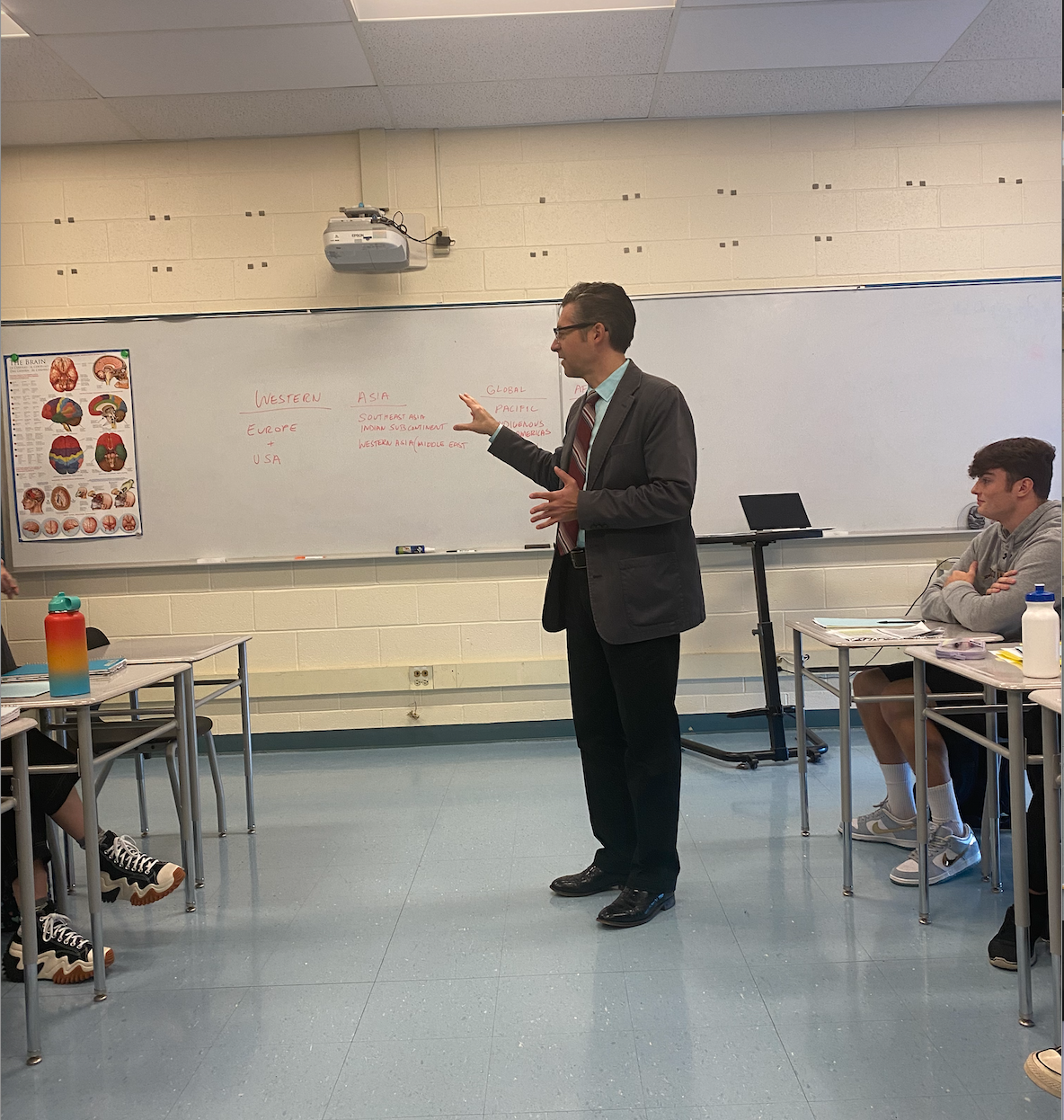
AP Econ introduces students to complex concepts like the production possibilities curve and marginal analysis, which Kinsman integrates with real-world applications. She conducts classes in a way that maximizes engagement, spending the first part of class lecturing and then transitioning to “hands-on engagement experiences in class time, so students can see how it [relates] to different scenarios in their day-to-day life.”
Senior Gavin Mottley described the class as going really well so far. “Economics is new for me,” he continued, “but it’s a lot easier to internalize information even though it started out as a totally foreign language.”
Mottley initially found interpreting two-way tables that demonstrate comparative advantage between countries challenging but gained clarification from Kinsman’s teaching method. “[She] had us work together in groups in a game that had us practicing exactly that. It helped me a lot because I got to work with my classmates; asking them questions helped [reduce] the confusion I had, and helping them when they needed it reinforced the ideas I was more comfortable with.”
Senior Arushi Biswas also reflected on the challenges and rewards of the class. She initially found the production possibilities curve and related graphs confusing but credited the summer work with helping her stay on track.
When it came to registering for the class last spring, Biswas was first drawn to the class because she was interested in pursuing a degree in business and wanted to get a feel for her future classes. “I think students should get educated in economics because it teaches you how the economy works, when to save and when to invest, how to make informed decisions,” she said. “It gives you a good understanding of society and policy.”
Looking ahead, Kinsman is eager to dive into more advanced topics and continue making the material of the course relevant to the students’ lives. She hopes for them to see how truly applicable all of the information that they are learning is in their lives. “I think it’s just really applicable to your day-to-day life like…we do a lot of economic theory, without really realizing that’s what it’s called.”