AP Econ Debuts at AHS
  • October 7, 2024

By Carissa Dessin
EXECUTIVE EDITOR

This course, taught by Digital Learning and Business teacher Ashley Kinsman, marks a significant shift from the school’s previous elective business courses.

Kinsman, who has previously taught electives such as Intro to Business Finance and Social Media Marketing, now teaches two sections of AP Econ. On top of this, Kinsman continues to teach one section of a class she taught years prior, Intro to Business. AP Econ covers both Microeconomics and Macroeconomics, offering students a challenging education in economic theory. 

Despite making the huge transition from unleveled classes to teaching an AP, Kinsman said she’s “really enjoying it.” One challenge she described is “staying on top of the students and going over the units beforehand, to make sure [she has] everything ready for them.”

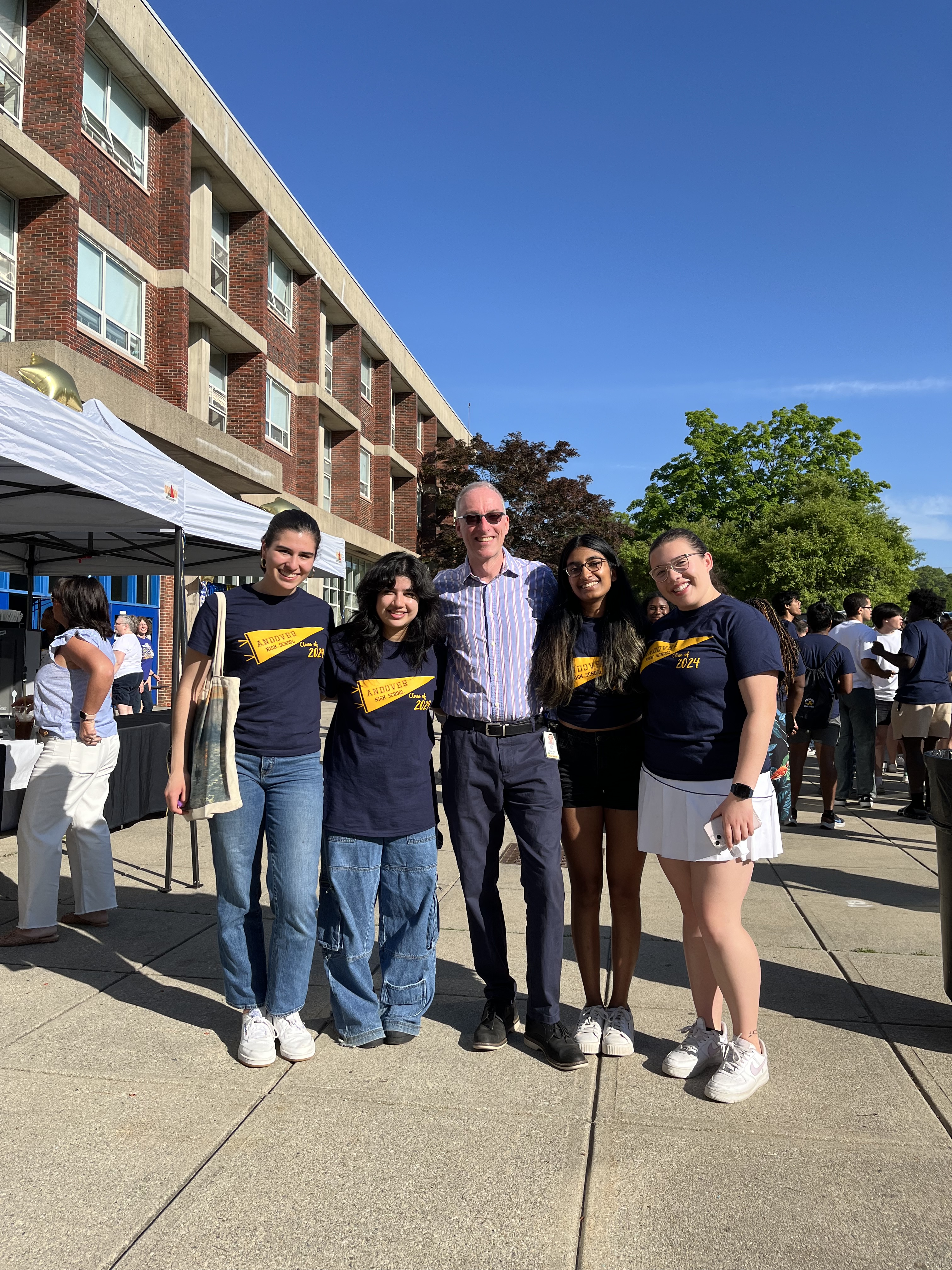
STAFF PHOTO / Carissa Dessin
AHS has added an Advanced Placement (AP) Economics course to its business curriculum this year, providing students with a deeper understanding of economic principles.

AP Econ introduces students to complex concepts like the production possibilities curve and marginal analysis, which Kinsman integrates with real-world applications. She conducts classes in a way that maximizes engagement, spending the first part of class lecturing and then transitioning to “hands-on engagement experiences in class time, so students can see how it [relates] to different scenarios in their day-to-day life.”

Senior Gavin Mottley described the class as going really well so far. “Economics is new for me,” he continued, “but it’s a lot easier to internalize information even though it started out as a totally foreign language.” 

Mottley initially found interpreting two-way tables that demonstrate comparative advantage between countries challenging but gained clarification from Kinsman’s teaching method. “[She] had us work together in groups in a game that had us practicing exactly that. It helped me a lot because I got to work with my classmates; asking them questions helped [reduce] the confusion I had, and helping them when they needed it reinforced the ideas I was more comfortable with.”

Senior Arushi Biswas also reflected on the challenges and rewards of the class. She initially found the production possibilities curve and related graphs confusing but credited the summer work with helping her stay on track.

When it came to registering for the class last spring, Biswas was first drawn to the class because she was interested in pursuing a degree in business and wanted to get a feel for her future classes. “I think students should get educated in economics because it teaches you how the economy works, when to save and when to invest, how to make informed decisions,” she said. “It gives you a good understanding of society and policy.”

Looking ahead, Kinsman is eager to dive into more advanced topics and continue making the material of the course relevant to the students’ lives. She hopes for them to see how truly applicable all of the information that they are learning is in their lives. “I think it’s just really applicable to your day-to-day life like…we do a lot of economic theory, without really realizing that’s what it’s called.”
Continue reading
Five AP Exams to Go Online This Spring
  • January 25, 2024

Jill Slotnick and Brandon Nguyen
CORRESPONDENT EDITOR AND LAYOUT EDITOR

The AP exams for AP European History, AP Computer Science, AP English Language Composition, AP English Literature, and AP United States History classes are to go online this spring. 

According to the College Board, all Advanced Placement Tests available in the digital format will be completely online by 2025. The option for these digital tests became available during the 2022-2023 school year. AP Coordinator and Head of Guidance, Aixa de Kelley, said the AHS administration had been discussing this change for the last few years but had ultimately decided they should wait until it was proven the tests could be administered online successfully. The choice to go digital this year was approved by de Kelley.

AHS Administration decided to go through with the switch after feedback they received nationally and locally. “From our experience last fall with the digital PSATs, offering the exam in the digital format streamlined the process. We received only positive feedback from students at AHS who took the digital PSAT exams,” said Dr. Magda Parvey, the Andover Public Schools superintendent. The administration also took into account feedback collected by the College Board, which stated that “students nationwide who participated in the digital exams [preferred the digital] format, especially when it comes to the long essays. Typing the responses was much easier and more familiar for them than handwriting the responses.” 

In regards to the actual content of the tests, the digital exam itself has the same number of sections, the same amount of questions, and has a parallel format for writing as well, said de Kelley. Students will also be using school-provided laptops which takes away the stress of having to remember a computer and charger, and downloading a lockdown browser in addition to an already nerve-racking exam.

With the decision coming out only a week before Thanksgiving break, many teachers were caught off guard by the decision. For the better part of three months, teachers had been preparing their classes for a paper exam. Michelle Chachus, an AP US History (APUSH) teacher for over ten years, expressed her discontent with the switch. “I’m not a huge fan of digital testing because it’s really hard to interact with documents. In my class we focus on annotating documents and highlighting key ideas, and I think that becomes a lot more challenging [with] a digital test. I know there are digital highlighting tools, but I feel like I need to really process what’s in the document.”  

Some teachers also had concerns regarding College Board’s previous digital AP Exams. Jennifer Percival, an AP English Language Composition (AP Lang) teacher, brought up the AP digital exam during the pandemic. “The platform that College Board is going to use should be more user-friendly than it was in the past to accommodate COVID. During the test, people had trouble with multiple choice questions and going back to questions they’ve already answered, so I hope problems like that don’t happen with this exam.” Percival also questioned the equitability of the digital exam. “I think it would be better if [the exam] was on paper,” she explained. “This switch affects not only our community of learners but also many other communities where digital learning isn’t as prevalent or easily accessible.”

The school seems divided on the issue of online testing, de Kelly admitted. “Some teachers were a little nervous; some teachers were happy about it,” she said. “They realize that computers are what kids are used to writing on, instead of with paper and pencil. There’s [also] a lot of resources on the College Board, and teachers can use AP Classroom.” AP Classroom is a nationwide website used to register students for their AP exams at the end of the year. It also provides resources for studying.

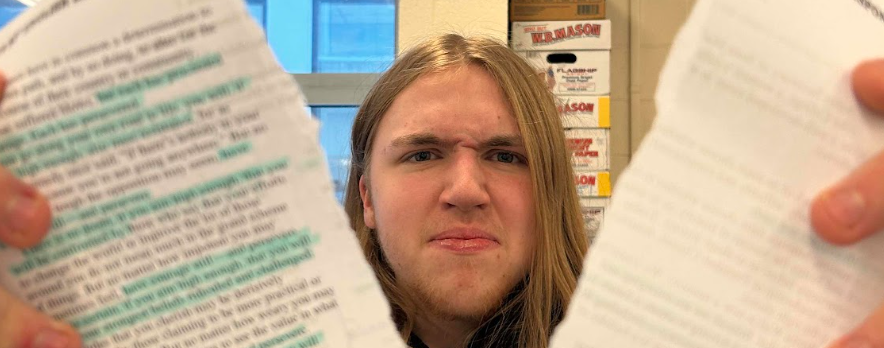
STAFF PHOTO ILLUSTRATION / Brandon Nguyen
Junior Ewan McCrimmon angrily tears a paper APUSH test.

For students, the announcement seems to have also caused disagreement, leaving some excited for a modern upgrade and others scrambling to adjust. Ewan McCrimmon, a junior taking APUSH, welcomed the move. “It’s a lot less paper, and it’s accommodating to the new way the world works online. Not that many people write stuff down on paper anymore,” he said. He appreciated the convenience and speed of typing, and stated that he will “be more focused on comprehending the question than focusing on spacing out [his] writing.” But McCrimmon also had some concerns about the school’s technological readiness: “Last year’s MCAS was a shame… [the school’s wifi] was struggling to keep up with everyone logging in all at once.”

Magdalena Phelps, a junior taking AP Lang and APUSH,  was more opposed to the change: “I’m just more of a visual person, so being able to really interact with the text helps me a lot.” Worried about the late announcement and lack of resources, she added, “In APUSH and AP Lang, there isn’t much digital work. It’s very much on paper, so [it’s hard to know] how they’re going to transition.” Both Phelps and McCrimmon agreed that students should be able to choose whether or not to have their exams be paper or digital. “It’s unfair that we don’t have those types of accommodations for AP testing,” Phelps said.

Continue reading
History Teachers Weigh In On AP African American Studies
  • May 2, 2023

By Carissa Dessin
STAFF WRITER

The nation is buzzing about a new course presented by the College Board that is currently being piloted in some schools, AP African American Studies.

This new course presents the opportunity for students to learn about the deep history of the African American people, which is often skimmed over during US History classes. It is not the fault of the curriculum of US History, but it is simply because of the lack of time during the school year. 

Many members of the history department have expressed interest in AP African American Studies, even to the point where history teacher Fred Hopkins “would probably like to take it,” himself. The implementation of this course would be a great opportunity for “teachers and students to explore issues regarding both race and also important demographics in the United States in a much deeper way than the current US History class allows for,” history teacher Kathryn Reusch said. 

Secretary of Education for Massachusetts Patrick Tutwiler showed immense support for the new class, saying, “Any opportunity to engage in a deeper exploration of a people’s history and culture is beneficial.” History teacher Matthew Bach provided another benefit of this new course: “academic freedom” and “an additional choice for students.”

In January 2023, the New York Times reported that Florida Governor Ron DeSantis had banned this course’s curriculum from being taught. It would not be unreasonable to believe that some other people could have the same opinion as him. While it is difficult to predict people’s reactions, there is bound to be at least one person that is uncomfortable with acknowledging the mistakes of America’s past. “As teachers and as a school, it’s our job to explore issues that make us uncomfortable,” said Reusch. 

Hopkins had some good advice for people that would be against this new course: if anyone “doesn’t want African American Studies to be offered, then they probably shouldn’t take it.”

Though there may be some naysayers in this whole ordeal, Tutwiler believes that “this [course] will be well received.” He thinks “the introduction of an opportunity to dive deeper into the exploration of a people’s history and culture is a good thing,” and he “applaud[s] the College Board for introducing this new class.”

History department head Gregory Hurley does have “some concerns about what [he has] seen the College Board do in terms of how they’ve changed the class,” referring to the topics that have been cut from the curriculum in order to please DeSantis. In response to the course topic itself, Hurley feels that could be “good for raising the voices of some of our more underrepresented populations in this town who may not always feel seen or heard in the curriculum.” 

Most of the opposition for the course comes from the uncomfortable feeling of showing America’s mistakes. “There are people who don’t want anything about American history to be taught if it’s critical to America,” said Hopkins. He followed up by saying, “You can’t examine a topic accurately if you’re not critical of it.” 

As for this course’s implementation at AHS, it lies in the hands of the people. “If we hear from enough people that it is something we want to pursue then we could look at it as a group of administrators, teachers, students, and community members to see if it’s right for our school,” said Hurley.

Continue reading
AHS Offers AP Psychology
  • November 19, 2021

150 Students Take New Course

By Shravya Sathi

CO-EDITOR IN CHIEF

Around one hundred fifty students sign up for a new course, Advanced Placement Psychology, at Andover High School. 

While AP Psychology was offered through Virtual High School previously, this is the first time it is being physically offered at AHS. The teachers for this course include Micheal McCarthy, Michelle Chachus, and Kathryn Vives, all of whom teach the half-year elective Psychology and Mental Health, offered in honors and CP-levels.

The idea of a psychology class mixed with the challenge of an AP course make it very appealing to students. “I don’t know if everybody wants to go into psychology,” said Vives, “but I think that there’s at least a nugget of interest that everybody holds, learning about the human brain psyche and why we behave the way that we do.” 

The half year elective itself, was a popular choice, which could have lead to the large number of signups for the AP version. “I took the psychology elective sophomore year, and I had a great time with it, so I decided to take the AP version of the class,” reflected senior Aahana Tiku.

Many students are also interested in the subject itself. “I have a big fascination with how the brain and mind work,” said senior Mimi Cung, “I decided to take the AP course because I think it has more opportunities and will allow me to go more in depth.”

In this course, students are encouraged to take a hands-on approach to learning and participate in a lot of activities. There have been simulations, as well as different types of projects surrounding zombies, restaurants, the brain, and theme parks so far. “I like it a lot,” said senior Saima Rahman, “the work and activities we do in this class kind of connect to my other classes so I’m happy with the way it is structured.”  

Through this approach, students are understanding and forming unique connections between the class, themselves, and beyond. “We are able to look at different perspectives and compare and contrast with our own experiences,” said Cung. “It is evident how we are able to apply these concepts to the outside world.” 

While the course has been going well overall, the teachers have already seen some challenges with lesson plans and pacing.

“It’s so early,” said Vives, “I already see things from every unit, every lesson I’ve taught, that I’d like to change a bit for next year.”

Additionally, since the AP exam will be held during the first week of May, there is great pressure on the teachers to finish the course by that date. “It’s just very hard to judge how fast we have to move through the content,” reflected Vives.

Continue reading